
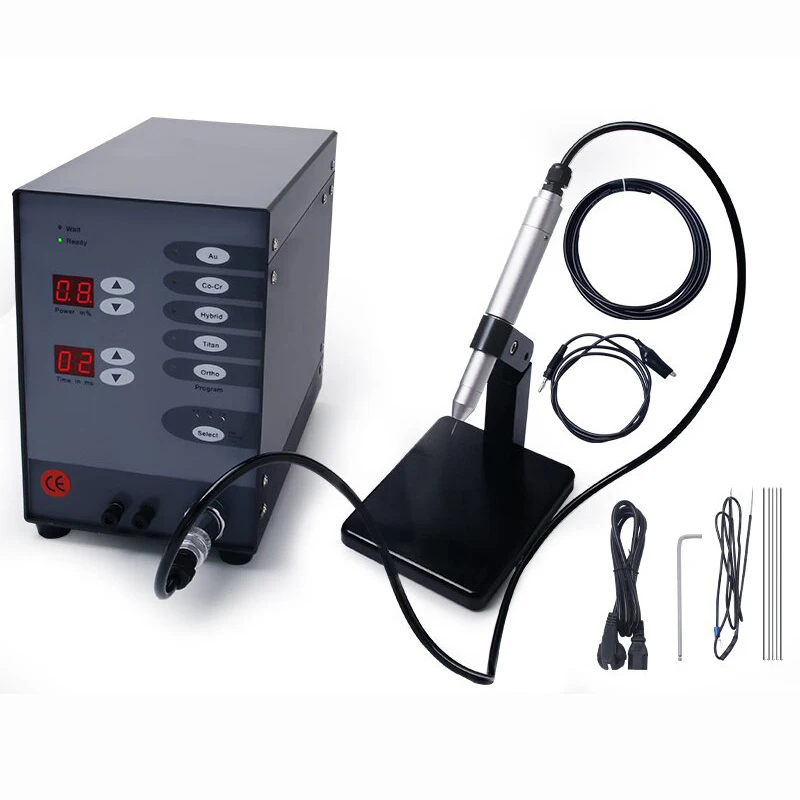
Eleven rows of real specification, six of them contradicted by the machine's own panel
This is not one of the records in this catalogue that publishes nothing. Product ID 1601253273443 carries eleven parameter rows, which places it among the seven most detailed records in the whole queue, and the rows are exactly the rows a buyer of a welding power source needs to ask for: supply, consumption, gas pressure, welding voltage, welding current, welding time, welding frequency, argon consumption, machine dimensions, shipping dimensions and weight. If the listing stopped there it would be a usable document.
It does not stop there, because one of its own gallery images is a specification panel, and that panel contradicts the parameters. Worse, the panel is divided into two columns and the two columns contradict each other as well. The table below sets out all three accounts side by side, and nothing in it is an interpretation: every figure was read from the record's parameter block or from the panel image.
| Quantity | Parameter block | Panel, left column | Panel, right column |
|---|---|---|---|
| Product name | TEBAK Numerical Control Touch Pulse Argon Arc Spot Welder, jewellery spot welding machine | 100A spot welding machine | 100A SPOT WELDING MACHINE |
| Welding current | 50 A to 600 A | 50 to 600 A | 0 to 100 A |
| Voltage | 220 V and 110 V | 220 V | 110 V and 220 V |
| Frequency | 50 and 60 Hz | 50 Hz | 50 to 60 Hz |
| Power | 100 W | 200 W | 200 W |
| Weight | 16 kg | 7.5 kg | 7.5 kg |
| Machine dimensions | 45 by 32 by 29, no unit | 28 cm by 15.5 cm by 22 cm, on the same panel | |
| Shipping dimensions | 38 cm by 51 cm by 49 cm, labelled H W D | not stated on the panel | |
Six quantities therefore disagree between the data and the picture, and three of those six also disagree between the two halves of the picture. There is no reading under which the block and the panel are both right, and the two halves of the panel cannot both be right either, since a machine cannot have a nameplate rating of 100 amperes in one column and 50 to 600 amperes in the other, or a voltage of 220 V in one column and 110 V and 220 V in the other, or a frequency of 50 Hz in one column and 50 to 60 Hz in the other. These are the three rows that decide whether the machine will run at all in a given workshop and which socket it will need.
The product names itself 100 amperes and then specifies 600
The name at the head of the panel is the most direct contradiction, because it is a self-description rather than a measurement. Both columns of that panel call the product a 100A spot welding machine, in capitals on the right and in mixed case on the left, so the name is unambiguous and it appears twice. The parameter block on the same listing gives a welding current of 50 A to 600 A, and the panel's own left column repeats 50 to 600 A, while the panel's right column gives 0 to 100 A.
The three accounts are therefore 100 A, 600 A and 100 A. Two of them agree with the product's name and one does not, and the one that does not is the one the listing's own parameter block carries. That is worth pausing on because of what a welder's current rating decides. Amperes at the work determine what cross-section of metal can be joined in one pulse and how much heat is delivered; they also determine the cable, the electrode and the handle, which are the parts that carry the current. A buyer who orders on the parameter block is ordering a 600 ampere machine. A buyer who reads the panel and the product name is ordering a 100 ampere machine. The price of the two is not the same, and neither is the work they can do.
The stated input power cannot supply the stated maximum pulse
The welding frequency row is what makes this checkable, and it is unusual to find it published at all: the record states a maximum welding frequency of 1 Hz, meaning at most one pulse per second. With the stated welding voltage of 40 V, the stated current range and the stated time range, the energy of a single pulse and the average power needed to sustain it at that maximum rate can both be calculated. The arithmetic is mine and the assumptions are stated.
| Current | Time | Energy per pulse at the stated 40 V | Average power at the stated maximum of one pulse per second |
|---|---|---|---|
| 50 A | 3 ms | 6 J | 6 W |
| 50 A | 30 ms | 60 J | 60 W |
| 300 A | 3 ms | 36 J | 36 W |
| 300 A | 30 ms | 360 J | 360 W |
| 600 A | 3 ms | 72 J | 72 W |
| 600 A | 30 ms | 720 J | 720 W |
The stated power consumption is 100 W in the parameter block and 200 W on the machine's own panel. At the maximum current and the maximum pulse duration the average input required to sustain one pulse per second is 720 W, which is 7.2 times the block's figure and 3.6 times the panel's. Even at the intermediate setting of 300 A and 30 ms it is 360 W, still above both. Only the short low-current corner of the table fits inside either figure.
Two adjustments should be made to that calculation in fairness to the machine, and neither rescues it. The first is the welding voltage: the stated 40 V is most likely the open-circuit voltage rather than the arc voltage under load, and an actual load voltage in the region of 20 V would halve every energy in the table, giving 360 J and 360 W at the top corner. That is still 3.6 times the block's stated 100 W and 1.8 times the panel's 200 W. The second is that a pulse welder stores energy in capacitors and draws it in bursts rather than continuously, so the input is not the same as the output; but a capacitor bank cannot average more than it is fed, and at one pulse per second a 360 to 720 joule pulse is a continuous duty demand, not a one-off burst. Under every reading, the stated maximum operating point draws more power than the record says the machine consumes.
The same arithmetic read backwards is even more direct. If the input really is 100 W and the pulse really is 30 ms, then the instantaneous power available is about 3,330 W, which at the stated 40 V corresponds to about 83 amperes, not 600. Either the power figure is a standby figure, or the current range is an envelope rather than a simultaneous limit, or the figures were copied from different machines. The record does not say which, and the questions that settle it are the energy per pulse in joules, the energy stored in the capacitor bank, the duty cycle at maximum settings, and whether the published consumption is a standby figure or a maximum.
The published current range cannot be set on the machine
There is a second and quieter problem with the current row, and it does not depend on any arithmetic. The machine is programmed through two red displays on its front panel, and the labels below them read power in per cent and time in milliseconds. Its settings are therefore a percentage of power and a number of milliseconds. The published range is a number of amperes.
Nowhere in the record, in the panel, in the labelled diagram or in the illustrated procedure is there a conversion between the two. An operator cannot set the machine to 300 A, because the machine does not accept amperes. A buyer cannot check that the delivered machine reaches 600 A, because the machine does not display amperes. A tender cannot specify a current if the machine's own interface has no current. This is not a defect in the figures; it is a gap between two vocabularies, and it is the reason the current range should be treated as a claim about the power source rather than as a setting. The question to put to the supplier is the mapping between the percentage and the amperes, or an output curve, or a statement that the percentage is not a current at all.
The machine is set up for orthodontics
The front panel carries six round buttons beside a column headed Material Instructions. The panel's own labels translate them as gold, diamond chrome alloy, mix, pure titanium and orthodontics, with the sixth labelled Program. The illustration of the working area lists the materials the machine can be used on as platinum, gold, K gold, silver, copper, stainless steel plate, cobalt-chromium alloy and pure titanium.
Read together, those two lists describe a dental and orthodontic spot welder. Cobalt-chromium is the alloy of dental frameworks; pure titanium is the implant and framework metal; orthodontics is braces; and a preset labelled for it is a preset for that work. A jewellery workshop welding gold and silver rings does not need an orthodontic preset, and a dental laboratory welding cobalt-chromium frameworks very much does. The listing's title sells the machine as jewellery equipment, one panel sells it as suitable for jewellery DIY, and the preset buttons sell it as a dental unit. Both uses are real and the machine may well serve both, but a buyer should know which machine they are being quoted, because the answer changes what the presets are worth to them.
There is a second reason to raise this. The catalogue's text contains none of these words. Searching all five hundred and twelve records, titanium, orthodontic, cobalt, dental and the panel's phrase for deflation time each appear in zero records, while argon appears in exactly three and the phrase spot weld in exactly one, this record. The machine's most distinctive feature, its set of material and orthodontic presets, exists only inside its pictures. A buyer comparing listings by their text would never learn that this machine has them.
Weight and size disagree, and the freight basis depends on which you believe
The record gives a weight of 16 kilograms and the machine's own panel gives 7.5 kilograms twice over. The record gives machine dimensions of 45 by 32 by 29 with no unit, and the panel gives 28 by 15.5 by 22 centimetres. Reading the parameter's figures as centimetres, which is the only sensible reading, the parameter's machine envelope is 41,760 cubic centimetres and the panel's is 9,548, so the two accounts differ by a factor of 4.37 in volume as well as by 2.13 times in weight.
Now bring in the one row the panel does not dispute, the shipping carton of 38 by 51 by 49 centimetres, which is 94,962 cubic centimetres. Against the parameter's machine size the carton is 2.27 times the machine, which is entirely ordinary for a machine of this kind packed in foam. Against the panel's machine size the carton is 9.95 times the machine, which is not ordinary at all: no one ships a 16 kilogram instrument in a box ten times its own volume. The carton row therefore corroborates the parameter's machine dimensions and contradicts the panel's, which is a useful result, since it means the panel's 28 by 15.5 by 22 centimetres is the row in that panel most likely to be the copied one.
The weight disagreement has a direct commercial consequence, because it decides what the freight is charged on. Taking the carton at 94,962 cubic centimetres, its dimensional weight is 15.83 kilograms at the common divisor of 6,000 and 18.99 kilograms at 5,000. Against an actual weight of 16 kilograms the billing basis is the actual weight at the 6,000 divisor and the volumetric weight at 5,000. Against an actual weight of 7.5 kilograms the volumetric weight wins at both divisors. So the answer to the simple question of what this shipment will be charged on depends on two numbers the listing disagrees with itself about, and a buyer who wants to predict freight has to establish both the weight and the carton dimensions from the supplier rather than from the listing. As a cross-check, the implied bulk densities of 383 kilograms per cubic metre for the 16 kilogram figure and 786 for the 7.5 kilogram figure are both plausible for a machine containing a transformer and a capacitor bank, so density does not settle which pair is right.
The gas supply pressure has a floor and no ceiling
The parameter row for gas supply pressure reads, in the raw feed, an entity for the greater-than-or-equal sign followed by 0.1 MPa, the unit written without its capital. As a statement it means the supply must be at least 0.1 megapascals and it says nothing about how much more the machine will tolerate. There is no maximum inlet pressure, no statement of the regulator's range or whether a regulator is supplied, and no working pressure at the torch.
That is the opposite defect from the one recorded in the previous item of this series, where a wax pot's instructions said to inflate to an appropriate value and never gave any number at all. Here a number is given and it is a minimum, so the buyer knows how much gas pressure is needed and not how much is safe. The questions that close it are the maximum inlet pressure to the machine, the regulator's inlet and outlet range if one is supplied, the working pressure at the torch for the stated maximum argon flow of 5 litres per minute, the purity grade of argon required, and the pre-flow and post-flow times.
That last item connects to a control on the machine's own panel, annotated in the labelled diagram as deflation time and adjust the deflation time, with the adjusting done through the Select button. Whatever it controls, the record does not define it: deflation time is not a term in welding, and in a machine that consumes argon the control is most likely the shielding gas post-flow, the interval during which gas continues after the arc stops so that the hot weld does not oxidise. If that is what it is, then the machine has a gas-timing function that no part of the record explains, and its correct setting for the buyer's metals is not published. If it is something else, the buyer needs to know what. Either way, a control whose function must be inferred from its label is a control that will be set wrongly. The word deflation appears in no record's text in this catalogue.
The description is the parameter block read back in running text, and the profile is what gets cut
The record's description field is seven hundred and ninety-nine characters long. Every one of its eleven parameter rows, label and value together, appears in it verbatim, in the same order, under a heading that reads Specification. In other words the description is not a description of the machine; it is the parameter block copied into prose, after which the supplier's standard company profile begins and runs out of room.
The effect of the fixed window is measurable here, and it refines the measurement published in the previous item of this series. Of the five hundred and twelve records, four hundred and ten have a description of exactly eight hundred characters, sixty-one have one of exactly seven hundred and ninety-nine, none exceeds eight hundred, and the shortest is one hundred and forty-four. So the window is eight hundred characters with the truncation landing at seven hundred and ninety-nine roughly one time in eight. This record is one of the sixty-one, and the reason it stops at seven hundred and ninety-nine rather than eight hundred is simply that its parameter block is eleven rows long: the profile heading appears at character 495, leaving three hundred and four characters for the entire company profile, which ends mid-phrase in the middle of the supplier's own boilerplate.
Across the catalogue, two hundred and forty-six records have a description that repeats every one of their parameter rows verbatim, which is forty-eight per cent of the queue. That figure is the reason the count matters: on nearly half of these listings the text a buyer reads is not written prose about the product at all, it is the parameter table restated, and what follows it is whatever is left of the window. The practical consequence is that on this listing the description adds no information to the parameters, so a buyer who has read one has read the other.
What the record does not state at all
- Which of the current, voltage and frequency figures is correct, and how the supply voltage is selected or whether one unit covers both.
- The energy per pulse in joules, the stored energy of the capacitor bank and the duty cycle at maximum settings.
- The mapping between the percentage of power shown on the machine and the amperes published in the listing.
- The maximum inlet pressure for the shielding gas, the regulator's range, the working pressure at the torch and the argon purity grade.
- The meaning of the control labelled deflation time, and its correct setting for a given metal.
- The electrode material, its diameter, its part number or its life, though the kit includes rods and a pair of tweezers.
- Whether the tweezers are a second welding handpiece or a handling tool, and whether the single handle interface on the panel must be unplugged to use them.
- Cooling arrangement, whether by air or by water, and the ambient temperature range for operation.
- Electrical safety particulars for any market: the insulation class, the ingress protection rating, the duty cycle and the approval mark behind the CE symbol that is visible on the machine's panel.
- Eye protection, skin protection, fume extraction and any consideration of the ozone that an argon arc process produces, none of which is mentioned in a record that nonetheless specifies a shielding gas.
- The gas nozzle, the torch's spare parts, the foot switch if one exists, and the wear parts that must be reordered.
- The welding capacity in material thickness, for any of the metals named, which is the figure a workshop actually buys on.
- The setting for each of the six presets, and whether the presets are fixed or freely programmable.
- Grounding and installation requirements, and the supply circuit's breaker and conductor rating for either voltage.
- Price, minimum order quantity, spare parts availability, warranty period and scope, and who services the machine in the buyer's country.
Incoming inspection when the unit arrives
- Photograph the nameplate and the machine's own specification panel on arrival, and compare them with the listing, because the two disagree on six quantities and the delivered nameplate is the only authority.
- Weigh the machine and measure its three dimensions, and record both, since the record and the panel differ by 2.13 times in weight and 4.37 times in volume.
- Read the carton's three dimensions and its markings, since the shipping row is the one figure the panel does not dispute, and the cartons visible in the supplier's own factory photograph carry a 220 V alternating-current marking.
- Establish the supply voltage of the delivered unit physically before connecting it, because the record offers 220 V and 110 V without saying how either is selected.
- Read every marking on the machine, including the CE symbol visible on its panel, and obtain the declaration of conformity that stands behind it, since the record's text states no certification at all.
- Inspect the welding cables, the handle and the ground clamp for the cross-section and the condition of their insulation, and record the markings, since no current rating is given for any conductor in the kit.
- Inventory the accessories against the gallery, which shows eight items, and record any shortfall, since the parameter block lists none of them.
- Confirm which of the two current accounts the machine actually implements, by measuring the output at a known power percentage with a calibrated meter rather than by reading the nameplate.
- Measure and record the output at several power percentages and several pulse durations, and build the mapping between percentage and amperes that the supplier does not publish.
- Check whether the machine will run at all on the supplied gas pressure, then establish the maximum inlet pressure the machine tolerates with the supplier in writing before connecting anything.
- Determine what the control labelled deflation time does, by observing the gas flow after a weld, and record the setting that produces clean welds on the buyer's materials.
- Weld a test coupon in each metal the workshop intends to use, and record the power percentage, the time, the gas setting and the result, because no welding capacity in material thickness is published for any metal.
- Test each of the six presets and record what each does, since the record does not state the setting behind any of them.
- Run the machine at the current the buyer actually intends to use for a full production shift and record whether it holds, since no duty cycle is published and the stated input power is inconsistent with the stated maximum.
- Keep the delivered nameplate photographs, the measurements, the output mapping and the test coupons together as the machine's specification file, because on this listing the buyer's own measurements will be more complete and more consistent than anything the supplier published.
What the catalogue says, counted
The counts below are this guide's own scans of all five hundred and twelve records, with the search terms named so that they can be reproduced.
| Observation | Records | Share |
|---|---|---|
| Records that carry at least one parameter row | 361 | 70.5% |
| Records carrying exactly eleven parameter rows, this record among them | 7 | 1.4% |
| Records whose description repeats every one of their parameter rows verbatim, this record among them | 246 | 48.0% |
| Records whose description is exactly 800 characters, against 61 at exactly 799, none over 800, and a shortest of 144 | 410 and 61 | 80.1% and 11.9% |
| Records carrying both a power row and a current row, the only ones on which the power and current figures can be checked against each other at all | 3 | 0.6% |
| Parameter rows whose value is an inequality rather than a figure, of which this record's gas pressure row is one | 16 rows | 3.1% |
| Records carrying a less-than-or-equal sign in a parameter row, an upper bound only | 21 | 4.1% |
| Records carrying a greater-than-or-equal sign in a parameter row, a lower bound only, this record among them | 3 | 0.6% |
| Dimension-like parameter rows, of which those carrying a unit and those carrying none | 262 rows: 223 and 39 | 85.1% and 14.9% |
| Parameter rows carrying unescaped entities of each type: apostrophe, degree, ampersand, times, superscript three, greater-than-or-equal, less-than-or-equal | 45, 17, 13, 13, 4, 3, 21 | see note |
| Records containing the word argon, of which this record is one | 3 | 0.6% |
| Records containing the phrase spot weld, which is this record alone | 1 | 0.2% |
| Records containing any word for welding, a looser match that also catches a magnetic pick-up tool, a brazed turning tool and a fibre fusion splicer | 9 | 1.8% |
| Records containing a word for jewellery, unchanged across three consecutive items' measurements of the same field | 15 | 2.9% |
| Records containing a frequency unit such as Hz | 49 | 9.6% |
| Records containing the words titanium, orthodontic, cobalt, dental or the panel's phrase for deflation time, all five of which appear in this record's pictures and in no record's text | 0 each | 0% |
| Records containing the word trachea, which appears on the argon tube in this record's gallery as well as in the previous item's gallery, and nowhere in anyone's text | 0 | 0% |
| Records sharing any of this record's eight images, which is none | 0 | 0% |
| Records whose description the supplier's company-name sentence appears in | 384 | 75.0% |
| Records referring to the ISO 9001 standard in that paragraph | 136 | 26.6% |
| Records containing the string OED&ODM, the misspelling used here and elsewhere | 329 | 64.3% |
| Records containing the string this filed, the misspelling used here and elsewhere | 319 | 62.3% |
| Records containing the phrase 70% for expert, as used here | 265 | 51.8% |
The entity counts in that table are rows rather than records and they overlap, so they are not additive; the point is only their scale. An apostrophe entity appears in forty-five parameter rows, a degree entity in seventeen, an ampersand in thirteen, a times sign in thirteen, a superscript three in four, a greater-than-or-equal sign in three and a less-than-or-equal sign in twenty-one. This record's gas pressure row is one of the three rows in the catalogue whose only bound is a lower one, which makes it the rarer of the two inequality defects: an upper bound without a lower one is four times more common here than a lower bound without an upper one.
Four rows carry the argument of this item. The first is the count of three records that carry both a power row and a current row, because it means the inconsistency worked out above could be checked on only three listings in the whole catalogue; on the other five hundred and nine records there is not enough published data to check anything. The second is the count of seven records with eleven parameter rows, which places this listing in the most detailed one and a half per cent of the queue and makes the contradictions in it the more striking, since they arise not from thin data but from thick data that disagrees with itself. The third is the pair of description counts, four hundred and ten at eight hundred characters and sixty-one at seven hundred and ninety-nine with none over, which establishes the fixed window and refines it: the window is eight hundred characters and roughly one truncation in eight lands one character short. The fourth is the group of zeros, five words that appear on this machine's controls and in no record's text, added to the word trachea that appeared on the previous item's hose and in no record's text either. Read together with the previous item, the pattern is that these listings publish a specification table that may or may not be true, a gallery that carries the machine's real features, and a shared boilerplate description that says nothing about either.
The house-style counts are unchanged once more: the company-name sentence in three quarters of the catalogue, the ISO 9001 reference in just over a quarter, the misspelled abbreviation in about two thirds, the phrase this filed in about five eighths, and the claim that seventy per cent of products are for experts in about half. The jewellery count of fifteen has now been measured identically for three consecutive items.
The specification to send before ordering
| Item | What to require in writing |
|---|---|
| Which figure governs | A single authoritative statement resolving the current, voltage and frequency rows, since the listing gives 600 A, 220 V and 50 to 60 Hz while the machine's own panel gives 100 A in its product name, 220 V in one column and 110 V or 220 V in the other, and 50 Hz against 50 to 60 Hz. Ask which document the delivered machine will match. |
| Power and duty | The energy per pulse in joules, the stored energy of the capacitor bank, the duty cycle at maximum settings, and whether the published 100 W is a standby figure or a maximum, because 100 W cannot sustain the stated 600 A at 30 ms and 1 Hz. |
| The percentage-to-ampere mapping | The relationship between the power percentage shown on the machine and the amperes published in the listing, or a statement that the percentage is not a current, because without it the published range cannot be set, checked or written into a work instruction. |
| Weight and size | The net weight and the machine's three dimensions, resolving 16 kg against 7.5 kg and 45 by 32 by 29 against 28 by 15.5 by 22 centimetres, together with the unit that the 45 by 32 by 29 row is missing. |
| Carton and freight | Confirmation of the carton dimensions and gross weight, and the dimensional weight basis the supplier expects a forwarder to apply, since the billing basis flips between actual and volumetric depending on which weight is correct and which divisor is used. |
| Gas | The maximum inlet pressure, the regulator's range and whether one is supplied, the working pressure at the torch for the stated 5 litres per minute, the argon purity grade, and the pre-flow and post-flow times, because the record publishes a minimum with no maximum. |
| The deflation-time control | What the control labelled deflation time does, what its range is, and its recommended setting for each metal, since the term is not standard and the record does not define it. |
| Materials and presets | The setting behind each of the six presets, whether they are fixed or programmable, and confirmation that the machine is intended for the metals the buyer will weld, given that the presets include cobalt-chromium, pure titanium and orthodontics while the listing sells the machine for jewellery. |
| Capacity | The maximum weldable material thickness for each metal named, which is the figure a workshop buys on and which appears nowhere in the record. |
| Consumables | The electrode material, diameter, part number, price and life; the gas nozzle; the torch's spare parts; and the wear parts to be reordered, none of which the record names. |
| Safety and compliance | The declaration of conformity behind the CE mark visible on the machine's panel, the insulation class, the ingress protection rating, the duty cycle, and the eye, skin and fume protection the process requires, because a record that specifies a shielding gas says nothing about them. |
| Installation | The supply circuit's breaker and conductor rating at each voltage, the grounding requirement, and the ambient temperature range, since no electrical particulars are published for either voltage. |
| Documentation | An instruction manual in a language the operators read, an output curve or a percentage-to-ampere table, a named setting for the buyer's metals, and a packing list rather than a photograph of a workbench covered in accessories. |
| Inspection | A pre-shipment record showing the machine run at a stated power percentage and pulse duration with each preset checked and coupons welded in the buyer's own metals, with photographs of the nameplate and the panel. |
| Commercial | Unit price, minimum order quantity, price breaks, delivery term, lead time, warranty period and scope, spare parts availability, and who services the machine in the buyer's country. |
Frequently asked questions
How much specification does this listing contain, and why does that make it worse rather than better?
Eleven parameter rows, which puts it among the seven most detailed records of the five hundred and twelve. That is the difficulty: the contradictions in it are not the result of thin data but of thick data that disagrees with itself. The block gives 600 A; the machine's own panel gives 600 A in its left column, 0 to 100 A in its right column, and calls the product a 100A spot welding machine in both. The block gives 100 W and the panel gives 200 W. The block gives 16 kg and the panel gives 7.5 kg. The block gives machine dimensions without a unit and the panel gives 28 by 15.5 by 22 centimetres. Six quantities disagree, and three of them disagree between the two halves of the panel as well.
Is it a 600 ampere machine or a 100 ampere machine?
Three accounts are on the record: the parameter block says 50 A to 600 A, the panel's left column repeats 50 to 600 A, and the panel's right column says 0 to 100 A while the product name above both columns says 100A spot welding machine. Two accounts say 100 A and one says 600 A, and the one that says 600 A is the one the listing's parameter block carries. What the current rating decides is the cross-section of metal that can be joined in one pulse and the cable, electrode and handle needed to carry it, so the question is not academic. Ask which document the delivered machine will match, and verify the output with a meter at a known power percentage.
Can the stated 100 W input really deliver 600 amperes?
No, under every reading of the figures. With a maximum frequency of one pulse per second stated by the record itself, a 600 ampere pulse for 30 milliseconds at the stated 40 volts is 720 joules, and sustaining one per second needs 720 W on average, which is 7.2 times the block's 100 W and 3.6 times the panel's 200 W. Even halving the energies to allow for the 40 V being open-circuit rather than arc voltage leaves 360 W. Read the other way, 100 W into a 30 millisecond pulse is about 3,330 W instantaneous, or about 83 amperes at 40 volts. Either the power figure is a standby figure, or the current range is an envelope rather than a simultaneous limit, or the figures came from different machines. Ask for the energy per pulse in joules and the duty cycle at maximum.
Why can't I just set the machine to a current?
Because the machine is not set in amperes. Its two front-panel displays are labelled power in per cent and time in milliseconds, and its settings are made with those. The published range is in amperes, and there is no conversion between the two anywhere in the record, in the panel, in the labelled diagram or in the illustrated procedure. So a buyer cannot check that the delivered machine reaches 600 A from the machine's own display, and an operator cannot write a setting of 300 A into a work instruction. Ask for the mapping between the percentage and the amperes, or an output curve.
Is this a jewellery welder or a dental welder?
Its presets say dental and orthodontic. The front panel's six buttons are labelled, by the machine's own translation, gold, diamond chrome alloy, mix, pure titanium, orthodontics and program, and the materials list adds platinum, gold, K gold, silver, copper, stainless steel plate and cobalt-chromium alloy. Cobalt-chromium is the alloy of dental frameworks and orthodontics is braces, so the machine is set up for the dental trade, and the listing's title and one panel sell it for jewellery. It may well do both, and the buyer should know which one they are being quoted, because the presets are worth different amounts to each trade. Note also that titanium, orthodontic, cobalt, dental and the phrase for deflation time each appear in zero records' text across the entire catalogue, so the machine's most distinctive feature is invisible to anyone comparing listings by their text.
What will the freight be charged on?
It depends on two numbers the listing disagrees with itself about. The carton of 38 by 51 by 49 centimetres is 94,962 cubic centimetres, so its dimensional weight is 15.83 kilograms at the 6,000 divisor and 18.99 kilograms at 5,000. Against the parameter block's 16 kilograms the actual weight wins at 6,000 and the volumetric weight wins at 5,000. Against the panel's 7.5 kilograms the volumetric weight wins either way. Establish the weight and the carton dimensions from the supplier, and ask the forwarder which divisor applies, before comparing quotes. One row does help settle part of it: the carton is only 2.27 times the machine if the parameter's dimensions are right and 9.95 times if the panel's are, and a box ten times the volume of a 16 kilogram instrument is not credible, so the carton row corroborates the parameter's dimensions.
What does the gas pressure figure mean?
It reads as at least 0.1 megapascals and it gives no maximum. So you know the floor and not the ceiling, which is the opposite of the more common defect in this catalogue where an upper bound is given and no lower one. Nothing in the record states the maximum inlet pressure, whether a regulator is supplied or what its range is, the working pressure at the torch for the stated 5 litres per minute, the argon purity required, or the pre-flow and post-flow times. Ask for the maximum inlet pressure in writing before connecting a supply.
What is the deflation time control?
The machine's labelled diagram names it and shows it adjusted through the Select button, and nothing defines it. Deflation time is not a term in welding. In a machine that consumes argon, the likely function is shielding gas post-flow, the interval during which gas continues after the arc stops so that the hot weld does not oxidise; if so, it is a real and useful function whose correct setting for a given metal is not published and whose name will not be recognised by any operator. Ask what it does, what its range is and how to set it. The word deflation appears in no record's text in this catalogue.
What safety information comes with it?
The record states none: no declaration of conformity, no standard, no test report, no insulation class, no ingress protection rating and no duty cycle. What the pictures show is a CE mark on the machine's front panel, visible in two photographs, and a factory photograph in which the cartons are marked 220 V alternating current. A mark without the declaration behind it establishes nothing, so ask for the declaration. Note also that this is a record which specifies a shielding gas and its flow rate, and which mentions no eye protection, no skin protection, no fume extraction and no consideration of the ozone an argon arc process produces; whatever your market requires for this process has to be obtained separately from the supplier's listing.
How does this relate to the previous items in this series?
By pattern rather than by product, and the pattern is consistent. The melting furnace carried a parameter block in which three of eight rows deferred to the customer. The wax injection machine carried two rows and neither was a measurement, while four sibling listings carried a seven-row block it lacked. This machine carries eleven rows and is contradicted on six of them by its own panel. Across all three, the description is a fixed eight-hundred-character window over shared boilerplate, the accessories exist only in the pictures, capacity or identity figures live in titles rather than in data, and words that describe the machine's real features appear in no record's text. This item adds the clearest instance of the last habit: five words on this machine's controls, including orthodontics, appear in zero of five hundred and twelve records.
Source, scope and what this guide does not claim
Everything about the product comes from the record for Product ID 1601253273443 as it stands: an eleven-row parameter block, a seven-hundred-and-ninety-nine-character description ending mid-phrase inside the supplier's boilerplate, and eight gallery images. The parameter values are quoted verbatim, including the gas pressure row, whose raw form in the feed carries an HTML entity for the greater-than-or-equal sign and writes the unit without its capital. The figures attributed to the machine's own panel are read from the specification panel image, and they are attributed to the panel at every point: the 100 A product name, the 0-100 A right column, the 220 V left column against the 110 V and 220 V right column, the 50 Hz against the 50 to 60 Hz, the 200 W, the 7.5 kg, and the 28 by 15.5 by 22 centimetres. The preset names and the materials list are read from two panel images and quoted as the machine's own translation. The CE mark and the 220 V carton markings are reported as visible in photographs, with the resolution limit on the carton markings stated.
The arithmetic is this guide's own, and its assumptions are stated. The pulse energies are the product of the stated current, the stated welding voltage and the stated pulse duration, and the average power column is the same figure at the record's own stated maximum of one pulse per second. The observation that a 40 V figure is more likely an open-circuit voltage than an arc voltage, and that load-voltage energies would be roughly half, is stated as an allowance rather than as a correction, and I show that even the halved figures exceed both published power ratings. The reverse calculation dividing 100 W by a 30 millisecond pulse, giving about 3,330 W and about 83 A at 40 V, is arithmetic. The volumes of 41,760, 9,548 and 94,962 cubic centimetres come from multiplying the stated dimensions, and the ratios of 2.27, 9.95 and 4.37 follow from them. The dimensional weights of 15.83 and 18.99 kilograms and the implied bulk densities of 383 and 786 kilograms per cubic metre are arithmetic on the stated figures, not quotations from any tariff. All eight images were downloaded and individually digested to confirm that they are eight distinct files, totalling 1,630,691 bytes or about 1.63 megabytes, an average of about 204 kilobytes each, which is the lightest gallery in this recent series and consistent with most of it being studio renders on white. No current, power, energy, weight, dimension, pressure or welding capacity is estimated anywhere in this guide where the record and its panels disagree, because choosing one of two contradictory figures and presenting it as the specification is exactly the error a buyer's own measurements exist to prevent.
The catalogue counts are this guide's own scans of all five hundred and twelve records with the search terms named so that they can be reproduced. Three hundred and sixty-one records carry at least one parameter row and seven carry exactly eleven. Two hundred and forty-six records repeat every parameter row verbatim in their description. Four hundred and ten records have a description of exactly eight hundred characters, sixty-one of exactly seven hundred and ninety-nine, none exceeds eight hundred and the shortest is one hundred and forty-four; the previous item's measurement of four hundred and ten at eight hundred is confirmed and extended by the sixty-one at seven hundred and ninety-nine. Three records carry both a power row and a current row, which is why the check in this guide could be performed on so few listings. Sixteen parameter rows state an inequality, twenty-one records carry an upper bound only and three a lower bound only. Of two hundred and sixty-two dimension-like rows, two hundred and twenty-three carry a unit and thirty-nine do not. The entity counts are per row and overlap. Argon appears in three records, spot weld in one, and titanium, orthodontic, cobalt, dental, deflation and trachea in none; the looser match on welding returns nine records, including a magnetic pick-up tool, a brazed turning tool and a fibre fusion splicer, which is why counts are read rather than trusted. Jewellery appears in fifteen records, identically for three consecutive items. The image-sharing count was established by normalising every image address in the catalogue to one scheme and counting the records that use each of this record's eight pictures; all eight are used by this record alone. The house-style counts of three hundred and eighty-four, three hundred and twenty-nine, three hundred and nineteen and two hundred and sixty-five, and the ISO 9001 count of one hundred and thirty-six, are unchanged from previous rounds.
Nothing here asserts that the supplier has misrepresented anything, and nothing here is an assessment of the machine's quality or safety. Publishing a specification panel whose two columns disagree, selling a machine under a name that carries a different current rating from its own parameter block, quoting an input power that the rest of the same block cannot sustain, setting the machine in percentages while advertising it in amperes, and describing a dental preset set in a listing titled for jewellery are the ordinary consequences of listings assembled by hand from parts of other listings, and the counts above show how common each habit is across this catalogue. Above all, nothing here is electrical approval, welding advice or purchase advice. An arc welding power source is electrical equipment that will be connected to a mains supply and operated at hundreds of amperes: its rating, its insulation, its grounding, its duty cycle, its shielding gas arrangement and the eye, skin and fume protection its process requires are matters for the manufacturer's own data, for the buyer's market rules and for a qualified person on site, and not for anything in a supplier listing or in this guide.
Key specifications
- Power supply
- 220 V and 110 V, 50 or 60 Hz as written in the parameter block, against 220 V on the machine's own panel's left column and 110 V or 220 V on its right column, and with no statement of how the voltage is selected or whether one unit covers both
- Power consumption
- 100 W according to the parameter block, against 200 W stated twice on the machine's own specification panel, and against an arithmetic requirement of 360 to 720 W of average input at the maximum current and pulse duration the same block permits
- Welding current
- 50 A to 600 A, a span of twelve times, and the only one of the eleven rows whose range the machine's own controls cannot address
- Welding time
- 3 ms to 30 ms, a span of ten times, so together with the current the stated pulse energy spans up to one hundred and twenty times
- Max. welding frequency
- 1 Hz, meaning at most one pulse per second, which is the figure that makes the input power checkable
- Max. argon consumption
- 5 litres per minute, with no purity grade, no pressure at the torch and no pre-flow or post-flow timing given
- Dimensions
- 45 by 32 by 29 with no unit stated at all, against 28 by 15.5 by 22 centimetres printed on the machine's own panel, so the two disagree by a factor of 4.37 in volume before any unit is even fixed
- Weight
- 16 kg, against 7.5 kg stated twice on the machine's own panel, a ratio of 2.13 times
- Controls and their units
- power in per cent and time in milliseconds on the machine, against a published range in amperes and milliseconds, with no conversion given anywhere
- Program presets
- six, labelled from the panel as Au, Co-Cr, Hybrid, Titan, Ortho and Program, which the machine's own labels expand to gold, diamond chrome alloy, mix, pure titanium and orthodontics
- Materials named
- platinum, gold, K gold, silver, copper, stainless steel plate, cobalt-chromium alloy and pure titanium, a list that mixes jewellery metals with dental alloys
- Certification
- a CE mark is visible on the machine's front panel in two photographs while the record's text states no certification, no standard, no test report and no declaration of conformity
- Accessories
- eight items shown in the gallery and named as trachea, welding fixture, solder pin, hexagon handle, power cable, soldering tweezers, workbench and welding loop clamp, and none of them appears in the parameter block