
Five parameter rows, and a name that belongs to a component rather than a machine
Product ID 1601367758662 is a two-handled mixing machine with a five-row parameter block: a product name, a material, a row labelled pole, a voltage and a power. That is a short block, and it is worth reading it against what the record's own pictures show, because the pictures carry more specification than the fields do.
The first thing the block gets wrong is the name of the thing being sold. The field reads Professional Mixing Rod. A mixing rod is the shaft and paddle that does the stirring, not the motor unit that turns it, and the listing is selling the motor unit with a rod fitted. The listing's own title calls it a handheld mixer, which is at least the right class of machine though it hides the two-handled layout. And the record's own parameter image, a Chinese table, gives the product name as a four-character Chinese phrase that translates as steering wheel mixer, which is what an operator would call it on site, because the frame with its two grips does look like one.
So one record calls the same machine by three names. That is not a theoretical complaint. A buyer searching the catalogue for a mixing rod will find a machine, a buyer searching for a steering wheel mixer will not find this record at all because that phrase appears nowhere in its English fields, and a buyer reading only the fields will not know the machine has two grips and must be held in both hands, which the pictures show plainly and one panel states in words. Across the catalogue a hundred and four records carry a product-name field, and four of them name a rod while the title names a machine, so this record is in a small group rather than alone; the difference is that for the other three, the rod and the title describe the same physical object, and here they do not.
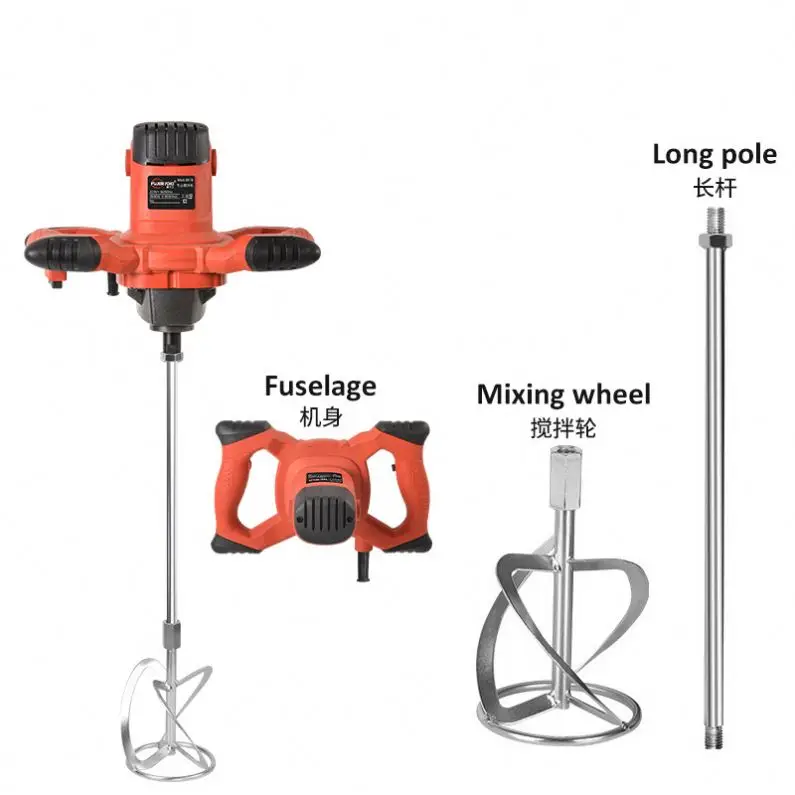
The row labelled Pole is the second problem. Its value is single, double. A pole could mean the mixing rod, the shaft, or the handle; the row does not say which, and its two options do not describe what the gallery shows. The gallery shows three interchangeable mixing heads: a double-S head built as a cage on the end of the shaft, a plain M14 mixing rod, and a four-prong head whose English label in the image is left as the untranslated pinyin Shuangsantou, next to its Chinese. So a buyer reading single, double cannot tell whether the machine ships with one rod or two, whether the two words describe head shapes, or whether the choice concerns the rod's length. In this series of guides a field that cannot be resolved from the record is treated as a question rather than a defect, and this is the question to ask first: what does the pole row distinguish, and how many rods come in the box.
The material row cannot describe one part, and it is the only row of its kind in the catalogue
The material field reads, as stored: stainless steel 304, galvanized.
Those two cannot both be true of the same part, and the reason is not a matter of opinion. Galvanising is the application of a zinc coating, and it is done to steel to protect it from corrosion; a part made of grade 304 stainless steel does not need that coating and is not galvanised, because the alloy's own chromium oxide layer is what protects it. A part is either a 304 stainless part or a galvanised part, and the field names both. There is a charitable reading, which is that the record describes several parts at once, so that the mixing rods are stainless and the frame or the bucket clamp is galvanised. That reading is plausible and the field does not say so, which is exactly the point: a material row that lists two mutually exclusive treatments without saying which part gets which is not a specification a buyer can quote or inspect against.
The count makes the point more sharply than the argument does. Scanning all five hundred and twelve records for a material row that contains both stainless and galvanized returns exactly one record, and it is this one. Four records mix two material families in a single material value, so the pattern exists but is rare, and only this record pairs those two specific words.
Why it matters practically is that the two answers carry different money. If the shafts and mixing heads are 304 stainless, they will survive mortar, plaster and paint without rusting, and they will also survive the washing that food contact requires in some markets. If they are galvanised carbon steel, the zinc layer will be attacked by the alkaline materials these machines are sold to mix, because cement, mortar and plaster are alkaline, and the coating will wear through at the point where the shaft meets the bearing and where the head's welds are, which is where rust then starts. The two materials also differ in hardness, so a stainless rod bends differently from a galvanised one when a paddle jams in a stiff mix. The question to put in writing is therefore not whether the machine is stainless but which parts are 304 and which are galvanised, with the rod, the shaft, the coupling, the mixing head, the gearbox casing and the frame listed separately.
The same machine appears four times in the same catalogue, at two different wattages
Searching the catalogue for other records in this machine's family finds three more, and they are close relatives rather than coincidences. One carries the title 3200W Steering Mixer Fast Stirring Handheld Profession Automatic Electric Mixer Variable Speed Industrial Paint, with four parameters whose values are Electric Steering Wheel Mixer, 220V/110V, 50/60HZ and 3200W. A second reads 3200W Steering Wheel Mixer Fast Stirring Handheld Paint Cement Mortar Food Mixing Machine Industrial Small Electric, with the same four values in the same order. A third reads TEBAK 2100W 6 Speeds Electric Steering Wheel Mixer New Stirring Handheld Paint Cement Mortar Food Mixing Machine, and its parameter block is empty.
Three things follow. First, the name the record's own image gives in Chinese is confirmed in English by its siblings: all three titles call this a steering wheel mixer, which is the phrase missing from this record's own English fields. Second, and more usefully, the third sibling's title independently confirms the six speeds that this record shows only as a dial in a picture. Third, and most important, the three siblings disagree with each other on power and with this record as well: two say 3200W, one says 2100W, for what the titles, the parameter values and the machine's appearance all describe as the same family with the same 220V/110V input and the same 50/60Hz supply.
A buyer cannot tell from the feed whether the family is made in two power classes and the listings have been mixed up, whether the 2100W figure is the honest one and 3200W is a marketing figure, or whether there are genuinely two machines in the family whose listings have been written from the same template. The listings are not verbatim duplicates in the way some pairs in this catalogue are: their parameter sets are not identical to this record's, and their images are entirely different, with no image shared between any of the four. So this is not one listing copied; it is the same machine presented four times with four sets of pictures and one inconsistency in the one figure that decides whether the machine can be plugged in.
The only power figure is a load power, and the wattage decides whether the machine can be used at all
The power field reads 3200W, and the record's own Chinese parameter image labels that figure with the characters for load power. It states no rated input power. The distinction is not pedantry; on an electric tool the two differ by the losses in the motor and the gearing, and the number that decides whether the machine works in a given workshop is the input current, which is not stated at all.
The arithmetic below is this guide's own, using the record's own figures of 3200 watts and the two voltages it names. The second column is what the socket must supply if the whole of 3200 watts were drawn as input; the third and fourth add a motor and gearbox efficiency of ninety and eighty-five per cent, which is the ordinary range for a machine of this kind and is an assumption, stated as such.
| Supply | Current if 3200 W is the input | If efficiency is 90% | If efficiency is 85% |
|---|---|---|---|
| 220 V | 14.6 A | 16.2 A | 17.1 A |
| 230 V | 13.9 A | 15.5 A | 16.4 A |
| 110 V | 29.1 A | 32.3 A | 34.2 A |
| 120 V | 26.7 A | 29.6 A | 31.4 A |
Set that against the circuits such machines are actually plugged into. A common domestic socket in the Chinese market is rated at ten amperes, which is about two thousand two hundred watts at two hundred and twenty volts; the sixteen ampere socket used for air conditioners gives about three thousand five hundred and twenty. In the North American market a fifteen ampere branch circuit at a hundred and twenty volts gives about one thousand eight hundred watts, and a twenty ampere circuit about two thousand four hundred.
Three consequences follow, and each is a question the buyer should settle before ordering rather than after delivery. At two hundred and twenty volts the machine cannot be run on a ten ampere socket at all and sits at the ceiling of a sixteen ampere one, so it needs a dedicated circuit and will trip a shared one whenever anything else is drawing on it. At a hundred and ten volts the stated figure is not achievable on any ordinary domestic circuit: twenty-nine amperes is beyond both the fifteen and the twenty ampere circuits, which means the hundred and ten volt version must in practice be a de-rated machine, and the buyer should ask by how much and at what actual power and current. And since the record gives a load power but no input power, the buyer should ask for the rated input power, the rated current, the recommended circuit rating, the plug or connector type and whether a circuit breaker or earth leakage device is needed, for the specific voltage being ordered.
The fourth question is about the supply itself. The record's own table gives the frequency as fifty or sixty hertz, which matches the two voltages, but the frequency appears in no field, and no field says whether the hundred and ten volt version is a single machine that accepts either or a separate variant. On a machine of this power the answer changes the motor's speed and the winding's temperature, so it should be asked rather than inferred, together with whether the nameplate is marked for the destination market and whether any certification is held for it.
Speed, gear steps and thread are in the pictures and in no field
The parameter block gives no speed. The record's own table gives a rated speed of 0-1200 r/min, one gallery image shows a ribbed dial with six positions marked and the words six speed adjustment, and a fourth image labels an all aluminium gearbox and a long pole. So the machine's whole control system, its output speed, its number of steps, the thread that holds the mixing head and the material of the gearbox exist only inside images and not in a single field a buyer or a search engine can read.
The thread matters more than it looks. The gallery names an M14 mixing rod, and M14 is a real and common interface for mixing paddles, but naming it is not the same as specifying it. Whether it is male or female, the pitch, and whether it is a right-hand or left-hand thread all decide whether the buyer's existing paddles will fit and whether the head tightens or loosens as the machine runs. A mixing head that threads off its shaft mid-batch is a common failure on these machines, and it is prevented by the thread's handedness and by a locking feature rather than by torque. So the questions are: is the coupling M14 male or female, what pitch, which handedness, and does it have a locking pin, flats for a spanner or a left-hand thread to keep the head tight in use.
The speed figure is worth converting, because the number a buyer needs is not the shaft speed but the speed of the tip of the paddle, and that depends on the head's diameter. The gallery gives the head's swept width as 11.5 centimetres, and the two arithmetic steps below use the record's own figures of 0-1200 revolutions per minute and 11.5 centimetres; the six steps assume the range is divided evenly, which the record does not state and is an assumption.
| Step | Shaft speed | Tip speed at 11.5 cm |
|---|---|---|
| 1 | 200 r/min | 1.20 m/s |
| 2 | 400 r/min | 2.41 m/s |
| 3 | 600 r/min | 3.61 m/s |
| 4 | 800 r/min | 4.82 m/s |
| 5 | 1000 r/min | 6.02 m/s |
| 6 | 1200 r/min | 7.23 m/s |
That range is wide and sensible for the work the listing names, which is paint, putty, cement and mortar. Heavy alkaline mixes want a slow, high-torque pass to wet the powder in and avoid throwing it out of the bucket, and paint wants the opposite. But the figures also show what the buyer should check: at the top step a paddle tip is travelling at about seven metres per second, which is fast enough to draw air into a paint or a plaster and to throw material over a bucket's rim if the bucket is shallow, and it is a speed that needs a two-handed grip rather than one. Since the record gives no duty cycle, no maximum continuous running time and no rest interval for the gearbox, the buyer should ask for those too, because at the top step the gearbox and the motor are working hardest and that is where a long batch will show whether the cooling is adequate.
The record's own dimensions do not add up
One gallery image is a labelled dimension drawing, and it is the most useful picture in the record. It gives the motor unit as 25 centimetres, the long pole below it as 57.5 centimetres and the mixing head as 20 centimetres, with the head's swept width as 11.5 centimetres, an overall dimension of 80 centimetres beside the whole machine, and a top view giving the handle span as 30 centimetres and the machine's depth as 20.5 centimetres.
The three sections do not add up to the overall figure. Twenty-five plus 57.5 plus 20 is 102.5 centimetres, and the drawing states 80. Even dropping the mixing head leaves 82.5, which is still not 80. So the four figures in a single drawing cannot all be right, and no reading of them reconciles the set: either the overall dimension is wrong, or one of the three sections is, or the sections overlap in a way the drawing does not show and a reader cannot recover from it.
This matters because the overall length is what decides whether the machine fits the work. At 102.5 centimetres the machine is a long-reach tool that can stand on the floor beside a tall drum and still reach the bottom of it, and the buyer plans the bucket, the bench and the operator's reach around that. At 80 centimetres it is a considerably shorter tool that needs the drum raised or the operator to lean in. And there is a second gap in the same drawing: the pole is given as 57.5 centimetres and the mixing head as 20, but the drawing never says how far up the pole the head can be positioned, so a buyer who needs the head closer to the motor, for a shallow bucket, or further from it, for a deep one, cannot tell whether the shaft is fixed, telescopic or interchangeable in length.
Two other dimensions are worth noting. The handle span of 30 centimetres is a comfortable two-handed width and confirms again that this is not a one-handed tool. And the motor unit's 25 centimetres includes the grips and the switch housing, so the buyer can judge the clearance the machine needs above a bucket. Neither the machine's weight nor its centre of gravity is given anywhere, which is the figure that decides how tiring a long batch is, and neither is any stated bucket size or batch capacity, which is what the buyer actually plans production around.
Torque, the two-handed grip, and a switch that keeps the tool running
The record never states a torque, but its own figures let a buyer work out the order of magnitude, and the answer explains several things the pictures show. At the top speed of 1200 revolutions per minute, which is about a hundred and twenty-six radians per second, a shaft delivering 3200 watts would be transmitting about 25.5 newton metres. That is this guide's own division of the record's own two figures, and it assumes the whole of the stated power is available at the shaft at the top speed, which is the most favourable reading of a load-power figure.
Twenty-five newton metres does not sound like much until it is turned into what the operator feels. The handle span is 30 centimetres, so each hand is roughly 15 centimetres from the axis, and the reaction to that torque at that radius is about a hundred and seventy newtons, or about seventeen kilograms of force, on a hand. That is a large force for a hand-held tool, and it is the arithmetic behind three things in the record: the panel that shows the machine being gripped with both hands and captions it grasp with both hands, relieve fatigue; the two widely spaced grips on the frame; and the fact that the machine offers six speeds, since the lowest steps are where a heavy mix is started precisely so that the reaction stays manageable.
The switches are where this becomes a safety question rather than a comfort one. One image labels a self-locking switch and a start switch, and another image, headed detailed analysis, labels an extension button switch and a lock button. Whatever the exact arrangement, the record describes a machine that can be locked on and left running without the trigger being held, which is normal on a tool that has to be gripped firmly with both hands for minutes at a time. The consequence to think through before ordering is what happens if the paddle jams in a stiff mix. A machine that is locked on cannot be stopped by releasing the grip; it has to be unlocked or unplugged, and in the moment when a jam turns into a kick the operator's instinct is to let go, which does nothing. The record mentions no mechanical safety clutch, no overload cut-out and no thermal cut-out anywhere in its fields or its images.
So the questions are: is there a mechanical safety clutch that slips when the head jams, and if so at what torque; is there an overload or thermal cut-out, and is it resettable; does the lock hold until deliberately released or does it release when the trigger is released; is the lock's release reachable with the hand that is holding the machine; and does the manual warn against running the machine while locked on with the head out of the material. On a machine of this power these are not optional details, and none of them can be answered from the record.
Three mixing heads in the gallery, and no field that says what is in the box
The record's images show three different mixing heads, and the parameters mention none of them. The first image, captioned concrete mixing wheel, shows a double-S head built as a cage of curved blades and, beside it, a second head formed as four straight prongs on a shaft. One of the part-analysis images labels a double S mixing head, and the image headed bold mixing rod shows all three together: the double-S head, an M14 mixing rod, and the four-prong head whose English caption is left as the pinyin Shuangsantou.
Three heads in the pictures against a field reading single, double is the whole of the problem here, and it has a commercial edge. A caged double-S head behaves differently from a four-prong head: the cage shears the mix and is good for wetting powder into liquid without throwing it, and the prongs are better at moving a stiff material. Whichever the buyer needs, the question is what is supplied, what each additional head costs, and whether the heads interchange on the same M14 coupling, because a machine sold with one head and a coupling that only takes that head is a different proposition from a machine that takes the supplier's whole range.
The heading bold mixing rod, as the image sets it, also claims a thickened rod, which is a good sign for torque capacity because a thicker shaft is stiffer and takes more load at the same length. But thickness is not a figure the record gives, so the buyer should ask for the shaft's diameter and its material, since a thickened rod in galvanised carbon steel and a thickened rod in 304 stainless behave differently in the alkaline mixes this machine is sold to stir.
What the record does not state at all
- The rated input power and the rated current, as distinct from the load power the table names.
- The circuit rating, plug type, fuse or breaker requirement, and whether a dedicated circuit is needed.
- The frequency as a field for each voltage variant, and whether the hundred and ten volt version is a separate machine or a switchable one.
- The shaft speed and the number of steps as fields, though both are visible in the pictures.
- The M14 thread's pitch, its handedness and its gender, and any locking feature.
- The mixing head's diameter as a field, and the shaft's diameter and material.
- Which mixing heads are supplied, how many rods come in the box, and what a spare head costs.
- The gearbox's reduction ratio, output speed, lubrication and service interval.
- A mechanical safety clutch, an overload cut-out or a thermal cut-out.
- The duty cycle, the maximum continuous running time and the rest interval.
- The machine's weight and its centre of gravity, which decide how tiring a batch is.
- The batch capacity: no volume, no kilograms, no viscosity limit and no maximum bucket diameter or depth.
- The working length of the shaft below the motor unit, and whether the head's position along it can be adjusted.
- The material of each part separately, given that the material field names two treatments in one value.
- The machine's colour as a field, though the table gives it as red.
- Noise and vibration figures, which matter for an operator holding the machine for a whole shift.
- Case dimensions, case weight, gross weight and units per container, despite the description carrying an empty packing and shipping heading.
- Country of origin, warranty period and scope, spare parts availability and who services the machine.
- Minimum order quantity, price breaks, delivery term, port pair, production lead time and transit time.
Incoming inspection when the machine arrives
- Read the nameplate before plugging anything in, and record the rated voltage, the rated frequency, the rated input power and the rated current, comparing all four with the quotation; the feed gives none of the last two.
- Check the plug and the connector type against the destination's sockets, and check whether the machine needs a sixteen ampere socket or a dedicated circuit before the first batch is mixed.
- Weigh the machine, since no weight is stated anywhere, and record the figure against the same model from another supplier if one is being compared.
- Measure the overall length and compare it with the 80 centimetres the drawing states and the 102.5 centimetres its own three sections add up to, to establish which figure the delivered machine matches.
- Measure the motor unit, the pole below it and the head separately, and check whether the head's position along the shaft can be changed and by how much.
- Magnet-test the shaft and the heads, and confirm in writing which parts are 304 stainless and which are galvanised, given that the material field names both.
- Inspect the galvanised parts for coating thickness and for damage at the welds and at the shaft's bearing area, which is where an alkaline mix will attack them first.
- Measure the mixing head's swept diameter and confirm it against the 11.5 centimetres in the drawing, and measure the shaft's diameter, which the record does not give.
- Check the M14 coupling: measure the thread, confirm whether it is male or female and what its pitch is, establish the handedness, and confirm whether the head tightens or loosens in the direction of rotation.
- Count and identify the mixing heads delivered, compare them with the quotation, and confirm that each one fits the coupling; ask the price of the heads that were not included.
- Turn the shaft slowly by hand in each of the six positions to confirm the dial selects six distinct speeds, and record the shaft speed at each step if a tachometer is available, comparing them with the stated 0-1200 r/min.
- With the machine unloaded, run each step for a minute and listen for bearing noise and gear rattle, and feel the gearbox casing for temperature rise, since no duty cycle is stated.
- Test the lock: confirm whether the machine can be locked on, how the lock is released, and whether the release is reachable by the hand holding the machine.
- Test whether a safety clutch, an overload cut-out or a thermal cut-out is fitted, by loading the machine progressively in a stiff mix at the lowest step and noting whether anything slips or trips, and by asking the supplier to state the answer in writing rather than inferring it from behaviour.
- Mix the intended material to the intended consistency and check the machine's behaviour at the step chosen for production: whether the material is thrown from the bucket, whether the operator can hold the machine against the reaction with one hand or needs two, and whether the head stays tight on its thread.
- Time a full batch from dry powder to a uniform mix at the production step, and multiply it out to a day's output, remembering that the record states no batch capacity, no mixing time and no duty cycle.
- Run a full production shift's worth of batches back to back and record the gearbox's temperature, any smell of hot windings, and whether the machine needs a rest it was not documented to need.
- Inspect the cable's length, its strain relief at the housing and its cross-section, since a machine of this power on a long thin cable will lose voltage and run hot.
- Check the housing's screws, the grips' fastenings and the ventilation openings, and confirm that the openings cannot admit the material being mixed.
- Ask for the price and the lead time of a spare mixing head and of the gearbox's service parts before accepting the machine, since the material field's ambiguity means the corroding parts may need replacing.
What the catalogue says, counted
The counts below come from scanning all five hundred and twelve records, and they place this record's defects in proportion. They are this guide's own measurements of the feed, not supplier statements, and the search strings are named so that the same counts can be reproduced.
| Observation | Records | Share |
|---|---|---|
| Material rows containing both stainless and galvanized. The one record is this one | 1 | 0.2% |
| Material rows mixing two material families in a single value | 4 | 0.8% |
| Records carrying a product-name field | 104 | 20.3% |
| Records whose product-name field names a rod while the title names a machine | 4 | 0.8% |
| Records stating a power figure without stating a frequency | 37 | 7.2% |
| Records containing the string 3200, one of which is this record | 9 | 1.8% |
| Records containing the string M14. Five of the six carry it inside a parameter field; this record is the one that names it only in a picture | 6 | 1.2% |
| Records whose parameters carry a power label of any kind | 113 | 22.1% |
| Records whose power label says rated power in English | 6 | 1.2% |
| Records whose power label says load power in English | 0 | 0.0% |
| Records whose entire image set is used by no other record | 101 | 19.7% |
| Records all of whose gallery images are plain http, in this record all eight are https | 47 | 9.2% |
| Records containing the supplier's company-name sentence used in this description | 384 | 75.0% |
| Records containing the string OED&ODM, the misspelling used here and elsewhere | 329 | 64.3% |
| Records containing the string this filed, the misspelling used here and elsewhere | 319 | 62.3% |
| Records containing the phrase 70% for expert, as used here | 265 | 51.8% |
| Records with an empty packing and shipping heading in the description | 49 | 9.6% |
Four rows carry the argument of this guide. The first is the material row, one record of five hundred and twelve, which is why it is quoted rather than paraphrased. The second is the power label: a hundred and thirteen records carry a power label of some kind, six of them call it a rated power, and not one calls it a load power in English, while this record's only power figure is labelled a load power in the picture and is written as a bare 3200W in the field, which is how a figure that needs a qualifier loses it between the picture and the field. The third is the M14 row: six records mention that thread and five of them carry it in a parameter, so the interface a buyer must match is normally machine-readable in this catalogue and it is this record that has dropped it into a picture. The fourth is the frequency, missing from thirty-seven records that do state a power, which is the same gap as here and the one most likely to cost a buyer money, because a machine that arrives wound for the wrong frequency cannot be corrected with a plug adapter.
The last four rows are the supplier's house style, counted on the same strings that were counted in earlier guides in this series so that the figures are comparable, and they are identical to the previous round's counts for the same strings, which is what a stable feed looks like. The company-name sentence appears in three quarters of the catalogue; the misspelling of the original equipment manufacturer abbreviation in about two thirds; the phrase this filed in about five eighths; and the claim that seventy per cent of products are for experts in about half. None of that is a defect in this machine, and it is reported here only because it is what a buyer comparing two suppliers' catalogues will actually be reading.
The specification to send before ordering
| Item | What to require in writing |
|---|---|
| Product and model | The name as it will appear on the machine's plate, the quotation and the packing list, and which of the supplier's several listings for this machine the quotation refers to. |
| Power | The rated input power and the rated current, not only the load power, together with the figure at the voltage being ordered. |
| Supply | Voltage, frequency, current, plug or connector type, cable length and cross-section, the recommended circuit rating, and whether a dedicated circuit, a breaker or an earth leakage device is required. |
| 110 V variant | Whether the hundred and ten volt machine delivers the same power as the two hundred and twenty volt one or is de-rated, and if so to what figure and at what current. |
| Speed | The rated speed range and the number of steps, with the shaft speed at each step, since the field states neither. |
| Coupling | The thread's designation, gender, pitch and handedness, and whether a locking feature or a left-hand thread keeps the head tight in use. |
| Mixing heads | Which heads are supplied, their shapes and swept diameters, what each additional head costs, and confirmation that every head in the supplier's range fits this coupling. |
| Shaft | The shaft's diameter and material, and the working length below the motor unit, including whether the head's position along it is adjustable. |
| Materials by part | A list of which parts are grade 304 stainless and which are galvanised, with the coating's specification for the galvanised ones, given that the field names both treatments in one value. |
| Gearbox | The reduction ratio, output speed, casing material, lubrication type and service interval. |
| Safety | Whether a mechanical clutch, an overload cut-out or a thermal cut-out is fitted, and at what torque the clutch slips. |
| Controls | Whether the lock holds until released or releases with the trigger, and how it is released while the machine is held. |
| Duty | The maximum continuous running time, the rest interval, and the recommended duty cycle for the materials intended. |
| Capacity | The recommended batch volume and weight, the maximum bucket diameter and depth, and any viscosity limit. |
| Geometry | The overall length, the motor unit's height, the head's height and swept diameter, the handle span, and the machine's weight and centre of gravity. |
| Operation | Noise and vibration figures, and the recommended step for each of the materials the listing names. |
| Packing and freight | Case dimensions and weight, gross weight, units per container, and the net and volumetric weights used for the freight quotation. |
| Documents | A manual written for this machine in a language the operators read, a wiring diagram, a spare parts list with prices, and any certification held for the destination market. |
| Commercial | Unit price for the chosen configuration, price breaks, minimum order, delivery term and port pair, production lead time, transit time, warranty and who services the machine. |
Frequently asked questions
Is the machine stainless steel or galvanised?
The material field says both: stainless steel 304, galvanized. Those cannot describe one part, because galvanising is a zinc coating normally applied to carbon steel and a grade 304 stainless part is not galvanised. The field probably describes several parts at once without saying which is which, and the count shows no other record of the five hundred and twelve pairs those two words. Ask for the material of each part separately, and remember why it matters: concrete, mortar and plaster are alkaline, and alkaline material attacks a zinc coating at the welds and where the shaft passes through its bearing.
What does the 3200 W figure mean?
In the field it is a bare 3200W. In the record's own parameter image it is labelled as a load power, and no rated input power is given anywhere. That distinction decides whether the machine can be plugged into the socket you have: 3200 watts at a hundred and ten volts is about twenty-nine amperes, which is beyond both a fifteen and a twenty ampere domestic circuit, and at two hundred and twenty volts it is about fifteen amperes, which is beyond a ten ampere socket and at the ceiling of a sixteen ampere one. Ask for the rated input power, the rated current and the circuit requirement, and for the 110 V version ask whether it still delivers 3200 W at all.
Why is the machine called three different things?
The parameter field calls it a Professional Mixing Rod, which is the part that stirs rather than the machine that drives it; the listing title calls it a handheld mixer; and the record's own parameter image gives the Chinese name that translates as steering wheel mixer. The supplier's three other listings for what appears to be the same machine all use steering wheel mixer, so that is the name to search with, and the wire-basket handles in the pictures are the reason for it.
What speed does it run at, and how many speeds are there?
The parameters state no speed at all. The record's own table gives 0-1200 r/min, one image shows a dial with six positions and the words six speed adjustment, and one of the supplier's sibling listings says six speeds in its title, so the family is consistent at six steps to 1200 r/min. The figure that matters for choosing a step is the paddle's tip speed, which depends on the head's diameter: with the 11.5 centimetre head in the drawing the top step gives about seven metres per second and the first about one and a fifth. Ask for the shaft speed at each of the six steps rather than assuming the range divides evenly.
Does the head stay tight on the shaft?
That depends on the thread, and the thread is named only in a picture. The gallery says M14, which is a common mixing-paddle interface, but gives no pitch, does not say whether it is male or female, and does not say which way it is handed. On a machine that turns one way, the handedness decides whether the reaction tightens the head or unscrews it, and a head that comes off mid-batch is a common failure on machines of this class. Ask for the pitch, the gender, the handedness and any locking feature.
Why do the record's dimensions not add up?
One image labels the motor unit at 25 centimetres, the pole at 57.5 and the mixing head at 20, beside an overall dimension of 80 centimetres. Twenty-five plus 57.5 plus 20 is 102.5, and even leaving out the head gives 82.5, so the figures cannot all be right and no reading reconciles them. Measure the delivered machine against both, and ask the supplier to confirm the overall length and whether the head's position along the shaft can be adjusted.
Can it be locked on, and is that safe?
Two images label a self-locking switch, a start switch, an extension button switch and a lock button, so the machine can be locked on and left running rather than held against the trigger for a whole batch. That is normal on a tool that needs two hands, and it changes what happens if the paddle jams: a machine that is locked on cannot be stopped by letting go. The record mentions no mechanical clutch, no overload cut-out and no thermal cut-out. Ask whether they exist, and if there is a clutch, at what torque it slips.
How much can it mix at once?
The record does not say, and this is the figure a buyer plans production around. There is no batch volume, no weight, no viscosity limit and no maximum bucket size anywhere in the fields or the images, and there is no machine weight either, which is the figure that decides how tiring a long batch is. Ask for the recommended batch volume and weight, the maximum bucket diameter and depth, the machine's weight, and the recommended step and mixing time for the material you actually use.
Is the same machine sold under other listings?
Yes, three others in the same catalogue appear to describe it: two at 3200 W and one at 2100 W, all with the same 220V/110V and 50/60Hz supply and all calling it a steering wheel mixer. Their parameter sets and their images are entirely different from this record's, with no image shared between the four, so this is one machine presented four times rather than one listing copied. Establish which listing the quotation refers to, and which power the family actually has.
Source, scope and what this guide does not claim
Everything about the machine comes from the record for Product ID 1601367758662 as it stands: five parameter rows, an eight-hundred-character description containing the same five rows flattened and then an empty packing and shipping heading followed by the supplier's company paragraph, and eight gallery images. The parameter values are quoted as stored, including the material row in full. The facts taken from the images are attributed as such throughout: the Chinese product name that translates as steering wheel mixer, the load power label, the 0-1200 r/min rated speed, the fifty and sixty hertz supply, the red colour, the labelled dimensions of 25, 57.5, 20, 11.5, 80, 30 and 20.5 centimetres, the all aluminium gearbox, the six-position dial, the M14 mixing rod, the three mixing heads including the one whose English caption is left as pinyin, and the switch and detail callouts.
The arithmetic is this guide's own and its assumptions are stated where they are used. The current column assumes the whole of the stated 3200 watts is drawn as input; the other two columns assume overall efficiencies of ninety and eighty-five per cent. The circuit ceilings of two thousand two hundred and three thousand five hundred and twenty watts are the ordinary ten and sixteen ampere sockets at two hundred and twenty volts, and the figures for the North American circuits are the ordinary fifteen and twenty ampere branch circuits at a hundred and twenty volts. The shaft torque of about 25.5 newton metres divides the stated power by the stated top speed of twelve hundred revolutions per minute, and the reaction of about a hundred and seventy newtons divides that torque by the fifteen centimetres from the axis at which the drawing puts each hand. The six tip speeds assume the range divides evenly across six steps, which the record does not state. The sum of the three labelled sections against the labelled overall dimension is straightforward addition of the record's own figures.
The comparison with three other listings uses their titles and parameter values as stored, and the finding that their images share nothing with this record's was made by comparing every image address in the catalogue with the address scheme normalised so that the same file reached over http and https counts once; all eight of this record's images were downloaded and digested, from about fifty-five to three hundred and ten kilobytes, and each is used by this record alone. The counts in the table are this guide's own scans of all five hundred and twelve records, with the search strings named so that they can be reproduced, and the four house-style counts are identical to the previous round's counts for the same strings.
Nothing here asserts that the supplier has misrepresented the machine. A material row that lists two treatments without saying which part receives which, a power figure labelled as a load power in a picture and written bare in a field, a speed range and an interface that exist only inside images, a set of labelled dimensions that do not sum, and the same machine listed several times at two different wattages are the ordinary consequences of listings assembled by hand from material at hand, and the counts above show how common each pattern is in this catalogue. Nothing here is engineering approval, electrical advice or purchase advice for a particular application. A mixing machine's suitability depends on the material, its viscosity and density, the batch size, the bucket, the operator's strength and the electrical installation on site, and the electrical figures in this guide are arithmetic on the record's own numbers, not a substitute for a qualified electrician's assessment of the circuit the machine will be plugged into.
Key specifications
- Product Name
- Professional Mixing Rod. The record's own parameter image gives the product name as 方向盘搅拌机, which translates as steering wheel mixer, and the listing title calls it a handheld mixer
- Material
- stainless steel 304, galvanized. The only record of 512 whose material row contains both words; galvanising is a zinc coating normally applied to carbon steel, so the two cannot describe one part
- Pole
- single, double. The gallery shows three mixing heads rather than two, and the row does not say which part it measures or whether it counts rods supplied
- Voltage
- 110V/220V. No frequency; the record's own table adds 50/60Hz, and no current, plug type or circuit requirement is given in any field
- Power
- 3200W. The record's own parameter image labels this 负载功率, a load power, and gives no rated input power, so what the socket draws is not stated anywhere
- Rated speed
- not a parameter. The record's own table gives 0-1200 r/min, and the gallery shows a six-position dial, so speed exists only in the pictures
- Speed adjustment
- not a parameter. Six steps are shown on a dial in one image, and one of the supplier's sibling listings for the same machine family says six speeds in its title
- Mixing head thread
- not a parameter. The gallery names an M14 mixing rod; the thread's pitch, whether it is male or female, and whether it is right or left handed are not stated
- Mixing heads supplied
- not a parameter. The gallery shows three: a double S mixing head, an M14 mixing rod, and a four-prong head whose English label is left as the pinyin Shuangsantou
- Machine dimensions
- not a parameter. Two images carry a labelled set: motor unit 25cm, pole 57.5cm, mixing head 20cm, head swept width 11.5cm, overall stated as 80cm, and a top view 30cm by 20.5cm
- Colour
- not a parameter. The record's own table says red, and every image shows an orange-red housing
- Weight
- not stated anywhere: not in the parameters, not in the table image, not in the description
- Mixing capacity
- not stated anywhere: no batch volume, no kilograms per batch, no litres, no viscosity limit, no maximum bucket size
- Mixing head diameter
- 11.5cm appears only as a dimension on a gallery image, and no parameter gives a diameter
- Gearbox
- not a parameter. The gallery labels an all aluminium gearbox, with no reduction ratio, no output speed and no lubrication stated
- Safety clutch
- not stated: no mention of a mechanical clutch, an overload cut-out or a thermal cut-out in any field or image
- Duty cycle
- not stated: no continuous running time, no rest interval, no duty rating
- Frequency
- not a parameter. The record's own table gives 50/60Hz, which is the kind of fact a buyer choosing between a 110V and a 220V machine needs in the fields rather than in a picture
- Packing
- not stated: no case, no case dimensions, no gross weight, no units per container, despite a PACKING SHIPPING heading in the description that is left empty
- Product slug
- 80 characters, ending cleanly in the word mixer