
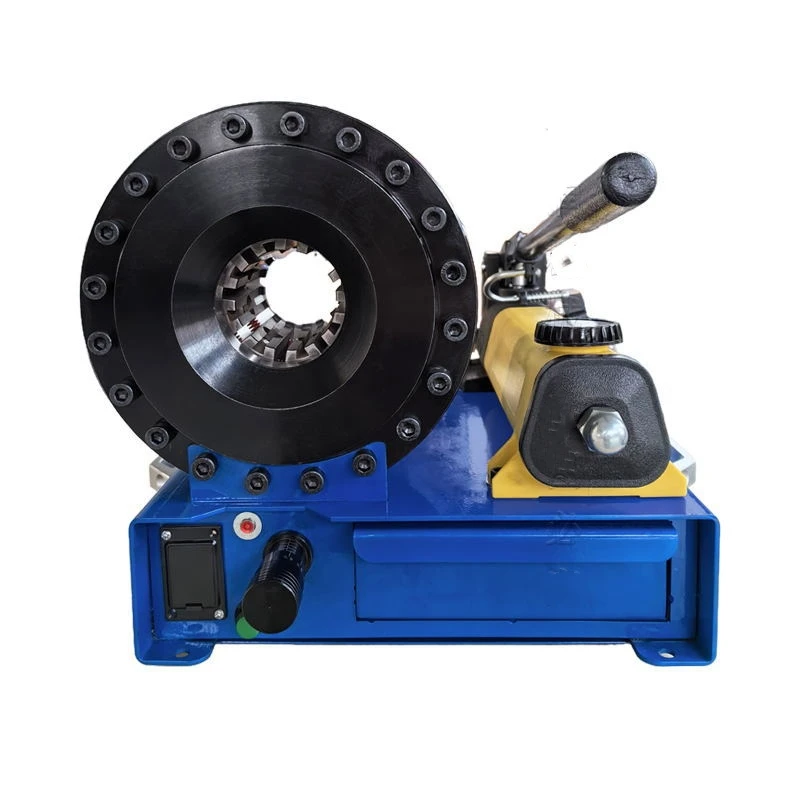
A parameter block with nothing in it, and a description that never names the machine
Product ID 1601274849088 has no parameter rows at all. That is not unusual in this catalogue: a hundred and fifty-one of its five hundred and twelve records carry an empty parameter block, which is twenty-nine and a half per cent. What makes this record worth reading is the second half of the same observation. Its description is eight hundred characters long and every one of them belongs to the supplier's company paragraph, beginning with the company's name and running through its brand, its claimed principles, its claimed experience, its claimed customer regions and its claimed quality-control standards. The description never repeats the title, never names a hose, never names a crimping machine, and never uses any of the three distinctive words from the product's own title.
That combination is rarer than either half alone. Twenty-four records have a description that never uses a distinctive word from their own title; twelve of those also have an empty parameter block, and this record is one of them. Only three records have a description consisting solely of the company paragraph, and this record is one of those three.
The practical consequence is that nothing about this machine is machine-readable. A buyer searching the supplier's catalogue, or an automated system reading it, cannot find the crimping range, the pressure, the size, the weight or the mould list, because none of them is in a field. Every figure in this guide therefore comes from one picture, and the rest of this article is about that picture and about what it does and does not settle.
The same machine appears a second time, with all eight picture files identical
Searching the catalogue for other records that use the phrase hose crimping returns exactly two, and they are this one and one other. The other is product ID 1601276840856, titled TEBAK Press Manual Hose Crimping Tool Hydraulic Hose Crimping Machine with Pump Core Component Pressing Rubber Product Making. Comparing the two records' picture addresses finds something more specific than a family resemblance: both carry eight images, and the eight addresses are the same eight, in the same order, with no difference at all. Six of those eight files are used by these two records and by no others in the catalogue.
Two listings of one machine sharing their entire picture gallery is a stronger relationship than a shared panel, and it makes the differences between the two listings the interesting part. Their parameter blocks differ: this record has none, while the other carries two rows, one naming the brand and one naming the product as a hydraulic hose crimping machine. Their descriptions differ: the other one opens by calling the machine a manual hydraulic pipe machine, a semi-automatic steel pipe crimping machine and a household oil pipe steel pipe shrinking machine, before falling into the same company paragraph. And their titles disagree on how the machine is operated: the other says press manual, and this one says manual, while the other's description says semi-automatic.
Manual and semi-automatic are not synonyms on a crimper. A manual machine is pumped by hand to pressure and then released, and the operator's work per crimp is a fixed number of strokes; a semi-automatic machine usually closes the crimp under power or holds the pressure for a set time before releasing. Which one a buyer is being quoted changes the cycle time, the operator effort and the consistency from crimp to crimp. The record does not settle it, and the two listings for the same eight pictures do not agree, so it is a question to put in writing along with a request for the quotation to name which listing it refers to.
One more detail in the same vein: this record's own picture gallery carries the picture of a payment and courier panel and a picture of wooden packing crates. Those two files are used by a hundred and thirty-two and forty-five records respectively, so they are supplier-wide furniture and not part of this machine's specification, which is worth knowing before a buyer reads the badges on the first image as promises. That image carries seven service claims, including installation guidance, technical support and support for factory inspection, and none of them comes with a scope, a party or a cost.
The panel has a row with a label and no value, and the missing value would settle the range
The one panel in the gallery that carries figures has a heading that translates as product parameters, and beneath it a labelled parts diagram and a list of rows. The rows give the product name, the crimping range, the system pressure, the no-mould maximum opening, the mould maximum opening, the net weight, the overall size and the mould apertures.
Two of those rows concern the machine's opening, and only one of them carries a value. The no-mould maximum opening is given as fifty millimetres, which is the clearance the crimping head has when no mould is fitted. The mould maximum opening is printed as a label with nothing after it. The value is simply absent from the panel.
That blank is the most consequential defect in the record, and the reason is arithmetic. The stated crimping range reaches an outer layer of thirty-two millimetres, so a buyer will assume the head opens far enough to admit a hose and fitting of that size. The figure that would confirm or deny it is the mould maximum opening, because the mould is what occupies the head's inside when the machine is working, and the panel leaves that figure out. A buyer can measure the no-mould opening of fifty millimetres and see eighteen millimetres of clearance over the stated thirty-two, but cannot tell from the record how much of that clearance the mould itself consumes, and therefore cannot tell whether the top of the stated range is reachable at all. Ask for the mould maximum opening as a number, and for the largest hose and fitting combination the machine can actually accept with its moulds fitted.
The stated crimping range names no hose construction
The crimping range is given as outer layer thirty-two millimetres and inner layer twenty-five millimetres. That is one pair of numbers, and the record attaches no hose construction to it, which is what makes it hard to use.
The arithmetic of the pair is unremarkable: thirty-two minus twenty-five is seven millimetres of combined wall, which is a plausible figure for a two-wire braided hose of that bore and is not plausible for a four or six spiral hose of the same bore, whose wall would be thicker. So the most natural reading is that the supplier measured one hose, described its inside and its outside, and published that pair as the machine's range. Nothing in the record says which hose, which construction, which standard or which wall thickness was measured.
Why that matters is that crimping is a matched operation. A crimper does not crimp a hose; it crimps a specific ferrule onto a specific hose, and the finished diameter is set by the ferrule maker's crimp chart for that combination of hose, ferrule and fitting. A machine's usable range is therefore not a single inside and outside pair but a table: hose bore and construction on one side, ferrule on the other, and the required finished crimp diameter in the middle, which the machine must be able to reach and hold. A pair of numbers with no construction attached cannot be turned into that table, and a buyer who orders on the pair alone may find that the machine covers their small two-wire work and not their larger spiral work, or the reverse.
So the questions are: which hose construction, standard and wall thickness produced the stated twenty-five and thirty-two millimetres; what is the machine's range for other constructions, in particular four and six spiral and thermoplastic hose; and will the supplier confirm the range against the buyer's own crimp chart by hose size rather than as one pair of numbers.
Thirty-five megapascals is a pressure, not a force, and the record withholds the number needed to convert it
The panel gives the system pressure as thirty-five megapascals. On a crimping machine the figure that decides what the machine can crimp is not the pressure but the force it produces, because the force is what closes the mould onto the fitting. Force is pressure multiplied by the area of the piston the pressure acts on, and the piston's area depends on its bore, which the record never gives. So the stated pressure cannot be converted into a crimping force from the record alone, and the table below shows how widely the answer moves across the range of bores a machine of this size might use. The bores are not the record's figures; they are this guide's own illustration of the gap, and every force in the table is this guide's own arithmetic on the record's own pressure of thirty-five megapascals, which is thirty-five newtons per square millimetre.
| Piston bore, assumed | Piston area | Crimping force at 35 MPa | In tonne-force |
|---|---|---|---|
| 70 mm | 3,849 mm2 | 134.7 kN | 13.7 |
| 80 mm | 5,027 mm2 | 175.9 kN | 17.9 |
| 90 mm | 6,362 mm2 | 222.7 kN | 22.7 |
| 100 mm | 7,854 mm2 | 274.9 kN | 28.0 |
The spread is more than a factor of two, from under fourteen to twenty-eight tonne-force, and that spread is the whole argument for asking. A buyer comparing two crimpers, one stating thirty-five megapascals and another stating two hundred kilonewtons, cannot tell from the record which is the stronger machine, and cannot check either against the crimp chart they actually have to meet. Ask for the cylinder bore, the rated crimping force in kilonewtons or tonnes, the maximum pressure the gauge is calibrated to, and whether the force figure is a working force or a peak.
The pressure figure also raises a question about how the crimp dimension is controlled, which is treated further below. On a machine whose mould closes to a hard stop, the gauge is an indicator and the finished diameter is set by the mould; on a machine whose gauge reading is what tells the operator to stop pumping, the finished diameter depends on the operator's judgement and on the gauge's accuracy. The record does not say which design this is, and the difference decides whether two operators on the same machine produce the same crimp.
The moulds: seven apertures, uneven steps, and the phrase attached at random
The panel lists the mould apertures as ten, twelve, fourteen, sixteen, nineteen, twenty-three and twenty-seven millimetres. That is seven values, and the panel also notes that seven sets of moulds are attached at random.
Two things about that list are worth pausing on. The first is that the steps between consecutive apertures are not equal. They run two, two, two, then three, then four and four millimetres. The set is therefore dense at the small end and increasingly sparse at the large end, which is the opposite of what a buyer with a mixed order book might want, since small hoses are usually the ones where a fraction of a millimetre matters most and large ferrules are where the crimp chart's tolerance band is proportionally tighter. Whether that distribution suits a given buyer depends entirely on the hose sizes they crimp, and the honest form of the question is: ask for the full list of apertures the supplier can make, not only the seven supplied, and price the ones the buyer actually needs.
The second is the word random. Seven sets attached at random may mean that the supplier ships the seven apertures listed, and the word is a translation artefact; or it may mean that seven are selected from a larger set without the buyer choosing. Those two readings have different consequences for a buyer whose work needs one specific size, and the record does not choose between them. Ask which apertures will be in the box, whether the buyer may nominate them, and what a further set costs.
The largest aperture in the listed set is twenty-seven millimetres, and the stated crimping range reaches an outer layer of thirty-two. The difference is five millimetres. The record explains it nowhere. There are at least two readings that a buyer should test rather than assume: perhaps the apertures describe the closed diameter of the mould rather than the fitting's outside diameter, so that a thirty-two millimetre hose is crimped by a smaller mould because crimping reduces the diameter; or perhaps the largest usable aperture simply is twenty-seven and the stated range is optimistic at its top end. Ask for the mapping from hose size to mould number to finished crimp diameter, and the ambiguity disappears.
The parts diagram names a battery holder on a machine that has no battery
The same panel carries a labelled photograph of the machine, with leader lines pointing to eleven parts. They are named as the eight-petal seat, the carved head, the pressure gauge, the pressure relief knob, the hydraulic pump, the push handle, the control knob, the fuselage, the mould box, the micrometer and the battery holder.
Three of those labels need explaining before a buyer uses the diagram to price spare parts. The first is the eight-petal seat, which is the useful one: eight petals describes the crimping head's construction, eight segments closing radially on the fitting, and it tells the buyer this is an eight-jaw crimper rather than a four-jaw one. The second is the fuselage, which is an aeroplane's body and here means the machine's housing, a translation of a Chinese word for a machine's frame. The third is the micrometer, which in English names a precision measuring instrument, and on a manual crimper almost certainly labels the fine adjustment that sets how far the mould closes. If it is that adjustment, it is the most important control on the machine for a buyer who has to hit a crimp diameter, and it deserves a real name, a range, an increment and a procedure.
The label that does not belong is the battery holder. This machine is pumped by hand: it has no motor, no wiring and no electrical specification anywhere in the record. A battery holder on its parts diagram suggests either that the diagram has been borrowed from a powered version of the same head, or that the label is wrong. Either way it is a question, and the question is worth asking because it is a small indicator of how much of the panel was assembled for this machine rather than reused. Ask what the battery holder is, and if the supplier also makes a powered version of the same crimper, ask for its specification and price at the same time.
The panel itself carries faint grey overprinted lettering behind its heading, including the fragment Milli on and characters in another script, which is the kind of mark a reused piece of artwork carries from whatever document it came from. That is not evidence of anything about the machine, and it is noted here only so that a buyer who opens the panel and sees it does not mistake it for a specification.
The machine's head also carries a printed label of its own, visible in one of the white-background photographs, with rows of small text that this resolution does not make readable. That is worth stating plainly rather than guessing: the machine has a nameplate, and neither the listing nor the picture at the size published allows a buyer to read what is on it. Ask for a readable photograph of the nameplate, because on a pressure vessel or a crimping head the plate is where the rated pressure, the serial number and the manufacturer are supposed to be, and a buyer inspecting the machine on arrival will want to compare the plate with the quotation.
Weight without oil, and everything else the record does not state
The panel gives the net weight as thirty-one kilograms and qualifies it as weight without oil. Four consequences follow, and each is a question rather than a complaint. The oil has to be added by someone, so the record should state the quantity and the grade, and it does not. The machine as shipped weighs less than the machine as used, so the figure a freight quotation is built on is not the figure a buyer will be moving. The oil is a consumable the buyer may have to source locally, and if the machine is specified for a particular grade that is not available, the warranty position should be established before rather than after a failure. And the head, the pump and the base together weigh thirty-one kilograms dry, which for a machine that an operator moves by hand between benches is the figure that decides whether it stays where it is put.
The overall size is given as three hundred and thirty-one by four hundred and one by two hundred and seventy-one millimetres. Those three numbers multiply to about thirty-six thousand cubic centimetres, or thirty-six litres, and putting thirty-one kilograms into that envelope gives a bulk density of roughly eight hundred and sixty kilograms per cubic metre, which is what a compact machine built around a cast head and a steel base looks like. For freight the same numbers give a volumetric weight of about six kilograms at the usual six-thousand divisor and about seven at five thousand, against thirty-one kilograms actual, so the chargeable weight will be the actual weight and the case will add to it. Since no case dimension or gross weight is given, ask for both.
Crimp diameter: set by the mould, or by the operator
This is the question a buyer of a crimper should ask before any other, and the record does not answer it. A hydraulic hose assembly is made to a crimp chart issued by the ferrule manufacturer, which states a finished crimp diameter and a tolerance for each combination of hose, ferrule and fitting. The machine's job is to reach that diameter and hold it, crimp after crimp, for a whole order.
On one design the mould closes to a hard stop, so the finished diameter is set by the mould's geometry and the operator's only job is to pump until the machine is closed. On another design the operator pumps until the gauge reaches a figure, so the finished diameter depends on the pressure, the gauge's accuracy and the operator's reading. The two designs have different repeatability, different training needs and different maintenance priorities, and the record describes neither. The presence of a pressure gauge, a pressure relief knob, a control knob and a component labelled micrometer is consistent with either, which is exactly why it should be asked rather than inferred.
The questions to send are therefore: does the mould close to a hard stop or to a pressure setting; how is the finished crimp diameter set and adjusted; what change in diameter does one increment of the micrometer adjustment produce; what tolerance can the machine hold on a given hose and ferrule; is there a crimp chart for the moulds supplied; and what does the supplier recommend for verifying a crimp, whether a gauge, a calliper measurement or a destructive test. A buyer who crimps for a pressure application will also want to know whether the supplier can provide any test or certification for the machine's repeatability, and should expect the answer to be no at this level of documentation, which is itself useful to know before the order rather than after.
What the record does not state at all
- Every parameter: the block is empty, so nothing about the machine is machine-readable.
- The crimping force in kilonewtons or tonnes, and the cylinder bore and stroke that would allow it to be calculated.
- The mould maximum opening, whose row on the panel is printed and left blank.
- The mapping from hose size to mould number to finished crimp diameter, and any crimp chart.
- The hose constructions and standards covered, and the range for each.
- The moulds' material, hardness and tolerance, and whether the seven are chosen by the buyer.
- Whether the machine is manual or semi-automatic, which its two listings answer differently.
- The oil quantity and grade, and whether it is included.
- The return type, the number of pump strokes to pressure, and the release procedure.
- The head's maximum working pressure as a rated figure, as opposed to the system pressure on the panel.
- The machine's weight with oil, and its centre of gravity.
- The case dimensions, the gross weight and the units per container.
- Country of origin, warranty period and scope, spare part availability and prices, and who services the machine.
- Any certification, any test report and any declaration for the destination market.
- A readable photograph or transcription of the machine's own nameplate.
- Minimum order quantity, price breaks, delivery term, port pair, production lead time and transit time.
Incoming inspection when the machine arrives
- Photograph the machine's own nameplate before doing anything else, and record the rated pressure, the maker's name and any serial number, comparing all three with the quotation; the listing's picture does not make the plate readable.
- Weigh the machine dry and record the figure against the stated thirty-one kilograms, then weigh the oil that goes in and record the total, since the record gives no quantity or grade.
- Measure the three overall dimensions against the stated three hundred and thirty-one by four hundred and one by two hundred and seventy-one millimetres, and measure the case separately if one is supplied.
- With no mould fitted, measure the opening and compare it with the stated fifty millimetres.
- Fit a mould and measure the opening, since the panel leaves that figure blank, and establish the largest hose and fitting the head will still admit.
- Count the moulds delivered and measure each aperture against the listed ten, twelve, fourteen, sixteen, nineteen, twenty-three and twenty-seven millimetres, then confirm that the seven match what was ordered and not a random selection.
- Check each mould for cracks, for damaged petals and for burrs on the working face, and check that the eight petals move together rather than one lagging.
- Measure the piston bore if the pump's drawing or a service manual allows it, and multiply by the stated thirty-five megapascals to obtain the crimping force, comparing it with the force the buyer's crimp chart requires.
- Check the pressure gauge's zero and its range against the stated system pressure, and confirm whether the gauge was calibrated or is a plain indicator.
- Establish how the finished crimp diameter is set: close a mould on a soft test piece and see whether the closure is a hard stop or a pressure reading, and turn the fine adjustment to find out what it changes and by how much.
- Crimp a test assembly using the buyer's own hose, ferrule and fitting, measure the finished diameter against the ferrule maker's chart, and record the deviation rather than accepting the crimp because it looks closed.
- Repeat the same crimp on the same settings ten times and measure every one, because repeatability is the property that decides whether the machine can hold a chart tolerance across an order.
- Crimp at both ends of the aperture range supplied and check that both reach the chart diameter, since the arithmetic gap between the largest aperture and the stated crimping range leaves the top end unproved.
- Confirm whether the machine is manual or semi-automatic in the sense the first listing's description uses, by counting the strokes needed to close a mould and noting whether anything holds the pressure.
- Test the pressure relief knob and confirm that releasing it at pressure does not leave the head closed, and record the release procedure for the operators.
- Inspect the hydraulic hose, the fittings and the pump's seals for weepage after a session at working pressure, since a crimper's oil leaks appear at pressure and not at rest.
- Check the pump's oil level and colour after a day's work, and record it, because the record gives no service interval.
- Check the carrying handle, the base's mounting holes and the head's fastenings, since a thirty-one kilogram machine is lifted by hand and the head is a heavy cantilever on a light base.
- Ask for the price and lead time of a replacement mould set and of the pump's seal kit before accepting the machine, since the record gives no spare parts prices.
- Write the whole inspection into a record with photographs, because the record's own documentation is thin and the buyer's own file is the only complete specification that will exist.
What the catalogue says, counted
The counts below come from scanning all five hundred and twelve records, and they place this record's defects in proportion. They are this guide's own measurements of the feed, not supplier statements, and the search strings are named so that the same counts can be reproduced.
| Observation | Records | Share |
|---|---|---|
| Records with an empty parameter block, of which this is one | 151 | 29.5% |
| Records whose description never uses a distinctive word from their own title | 24 | 4.7% |
| Records that are both empty of parameters and unnamed in their description | 12 | 2.3% |
| Records whose description is nothing but the company paragraph, of which this is one of three | 3 | 0.6% |
| Records containing the string crimp, this record among them | 5 | 1.0% |
| Records containing the string hose, this record among them | 5 | 1.0% |
| Records containing the string hydraulic | 10 | 2.0% |
| Records stating a pressure in megapascals at all, so the figure is rare in this catalogue | 3 | 0.6% |
| Records whose description the supplier's company-name sentence appears in | 384 | 75.0% |
| Records referring to the ISO 9001 standard in that paragraph | 136 | 26.6% |
| Records containing the string OED&ODM, the misspelling used here and elsewhere | 329 | 64.3% |
| Records containing the string this filed, the misspelling used here and elsewhere | 319 | 62.3% |
| Records containing the phrase 70% for expert, as used here | 265 | 51.8% |
| Records all of whose gallery images are plain http, in this record all eight are http | 47 | 9.2% |
| Records sharing the payment and courier panel that is the seventh image here | 132 | 25.8% |
| Records sharing the wooden crate panel that is the eighth image here | 45 | 8.8% |
| Records whose entire image set is used by no other record | 101 | 19.7% |
Four rows carry the argument of this guide. The first is the empty parameter block, which is not rare at all: almost a third of this catalogue is in the same condition, so a buyer cannot treat a full parameter block as the norm or an empty one as an exception. The second is the description row, where the count falls to twenty-four and then to three, which is the rarity that makes this record worth reading. The third is the pair of rows on pressure and crimping words: five records mention crimping, five mention a hose and only three state a pressure in megapascals, so this machine sits in a very small group in the catalogue while the panel inside its own gallery carries the most specification of any picture in it. The fourth is the two shared panels, at a hundred and thirty-two and forty-five records, whose counts are identical in this round to the last time they were measured, which is what a stable feed looks like.
The house-style counts are unchanged again: the company-name sentence in three quarters of the catalogue, the misspelled abbreviation in about two thirds, the phrase this filed in about five eighths, and the claim that seventy per cent of products are for experts in half. They are reported because a buyer comparing this supplier's catalogue with another's will be reading exactly this, and because the description on this record is nothing else.
The specification to send before ordering
| Item | What to require in writing |
|---|---|
| Machine identification | Which of the supplier's listings the quotation refers to, the model designation if one exists, and the machine's own nameplate details including the rated pressure and the serial number. |
| Operation | Whether the machine is manual or semi-automatic, and if semi-automatic, what is powered and on what supply. |
| Force | The rated crimping force in kilonewtons or tonnes, the cylinder bore and stroke, and the maximum working pressure. |
| Range | The hose bore and construction covered, expressed as a table by hose size and ferrule standard, not as a single inside-and-outside pair. |
| Opening | The mould maximum opening, which the panel leaves blank, and the largest hose with fitting the machine accepts with a mould fitted. |
| Moulds | Which apertures are supplied, whether the buyer may nominate them, the full list of apertures available, the material and hardness of the moulds, and the price of further sets. |
| Crimp control | Whether the mould closes to a hard stop or to a pressure reading; how the finished diameter is adjusted; what one increment of the fine adjustment changes; and the tolerance the machine holds. |
| Crimp chart | A crimp chart for the moulds supplied, or confirmation that the buyer's own ferrule maker's chart governs, and the recommended way to verify a finished crimp. |
| Hydraulics | Oil quantity and grade, whether oil is included, the service interval, the seal kit's part number and price, and the release procedure. |
| Geometry | Overall size, weight dry and with oil, the case dimensions and weight, and the gross weight per unit. |
| Head | The number of jaws, the head's material, and the head's maximum working pressure as a rated figure. |
| Inspection | A readable photograph of the nameplate, and agreement on the inspection and test that will be carried out before shipment, with the buyer's own hose and ferrule if possible. |
| Documents | A manual in a language the operators read, a parts list with prices, and any certification or test report held for the destination market. |
| Packing and freight | Case type and dimensions, gross weight, units per container, and the net and volumetric weights used for the freight quotation. |
| Commercial | Unit price for the chosen configuration, price breaks, minimum order, delivery term and port pair, production lead time, transit time, warranty period and scope, and who services the machine. |
Frequently asked questions
Why is the parameter block empty, and does it matter?
The record carries no parameter rows at all, and the description is entirely the supplier's company paragraph, so nothing about the machine is machine-readable. It matters because a buyer cannot search for it, cannot compare it in a spreadsheet, and cannot quote its figures in a purchase order. It is not unusual: a hundred and fifty-one records of five hundred and twelve have an empty parameter block. What is unusual is that only three records in the catalogue have a description consisting solely of the company paragraph, and this is one of them. Every figure in this guide comes from one panel in the picture gallery, so ask the supplier to move those figures into the parameter fields before quoting.
Is the same machine listed twice?
Yes. Product ID 1601276840856 uses the same eight image files in the same order as this record, with six of them used by these two records and no others. That listing has two parameters and a description that calls the machine a manual hydraulic pipe machine, a semi-automatic steel pipe crimping machine and a household oil pipe steel pipe shrinking machine, while this listing's title calls it manual. The pictures are identical and the words are not, so the buyer should establish which listing the quotation refers to and whether the machine is manual or semi-automatic.
What is the machine's crimping force?
It cannot be derived from the record. The panel gives a system pressure of thirty-five megapascals and no cylinder bore, and force is pressure multiplied by the piston's area, so the answer moves by more than a factor of two across plausible bores: this guide's own arithmetic at the record's own pressure gives about one hundred and thirty-five kilonewtons for a seventy millimetre bore and about two hundred and seventy-five for a hundred millimetre bore, which is thirteen and a half to twenty-eight tonne-force. Ask for the force directly, in kilonewtons or tonnes, and for the bore and stroke.
What is the largest hose it can crimp?
The panel states a crimping range reaching an outer layer of thirty-two millimetres and an inner layer of twenty-five, and lists mould apertures up to twenty-seven millimetres. The five millimetre difference between the largest aperture and the stated top of the range is not explained anywhere in the record. The row that would settle it, the mould maximum opening, is printed on the panel with no value beside it. Ask for the mould maximum opening, for the mapping from hose size to mould number to finished crimp diameter, and for the range expressed per hose construction, since a single inside and outside pair cannot be applied to a four or six spiral hose.
Are the moulds the right ones?
The panel lists seven apertures, ten, twelve, fourteen, sixteen, nineteen, twenty-three and twenty-seven millimetres, with steps of two, two, two, three, four and four millimetres, and notes that seven sets are attached at random. The steps grow towards the large end, and the word random leaves open whether the buyer may choose. Ask which apertures will be in the box, whether the buyer can nominate them, what the full list of available apertures is, and what an extra set costs.
How is the finished crimp diameter controlled?
The record does not say, and it is the most important question for anyone crimping to a chart. If the mould closes to a hard stop, the diameter comes from the mould and the operator only pumps until it closes; if the operator pumps until the gauge reads a figure, the diameter depends on the gauge and on the operator. The panel's own labels are consistent with either, since it shows a pressure gauge, a pressure relief knob, a control knob and a component it calls a micrometer, which on a manual crimper is most likely the fine adjustment that sets how far the mould closes. Ask which design the machine is, what one increment of that adjustment changes, and what tolerance it holds.
What is the battery holder on the parts diagram?
The diagram labels eleven parts of a machine that is pumped by hand and has no electrical specification anywhere in the record, and one of the eleven is a battery holder. Either the diagram was borrowed from a powered version of the same head, or the label is wrong. Ask what it is, and if the supplier also makes a powered crimper, ask for its specification and price at the same time.
What does the machine weigh, and what oil does it need?
The panel gives thirty-one kilograms and qualifies it as weight without oil. The oil quantity and grade are not stated, and neither is the weight with oil, which is the weight the machine will actually have and the figure a freight quotation should be built on. Ask for the quantity, the grade, whether it is supplied, and the service interval, and treat the oil as a consumable to source locally only after confirming the grade.
Would the supplier inspect or test the machine?
The first image carries badges offering installation guidance, technical support and support for factory inspection, with no scope, no party and no cost attached. Since the documentation is thin, a buyer's best use of that offer is to have the machine crimped on the buyer's own hose, ferrule and fitting before shipment, with the finished diameter measured and recorded against the ferrule maker's chart. Ask for that in writing, with the test method and the acceptance figure named.
Source, scope and what this guide does not claim
Everything about the machine comes from the record for Product ID 1601274849088 as it stands: an empty parameter block, an eight-hundred-character description that is entirely the supplier's company paragraph, and eight gallery images. The figures quoted are the ones printed on the panel in the second image: a product name given as Manual pipe Press, a crimping range of outer layer thirty-two millimetres and inner layer twenty-five, a system pressure of thirty-five megapascals, a no-mould maximum opening of fifty millimetres, a mould maximum opening row with no value, a net weight of thirty-one kilograms described as without oil, an overall size of three hundred and thirty-one by four hundred and one by two hundred and seventy-one millimetres, and mould apertures of ten, twelve, fourteen, sixteen, nineteen, twenty-three and twenty-seven millimetres with a note that seven sets are attached at random. The eleven parts named in the diagram, the seven service claims on the first image, the shipping panel and the crate panel are described as they appear. The machine's own head label is described as present but not readable at the resolution published, and no attempt is made to guess its contents.
The arithmetic is this guide's own and its assumptions are stated where they are used. The four crimping forces divide the stated pressure, thirty-five megapascals, by four assumed piston bores of seventy, eighty, ninety and a hundred millimetres; the bores are not the record's figures and are given only to show how wide the answer moves without them. The volume of about thirty-six litres multiplies the record's own three dimensions, the bulk density of about eight hundred and sixty kilograms per cubic metre divides the stated net weight by that volume, the volumetric weights of about six and seven kilograms use the usual six-thousand and five-thousand divisors, and the five millimetre gap and the seven millimetre combined wall are subtractions of the record's own numbers. The mould step sizes of two, two, two, three, four and four millimetres are the differences between consecutive apertures in the record's own list.
The duplicate finding was made by comparing every image address in the catalogue with the address scheme normalised so that the same file reached over http and https counts once. All eight of this record's images were downloaded and digested, from about ninety kilobytes to eight hundred and twenty-four kilobytes, and each one is confirmed to be used by at least one other record: the first six by product ID 1601276840856 and by no other record, the seventh by a hundred and thirty-two records and the eighth by forty-five. The counts in the table are this guide's own scans of all five hundred and twelve records, with the search strings named so that they can be reproduced; the shared-panel counts of a hundred and thirty-two and forty-five are identical to the previous round's measurements of the same two files, and the four house-style counts are likewise unchanged.
Nothing here asserts that the supplier has misrepresented the machine. An empty parameter block, a description that is only a company paragraph, a panel whose mould-opening row was left unfilled, a stated range whose top end is five millimetres beyond the largest aperture listed, a pressure given without the bore that would convert it into force, and a second listing for the same eight pictures that describes the operation differently are the ordinary consequences of listings assembled by hand from material at hand, and the counts above show how common each pattern is in this catalogue. Nothing here is engineering approval, a crimping specification, or purchase advice for a particular application. A hose assembly's integrity depends on the hose, the ferrule, the fitting, the crimp chart and the assembly procedure as much as on the machine, and the safe working pressure of a finished assembly is established by its manufacturer's data and by testing, not by the crimping machine's nameplate or by anything in this guide.
Key specifications
- Parameter block
- empty. The record carries no parameter rows at all, so no specification is machine-readable and every figure below has to be taken from a picture
- Product name
- not a parameter. The record's own panel gives it as Manual pipe Press, while the listing title calls it a manual hydraulic hose crimping machine, and one panel says the supplier focusses on all kinds of metal pipe processing
- Crimping range
- not a parameter. The panel gives outer layer 32mm and inner layer 25mm, as a single pair with no hose construction named
- System pressure
- not a parameter. The panel gives 35MPA, with no cylinder bore, no crimping force in kilonewtons or tonnes, and no stroke
- No-mould maximum opening
- not a parameter. The panel gives 50mm
- Mould maximum opening
- not a parameter, and the panel leaves this row blank: the label is printed and the value is missing
- Mould apertures
- not a parameter. The panel lists 10-12-14-16-19-23-27mm, seven values, and notes that seven sets of moulds are attached at random
- Net weight
- not a parameter. The panel gives 31kg, described as weight without oil, so the working weight and the oil quantity are both unknown
- Overall size
- not a parameter. The panel gives 331x401x271mm
- Crimping force
- not stated anywhere in the record, in any field or any picture
- Cylinder bore and stroke
- not stated anywhere, which is why the stated pressure cannot be converted into a force
- Oil quantity and grade
- not stated anywhere, though the weight is quoted without oil, which implies oil is added by the user
- Mould material and hardness
- not stated, though the moulds are the parts that wear
- Mould tolerance and crimp diameter control
- not stated: no crimp chart, no die numbering, no tolerance, and no procedure for setting the finished diameter
- Hose constructions covered
- not stated: no mention of wire braid, spiral, thermoplastic, or any hose standard such as SAE or DIN
- Mould set selection
- not a parameter. The panel says seven sets are attached at random, and does not say whether the buyer chooses which seven
- Return and stroke
- not stated: no spring return, no manual return, no number of pump strokes to reach pressure
- Packing
- not stated: no case, no case dimensions, no gross weight, no units per container