
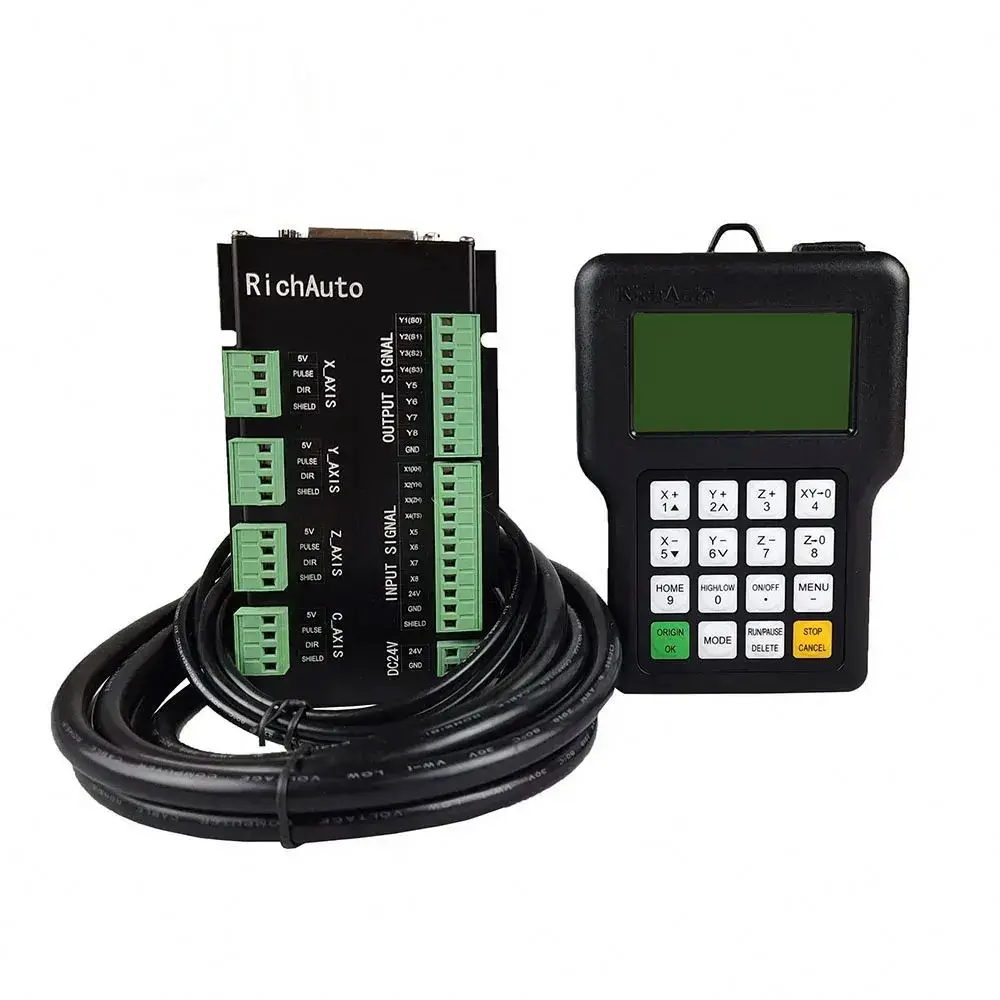
A CNC controller should be purchased as a complete control-system interface, not as a handheld pendant alone. The TEBAK Hoting queue record identifies product ID 1601451953577 as a Genuine RichAuto DSP A11/A18 motion-control system with English A11E/A18E wording, a 3-axis/4-axis configuration, USB handle controller, and CNC-router application.
The source describes a DSP-based embedded structure, independent operation from a PC platform, USB interface communication, support wording for U disk, card reader and mobile storage, direct file reading, G-code support, multi-head replacement, and use in machinery, advertising, woodworking, mold engraving, laser, flame and plasma cutting fields. It also combines A11, A18, A11E and A18E names. This guide keeps the series and axis ambiguity visible and turns missing electrical, mechanical and software data into an RFQ acceptance plan.
1. What product ID 1601451953577 confirms
Use product ID 1601451953577 on the quotation, controller label, wiring drawing, firmware record, packing list and purchase order. The source confirms broad controller functions, but it does not supply the pinout, drive signals, input voltage, firmware version, memory size, display details or machine-specific compatibility needed for a safe replacement.
| Recorded field | Source wording | Buyer action |
|---|---|---|
| Brand | TEBAK | Use TEBAK and product ID 1601451953577 on all technical and commercial records. |
| Controller family | RichAuto DSP A11 / A18; English A11E / A18E | Confirm the exact model, hardware revision, language, firmware and supplied accessories. |
| Axis wording | 3-axis / 4-axis | Confirm the actual axis count, output channels, homing inputs and supported machine layout. |
| Transfer | USB communication; U disk, card reader and mobile storage wording | Confirm which physical media and file-transfer method are included in the exact model. |
| Work mode | Offline work independent from a PC platform | Confirm whether files are loaded and executed from the controller without a live PC link. |
| File wording | G-code support and direct file reading | Confirm syntax, file extension, coordinate rules, memory, line limits and post-processor requirements. |
| Application wording | Machinery, advertising, woodworking, mold engraving, laser, flame and plasma cutting | Qualify the controller against the buyer's specific machine, drive, spindle or torch system. |
2. Resolve the A11, A18, A11E and A18E identity
The source title combines RichAuto DSP A11, A18, English A11E and A18E. These may represent different hardware generations, language versions or configurations, but the queue record does not define the relationship. Do not quote a generic “A11/A18” controller without identifying the exact unit to be shipped.
Ask the supplier for a photograph of the model label, hardware revision, firmware screen, language menu and serial or lot identifier. Request a model comparison table that states the difference between A11 and A18 and between the base and E versions. Confirm whether English is the controller language, the manual language, the firmware language or only a listing descriptor.
Put the exact model in the purchase order. If alternatives are acceptable, list them as controlled substitutions with separate pinout, firmware, accessory and compatibility approval. A replacement controller must not be accepted merely because its pendant looks similar.
3. Confirm the actual 3-axis or 4-axis configuration
The title says 3-axis/4-axis, but it does not identify which axis configuration is supplied. Ask whether the product can be configured for X/Y/Z only, X/Y/Z plus A, or another arrangement. Confirm whether the fourth axis is rotary, multi-head, slave, auxiliary or another function.
Request the axis naming, direction convention, travel limits, homing behavior, interpolation support, step resolution, maximum pulse frequency and output channel allocation. Do not infer fourth-axis support from a spare connector or a listing title.
Map the controller to the machine's physical axes. Confirm motor-drive quantity, step and direction polarity, enable signal, common-anode or common-cathode convention if relevant, limit inputs, probe input, emergency stop and spindle or torch outputs. Perform a dry axis-direction test with motors disabled from cutting before releasing the system.
4. DSP embedded offline control
The source describes the RichAuto control system as DSP-based, with an embedded structure, high integration, strong stability, easy installation and easy operation. These are product-description statements, not measured reliability or installation results. Request the exact DSP hardware, firmware version, update procedure, recovery method and diagnostic display.
The source also states that the system is independent from a PC platform and can fully realize offline work. Clarify whether the PC is needed only to create or copy G-code, whether a PC is needed for firmware updates, and whether the controller can resume a job after power interruption or only after a manual restart.
Define the production requirement for offline operation. Test file loading, job start, pause, stop, reset, dry run, coordinate return, power recovery, alarm display and file deletion without a live PC. Record the actual behavior for the approved firmware and machine wiring.
5. USB, U disk, card reader and mobile-storage wording
The source mentions USB interface communication and support for U disk, card reader and mobile storage. It does not identify connector type, protocol, storage capacity, file system, hot-plug behavior or whether every medium is included in the exact configuration.
Ask the supplier to specify the physical USB port, cable, connector, voltage, current limit, supported file system, maximum file size, maximum file count, folder depth, file-name rules and removal procedure. Confirm whether “card reader” is built in, an optional accessory or copied from a related model.
Test representative media prepared by the buyer. Use a short file, a long file, a file with nested paths if allowed, and a file containing the buyer's actual post-processor output. Verify that the controller shows the correct file, does not truncate coordinates, and gives a clear error for unsupported media or syntax.
6. G-code and direct-file reading
The source states G-code support and direct file reading, but no command list or file-format specification is supplied. Request the supported G-code dialect, extensions, comment rules, decimal precision, coordinate modes, arcs, drilling cycles, spindle commands, tool changes, pauses and subprogram behavior.
Compare the supplier's command list with the buyer's CAM post-processor. Confirm whether absolute and incremental coordinates, feed units, spindle speed, laser power, torch height, coolant, dwell and M-code handling are available. Do not assume that “G-code” means every standard command is supported.
Run a software acceptance file that exercises only safe, non-cutting moves first. Then use a test file for each machine function. Compare the controller's displayed line, coordinates, feed, output state and alarm response with the expected post-processor result. Keep the approved post-processor revision with the controller record.
7. Multi-head replacement and machine topology
The product description says the system supports multi-head replacement. It does not state the number of heads, switching hardware, output channels, head-selection command, calibration method or supported machine layout.
Ask whether multi-head means interchangeable tools, multiple spindle heads, automatic tool selection, duplicate outputs, laser and spindle switching, or another arrangement. Request a wiring diagram and an example macro or G-code sequence for the buyer's machine.
Test head selection with the machine secured and cutting disabled. Verify that the selected output is correct, the unselected head remains safe, offsets are loaded correctly, and an invalid head number causes an alarm rather than an unsafe output.
8. Drive and motor compatibility
The queue record does not identify stepper or servo drive type, pulse voltage, pulse frequency, direction timing, enable behavior, closed-loop feedback, encoder input or maximum motor count. Request a complete electrical interface specification.
Match the controller output to the drive input. Confirm signal level, common connection, pulse edge, direction setup time, maximum frequency, electronic gearing, alarm input and reset behavior. Do not connect an unknown pendant output directly to a drive or controller terminal.
Perform a single-axis test with the machine unloaded. Check positive and negative motion, emergency stop, limit switch, homing, alarm reset, coordinate display and repeatability. Then test simultaneous axes and the fourth-axis arrangement if approved.
9. Spindle, laser, flame and plasma use
The source lists woodworking, mold engraving, laser, flame and plasma cutting fields. These applications have different outputs, safety controls, torch or laser requirements and post-processors. The broad application list must not be treated as proof that one configuration safely supports every process.
Ask the supplier which outputs are available for spindle enable, spindle speed, laser power, flame ignition, plasma arc start, torch height, coolant, dust extraction and auxiliary relays. Request voltage, current, isolation, polarity, duty cycle and emergency-stop behavior for each output.
Qualify only the intended application. A CNC router spindle test is not evidence for plasma arc control or laser power modulation. Use a machine-specific wiring review, guarded dry run and process acceptance test before connecting energy sources.
10. Offline safety and recovery
Offline work reduces dependence on a live PC but does not remove the need for machine safety. Confirm how the controller handles emergency stop, limit alarms, probe triggers, drive faults, power loss, corrupted files, USB removal and communication failure.
Request the alarm list and recovery instructions. Determine whether reset clears a job, whether resume restarts from a saved line, whether coordinates are retained, and whether the spindle, laser, flame or plasma output is forced off after an alarm.
Test each recovery path with energy disabled or a safe dummy load. Document the operator decision tree: stop, isolate, inspect, reset, re-home, re-check offsets and restart only after the file and workpiece state are verified.
11. Coordinate systems, offsets and homing
No coordinate-system, work-offset, tool-offset, homing or soft-limit specification is supplied. Ask for supported coordinate modes, origin setting, workpiece zero, machine zero, soft-limit behavior, return-to-origin and offset storage.
Use a reference block to test X, Y, Z and the approved fourth axis. Confirm that values survive power cycling, file changes and reset as intended. Verify the displayed coordinate against a measured axis movement and check the sign convention before connecting a cutting tool.
For multi-head or multi-process machines, maintain separate offsets and identify them by model or head. A controller that reads the right G-code but applies the wrong offset can still produce a dangerous or unusable result.
12. Installation and enclosure
The source calls the structure easy to install and operate but does not provide dimensions, mounting method, enclosure rating, cable length, connector layout, cooling, grounding or environmental limits.
Request the controller and handle dimensions, mounting drawing, cable bend radius, connector pinout, strain relief, grounding point, fuse or protection requirement, operating temperature, humidity, dust and coolant limitations.
Install the controller so the operator can reach emergency stop and see alarms without reaching into the machine. Separate signal cables from high-power spindle, plasma, laser or flame wiring according to the machine builder's electrical practice. Verify protective earth, shielding and cable labels before power-on.
13. Language, display and operator workflow
The title uses English A11E/A18E wording, but the exact language support and display specification are not provided. Confirm display type, screen size, menu language, alarm language, button labels, keyboard or handle layout, units, decimal display and manual.
Run the complete operator workflow in the buyer's working language: insert media, locate a file, preview or dry run, set zero, start, pause, stop, reset, clear alarm, return home and remove media. Check whether the physical buttons match the manual and whether the display clearly shows axis, feed, spindle or auxiliary status.
Keep the approved manual revision with the machine. If multiple language versions exist, identify the exact firmware and label to prevent a language mismatch during service or training.
14. Firmware, memory and updates
The source provides no firmware version, memory capacity, update package, backup method, checksum, update connector or recovery image. Request these before production installation.
Confirm how files, parameters, offsets, macros and language settings are stored. Ask whether a firmware update can change pinout, G-code behavior, axis limits or file compatibility. Back up the approved configuration before an update and record the firmware checksum or version.
Use a controlled update test on a spare or non-production unit where possible. After an update, verify model identity, axis count, language, media reading, G-code, outputs, homing, limits, emergency stop and recovery before returning the machine to service.
15. Incoming inspection and commissioning
At receipt, verify product ID 1601451953577, exact A11/A18 or A11E/A18E model, axis configuration, handle, cable, USB or media accessories, manuals, labels and package condition. Photograph the label and retain the firmware screen.
Commissioning should proceed in stages: visual inspection, continuity and grounding review, power-on with outputs isolated, display and button test, media test, dry G-code test, single-axis test, multi-axis test, homing and limits, emergency stop, alarm recovery, and only then process test.
Record every measured or observed result. A successful power-on is not proof of motor compatibility, G-code correctness, multi-head operation or plasma/laser safety. Release the system only after the buyer's machine-specific acceptance criteria pass.
16. Supplier and company-profile verification
The description identifies Hengshui Mengshang Trading Co., Ltd. and describes TEBAK as its brand for design and sales. Treat these as supplier-profile statements requiring normal due diligence. They do not prove the exact RichAuto model, firmware, pinout, output isolation or machine compatibility.
Request the legal entity on the quotation, invoice, packing list, warranty and technical records. Confirm whether the supplier manufactures, integrates, distributes or services the controller. Ask for the responsible technical contact, replacement route, wiring support, spare parts and change-notification process.
If company certifications are presented, verify holder, scope, issuer, validity and entity match. Keep company-level evidence separate from controller hardware, firmware, electrical interface and machine-acceptance evidence.
17. RFQ checklist for product ID 1601451953577
- Confirm the exact RichAuto DSP model: A11, A18, A11E, A18E, hardware revision and firmware version.
- Confirm the actual 3-axis or 4-axis configuration, axis naming, output channels, fourth-axis type and multi-head arrangement.
- Provide controller and handle dimensions, mounting, cable, connector and complete pinout drawings.
- Provide input voltage, current, fuse, grounding, signal levels, pulse frequency and drive compatibility.
- Provide limit, homing, probe, emergency-stop, alarm, reset and soft-limit wiring.
- Define USB, U disk, card-reader and mobile-storage support, including connector, file system and capacity.
- Provide the supported G-code dialect, extensions, coordinate modes, arcs, cycles, M-codes, macros and line limits.
- Confirm offline operation, power-loss behavior, resume, file corruption response and PC requirements.
- Define spindle, laser, flame and plasma outputs with voltage, current, isolation, polarity and safety behavior.
- Provide multi-head replacement method, head-selection command, offsets, interlocks and example test file.
- Confirm English language support, display, buttons, menus, manuals and firmware-language relationship.
- Provide memory, parameter backup, firmware-update, rollback and configuration-recovery procedures.
- Provide environmental, enclosure, cable, shielding, cooling and storage requirements.
- Run machine-specific dry tests and process acceptance tests before production release.
- If company certifications are claimed, provide certificate holder, scope, issuer, validity and entity match; do not treat them as controller certification.
18. Comparing CNC-controller offers
Compare offers by exact model, axis count, firmware, language, input/output interface, drive compatibility, G-code coverage, offline workflow, media support, fourth-axis or multi-head functions, machine-specific outputs, alarm behavior, recovery, documentation, spare parts, technical support and warranty.
Normalize each quotation into controller, handle, cable, mounting hardware, USB or media accessories, wiring harness, firmware, manual, post-processor, macros, configuration backup, installation support, test file, training and warranty. A low price may cover the handle but exclude the machine interface, firmware configuration or commissioning work.
Do not merge A11 and A18 claims into one specification. The approved purchase line must identify the exact model and the machine configuration that the supplier has tested or approved.
19. Purchase-order wording
A purchase order can state: “TEBAK RichAuto DSP controller, product ID 1601451953577, exact approved model A11/A18 or A11E/A18E, approved 3-axis or 4-axis configuration, English requirement if applicable, USB and offline G-code operation, approved machine pinout, handle, cables, firmware, manuals, configuration backup, wiring diagram, acceptance test and warranty.”
Add the actual drive, spindle, laser, flame or plasma application, multi-head method, output specifications, limits, emergency stop, power-loss behavior, media compatibility, file syntax and rejection criteria. State that the broad source title does not replace a machine-specific wiring and commissioning approval.
20. Frequently asked questions
What product is identified by product ID 1601451953577?
The source identifies a TEBAK Genuine RichAuto DSP A11/A18 motion-control system with English A11E/A18E wording, 3-axis/4-axis wording, USB handle controller and CNC-router application.
Is the exact model A11 or A18?
The source combines A11, A18, A11E and A18E. Confirm the exact model, hardware revision, firmware and language before purchase.
Does it work without a PC?
The source describes independent operation from a PC platform and fully offline work. Confirm the exact file-loading, editing, update and recovery workflow for the supplied model.
Does it support G-code?
G-code support and direct file reading are stated, but the command dialect, extensions, memory and line limits are not provided. Request the controller's command list and test the buyer's post-processor output.
Does 3-axis/4-axis mean a fourth rotary axis?
Not necessarily. Confirm whether the fourth axis is rotary, auxiliary, multi-head, slave or another configuration, and verify the output and software behavior.
Can it control laser, flame and plasma machines?
Those application fields appear in the source description, but each process requires specific outputs and safety controls. Qualify the exact machine wiring and process configuration separately.
Supplier inquiry template
Hello, we are evaluating TEBAK product 1601451953577, RichAuto DSP A11/A18 controller with A11E/A18E English wording. Please confirm the exact model, hardware revision, firmware, language, actual 3-axis or 4-axis configuration and fourth-axis or multi-head function. Provide the complete pinout, input voltage, signal levels, drive compatibility, limit/homing/probe/emergency-stop wiring, spindle or laser/flame/plasma outputs, USB and storage-media specifications, supported G-code dialect, file limits, offline workflow, power-loss recovery, display, manuals, firmware backup and update procedure. Please test the controller with our machine, motors, drives, post-processor and required process outputs before production approval.
Key specifications
- Brand
- TEBAK
- Product ID
- 1601451953577
- Source title wording
- Genuine Richauto DSP A11 A18 3-axis/4-axis Motion Control System English A11e A18e DSP USB Handle Controller for CNC Router
- Controller family wording
- RichAuto DSP A11 / A18 and English A11E / A18E wording are combined; confirm the exact supplied model
- Axis wording
- 3-axis / 4-axis; confirm the actual axis count, output channels, and supported machine configuration
- Storage and transfer
- USB interface communication; source also mentions U disk, card reader, mobile storage, and direct file reading
- Work mode
- Offline work independent from a PC platform
- Control basis
- DSP-based embedded structure; source describes high integration, stability, and ease of installation and operation
- File wording
- G-code support and direct file reading are stated; confirm supported syntax, file extensions, memory, and line limits
- Application wording
- Machinery, advertising, woodworking, mold engraving, laser, flame, and plasma cutting fields
- Unspecified buyer-critical fields
- Input voltage, output signals, pinout, motor/drive compatibility, limit inputs, spindle control, emergency stop, communication protocol, display, firmware, memory, software, macros, enclosure, and compliance documents
- Company profile
- Hengshui Mengshang Trading Co., Ltd.; TEBAK is described as its brand for design and sales
Frequently asked questions
- What product is identified by product ID 1601451953577?
- The source identifies a TEBAK Genuine RichAuto DSP A11/A18 motion-control system with English A11E/A18E wording, 3-axis/4-axis wording, USB handle controller and CNC-router application.
- Is the exact model A11 or A18?
- The source combines A11, A18, A11E and A18E. Confirm the exact model, hardware revision, firmware and language before purchase.
- Does it work without a PC?
- The source describes independent operation from a PC platform and fully offline work. Confirm the exact file-loading, editing, update and recovery workflow for the supplied model.
- Does it support G-code?
- G-code support and direct file reading are stated, but the command dialect, extensions, memory and line limits are not provided. Request the controller's command list and test the buyer's post-processor output.
- Does 3-axis/4-axis mean a fourth rotary axis?
- Not necessarily. Confirm whether the fourth axis is rotary, auxiliary, multi-head, slave or another configuration, and verify the output and software behavior.
- Can it control laser, flame and plasma machines?
- Those application fields appear in the source description, but each process requires specific outputs and safety controls. Qualify the exact machine wiring and process configuration separately.