
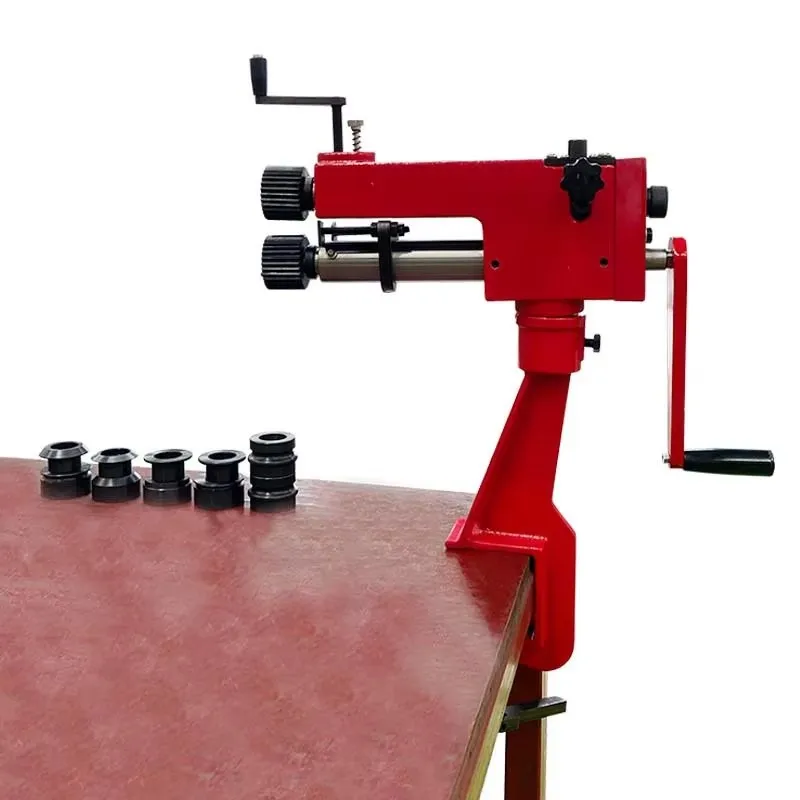
Source-controlled product identity
The Hoting queue record identifies the TEBAK RM08 manual metal sheet rotary forming machine, also described as a bead roller or bead rolling machine. The structured fields confirm model RM08, capacity 0.8mm/22Ga, throat depth 177mm/7", packing size 50x45x16 cm and N.W./G.W. of 22/24 kg. These are the verified product fields available for this procurement guide.
The description says that the rotary machine is used for blank pressing and arc pressing on various plates, includes six sets of standard rollers, can form different shapes, has adjustable roll pressure through a top-mounted hand crank, can operate in forward and reverse, and is supplied with a table mount and clamp. These are source-description claims. The exact roller profiles, material basis for the 0.8mm/22Ga capacity, maximum workpiece width, force, stand arrangement and acceptable production tolerances must be confirmed on the quotation and sample.
Product ID 1601627675307 should appear on the quotation, machine label, inspection report and packing list. This guide is for sheet-metal workshops, HVAC duct fabricators, restoration shops, automotive bodywork suppliers, roofing and flashing contractors, vocational schools, maintenance departments and distributors evaluating a compact manual bead roller.
Confirmed fields and open RFQ questions
| Information | Recorded value or status | Buyer action |
|---|---|---|
| Product ID | 1601627675307 | Require the same ID on the quotation, nameplate, inspection sheet and shipping documents. |
| Model | RM08 | Confirm the current revision, roller package, clamp arrangement and spare-part list. |
| Capacity | 0.8mm/22Ga | Request the material, width, temper, profile and test method behind this capacity. |
| Throat depth | 177mm/7" | Confirm the measurement point, usable depth, roller clearance and workpiece access. |
| Packing size | 50x45x16 cm | Use for freight planning only; request unpacked footprint, height and operating clearance. |
| N.W./G.W. | 22/24 kg | Confirm whether tools, rollers, clamp and package materials are included in each value. |
| Six standard roller sets | Description claim | Request profile drawings, roller material, dimensions, markings and included quantity. |
| Adjustable roll pressure | Description claim | Define hand-crank travel, adjustment resolution, locking method and repeatability. |
| Forward and reverse | Description claim | Confirm drive mechanism, control method, guarding and safe reversal procedure. |
| Table mount with clamp | Description claim | Request clamp opening, mounting points, bench requirements and stability test. |
Define the forming operation before selection
A bead roller should be selected from the sheet material, thickness, width, profile, radius, depth, repeatability and production method. Record whether the work is a bead, flange, offset, channel, blank edge, arc or another formed feature. “Bead roller” is a broad description and does not define the final geometry.
Prepare a process specification with the sheet alloy, grade, temper, thickness, blank width, finished profile, bead location, required radius, acceptable springback and surface-finish limit. If the buyer works with galvanized, stainless, aluminum or painted sheet, test each material separately. Do not transfer a capacity claim from one material to another without evidence.
For HVAC work, prioritize profile repeatability, sheet access and clean edges. For automotive restoration, prioritize controlled pressure, roller alignment and surface protection. For a school or maintenance shop, prioritize guarding, stable mounting and clear adjustment instructions. For a distributor, list the exact roller set and capacity basis for each customer configuration.
Use the buyer's actual sheet and target profile in supplier trials. A sample made from a thinner or softer sheet may look successful while failing the intended production requirement.
0.8mm/22Ga capacity: request the basis
The structured capacity is 0.8mm/22Ga. The record does not identify the material, width, temper, profile, roller diameter, edge distance or number of passes used to establish this value. Request a written capacity table for the buyer's material and profile.
Gauge references vary by material and market. Keep the source expression 0.8mm/22Ga on the RFQ, but require the supplier to state the actual thickness in millimeters and the material standard used for the test. Do not treat 22Ga as a universal thickness for every alloy.
Ask whether the capacity applies to a straight bead, curved workpiece, flange, offset or another operation. Confirm whether the value is a maximum occasional limit or a recommended repeat-production range. Request the minimum sheet thickness as well as the maximum.
Run a stepped test across the intended thickness range. Record roller profile, pressure setting, feed direction, pass count, blank width, formed depth, springback, cracking, wrinkling and surface marks. The final purchase specification should identify the approved material and profile, not just the catalog maximum.
Throat depth and workpiece access
The source records a 177mm/7" throat depth. Request a dimensioned drawing showing the throat measurement, roller centerline, side frame, shaft clearance, workpiece entry and usable distance before the sheet contacts the frame.
Throat depth limits where a feature can be placed from the sheet edge. It does not by itself define the maximum sheet width or the largest panel that can be handled. Ask for maximum workpiece width, roller face width, shaft length and clearance above and below the workpiece.
Test a flat blank and a curved panel at the intended feature location. Check whether the sheet can be inserted without scraping the frame, and whether the workpiece can be rotated or reversed. Record the minimum access needed for the operator's hands and for safe removal.
If the buyer forms large panels, ask whether a support table or second operator is required. Do not infer large-panel capability from the 177mm throat figure.
Roller sets and profile control
The product description says that six sets of standard rollers are included. The source does not provide profile names, drawings, material, hardness, shaft diameter, roller width or storage method. Request a complete roller inventory and a profile drawing for every included set.
Ask whether the rollers are intended for different bead widths, radii, flanges or sheet thicknesses. Confirm how the roller pair is installed, how the upper and lower profiles align, and whether the buyer can purchase additional matched sets.
Inspect roller surfaces for chips, burrs, contamination and runout. Measure the profile at acceptance and compare it with the approved drawing. A roller that is visually similar may create a different bead radius or pinch the sheet.
Keep matched roller pairs together and mark them with a durable identifier. Define cleaning, lubrication, storage and replacement procedures. Request the roller material and hardness only as supplier-confirmed values; do not infer them from appearance.
Adjustable roll pressure and hand-crank setting
The description claims adjustable roll pressure through a top-mounted hand crank, but it does not state force, travel, pitch, scale, locking method or adjustment repeatability. Request a mechanical drawing and operating procedure.
Ask whether the hand crank changes the upper roller position, spring load, shaft spacing or another mechanism. Confirm how the setting is locked during a pass and how the operator avoids overloading the rollers or sheet.
Create a setting record for each material and profile: roller pair, initial gap, crank turns, direction, pass count, feed direction and final formed dimensions. Repeat the setting after removing and reinstalling the rollers to assess repeatability.
Check for pinch points at the rollers, crank, shafts and frame. The operator should never place fingers near the nip while the sheet is moving. Request guards and safe-hand-position guidance for the exact configuration.
Forward and reverse operation
The description says the machine can operate in both forward and reverse. Confirm whether this means the sheet can be fed in either direction by reversing the drive, or whether it refers to manual workpiece movement. Request the control layout, transmission diagram and safe reversal sequence.
If reversal is used to correct a pass, define when it is safe to stop, how pressure is released and how the operator prevents the sheet from buckling. Check whether the rollers remain aligned and whether reverse operation changes the profile or surface finish.
Run forward and reverse trials on the same sample. Record marks, wrinkling, edge distortion, bead depth and the number of adjustments required. Do not claim that reverse operation is suitable for every profile until the test is documented.
Inspect guards and access around rotating components. A manual reversal process still creates entanglement and nip hazards.
Table mount, clamp and installation
The source description says a table mount with clamp is standard. The record does not provide clamp opening, mounting-hole pattern, required bench thickness, support height or allowable load. Request those dimensions before installation.
Use a rigid, level bench with sufficient mass and edge clearance for the intended sheet. Confirm where the clamp contacts the bench and whether the clamp can damage the surface or loosen under repeated forming loads.
Measure stability during a maximum approved pass. Check movement, vibration, frame twist, clamp slip and roller alignment. If the machine moves, do not compensate by increasing pressure; correct the mounting first.
Ask whether optional floor stands, support tables or additional clamps are available. The fact that a clamp is listed as standard does not prove that every bench can support the machine safely.
Material, surface finish and formed quality
The queue record does not state the machine-frame material, roller material or surface treatment. Request these values and identify which parts contact the sheet. Surface finish matters when forming prepainted, galvanized, polished or decorative material.
Define acceptable marks, scratches, dents, cracks, edge waves and coating damage. Inspect a formed sample under the same lighting and measurement method used by production quality control.
Measure bead height, width, location, radius and angle where relevant. Record springback after unloading and the change after repeated passes. Visual approval without dimensions is not enough for a repeatable metal-forming process.
Ask for cleaning and lubrication instructions. Excess lubricant can contaminate painted sheet, while insufficient lubrication may increase wear or affect feed behavior. Follow the supplier's stated procedure for the confirmed roller material.
Packing size, weight and receiving inspection
The recorded packing size is 50x45x16 cm, with N.W./G.W. of 22/24 kg. Confirm whether this package contains the RM08 frame, six roller sets, clamp, tools, manual and any protective parts. Request carton construction, internal supports, moisture protection and lifting marks.
Photograph the package before opening and record damage, wetness, crushed corners and missing labels. After unpacking, verify the product ID, model, roller count, clamp, fasteners, crank and frame against the packing list.
Measure the unpacked machine and compare it with the approved drawing. Check that shafts rotate freely without binding, rollers are clean and matched, the crank moves smoothly and the clamp can be secured to the intended bench.
Retain the packing material until the acceptance test is complete. If the unit will be moved between sites, ask for a reusable transport case or a documented re-packing method.
Factory acceptance test proposal
- Verify Product ID 1601627675307, model RM08 and the approved label.
- Verify the 0.8mm/22Ga capacity basis: material, width, profile, roller set and pass method.
- Verify the 177mm/7" throat-depth measurement with a dimensioned drawing.
- Inventory all six standard roller sets and match each pair to an approved profile drawing.
- Verify roller material, surface condition, alignment, runout and replacement identification.
- Test the top-mounted hand-crank adjustment, gap setting, locking method and repeatability.
- Test forward and reverse operation using the buyer's sheet and record formed dimensions.
- Test the table mount and clamp on a representative bench for stability and slip resistance.
- Run the buyer's material at the smallest, nominal and maximum approved thickness.
- Measure bead or formed-profile width, depth, radius, location, springback and surface marks.
- Check nip points, rotating parts, operator access, safe hand positions and maintenance steps.
- Verify packing size, net/gross weight, package protection, tools, manual and spare parts.
RFQ checklist
- Product ID 1601627675307, RM08 model and current revision.
- Capacity basis for 0.8mm/22Ga: material, width, temper, profile, roller set and pass count.
- Minimum recommended thickness and maximum repeat-production thickness.
- 177mm/7" throat-depth definition, roller centerline, usable clearance and access drawing.
- Maximum workpiece width, roller face width, shaft diameter and support requirements.
- Six roller-set inventory with material, hardness, profiles, dimensions and spare-part codes.
- Roll-pressure mechanism, hand-crank travel, scale, lock, force and adjustment repeatability.
- Forward/reverse mechanism, control, reversal procedure and safe operating limits.
- Table-mount clamp opening, mounting pattern, bench thickness and stability test.
- Frame, shaft and roller materials, finish, lubrication and corrosion-protection information.
- Acceptance limits for bead depth, width, radius, springback, marks and cracks.
- Packing size 50x45x16 cm, net/gross weight 22/24 kg, package and lifting instructions.
- Manual, tools, included clamp, roller storage, replacement parts and warranty.
- Lead time, inspection terms, destination documents and after-sales contact.
Safety and compliance questions
A bead roller has rotating rollers, shafts, hand cranks and nip points. Request the operating manual, hazard labels, safe-hand-position diagrams and maintenance isolation procedure for the RM08 configuration.
Keep hands, clothing, hair and loose material away from the roller nip. Use stable sheet supports for large blanks, wear appropriate eye protection and gloves suitable for sheet edges, and deburr or safely handle sharp blanks before forming.
Do not reach into the roller area to remove a jam while pressure is applied. Stop the machine, release the forming load according to the manual and secure the workpiece before clearing it.
Do not claim CE, ISO, guarding compliance or another certification unless the supplier provides current documents identifying the exact RM08 configuration. A product photograph is not a compliance document.
Buyer decision framework
This candidate is the TEBAK RM08 manual rotary forming machine with recorded 0.8mm/22Ga capacity, 177mm/7" throat depth, 50x45x16 cm packing size and 22/24 kg net/gross weight. The description adds six standard roller sets, adjustable roll pressure, forward/reverse operation and a table mount with clamp.
Approve the unit only after the supplier defines the capacity test, provides roller profiles and material data, confirms the throat-depth drawing, demonstrates the buyer's sheet and target profile, validates the clamp and bench installation, and documents safe operation. The most important open questions are material basis, roller geometry, pressure repeatability, formed-profile tolerance and actual working clearance.
Frequently asked questions
What sheet thickness can the RM08 form?
The source records 0.8mm/22Ga. Confirm the material, width, temper, roller profile and pass method behind that value before treating it as a production capacity.
What does 177mm/7" throat depth mean?
It is the recorded throat-depth field, but the measurement basis is not supplied. Request a dimensioned drawing showing the roller centerline, frame clearance and usable access.
Are six roller sets included?
The product description claims six sets of standard rollers. Request an itemized inventory, profile drawings and a quotation that clearly states what is included.
Can the machine form every bead or flange?
No universal profile range is confirmed. Select a matched roller pair and test the buyer's sheet, feature and tolerance before approval.
Is the 50x45x16 cm size the machine footprint?
No. It is recorded as packing size. Request unpacked dimensions, operating envelope, bench requirements and clearance around the crank and sheet.
Source and contact
This guide is based on the Hoting queue record for Product ID 1601627675307. The recorded fields are model RM08, capacity 0.8mm/22Ga, throat depth 177mm/7", packing size 50x45x16 cm and N.W./G.W. 22/24 kg. Before purchase, request the current quotation, capacity test, roller inventory, dimensioned drawing, safety manual, packing details, spare-parts list, warranty and destination-market documents through the TEBAK sales inquiry channel.
Key specifications
- Model
- RM08
- Capacity
- 0.8mm/22Ga
- Throat Depth
- 177mm/7"
- Packing Size
- 50x45x16 cm
- N.W./G.W.
- 22/24 kg