
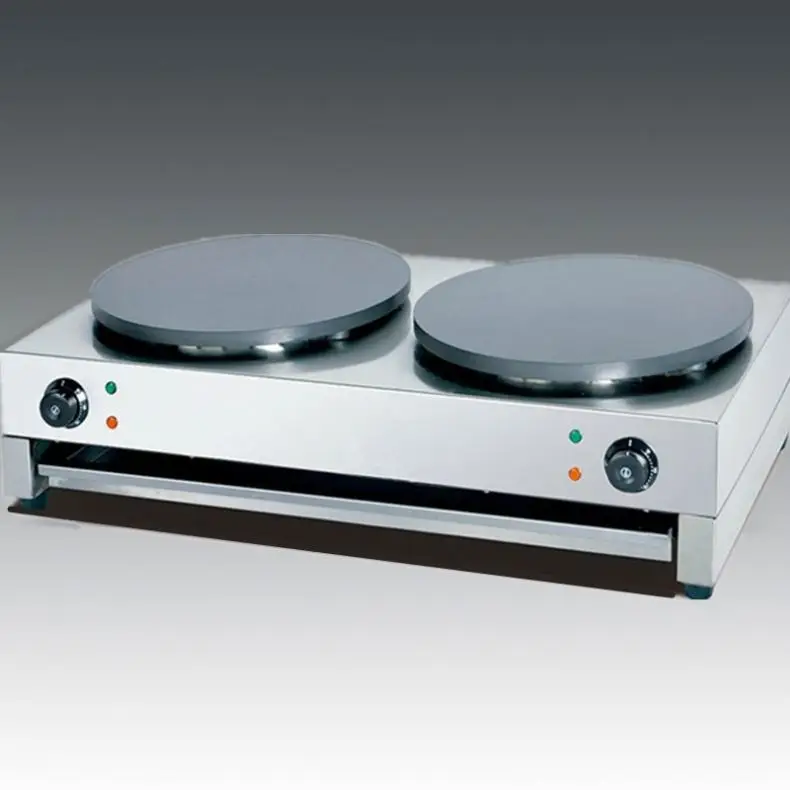
What the source record confirms
The TEBAK source record identifies a rotating French large pancake automatic double hot plate electric crepe and pancake maker for commercial crepe making. The product ID is 1601369036286. The structured record provides four confirmed fields: product name, model, voltage and power.
| Source field | Confirmed value | Procurement meaning |
|---|---|---|
| Product Name | Electric Crepe Machine | Equipment identity stated in the source record. |
| Model | AK - 31 | Model identifier to repeat on the quotation and documents. |
| Voltage | 220 Volts | Declared electrical supply; confirm frequency, phase, plug and tolerance. |
| Power | 3000 Watts | Declared connected power; confirm circuit, current and control arrangement. |
The title describes a rotating French large pancake, automatic double hot plate configuration, but those title terms do not establish plate diameter, plate material, rotation method, temperature range, output rate or food-contact compliance. The source does not provide dimensions, weight, heating-zone layout, thermostat type, timer, control panel, plug, frequency, phase, certification, warranty or spare-parts data. Treat each missing item as an RFQ confirmation point.
This guide separates the source description from verified engineering and commercial information. Buyers should use product ID 1601369036286 and model AK - 31 in every request for quotation, drawing, sample test, inspection record, packing list and manual.
1. Procurement identity and intended use
Use the exact procurement identity: TEBAK Rotating French Large Pancake Automatic Double Hot Plate Electric Crepe and Pancake Makers Commercial Crepe Making Machine. Ask the supplier to confirm that the quotation and photographs correspond to product ID 1601369036286 and model AK - 31.
Define the intended operation before comparing prices. Record whether the machine will be used in a restaurant, bakery, hotel breakfast line, food stall, central kitchen, catering operation or demonstration area.
Clarify the menu: thin French crepes, larger pancakes, a specific batter recipe or several products. The title indicates French large pancake and crepe use, but it does not define batter viscosity, portion size, cooking time or acceptable browning.
Confirm whether “automatic” refers to heating control, plate rotation, batter distribution, cooking cycle, dual-plate operation or another function. Request a process description and control sequence rather than treating the word as a complete automation specification.
Ask whether the “double hot plate” means two cooking surfaces, two heating zones, two rotating plates or a double-sided cooking arrangement. Request a labelled drawing showing each plate, heater, control and operator action.
Keep the product ID on the nameplate photograph and carton markings. Do not approve a visually similar AK-series unit unless the supplier confirms the exact model and electrical configuration in writing.
2. Confirmed electrical baseline
The source record states 220 Volts and 3000 Watts for model AK - 31. Confirm whether these values are rated input values for the complete machine or for a single heating assembly.
Ask for rated current, frequency, phase, plug type, cable length, connector, circuit-breaker recommendation, grounding method and acceptable voltage tolerance. The source does not provide these fields.
At 220 Volts and 3000 Watts, a buyer should not select a circuit from the wattage alone. The supplier must confirm the actual current, duty cycle, startup behavior and installation instructions for the destination market.
Confirm whether both hot plates can operate at full power simultaneously. Ask for the power distribution between heating zones and whether automatic controls cycle the heaters.
Request a wiring diagram, terminal information, control-panel rating, fuse or overload protection and emergency isolation method where applicable.
Check the destination country's plug and electrical requirements before shipment. Do not infer CE, UKCA, UL, ETL, RoHS or other compliance from the product title or company profile.
Require a nameplate photograph showing model AK - 31, 220 Volts and 3000 Watts before dispatch. Match the nameplate with the quotation and inspection report.
3. Hot plate and cooking-surface confirmation
The title describes a large pancake and double hot plate machine, but the queue contains no plate diameter, usable cooking area, plate thickness, material, coating or surface finish. Request a dimensioned plate drawing.
Confirm the number of cooking surfaces and the usable diameter or area of each surface. Separate the overall plate size from the effective batter-cooking area.
Ask for the plate material, surface treatment, coating type, maximum temperature rating and cleaning restrictions. Do not describe the surface as non-stick, stainless steel, cast iron or food-grade unless the supplier provides model-specific evidence.
Confirm whether the two surfaces have independent temperature control. Request the setpoint range, display accuracy, hysteresis and actual surface-temperature test method.
Ask how the rotating action operates and whether the operator starts it manually or through an automatic cycle. Confirm rotation direction, speed, stop position and guarding around moving parts.
Check the edge, frame and underside of each plate for batter traps, grease accumulation and cleaning access. Request an exploded view or cleaning diagram.
Test surface flatness and heating uniformity with the buyer's batter. Record center-to-edge browning, cold spots, hot spots and repeatability across both plates.
Confirm whether plates are removable and what tools or isolation steps are required. A removable surface must still be protected from damage and contamination during cleaning.
4. Heating control and cooking performance
Request the heating method, heater location, thermostat or electronic controller type and temperature feedback point. The source only confirms total power, not the internal heating design.
Define the buyer's cooking target: batter weight per crepe, target diameter, thickness, color, texture, cooking time and maximum acceptable variation.
Run a controlled test using the buyer's recipe. Record batter temperature, ambient conditions, preheating time, setpoint, surface temperature, cooking time and output appearance.
Test both plates separately and together. A machine that performs well on one surface may require different loading, recovery or control settings on the other.
Record heat recovery after a series of crepes. Do not infer continuous commercial capacity from 3000 Watts or from the word automatic.
Ask for performance data under a defined recipe and duty cycle. If the supplier claims an output rate, require the batter weight, plate size, cook time and acceptance criteria used to obtain it.
Confirm over-temperature protection, sensor-failure response, heater cut-off and restart behavior after power interruption.
Do not publish a temperature, warm-up time, cooking time, production rate or uniformity percentage until it is confirmed for model AK - 31 in a supplier document or buyer test.
5. Automatic operation and controls
Map every operator action from switch-on to finished product. Ask which functions are automatic and which require manual batter spreading, plate rotation, timing, turning or removal.
Request a control-panel photograph and manual. Identify power, heating, temperature, timer, rotation, start, stop, alarm and reset controls if present.
Confirm whether each plate has a separate control channel. Ask whether a fault on one channel disables the other and how the operator is warned.
Check whether the controller displays actual temperature or only a set value. Ask for display resolution, sensor location and calibration procedure.
Ask whether a timer is included and whether it controls heating, rotation, alarm or the full cooking cycle. Do not infer a timer from the word automatic.
Define safe restart behavior after a power cut, emergency stop, over-temperature event or opened access panel. Request a written sequence.
Confirm operator training requirements and language options for the manual, labels and control panel. Keep translated operating instructions with the equipment record.
6. Food-contact and sanitation review
The source title describes crepe and pancake making but does not prove food-contact suitability, sanitary construction, allergen controls or regulatory compliance.
Identify every surface that may contact batter or finished food. Request material grade, coating documentation, surface finish and cleaning compatibility for each contact surface.
Define the cleaning method: scrape, wipe, dry clean, water wash, detergent wash or another approved process. Confirm the machine's electrical protection and drying requirements before using liquid cleaning.
Inspect edges, seams, fasteners, hinges, plate supports and control gaps for residue traps. Request a cleaning-access drawing and the recommended cleaning sequence.
Confirm whether the machine can be cleaned between recipes and allergens. Define batter changeover, utensil segregation, residue removal and verification steps.
Ask for food-contact declarations or certificates only when they cover the exact model, plate surface and intended market. A general company statement is not model-specific evidence.
Do not call the machine food-grade, sanitary, non-stick or allergen-safe without supporting documents. Use “food-service application” only as a description of intended use unless compliance is confirmed.
Perform a post-cleaning inspection with the buyer's actual batter and cleaning products. Record residue locations, cleaning time, surface damage and any coating change.
7. Installation, counter space and ventilation
Request assembled length, width, height, working clearance, plate clearance and access requirements. The queue provides no physical dimensions.
Check counter load, leveling, stability and the space needed for batter containers, tools, finished crepes and cleaning supplies. Do not use the 3000-Watt value as a substitute for machine weight or counter requirements.
Confirm whether the machine requires a dedicated stand, heat-resistant counter, rear clearance or side access. Request installation drawings and minimum clearances.
Assess heat, steam, grease and batter-splash conditions at the planned location. Ask whether a hood or local ventilation is required by the buyer's facility rules.
Confirm cable routing, outlet position, isolation switch and protection from hot surfaces or cleaning liquids.
For mobile or temporary catering use, ask about lifting points, transport position, vibration protection and recovery after relocation. Do not assume the machine is portable from the product title alone.
Complete a site acceptance check before dispatching the machine. Record the outlet, circuit, counter, ventilation, access route and cleaning area.
8. Capacity and production planning
Capacity must be defined using the buyer's recipe and target product. A nominal 3000-Watt rating does not establish finished crepes per hour.
Record batter mass per piece, target diameter, cooking time, loading time, removal time, operator count and planned operating hours.
Test preheating, first-piece quality, repeated cycles, simultaneous plate use and recovery after peak demand.
Measure output only after excluding rejected pieces, rework, cleaning interruptions, batter replenishment and operator breaks. State the test duration and acceptance criteria.
Ask whether the supplier's stated application is for a single recipe or multiple products. Recipe changes can alter spreading behavior, heat recovery and cleaning time.
Define the required availability and spare-machine plan for a commercial kitchen. Request recommended duty cycle, maintenance intervals and recovery procedures.
Do not state a production rate, warm-up time or continuous-duty claim in the purchase order without a model-specific test agreement.
9. Safety and operator protection
Identify hot surfaces, rotating parts, pinch points, electrical access, sharp edges and spill hazards. Request the risk-control features supplied with model AK - 31.
Confirm handles, guards, heat shields, insulated grips and warning labels. Do not assume the title's automatic description removes the need for operator protection.
Ask for emergency stop or power-isolation instructions and the safe response to a stuck plate, batter spill, overheating event or rotating mechanism fault.
Define safe loading and removal methods for large pancakes. Confirm the clearance required for spatulas and the operator's hands.
Ask whether the machine should be grounded through the supply cord and whether additional bonding is required. Use the supplier's electrical diagram and local safety rules.
Provide training on hot-surface burns, electrical isolation, cleaning, batter spills, moving components and fault reporting.
Record safety checks during acceptance: guards, labels, isolation, temperature limit, abnormal noise, rotation control and cable condition.
10. Quality acceptance test
Write an acceptance protocol before ordering. It should identify product ID 1601369036286, model AK - 31, 220 Volts, 3000 Watts, the buyer's recipe and the agreed cooking criteria.
Verify the nameplate, machine identity, plate count, control functions, supplied accessories and electrical data against the quotation.
Perform an unloaded electrical and control test. Check power-on, heating indication, temperature control, rotation, stop, alarm and restart behavior.
Perform a product test using the buyer's batter. Measure batter mass, surface temperature, cooking time, diameter, browning, texture, sticking, release and repeatability.
Test both hot plates individually and simultaneously. Record any difference in heating or rotation and the settings used.
Inspect food-contact surfaces after cooking and cleaning. Record residue, coating condition, scratches, inaccessible areas and cleaning time.
Measure power input under defined conditions if the buyer requires electrical verification. Compare the result with the declared 220 Volts and 3000 Watts, allowing for controller cycling.
Photograph the nameplate, controls, plates, accessories and packing. Attach the signed results to the purchase file.
Define remedies for failed heating, uneven cooking, incorrect model, missing accessories, unsafe controls, wrong voltage or unapproved surface materials.
11. Maintenance and spare parts
Request a maintenance schedule covering plates, heaters, sensors, controllers, rotation components, bearings, switches, cables, seals and fasteners.
Ask for spare-part numbers and prices for heating elements, thermostats or sensors, control boards, switches, knobs, rotation parts, handles and food-contact surfaces.
Confirm whether the plates, heating elements and sensors are replaceable on site and what isolation or service tools are required.
Define inspection criteria for uneven heating, slow recovery, temperature drift, abnormal rotation, loose hardware, damaged cable and coating wear.
Ask for troubleshooting steps for no heating, one plate not working, unstable temperature, plate rotation failure, sticking batter and control alarms.
Confirm cleaning products that are approved for the plate surface and prohibited tools or abrasives.
Request local service, remote technical support, warranty response time and spare-part lead time for the destination market.
Keep a service log with the product ID, model, operating hours, recipe, fault, repair and replacement part.
12. Packing, delivery and documentation
Request packed dimensions, gross weight, package type, moisture protection, shock protection and lifting instructions. The source queue does not provide these values.
Ask for a complete packing list naming the machine body, both hot plates, control parts, cable, accessories, tools, manual and spare parts.
Confirm whether the machine is assembled or partially disassembled. If the rotating assembly or plates are packed separately, request installation and alignment instructions.
Protect hot plates and control components from impact and moisture. Require pre-shipment photographs of the package and machine identification.
Match carton markings to product ID 1601369036286 and model AK - 31. Record any discrepancy before dispatch.
Confirm price, MOQ, lead time, shipping term, insurance, duties, destination delivery, warranty and after-sales service in writing.
Keep the quotation, electrical data sheet, drawing, test report, packing list, manual, certificates and correspondence together.
13. Commercial comparison framework
Compare quotations on the complete delivered configuration, not only on the 3000-Watt headline. List machine body, two hot plates, controller, rotation mechanism, cable, plug, accessories, spare parts, documentation and service.
Separate confirmed source data from supplier promises. The baseline is Electric Crepe Machine, model AK - 31, 220 Volts and 3000 Watts; all other performance or compliance claims require evidence.
Ask each supplier to quote the same batter test and acceptance criteria. Otherwise, output and quality claims are not comparable.
Confirm whether replacement plates, heaters and controls are available and priced. A lower initial price can create a higher operating risk if critical parts have no documented supply route.
Check the warranty exclusions for coating, food-contact wear, improper cleaning, voltage variation, overload, unauthorized repair and commercial duty.
Do not treat a generic factory profile, marketing image or unrelated certificate as proof of the quoted model's performance.
14. RFQ checklist
- Confirm product ID 1601369036286 and model AK - 31.
- Repeat the source values: Electric Crepe Machine, 220 Volts and 3000 Watts.
- Explain whether the double hot plate configuration has two independent cooking surfaces or another arrangement.
- Provide plate count, usable diameter or area, material, surface treatment and cleaning instructions.
- Provide heating method, temperature range, control accuracy, sensor position and over-temperature protection.
- Provide rotation method, speed, direction, stop position, guarding and maintenance requirements.
- Provide rated current, frequency, phase, plug, cable, circuit protection and grounding information.
- Provide assembled dimensions, net weight, packed dimensions, gross weight and counter clearances.
- Provide model-specific food-contact, coating, safety and destination-market compliance documents.
- Provide a capacity test using the buyer's batter, target diameter, batter mass and acceptance criteria.
- Provide controls, manuals, labels, spare parts, warranty, MOQ, lead time and shipping terms.
- Confirm all included accessories and the remedy for failed heating, uneven cooking or wrong electrical configuration.
15. Questions for the supplier
Does model AK - 31 have two independently controlled hot plates, and what exactly does “automatic double hot plate” describe?
What are the usable plate diameter, plate material, surface treatment and heating-zone layout?
What temperature range and control accuracy can you guarantee on both plates?
What are the rated current, frequency, phase, plug type, cable length, grounding and circuit-protection requirements for 220 Volts and 3000 Watts?
How does the rotating mechanism work, and what are its speed, direction, stop and guarding details?
What cooking time and output can you demonstrate with the buyer's batter and target crepe size?
Which surfaces contact batter, and what model-specific food-contact and cleaning documents are supplied?
What are the assembled and packed dimensions, net and gross weights, counter clearances and lifting requirements?
Which heaters, sensors, controllers, plates and rotation parts are replaceable, and what are their lead times?
What warranty, service, spare-parts and destination-market compliance support is included?
16. What not to assume
Do not assume 3000 Watts proves a particular cooking speed, capacity or continuous-duty rating.
Do not assume 220 Volts specifies frequency, phase, plug, current, tolerance or destination-market compliance.
Do not assume “automatic” means automatic batter spreading, timing, rotation or product removal.
Do not assume “double hot plate” establishes two independent controls or two identical cooking surfaces.
Do not assume “large pancake” provides a plate diameter or finished product size.
Do not assume a plate is non-stick, stainless, cast iron, food-grade or chemically compatible without model-specific evidence.
Do not assume a product image proves internal heater design, temperature uniformity, safety guarding or cleaning access.
Do not assume a general certificate, company profile or unrelated model document applies to AK - 31.
Do not approve the machine without testing both plates with the buyer's recipe and acceptance criteria.
17. Final procurement decision
The source-confirmed baseline for this TEBAK item is an Electric Crepe Machine, model AK - 31, with declared voltage of 220 Volts and declared power of 3000 Watts. The title additionally describes a rotating French large pancake, automatic double hot plate configuration, but the title does not provide the missing engineering or compliance data.
Proceed to purchase only after the supplier provides the plate and rotation drawing, electrical data sheet, food-contact and cleaning information, safety documentation, capacity test, packed configuration, spare-parts list and commercial terms. The purchase order should identify product ID 1601369036286 and model AK - 31.
Editor's note: This guide uses the supplied Hoting queue fields and does not convert title wording into unverified specifications. Temperature, plate dimensions, capacity, materials, certifications, warranty and other unreturned values remain supplier-confirmation items.
Key specifications
- Product Name
- Electric Crepe Machine
- Model
- AK - 31
- Voltage
- 220 Volts
- Power
- 3000 Watts
Frequently asked questions
- What model is identified in the source record?
- The source record identifies model AK - 31 and names the product Electric Crepe Machine.
- What electrical specifications are confirmed?
- The source states 220 Volts and 3000 Watts. Confirm frequency, phase, plug, current, grounding and circuit protection before ordering.
- Does the title confirm plate size and cooking capacity?
- No. The title describes a rotating French large pancake automatic double hot plate configuration, but plate dimensions, temperature and output require supplier confirmation and testing.
- Is food-contact compliance confirmed?
- No. Request model-specific contact-surface materials, coating, cleaning and destination-market compliance documents.
- What should the RFQ include?
- Include the product ID, model, electrical baseline, plate and rotation details, recipe test, sanitation requirements, safety documents, packing data, spare parts and warranty.