
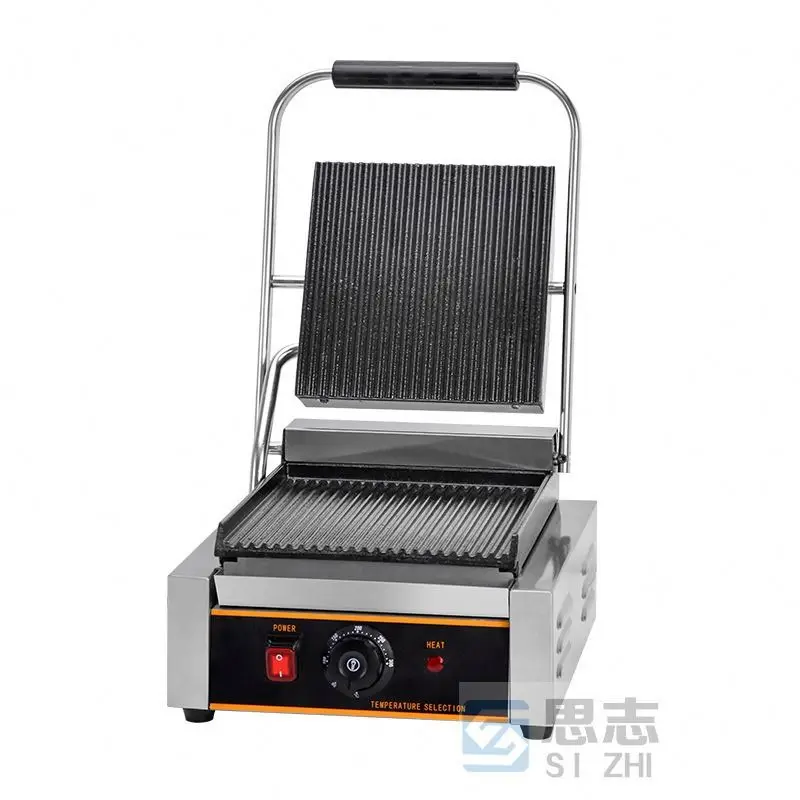
A commercial panini press or sandwich grill should be purchased as a food-contact cooking system, not only as a product photograph or a broad listing title. The TEBAK Hoting queue record identifies product ID 1601369153716 as a sandwich grill, panini maker, panini press, electric steak frying machine, griddle and teppanyaki beef or grilled squid machine.
The source provides a product title and a supplier profile but no parameter array. This guide therefore does not invent rated power, voltage, plate size, temperature, heating performance, materials, certification, capacity or packaging. It converts the available application wording into a practical B2B RFQ and acceptance plan for cafés, restaurants, kiosks, hotel breakfast operations, catering teams and food-equipment distributors.
1. What the source confirms
Use product ID 1601369153716 on the quotation, invoice, packing list, technical drawing, warranty record and inspection report. The source title contains several related use cases, but it does not prove that one supplied configuration is optimized for every food listed. Confirm the exact machine configuration before purchase.
| Recorded field | Source wording | Buyer action |
|---|---|---|
| Brand | TEBAK | Keep TEBAK and product ID 1601369153716 on all commercial and technical documents. |
| Product family | Sandwich grill, panini maker and panini press | Confirm whether the supplied unit is a contact press, open griddle, hinged grill or a combination. |
| Cooking wording | Electric steak frying machine and griddle | Confirm heating method, plate arrangement, grease drainage and menu suitability. |
| Food wording | Sandwich, panini, beef and grilled squid | Request a food-specific test plan; do not treat a broad title as a capacity or safety claim. |
| Teppanyaki wording | Teppanyaki beef and grilled squid machine | Confirm whether this is a flat cooking surface, a product-family label or an optional configuration. |
| Parameters | No product parameter array supplied | Make all electrical, thermal, dimensional, material, compliance and commercial fields conditional on supplier confirmation. |
2. Define the machine configuration before comparing prices
“Sandwich grill,” “panini maker,” “panini press,” “griddle” and “teppanyaki machine” can describe different cooking arrangements. Ask the supplier to send a current product drawing and a photograph of the actual configuration to be quoted.
Confirm whether the upper plate is hinged, floating, ribbed, smooth or optional. Confirm whether the lower plate is ribbed, smooth or mixed, and whether the plates are fixed, removable, reversible or replaceable. Ask for the opening angle, working clearance and maximum food thickness permitted by the design.
If the buyer needs both pressed panini and open-surface cooking, confirm whether one unit can perform both jobs safely or whether the listing combines several related configurations. Record the exact model code, plate set and accessories in the purchase order.
3. Electrical specification and site compatibility
The queue record does not provide rated voltage, frequency, power, plug, current, phase or cord length. These are mandatory fields for a commercial kitchen quotation. Ask for the rating plate photograph and the electrical data sheet for the exact unit.
Confirm the target market's voltage and frequency, plug standard, earthing method, over-current protection, leakage protection and installation requirements. Ask whether the machine is intended for a grounded outlet, a dedicated circuit or another arrangement. Do not infer electrical data from the word “electric.”
Before connecting the unit, inspect the cable, plug, strain relief, enclosure, switch and earth continuity. A distributor should retain the rating plate photograph and test result with the serial or lot record. If several electrical versions exist, identify the version on the carton and invoice.
4. Heating system and control method
No heating element type, control method, warm-up time, temperature range, thermostat accuracy, independent-zone control or recovery behavior is provided. Request these details in writing and specify whether they are measured values, design limits or marketing descriptions.
Ask whether the upper and lower surfaces heat independently, whether heat is controlled by a mechanical thermostat, electronic controller or another method, and how the operator sees the setpoint and actual temperature. Confirm the control range, adjustment increments, hysteresis, alarm behavior and restart behavior after a power interruption.
For food-service planning, test warm-up from ambient conditions, surface temperature distribution, recovery after a cold product is loaded and repeatability over several cycles. Use a calibrated thermometer or the buyer's approved measurement method. Do not publish a temperature or warm-up time unless it is confirmed for the supplied model.
5. Plate geometry and food-contact surface
The source does not specify plate dimensions, shape, pattern, material, coating, thickness or surface finish. These details affect product size, browning, cleaning and replacement cost. Request a dimensioned drawing and food-contact material statement.
Confirm the usable length and width of each plate, the cooking area, plate gap, rib spacing or flat area, edge clearance and maximum product thickness. Ask whether the plates are cast, machined, stamped or another construction, and identify the food-contact surface and any coating.
Do not describe a plate as non-stick, stainless steel, cast iron, ceramic, removable or dishwasher-safe unless the supplier confirms it. If a coating is used, request the coating type, temperature limit, care instructions and replacement route. For an uncoated surface, request seasoning and cleaning instructions.
6. Menu qualification: panini and sandwiches
For panini and sandwiches, agree the buyer's test recipe before purchase. Record bread size, filling mass, product thickness, starting temperature, target browning, press time and acceptable compression. The source title confirms panini and sandwich use wording but does not establish a rated throughput.
Test whether the upper plate floats or applies a fixed geometry. Check whether the hinge keeps even contact across the product and whether the rear edge cooks differently from the front edge. Inspect cheese leakage, filling displacement, bread sticking, grease run-off and cleanup time.
Measure cycle time only under the buyer's defined recipe and loading procedure. Report it as a test result rather than a general capacity claim. If several sizes are required, test the smallest, largest and most irregular products that the operator expects to serve.
7. Menu qualification: steak, beef and grilled squid
Steak, beef and grilled squid have different thickness, moisture and grease behavior from pressed sandwiches. Ask the supplier whether the quoted plate set and grease path are intended for these products or whether the title lists possible applications without a validated recipe.
Use separate test protocols for raw, chilled and pre-cooked products. Define food-contact separation, cleaning between recipes, cross-contamination controls and the required surface temperature. Do not use a panini test to approve raw meat or seafood processing.
Observe smoke, grease accumulation, splashing, odor, sticking and operator contact points. Confirm whether a grease tray, scraper, splash guard or other accessory is included. If the buyer serves raw animal products, require the food-safety review and local operating procedure before production use.
8. Griddle and teppanyaki interpretation
The title includes “griddle” and “teppanyaki,” but no plate size or open-surface specification is supplied. Confirm whether the product is a contact press with a flat lower plate, a two-sided griddle, an open cooking surface or a related product-family listing.
Ask for the open and closed operating drawings, hot-surface boundaries, grease channels, splash protection and operator clearance. Confirm whether the upper assembly can remain open during cooking and whether the hinge is designed for that operating mode.
For counter layout, measure the footprint, service clearance, handle travel, lid height, ventilation space and access to the switch, tray and controls. Use the supplier's drawing rather than estimating dimensions from the product image.
9. Grease management and cleaning
No grease tray, drain, channel, splash guard, scraper or cleaning method is listed in the source. These should be part of the RFQ because cleaning labor and food safety affect total cost of ownership.
Request a cleaning diagram showing removable parts, food-contact boundaries, electrical exclusions and recommended detergents. Confirm whether the plates can be cleaned in place, removed by the operator or serviced only by a technician. Ask how grease is collected and how the tray is removed without touching hot surfaces.
Run a cleaning trial after the buyer's heaviest intended recipe. Record disassembly time, tools required, trapped residue, access around hinges and the condition of the coating or surface after cleaning. Do not use abrasive tools or chemicals unless the supplier's instructions allow them.
10. Thermal safety and operator protection
The source provides no insulation, handle temperature, hot-surface marking, thermal cutoff, over-temperature protection or emergency behavior. Request the safety design and test documentation applicable to the destination market.
Inspect handles, hinges, guards, feet, cable routing, switch placement and exposed hot surfaces. Confirm that the operator can open and close the press without contacting the cooking plates and that the unit remains stable during loading.
Test normal shutdown, thermostat failure response if a safe test method is available, over-temperature protection, power restoration and accidental switch operation. A commercial kitchen should have a documented cool-down, cleaning and isolation procedure.
11. Dimensions, weight and counter layout
The queue record does not provide length, width, height, net weight, gross weight or working clearance. Request a dimensioned outline drawing and packing information before approving the counter layout or freight quotation.
Confirm footprint, open-lid height, handle projection, cable exit, ventilation gap, grease-tray access and service access. Check whether the counter can support the unit and whether lifting requires one or two operators.
For distributors, request carton dimensions, packing material, pallet configuration and gross weight. Do not use the product image to calculate a shipping quote or promise a particular container quantity.
12. Materials and durability
No body material, plate material, coating, insulation or component life is stated. Ask the supplier to identify the external body, food-contact surfaces, handles, hinges, fasteners, tray and electrical enclosure.
Request the cleaning compatibility, corrosion resistance, coating care, replacement parts and service intervals. If the machine is intended for seafood, high humidity or continuous restaurant operation, state those conditions in the inquiry.
Do not turn the company profile's general quality wording into a product-level material or durability claim. Product evidence must identify the exact machine configuration and its actual contact surfaces.
13. Capacity and commercial workflow
The source gives no rated capacity, cycle time, daily duty, duty cycle or recommended operating hours. Ask for the supplier's definition of capacity and test it against the buyer's menu and queue length.
Define throughput as a complete cycle: loading, heating or recovery, cooking, unloading, cleaning and any product changeover. Separate a short demonstration cycle from sustained service operation. Record product size, mass, starting temperature and operator count.
For a café or kiosk, calculate demand by peak fifteen-minute period and compare it with the measured cycle. If one machine cannot meet the peak, evaluate a second unit, a different plate size or a larger configuration rather than accepting an unsupported capacity promise.
14. Quality inspection before shipment
Request a pre-shipment inspection using the exact product ID and model code. Check the rating plate, switch, cord, plug, body, hinge, handle, feet, plates, tray, fasteners, controls and accessories against the approved drawing.
Run a cold mechanical test, a powered heating test, a control test and a food-safe functional test using the buyer's approved procedure. Measure surface uniformity if it is part of the specification. Photograph the nameplate and record serial or lot information.
For private-label or OEM orders, approve artwork, labels, manuals, warning marks, carton markings and electrical information before production. Keep any sample approval tied to the exact configuration and electrical version.
15. Compliance and documentation
The product record does not provide CE, UKCA, UL, ETL, RoHS, food-contact or other product-level certification. The supplier profile mentions ISO9001-based quality-control wording, but a company-level statement is not proof that this sandwich grill carries a particular certification.
Ask for the destination-market compliance documents, declarations, test reports, rating label, user manual, wiring information, food-contact statements and warranty terms. Verify the legal entity, model, electrical version and validity on each document.
Do not publish or print a certification mark based only on the supplier profile. If a document is unavailable, record it as a purchase condition and resolve it before import or commercial deployment.
16. Installation and commissioning
Commissioning should begin with an unpacking inspection, rating-plate check, electrical review, mechanical movement check and cold cleaning review. Next perform a guarded heating test and verify the controls, indicator, switch and shutdown behavior.
Run the buyer's approved sandwich or panini recipe only after the machine passes the no-food test. If steak, beef or squid is required, run separate process tests with the appropriate hygiene and cleaning controls. Record surface observations, cooking time, product result, smoke, grease and cleanup.
Train operators on loading, closing, opening, shutdown, cool-down, cleaning, tray removal, surface protection and fault reporting. Keep the manual and approved test record near the machine or in the kitchen's equipment file.
17. Warranty, service and spare parts
Warranty duration, exclusions, spare parts and service response are not provided. Ask which parts are replaceable: plates, thermostat or controller, heating element, hinge, handle, tray, feet, cord, switch and indicators.
Request a parts list, exploded drawing, part numbers, lead times, troubleshooting guide and service contact. Confirm whether the buyer or a local technician may replace wear parts and whether doing so affects warranty.
For distributors, define the process for a dead-on-arrival unit, heating imbalance, damaged coating, faulty control or missing accessory. A clear service path is part of the commercial specification.
18. RFQ checklist for product ID 1601369153716
- Confirm the exact model and whether it is a contact panini press, open griddle, hinged grill or combination.
- Provide rated voltage, frequency, power, current, phase, plug, cable length, earthing and circuit requirements.
- Provide upper and lower plate dimensions, usable area, plate pattern, gap, opening angle and maximum product thickness.
- Identify food-contact materials, coatings, surface finish, temperature limits and care instructions.
- Provide heating method, control type, temperature range, adjustment, warm-up, recovery and over-temperature protection.
- Explain suitability for sandwiches, panini, steak, beef and grilled squid separately; include test conditions.
- Confirm grease tray, drain, splash guard, scraper, removable parts and cleaning procedure.
- Provide body dimensions, open-lid height, net weight, gross weight, footprint, ventilation and service clearance.
- Provide capacity only with product size, mass, starting temperature, cycle and operator assumptions.
- Provide rating label, user manual, wiring information, warranty, spare-parts list and service procedure.
- Provide destination-market compliance documents and food-contact statements where applicable.
- Confirm accessories, packaging, carton dimensions, pallet details, MOQ and lead time in the quotation.
- Perform pre-shipment heating, control, mechanical and food-safe functional tests for the exact configuration.
19. Comparing sandwich-grill offers
Normalize each offer by cooking configuration, plate geometry, usable area, electrical version, control method, heating performance, cleaning system, safety features, materials, accessories, documentation, warranty, spare parts and service. A low purchase price can exclude the plate set, tray, correct plug, shipping packaging, manual or local compliance documents.
Compare results using the same food recipe and test conditions. Do not compare a flat griddle demonstration with a pressed panini cycle or compare a single short cycle with sustained service operation.
Record open questions in the quotation rather than filling them with assumed values. The approved offer should identify the exact model, electrical version, included accessories and acceptance criteria.
20. Purchase-order wording
A purchase order can state: “TEBAK sandwich grill / panini maker, product ID 1601369153716, exact approved model and electrical version, approved plate configuration, rated data, food-contact materials, control range, grease-management accessories, manuals, compliance documents, pre-shipment test, warranty and spare-parts support.”
Add the approved recipes, product dimensions, test temperature or result, cycle conditions, cleaning procedure, packaging requirements, destination plug and rejection criteria. State that the broad listing title does not replace the supplier's confirmed drawing and rating plate.
Frequently asked questions
What product is identified by product ID 1601369153716?
The source identifies a TEBAK sandwich grill, panini maker, panini press, electric steak frying machine, griddle and teppanyaki beef or grilled squid machine.
What is the rated power?
The queue record does not provide rated power. Request the rating plate and electrical data sheet for the exact model and destination version.
What are the plate dimensions?
No plate dimensions are provided. Request a dimensioned drawing showing usable cooking area, plate pattern, gap and opening angle.
Is it suitable for steak or grilled squid?
Those applications appear in the source title, but they require separate food, grease, temperature and cleaning qualification. Confirm the exact configuration and test it with the buyer's recipe.
Does the machine have a non-stick coating?
The source does not state the plate material or coating. Do not make a coating claim until the supplier confirms the food-contact surface and care instructions.
Does the supplier provide certification?
No product-level certification is provided in the queue record. Request destination-market compliance documents and keep company-level ISO9001 wording separate from product certification.
Supplier inquiry template
Hello, we are evaluating TEBAK product 1601369153716, sandwich grill / panini maker / panini press. Please confirm the exact model, electrical version, rated voltage, frequency, power, plug, plate dimensions, plate pattern, food-contact material, coating, temperature range, control method, warm-up and recovery. Please also confirm whether the supplied configuration is intended for sandwiches, panini, steak, beef and grilled squid, and provide grease tray, cleaning, safety, warranty, spare-parts, packaging and destination-market compliance information. Please send a drawing, rating plate photograph, manual and pre-shipment test record before approval.
Key specifications
- Brand
- TEBAK
- Product ID
- 1601369153716
- Source title
- TEBAK Sandwich Grill Panini Maker Panini Press Grill Electric Steak Frying Machine Griddle Teppanyaki Beef Grilled Squid Machine
- Product category wording
- Sandwich grill, panini maker, panini press, electric steak frying machine, griddle and teppanyaki machine wording are used in the source
- Stated food applications
- Sandwiches, panini, steak, beef and grilled squid wording; confirm the approved menu and process
- Operating concept
- Electric countertop cooking/grilling equipment is stated by the source title; confirm the exact electrical configuration
- Unspecified buyer-critical fields
- Rated voltage, frequency, power, plug, heating zones, plate dimensions, plate pattern, temperature range, control method, warm-up time, recovery, materials, coating, insulation, grease management, safety, dimensions, weight, packaging, certifications, warranty, MOQ and capacity
- Company profile
- Hengshui Mengshang Trading Co., Ltd.; TEBAK is described as its brand for design and sales
Frequently asked questions
- What product is identified by product ID 1601369153716?
- The source identifies a TEBAK sandwich grill, panini maker, panini press, electric steak frying machine, griddle and teppanyaki beef or grilled squid machine.
- What is the rated power?
- The queue record does not provide rated power. Request the rating plate and electrical data sheet for the exact model and destination version.
- What are the plate dimensions?
- No plate dimensions are provided. Request a dimensioned drawing showing usable cooking area, plate pattern, gap and opening angle.
- Is it suitable for steak or grilled squid?
- Those applications appear in the source title, but they require separate food, grease, temperature and cleaning qualification. Confirm the exact configuration and test it with the buyer's recipe.
- Does the machine have a non-stick coating?
- The source does not state the plate material or coating. Do not make a coating claim until the supplier confirms the food-contact surface and care instructions.
- Does the supplier provide certification?
- No product-level certification is provided in the queue record. Request destination-market compliance documents and keep company-level ISO9001 wording separate from product certification.