
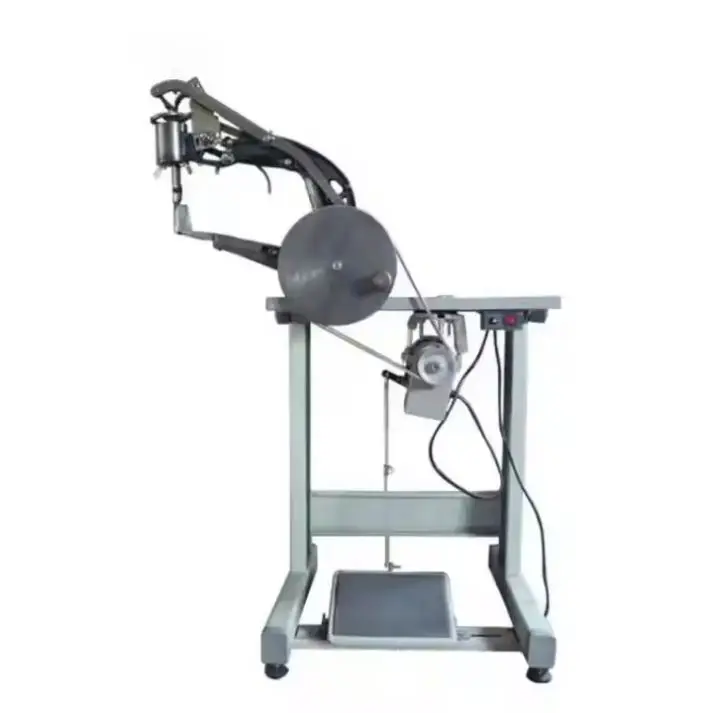
Source-controlled product identity
The Hoting queue identifies Product ID 1601247407765 as a TEBAK shoe mending sewing machine, listed under the title "TEBAK Sewing Machine TK-26C Manual or Electric Shoe Mending Motor Sewing Machine". The description text repeats the same machine under the heading "TEBAK Shoe Repairing Machine Manual Or Electric Shoe Mending Motor Sewing Machine".
This record does contain a parameter block, but it has an unusual shape that must be read carefully before any figure is used. The block holds four rows, and in each row the left-hand column carries a machine description while the right-hand column carries a packing dimension or a weight. The two columns are not a question-and-answer pair. They are two independent lists that the supplier has placed side by side, and the description column is further broken by commas so that a single row contains more than one fact. The figures below are reproduced exactly as the record holds them, including the spacing, the abbreviations and the trailing semicolons.
Recorded parameters, exactly as supplied
| Description column (as recorded) | Packing dimension / weight column (as recorded) |
|---|---|
| Model: GSB-26C (inclined head machine to make shoes above size 36) | Head :57*41*17cm; |
| Hook diameter: 2.6cm, including FRP foot base, | Motor :33*28.5*22cm; |
| Fine nylon thread: #21-26 stitches, | Platform :85*60*0.8cm; |
| Needle length: h: 0.25-1.5cm | Head :18KG; Motor :8KG; Table :15KG |
Read across both columns, the record yields the following machine facts: the model is given as GSB-26C, described as an inclined head machine intended for shoes above size 36; the hook diameter is 2.6cm; an FRP foot base is included; the thread specified is fine nylon in the #21 to #26 range; and the needle length is given as h 0.25 to 1.5cm. The record yields the following dimensional facts: the head packs at 57 by 41 by 17cm, the motor at 33 by 28.5 by 22cm and the platform at 85 by 60 by 0.8cm, while the head weighs 18KG, the motor 8KG and the table 15KG.
The description text adds nothing to the parameter block. It contains only the section headings Product parameter, Packing & Delivery, Certifications, Company and FAQ, and the Certifications, Company and FAQ sections carry no content in the record. No certification document, no test report and no electrical data appear anywhere in the source.
Model code conflict: TK-26C against GSB-26C
The title names the machine TK-26C. The parameter block names the model GSB-26C. These are two different model codes for what is presented as one product, and the difference is not a matter of formatting or abbreviation.
This conflict has a direct commercial consequence and must not be smoothed over. A purchase order, a quotation, a warranty claim and a spare-parts request all refer to the model code. If the buyer orders a TK-26C and receives a machine marked GSB-26C, or the reverse, there is no agreed basis for deciding whether the delivery matches the order. Spare parts are the sharper version of the same problem: needles, hooks, bobbins and presser feet are matched to a machine family, and a wrong model reference produces wrong parts.
Ask the supplier in writing which code is correct, whether the two codes denote the same machine or two different machines, and what the nameplate on the delivered machine will actually say. Ask for a photograph of the nameplate. Treat every other figure in this record as provisional until this is settled, because the model code determines which parameter set applies.
Manual or electric: what the drive arrangement actually is
The title and the description both present the machine as "Manual or Electric". On a shoe stitcher of this class that phrase normally means the head can be driven either by hand, through a handwheel, or by a separate motor, and the motor is listed as a distinct item with its own packing dimensions and its own weight of 8KG.
Confirm what is included in the quoted price: the head alone, the head with the motor, or the complete set with the stand and table. The weights in the record are listed separately for head, motor and table, which suggests they may be priced and shipped separately as well. Ask for the price of each configuration rather than assuming the motor is included.
Confirm the motor type and its control arrangement. On machines of this class the motor is often a clutch motor, which runs continuously and is engaged by a pedal, or a servo motor, which starts only when the pedal is pressed. The two behave differently in use: a clutch motor is noisier and draws power continuously, while a servo motor is quieter, more economical and more controllable at low speed. Ask which type is offered, and ask whether a speed reducer or a speed-limiting pulley is available, because shoe work frequently needs slow, controlled stitching that a direct-drive motor cannot deliver at full speed.
Confirm the pedal arrangement, whether the machine is a table-mounted unit with a knee lifter, and whether the hand drive works with the motor disengaged or only with the motor removed. Ask what maintenance the motor needs, since a clutch motor needs its clutch adjusted and a servo motor needs its controller set up, and ask whether the controller's parameters are documented.
Inclined head and the shoe size limit
The parameter block describes the machine as an inclined head machine to make shoes above size 36. Two separate statements are bundled into that one phrase, and each has a practical consequence.
The first statement is about head geometry. An inclined head, sometimes called a post-bed or inclined post machine, raises and tilts the sewing head so the operator can work around a three-dimensional shape, which is what shoe uppers require. The important question for a buyer is the clearance the head provides: confirm the post height, the distance from the needle to the machine body, the throat space and the available working angle, because those dimensions decide which parts of a shoe can physically be reached.
The second statement is about a size limit. "Above size 36" is a floor, not a ceiling, and it is not a standardised measurement across markets, because shoe sizing systems differ between the United States, the United Kingdom, Europe and Asia, and a size 36 in one system is not a size 36 in another. Ask the supplier to express the intended range in millimetres of last length or foot length rather than in a size number, and to state whether any upper limit applies. If the buyer intends to work on children's footwear, small sizes or narrow shapes, ask directly whether the machine can handle them, because a machine described as suitable above a certain size may not be the right tool below it.
Note also that the title and the description call this a mending and repairing machine, while the parameter block describes it as a machine "to make shoes". Repair work and upper manufacturing place different demands on the machine, particularly on stitch length control, presser foot clearance and the ability to stitch along an existing seam line. Ask the supplier which of the two uses the machine was set up for, and confirm that the intended use is supported.
Hook diameter, thread range and consumables
The record gives the hook diameter as 2.6cm and specifies fine nylon thread in the #21 to #26 range. Together these define the thread system the machine is built around, and they are the most concrete mechanical facts in the whole record.
The hook is the rotating element that carries the bobbin and forms the stitch. Its diameter limits how much bobbin thread can be held and, together with the needle and the take-up mechanism, it sets the practical range of thread thickness the machine will stitch cleanly. Confirm the bobbin type and size that fits the 2.6cm hook, how many bobbins are supplied, and whether bobbins and bobbin cases are available as separate spare parts. Confirm the hook material and whether it is a standard size that can be sourced outside the supplier's own parts channel.
The thread range of #21 to #26 is a fine thread band. Confirm the thread ticket or count system being used, because the same number denotes different thicknesses in different systems, and confirm the thread material the hook was designed for. Ask the supplier to state the maximum and minimum thread size the machine will stitch, and whether heavier thread such as a bonded nylon in a lower ticket number can be used, since shoe repair work often calls for a thread heavier than the fine nylon named in the record.
Ask which needle system the machine takes. The needle system code, not the length, is what lets a buyer purchase needles from an independent supplier, and the record does not state it. Confirm the needle size range, the point type for the materials being sewn and the number of needles supplied with the machine.
Needle length: an ambiguous figure that needs defining
The record states "Needle length: h: 0.25-1.5cm". This is the least clear figure in the parameter block and it should not be relied on as written.
A needle length of 0.25 to 1.5cm covers a range from 2.5mm to 15mm. Industrial sewing needles are commonly supplied in overall lengths of roughly 30mm to 45mm, so a range of 2.5 to 15mm does not describe the overall length of a needle. The figure is much more likely to describe the needle bar stroke, the stitch length range, or the range of material thickness the machine can sew through, and the letter h is not a recognised needle designation on its own.
Ask the supplier to state plainly what the 0.25 to 1.5cm figure measures, and to give the needle system code, the needle size, the stitch length range and the maximum material thickness the machine handles, as four separate and unambiguous values. Until that is done, the figure should not be used to plan work or to compare this machine with another.
Weights, packing dimensions and freight planning
The record gives the head as 57 by 41 by 17cm and 18KG, the motor as 33 by 28.5 by 22cm and 8KG, and the platform as 85 by 60 by 0.8cm with the table at 15KG. Taken together, the set weighs approximately 41KG.
Those figures describe the items, not the shipped packages. Confirm the packed dimensions and packed weight of each carton, the number of cartons, and how the platform is packed, because a thin 0.8cm platform of that size is vulnerable to bending in transit and its packing method determines whether it arrives flat. Ask for the packing method for the head, including whether it is braced inside the carton, and for the total shipment volume, since freight quotations are usually calculated on volume rather than on weight for this type of equipment.
Confirm whether the stand legs, the table, the motor, the pedal and the accessories ship in one carton or several, and whether partial shipments are possible. Confirm the shipping marks and whether the buyer's own marks can be applied. Ask who bears the cost if the platform or the head arrives bent or cracked, and confirm that the packing is adequate for the mode of transport actually used, since the packing appropriate for a full container is not the same as the packing needed for a single unit shipped by courier or consolidated freight.
Electrical data that the record does not contain
The record states nothing at all about the electrical supply. There is no voltage, no frequency, no phase, no motor power rating and no plug or cable standard. The motor is named and weighed but not specified.
Confirm the motor power, expressed in watts or in horsepower, together with the voltage, the frequency and the phase. Ask whether the motor is single phase or three phase, because that decision affects both the price and what the buyer can run on site. Ask for the current draw, the plug type, the cable length and the earthing arrangement, and request the nameplate photograph for the exact motor variant being quoted.
Confirm whether the motor is supplied with a mounting bracket, a belt and a pulley matched to the machine, or whether those items must be bought separately. Ask for the recommended pulley ratio, since that ratio sets the machine's stitching speed, and ask whether a speed reducer is available for slow work. Confirm whether the machine needs any compressed air supply, which is unlikely for this class of equipment but should be stated rather than assumed.
Stitch and feed data that the record does not contain
Beyond the hook diameter and the thread band, the record provides no sewing performance data. Confirm the following before ordering, because each one determines whether the machine suits the work.
Ask for the maximum stitching speed in stitches per minute, the stitch length range, the number of stitch types the machine can produce, and whether it can reverse. Ask for the needle bar stroke, the presser foot lift, the alternation or walking action if the machine has one, and the maximum thickness of material that can be sewn. Ask for the thread take-up and tension arrangement, and whether the tension can be adjusted separately for bobbin and needle thread.
Ask how the bobbin is wound, whether a separate bobbin winder is built in or supplied, and whether the machine has a thread trimmer. Ask for the feed dog type and whether it can be changed for different materials, since shoe work involves leather, synthetic upper material, lining and sometimes rubber, and each behaves differently under the feed.
RFQ checklist
- Exact model, resolving the TK-26C against GSB-26C conflict, with a nameplate photograph.
- Written statement of whether the two codes are the same machine or different machines.
- Whether the quoted price covers the head only, the head with the motor, or the complete set with stand and table, priced separately.
- Motor type (clutch or servo), motor power, voltage, frequency, phase, current draw, plug standard, cable length and earthing.
- Whether the mounting bracket, belt and pulley are included, and the recommended pulley ratio.
- Availability of a speed reducer or speed limiting arrangement for slow stitching.
- Pedal arrangement, table mounting and knee lifter.
- Whether hand drive works with the motor disengaged, and the procedure for switching between the two modes.
- Hook material, bobbin type and size matching the 2.6cm hook, and the number of bobbins supplied.
- Needle system code, needle size range and point type, and the number of needles supplied.
- Clarification of what the 0.25 to 1.5cm figure actually measures.
- Confirmed thread range and the system in which the #21 to #26 numbers are expressed, with maximum and minimum thread size.
- Maximum stitching speed, stitch length range, stitch types, reverse capability, needle bar stroke and presser foot lift.
- Maximum material thickness and the feed dog options.
- Bobbin winder and thread trimmer, whether built in or separate.
- Head geometry: post height, throat space and working clearance.
- Intended foot length range in millimetres rather than shoe size numbers, with any upper limit.
- Whether the machine is set up for shoe making or for shoe repair, and whether the intended use is supported.
- FRP foot base details: dimensions, mounting arrangement and whether it is included.
- Packed dimensions, packed weight and carton count for each item, and total shipment volume.
- Packing method for the platform and the head, and the shipping marks used.
- Included accessories, spare parts and consumables, and everything priced separately.
- Certification and conformity documents applicable to the destination market.
- MOQ, sample or trial terms, unit price at the target quantity, lead time, packing and shipping terms.
- Warranty period, service response time and the price of the most likely wearing parts.
Acceptance and incoming inspection
Because the record leaves the electrical, stitching and model-code details open, the delivered machine can only be verified against a specification the buyer writes itself. Settle the model code and the price configuration first, set the agreed values out in the purchase order, and check the following on arrival.
Verify the nameplate against the ordered model code and the ordered motor variant. Confirm that the delivered set contains everything the price covered, counting the head, motor, stand, table, pedal, FRP foot base and accessories against the written list, and confirm that no item listed as included has been invoiced separately.
Check the platform and the head for transit damage, particularly for bending or cracking of the thin platform and for distortion of the head casting. Weigh the head, the motor and the table and compare against the recorded 18KG, 8KG and 15KG, and measure the packed and unpacked dimensions against the stated values.
Thread the machine and stitch a test seam on the material the buyer actually intends to use, at both high and low speed, on the thinnest and thickest material in the intended range. Check the stitch appearance on both sides, the tension balance, the stitch length consistency, whether the machine reverses cleanly, and whether the feed marks the material. Check the hand drive with the motor disengaged and confirm that the two modes switch as described.
Confirm the hook and bobbin size against the 2.6cm figure, confirm that the specified needles and thread fit and stitch cleanly, and record how many acceptable test seams were produced. Record the serial number so the delivered unit can be traced to the tested sample. Run the motor long enough to confirm that it does not overheat at the intended duty, and check the pedal response and the knee lifter if fitted.
Packaging, shipping and after-sales
Confirm the documentation supplied with the shipment, including the manual, the parts list, the wiring diagram for the motor and controller, and the thread and tension setting guidance, together with the language of those documents. On this class of machine the setting-up instructions matter, because the motor, the belt tension and the thread tensions all have to be adjusted before the machine stitches correctly.
Confirm the warranty period, what is covered and excluded, the response time for technical questions, whether remote support is available, and the lead time and price for the most likely replacement parts. On a shoe stitcher those are typically the needles, the hook and bobbin case, the bobbins, the belts, the presser feet, the feed dog and, on a clutch motor, the clutch itself.
Confirm the shipping terms and who bears the cost if the machine arrives damaged or if the delivered model code does not match the order. That last risk is specific to this listing, because the title and the parameter block disagree on the model code before the order is even placed.
Buyer decision framework
The source confirms a TEBAK shoe stitcher with four recorded parameter rows: a model given as GSB-26C described as an inclined head machine for shoes above size 36, a hook diameter of 2.6cm with an FRP foot base included, fine nylon thread in the #21 to #26 band, and a needle length stated as h 0.25 to 1.5cm. The packing column gives the head as 57 by 41 by 17cm and 18KG, the motor as 33 by 28.5 by 22cm and 8KG, and the platform as 85 by 60 by 0.8cm with the table at 15KG.
The purchase decision rests on five written answers. Which model code is correct, TK-26C or GSB-26C, and what the nameplate will say. What the quoted configuration contains and what the motor's electrical specification is, including whether the motor is a clutch or a servo type. What the 0.25 to 1.5cm figure actually measures, together with the needle system code and the stitch length range. What the machine's head geometry and foot length range are in millimetres, and whether the machine is set up for shoe making or shoe repair. And what the maximum stitching speed, presser foot lift and material thickness limits are.
A supplier who settles the model code in writing, prices each configuration separately, states the 0.25 to 1.5cm figure unambiguously and stitches a test seam on the buyer's own material is offering a workable basis for a purchase. Where those answers cannot be obtained, the buyer should treat the recorded figures as indicative only and plan a trial unit and an incoming inspection rather than committing to production capacity in advance.
Frequently asked questions
Is the model TK-26C or GSB-26C?
The title says TK-26C and the parameter block says GSB-26C. The record does not reconcile them. Ask the supplier which code is correct and what the delivered nameplate will show, and treat matters such as spare parts and warranty claims against that answer.
Is the motor included in the price?
The record lists the motor separately with its own packing dimensions and an 8KG weight, and also lists the table separately at 15KG. Ask for the price of the head alone and of the complete set, rather than assuming the motor, stand and table are included.
What does the needle length of 0.25 to 1.5cm mean?
It cannot be the overall length of an industrial needle, which is normally around 30mm to 45mm. Ask the supplier to state what the figure measures and to give the needle system code, needle size, stitch length range and maximum material thickness as separate values.
Can it sew children's shoes or sizes below 36?
The record describes the machine as intended for shoes above size 36, without giving an upper limit, and shoe size numbers are not standardised across markets. Ask for the foot length range in millimetres and confirm whether smaller work is supported.
Is this a shoe making or a shoe repair machine?
The title and description present it as a mending and repairing machine, while the parameter block describes it as a machine to make shoes. The two uses place different demands on the machine, so ask the supplier which one it was set up for.
What thread and needles does it take?
The record specifies fine nylon thread in the #21 to #26 range and a hook diameter of 2.6cm, but gives no needle system code. Ask for the system code and the needle size range so that needles can be bought independently.
What electrical supply does the motor need?
The record gives no voltage, frequency, phase or motor power. Confirm all four, together with the current draw, plug standard and whether the motor is a clutch type or a servo type.
How fast can it stitch?
No speed is recorded. Ask for the maximum stitching speed in stitches per minute and whether a speed reducer is available, since shoe work often requires slow controlled stitching.
Source and contact
This guide is based on the Hoting queue record for Product ID 1601247407765. It reproduces the four recorded parameter rows exactly, including the spacing and the trailing semicolons, and it reads the description column and the packing column as two independent lists rather than merging them into paired specifications. It keeps the title's model code TK-26C and the parameter block's model code GSB-26C separate, and it does not convert the shoe size reference, the thread numbers or the ambiguous needle length figure into confirmed specifications.
Request the model code confirmation, the price configuration, the motor electrical specification, the needle system and thread range, the stitch data, the head geometry and foot length range in millimetres, the packed weights and volumes, and the test-seam result through the TEBAK sales inquiry channel before placing an order.
Key specifications
- Model: GSB-26C (inclined head machine to make shoes above size 36)
- Head :57*41*17cm;
- Hook diameter: 2.6cm, including FRP foot base,
- Motor :33*28.5*22cm;
- Fine nylon thread: #21-26 stitches,
- Platform :85*60*0.8cm;
- Needle length: h: 0.25-1.5cm
- Head :18KG; Motor :8KG; Table :15KG