
Source-controlled product identity
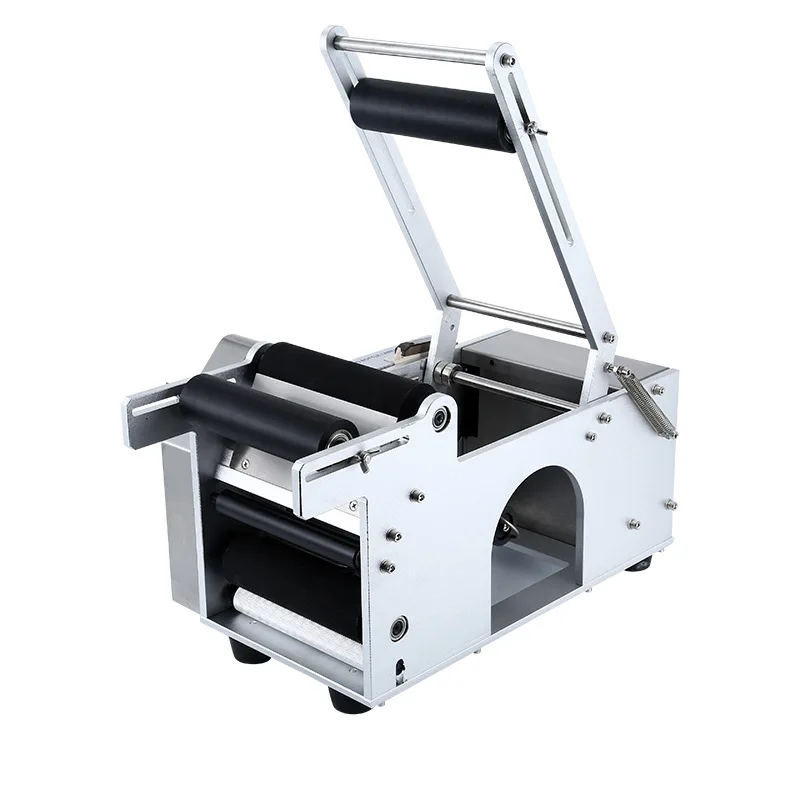
This TEBAK Hoting queue record describes a small manual labeling and packing machine for round plastic and glass wine bottles. The source title also mentions adhesive stickers, a handle and bottle labeling. Five structured values are provided: Labeling Speed ≤30times/min, Min.Label Roll Inner Diameter ≥75mm, Max.Label Roll Out Diameter ≤180mm, Bottle Diameter 15-120mm, and Label Size L:10-300mm W:10-110mm.
Product ID 1601244114520 should appear on the quotation, machine drawing, sample approval record, packing list and spare-parts list. This guide keeps the original field names, symbols and units. The source does not provide labeling accuracy, label gap, label material, bottle height, bottle taper, adhesive type, electrical data, footprint, weight, operator cycle definition or certification. Those items require supplier confirmation for the exact manual configuration.
Recorded specifications
| Source field | Recorded value | Procurement treatment |
|---|---|---|
| Labeling Speed | ≤30times/min | Source-recorded upper limit; confirm the test method, bottle and label conditions, operator actions and whether one label or one complete cycle is counted. |
| Min.Label Roll Inner Diameter | ≥75mm | Source-recorded lower boundary; confirm the core tolerance, core material, mandrel fit and whether the value is an inner diameter or a recommended minimum. |
| Max.Label Roll Out Diameter | ≤180mm | Source-recorded upper boundary; confirm roll width, winding quality, label pitch, backing thickness and the usable roll diameter under the actual dispenser. |
| Bottle Diameter | 15-120mm | Source-recorded diameter range; confirm roundness, seam, shoulder, taper, bottle height, surface finish and the supported labeling zone. |
| Label Size | L:10-300mm W:10-110mm | Source-recorded length and width range; confirm orientation, backing, gap, corner radius, adhesive, label pitch and whether the full range works at the same setting. |
Define the labeling job before requesting a quotation
A manual round-bottle labeler should be purchased around the bottle, label and finished-position requirement rather than around a speed headline. Send the supplier representative bottles and label reels, including the smallest and largest formats that will be used. State whether the label is a full wrap, partial wrap, front label, back label, neck label, tamper label or another format.
The source describes round plastic and glass wine bottles, but it does not establish that every round container in the 15-120 mm range can be labeled without a change part. Ask the supplier to confirm the bottle diameter measurement point, allowable ovality, seam or mold-line tolerance, shoulder shape, base stability and minimum bottle height. A bottle can be nominally round while still rotating unevenly under a manual roller.
Provide the required label location and tolerance. Ask for a drawing showing the reference point, label centerline, wrap overlap or gap, vertical position and allowable skew. If artwork has a front-facing feature, logo or seam, confirm how the operator or guide identifies the orientation.
Clarify whether the machine is intended for empty bottles, filled bottles, capped bottles or bottles before downstream packing. The title uses the word packing, but no packing operation is structured in the queue record. Ask the supplier to list exactly what the machine does and what remains manual.
Labeling Speed: interpret ≤30times/min correctly
The recorded “Labeling Speed” is ≤30times/min. Preserve the symbol and the source unit. Treat it as a source-recorded upper boundary, not as a guaranteed output rate. Ask the supplier to define one “time”: one applied label, one completed bottle, one operator cycle or another event.
Request a timed demonstration using the buyer's actual bottle and label. Record loading, positioning, roller action, label release, inspection and removal separately. A manual machine's operator cycle may include steps not visible in an automatic equipment specification, so the effective output depends on the chosen bottle, label, operator and quality check.
Test at least three conditions: a short label, a long label and a format close to the requested maximum. Record the selected roll diameter, bottle diameter, label width, label length, operator count, total elapsed time, accepted units and rejected units. Report both gross cycles per minute and accepted labeled bottles per minute.
Ask for the supplier's definition of stable output. Confirm whether the ≤30times/min value excludes roll changes, bottle loading, alignment corrections, adhesive failures, inspection, breaks and cleaning. If the buyer needs a production planning figure, write the agreed test method into the quotation and acceptance protocol.
Label roll inner diameter: verify ≥75mm
The source records “Min.Label Roll Inner Diameter” as ≥75mm. Ask the supplier to confirm whether this is the minimum core inner diameter, a mandrel compatibility requirement or a recommended value. Request a cross-section drawing of the roll holder, core support, flange and tension mechanism.
Confirm the permitted core material, core width, core concentricity, core strength and axial play. A paper core with the same nominal diameter can behave differently if it is soft, damaged or out of round. Ask whether an adapter is included for smaller or different cores, and whether an adapter changes the supported roll-out diameter.
Use the buyer's real label reels for the test. Measure the core with a calibrated gauge, install the reel, and check lateral movement, braking, label tracking, tension, peeling and roll collapse. Record the roll width and backing thickness together with the inner diameter.
Ask how the operator changes a roll and resets the label path. Confirm whether a new reel requires a tool, a calibration mark, a web guide adjustment or a label-position reset. Include roll-change steps and restart waste in the production trial.
Maximum roll out diameter: verify ≤180mm
The source records “Max.Label Roll Out Diameter” as ≤180mm. Ask whether the value means the maximum wound outside diameter that fits physically, the maximum recommended diameter for stable dispensing, or a limit that depends on label width and backing material.
Request the maximum roll width and the relationship between roll width, label length, label gap and backing thickness. A reel with a narrow label and thin backing may wind differently from a reel with a wide label and thick backing. Confirm whether the dispenser can handle the buyer's full reel without edge contact or excessive drag.
Test a full reel close to 180 mm and a partially used reel. Check that the label web stays centered, the roll does not rub the frame, the brake remains controllable, and the operator can remove and reinstall it safely. Record any residual label waste and the minimum remaining roll diameter at which the machine remains stable.
Ask for transport and storage guidance for wound labels. The source does not state whether rolls must be protected from heat, moisture or deformation. Include reel packaging, core protection and shelf-life requirements in the material specification rather than assuming that the machine determines them.
Bottle diameter: working range 15-120mm
The recorded “Bottle Diameter” is 15-120mm. Ask where the diameter is measured and whether the range applies to the cylindrical labeling zone or to the widest bottle body. Request a dimensioned bottle envelope showing minimum and maximum diameter, usable height, shoulder transition and base support.
Test a narrow bottle near 15 mm and a wide bottle near 120 mm, then test a mid-range bottle. Record bottle height, fill level, cap, center of gravity, surface finish, material, ovality and rotation behavior. A narrow or tall bottle may require different support even when its diameter is within the stated range.
Confirm the supported bottle shapes. The title says round plastic and glass wine bottle, but it does not state whether tapered bottles, bottles with a shoulder, bottles with a seam, square-shoulder round bottles or lightly oval bottles are supported. Ask for separate approval of each shape family.
Request the positioning and pressure adjustment. Excessive roller pressure may mark thin plastic or move the label, while insufficient pressure may create wrinkles or a partial wrap. Record the adjustment scale, reference setting and repeatability for each approved bottle.
Label size: L:10-300mm W:10-110mm
The source records “Label Size” as L:10-300mm W:10-110mm. Preserve the original L/W notation and ask the supplier to define which dimension is web direction, which is transverse width, and how corner radius, gap and overlap are handled.
Confirm the usable label length for a full wrap around each bottle. A 300 mm label may not be a practical wrap length on every bottle within the stated diameter range. Ask the supplier to calculate the required label length from the bottle circumference, desired overlap or gap and artwork tolerance.
Request the minimum and maximum label width together with the supported backing thickness, liner stiffness, adhesive tack, die-cut shape and edge quality. The queue data does not provide any of these. Test short labels at 10 mm length, wide labels near 110 mm and long labels near 300 mm only after the supplier confirms the format is safe for the dispenser.
Inspect label edges, corners and transparent materials separately. Clear labels, stiff synthetic stock, textured paper and labels with a thick varnish can release differently from ordinary paper labels. Ask whether the manual labeler has a sensor, edge guide or operator mark for transparent labels, and request a sample run before approval.
Manual operation and positioning control
Because the source calls the machine manual, ask for the exact operator workflow. It may involve placing the bottle, aligning it against a stop, turning a handle, pressing a roller or triggering a label release. The source does not define the mechanism. Request photographs or a sequence drawing with every hand position and adjustment.
Define the operator reference for bottle height and label start position. Ask for a stop, collar, guide, scale or template. If the operator visually aligns a printed mark, request a stated tolerance and a lighting recommendation. If the machine uses a mechanical stop, confirm how it is changed between bottle formats.
Run a repeatability trial with one trained operator and then with a second operator. Compare label height, skew, start position, wrap overlap, wrinkles and rejected units. The result should distinguish machine repeatability from training and handling variation.
Ask for a cleaning and changeover procedure. Adhesive residue, paper dust, glass fragments, liquid spills and product leakage can affect rollers and guides. Confirm which surfaces are compatible with the recommended cleaning agent and which parts must be removed before cleaning.
Adhesive, bottle surface and environmental checks
The source says adhesive sticker but does not specify adhesive chemistry. Request the label adhesive type, application temperature, shelf life, substrate compatibility and minimum surface energy requirement. Test labels on the buyer's actual plastic and glass surfaces after washing, drying, chilling or condensation conditions relevant to the process.
Wine bottles may be cold, damp, dusty or coated with residue. Ask the supplier to define acceptable surface cleanliness and moisture. Run a test with dry room-temperature bottles and a separate test under the buyer's real environmental condition. Inspect immediate adhesion and later edge lift after an agreed dwell period.
Confirm whether the label must survive refrigeration, condensation, transport vibration, handling, immersion or contact with a secondary package. These requirements belong to the label specification and acceptance test, not to the speed or roll-diameter fields.
For plastic bottles, ask whether the bottle wall flexes under manual roller pressure. For glass, inspect scratches, chips and tipping risk. Request recommended pressure and support adjustments for each material family, with a safe operating range and a sample setup.
Electrical, pneumatic and installation data
No voltage, frequency, power, current, air pressure, air consumption, footprint, weight or mounting requirement is provided. Ask the supplier to confirm whether the machine is entirely manual or includes a powered dispenser, sensor, heating element or counter. Obtain the complete utility and installation sheet for the exact configuration.
Request the machine footprint, working height, net and gross weight, bench load, mounting-hole pattern and clearance for the label roll. “Small” and “table top” are descriptive terms, not dimensional specifications. Confirm that the operator can access the roll holder, bottle stop, label path and cleaning areas.
If the machine includes an electrical sensor or counter, request the nameplate, cable, plug, control logic, spare sensor and failure behavior. If there is no electrical system, ask the supplier to state that clearly in the quotation. Do not assume that a manual machine is power-free based only on the title.
Acceptance criteria and quality inspection
Before ordering, approve a reference sample for every bottle and label family. Define maximum label skew, vertical-position tolerance, start-point tolerance, overlap or gap, wrinkles, bubbles, edge lift and accepted cosmetic variation. No such limits are supplied in the queue record.
Use a sample plan that includes start-up, steady operation, roll change, bottle changeover and restart after interruption. Count accepted and rejected bottles, record the reason for every rejection, and separate operator error from machine or material behavior.
Inspect the finished label from multiple angles and under the lighting used by the buyer. Check that the label does not bridge a bottle seam, wrinkle at a shoulder, lift at an edge or move during handling. For transparent labels, inspect registration and trapped air separately.
Measure speed only after quality criteria are met. A cycle that reaches ≤30times/min but produces out-of-position or wrinkled labels is not an acceptable production result. Record the bottle diameter, label size, roll dimensions, operator, setup and accepted output with every speed test.
Factory acceptance test proposal
- Verify product ID 1601244114520, machine description, manual table-top configuration, drawing revision and included accessories.
- Measure and document the buyer's label-roll core against the recorded ≥75mm minimum inner diameter.
- Install a reel at or near the recorded ≤180mm maximum outside diameter and check tracking, braking, clearance and label release.
- Test bottle diameters near 15 mm, mid-range and 120 mm, recording shape, height, surface and rotation behavior.
- Test label sizes near the recorded L:10-300mm and W:10-110mm boundaries only after the supplier defines L and W orientation.
- Demonstrate the complete manual cycle, changeover, roll change, label-path threading and restart procedure.
- Run a timed quality-controlled trial and define whether one “time” means one bottle, one label or one complete operator cycle.
- Inspect label position, skew, overlap, wrinkles, bubbles, edge lift, adhesion and bottle damage for every approved material.
- Confirm utility requirements, footprint, bench load, safety controls, cleaning instructions, packing data and spare parts.
RFQ checklist
- Exact machine configuration and product ID 1601244114520 on quotation, drawing and packing list.
- Definition and test method for Labeling Speed ≤30times/min, including accepted output and operator steps.
- Definition of Min.Label Roll Inner Diameter ≥75mm, core tolerance, width, adapter and mandrel fit.
- Definition of Max.Label Roll Out Diameter ≤180mm, supported roll width, backing thickness and clearance.
- Definition of Bottle Diameter 15-120mm and the measurement point, ovality, height and shape limits.
- Definition of Label Size L:10-300mm W:10-110mm, direction, gap, overlap, corner radius and backing limits.
- Supported bottle materials, surfaces, seams, shoulders, tapers, filled states, caps and environmental conditions.
- Supported label paper, synthetic, transparent, adhesive, liner, thickness, stiffness and storage requirements.
- Label-position tolerance, skew, start point, overlap, wrinkles, bubbles, edge lift and adhesion test method.
- Manual workflow, operator count, changeover steps, roll-change method, guides, stops, scales and templates.
- Voltage, frequency, power, sensors, counters, plug, air requirements or written confirmation of manual operation.
- Footprint, working height, net and gross weight, bench load, mounting holes, clearance and handling points.
- Cleaning method, adhesive-residue removal, wear parts, rollers, sensors, guides, spare parts and prices.
- English manual, drawings, parts list, training, warranty, MOQ, lead time, packaging and after-sales response.
- Applicable safety documents, declarations, labels and destination-market compliance for the quoted configuration.
Buyer decision framework
This listing is a starting point for sourcing a small manual round-bottle labeling and packing machine. Its source-backed boundaries are ≤30times/min labeling speed, ≥75mm minimum label-roll inner diameter, ≤180mm maximum label-roll outer diameter, 15-120mm bottle diameter and L:10-300mm W:10-110mm label size. Approve the purchase only after the supplier defines every symbol, proves the buyer's actual bottle and label combinations, demonstrates quality-controlled output, and signs the acceptance criteria.
Frequently asked questions
Is ≤30times/min a guaranteed production rate?
No. It is the source-recorded labeling-speed boundary. Ask whether a time means one label, one bottle or one complete manual cycle, and verify accepted output with the buyer's materials.
Can the machine use any label roll with a core of at least 75 mm?
No conclusion should be made from the inner-diameter field alone. Confirm core width, roll width, backing, adapter, winding quality and mandrel compatibility.
Does the 15-120mm bottle range include tapered wine bottles?
The source records a diameter range but does not define bottle shape or measurement location. Test each bottle family, including taper, shoulder, seam and ovality.
What do L:10-300mm and W:10-110mm mean?
The source records these dimensions but does not define direction. Ask the supplier to identify web direction and transverse width, then confirm gap, overlap and corner limits.
Is the machine fully automatic?
The source describes it as manual and small/table top. Confirm every loading, alignment, release, inspection and packing step before estimating labor or output.
Source and contact
This guide is based on the Hoting queue record for product ID 1601244114520. Before purchase, request the current quotation, bottle and label compatibility matrix, setup drawing, sample labeling report, utility sheet, safety documents, packing list, spare-parts offer and final machine photographs. For sourcing questions, contact the TEBAK sales team through the site's current inquiry channel.
Key specifications
- Labeling Speed
- ≤30times/min
- Min.Label Roll Inner Diameter
- ≥75mm
- Max.Label Roll Out Diameter
- ≤180mm
- Bottle Diameter
- 15-120mm
- Label Size
- L:10-300mm W:10-110mm