
Three parameters that are a table shifted sideways
Product ID 1601566436233 sells a manual bender for scrolls and curves, and its parameter block has three rows. Read as the platform presents them, the first row is a parameter named Model whose value is Capacity, Weight and Dimension. The second row is a parameter named Flat Steel whose value is Square Steel and Round Steel. The third row is a parameter named DH-SBG whose value is the entire data row: thirty by eight millimetres, ten by ten millimetres, diameter ten millimetres, twenty-nine kilograms, and fifty-two by thirty by twenty-two centimetres.
That is not a set of parameters. It is a capacity table that has been taken apart with the model's first column used as labels and everything to the right of it used as values, so the whole thing has moved one cell sideways. In the table the supplier evidently built, the first row was the heading row, with Model, Capacity, Weight and Dimension as headings. The second row was the sub-heading, naming the three capacities. The third row was the data, beginning with the model code DH-SBG and continuing with the three capacities, the weight and the dimension. Flattened into fields, the heading row became a parameter, the sub-heading row became a second parameter, and the data row became a third parameter whose label is the model code.
The consequences are worth spelling out because they are not only a tidiness problem. A buyer filtering listings by a model field will find this machine's Model parameter sitting empty of a model and holding headings instead, while the model code is filed where the platform expects a specification name. A buyer reading the fields for a weight or a dimension will not find either, because both are inside a value string that begins with three capacities. And a buyer comparing quotations will find that the model code DH-SBG appears in this record as the name of a parameter rather than as the model of the machine, which is exactly the kind of thing that produces a quotation for the wrong line.
The defect has a detectable signature, and it is widespread in this catalogue. Counting every parameter of all five hundred and twelve records, none of the five hundred and twelve has a pipe character in a parameter's label, while fifty-seven of them, which is eleven per cent, have a pipe inside a parameter's value. A pipe is a table's cell separator, so a pipe inside a value is the mark of a table that has been flattened into a field. This record is the extreme case of it, where the shift has gone far enough that the model code itself sits in the label column. For a buyer the lesson is narrow and useful: on this catalogue, when a field's value contains a separator, read it as a row of a table rather than as a value, and reconstruct the table before using any figure in it. Two hundred and thirty-five of the five hundred and twelve records have three parameters or fewer, so a short parameter block is normal here, and a short block is exactly where a flattened table is hardest to notice.
The same machine is listed twice, under two titles
Elsewhere in the same queue is a second record, product ID 1601276303558, and it is the same machine. Its three parameters are the same three parameters, with the same label and value shift, the same model code DH-SBG in the label column, and the same data row: thirty by eight millimetres, ten by ten, diameter ten, twenty-nine kilograms, and the same fifty-two by thirty by twenty-two centimetres. It uses the same five product photographs, at the same addresses. Its description field is the same length as this one, eight hundred characters, and contains the same flattened table and the same supplier profile.
The two records differ in their titles and in little else. One is titled as a manual pipe bender and a spiral metal bender; the other, this one, is titled as a TEBAK spiral metal bender for metal production. One description repeats its own title at the top before the table; the other begins with the table. So the catalogue presents one machine twice, under two titles, with two product identifiers, and with two sets of search terms attached.
For a buyer the practical effect depends on how the buyer shops. Anyone comparing these two listings side by side is comparing one machine with itself, which is mostly harmless and occasionally useful, since it shows what the same machine is called in two places. Anyone treating the two titles as two different products is comparing a pipe bender against a scroll bender, which are different jobs, and both titles belong to the same set of photographs and the same capacity row. And anyone building a shortlist from search results may find this machine occupying two places on it. The questions that follow are simple: which of the two listings is current, whether the machine is a pipe bender or a scroll bender or can be both with different dies, and whether the same machine exists under a third identifier elsewhere in the catalogue.
That last question is not rhetorical. Thirteen records in this queue carry bender, bending or curving in the title, and they include a manual round bender described as gear driven and a hand-operated bar bender whose code is SBG-40, which sits close to this machine's DH-SBG. Whether SBG-40 and DH-SBG are two models, two names for one model, or two generations of one model is not something this record answers, and the difference matters, because a gear-driven bender needs far less force at the handle than a direct-drive one, which is the subject of the arithmetic further down this guide.
A scroll bender with no scroll figure anywhere
A scroll bender makes curls and spirals in flat bar, and the numbers that decide whether it can do a given job are the ones that describe the curl: the smallest inside diameter it can form, the largest diameter it can reach, and the pitch of the spiral if it is making more than one turn. None of those appears in this record, in the fields or in the pictures.
What the record gives instead is three straight-section capacities, which answer a different question. A capacity of thirty by eight millimetres of flat bar says what section the machine can bend at all. It says nothing about how tightly it can bend it, and the two are not the same limit. A machine can be strong enough to bend a section and still be unable to roll it into a small curl, because the curl's inside diameter is set by the die and by the material's own ductility, not by the machine's force. Roll a section too tightly and it will crack on the outside of the bend, or wrinkle, and the tightest curl a machine can make is often set by the material rather than by the machine.
So the questions are the ones a scroll maker would ask first. What is the smallest inside diameter the dies will produce, in the material and section intended. What is the largest circle. Can the machine close a full circle, and if so at what diameter. For a spiral, what pitch can it hold, and is there a stop for repeated scrolls of the same size. And since the curl is set by the die rather than by the machine, what die diameters come with it, are they measured on the outside or the inside, and what does an extra die cost.
Three die sets and seven combinations, and not one diameter
The pictures make two claims about tooling. One panel says the machine is for bending all kinds of what it spells as Wray flowers, and that it includes three sets of moulds. Another says that according to the size of the pattern the sets can be disassembled, and that they can be combined into seven different moulds.
Those two numbers are consistent with each other, and the arithmetic is worth doing because it shows the claim is a count rather than a specification. Three dies, each either used on its own or combined with others, give seven possible non-empty selections: each die used alone is three combinations, two dies together is three more, and all three together is one, which is seven, and which is also two raised to the third power minus one. So the panel's seven is simply the number of ways three parts can be used, and it says nothing about what any of those seven combinations produces.
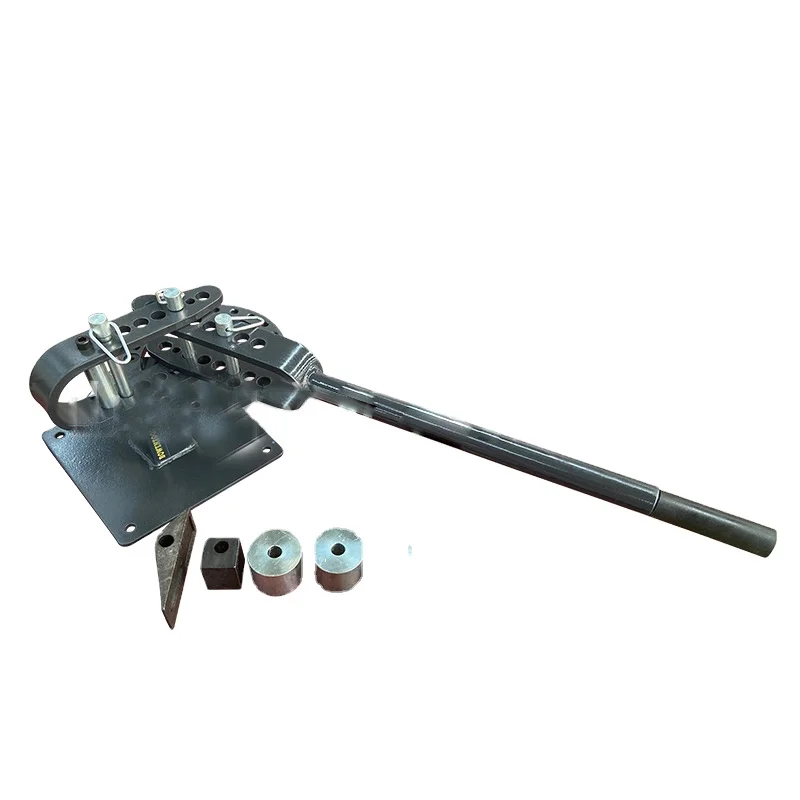
What the buyer needs is the diameters. The pictures show the tooling as a set of dark crescent-shaped pieces of decreasing size together with a small round pin, and in two photographs a plastic tape measure is laid across the plate, legible to the individual millimetre, which shows the plate's diameter is of the order of twenty centimetres. Nothing in the pictures dimensions the dies themselves, and the outside of a crescent die is not what sets the curl in any case. If the machine's die diameters were listed, the buyer could compare them against the scroll sizes in the work and against the material's minimum bend radius. Without them the buyer can only buy the tooling and try it.
So the questions are: the inside diameter each die produces, in the section and material intended; whether the dies are hardened or soft; whether they are pinned or bolted and how they are removed; the shank or pin diameter that locates them; whether extra dies beyond the three are available and at what price; and whether a die can be made to order for a particular scroll, which is the normal way a scroll bender is matched to a range of work. None of that is in the record.
Eight millimetres in the fields, five millimetres in the picture
The fields state the flat steel capacity as thirty by eight millimetres. One of the record's own panels, headed Product Information, states it as five millimetres by thirty millimetres. Those are the same bar described in two orders, thirty wide and eight thick in one place, thirty wide and five thick in the other, and they disagree by three millimetres of thickness, which is sixty per cent.
It would be easy to treat that as a typographical slip and move on. It is worth doing the arithmetic first, because on a bending machine the thickness of the section is the number that decides how much force the machine has to apply, and sixty per cent more thickness is a great deal more than sixty per cent more work.
The force a bender needs is set by the section's resistance to bending, which for a rectangular bar is proportional to the bar's width multiplied by the square of its thickness, divided by four, when the bar is bent across its thickness. For a bar thirty millimetres wide and eight millimetres thick that figure is one thousand eight hundred cubic millimetres; for the same bar at five millimetres thick it is one thousand one hundred and twenty-five. Multiplying by a yield strength of two hundred and thirty-five megapascals, which is the usual assumption for mild steel, gives a moment of about four hundred and twenty newton metres for the eight millimetre bar and about two hundred and sixty for the five millimetre one.
So the disagreement between the two panels is not a cosmetic one. On the fields' figure the machine's heaviest advertised cut needs about four hundred and twenty newton metres of torque at the die; on the picture's figure it needs about two hundred and sixty. The rest of this guide uses those two numbers, and they are this guide's calculations from the record's own figures rather than the supplier's statement, and they assume mild steel at two hundred and thirty-five megapascals with the bar bent across its thickness.
Which way round the bar goes, and why it changes everything
There is a second and larger ambiguity in the single capacity figure, and it is not a typo. A flat bar has two orientations in a bender, and they behave differently by a large factor.
Bent across its thickness, with the bar standing on its edge, a thirty by eight bar has a bending resistance of one thousand eight hundred cubic millimetres, as above. Laid on the flat, with the bending plane across the eight millimetre thickness, the same bar's resistance is thirty multiplied by sixty-four divided by four, which is four hundred and eighty cubic millimetres. The ratio is three and three quarters, and it is exactly the ratio of the two dimensions, thirty over eight. So the same bar, in the same machine, laid the other way up, needs under a third of the force, and about one hundred and thirteen newton metres rather than four hundred and twenty.
The record's capacity figure does not say which orientation it means, and the difference is not academic in either direction. If the figure means the easy orientation, then a buyer who intends to bend the bar on edge will find the machine is far weaker than the figure suggests for the work they have in mind. If it means the hard orientation, then the figure is the limiting case and the machine will bend more when the bar is laid flat, which is the safer way round to be wrong. Since a single capacity figure on a bender is almost always quoted as the heaviest section the machine can manage, the hard orientation is the reasonable assumption, and it should be confirmed in writing along with the orientation of the work.
The terms to use with the supplier are on the flat and on edge, or the easy way and the hard way, and the answer to ask for is a capacity for each, because a scroll maker bending decorative bar on edge and a shop bending brackets on the flat are buying different capability from the same machine.
What the handle actually has to do
The torque figures are the machine's requirement. What a buyer feels is the force at the handle, which is the torque divided by the handle's length. Since the record does not give the handle's length, the table below gives the force for a range of lengths, which shows how much the missing figure matters.
| Handle length | At thirty by eight, on edge | At thirty by five, on edge | At thirty by eight, on the flat |
|---|---|---|---|
| 300 mm | about 1,410 N, or 144 kgf | about 880 N, or 90 kgf | about 376 N, or 38 kgf |
| 400 mm | about 1,058 N, or 108 kgf | about 660 N, or 67 kgf | about 282 N, or 29 kgf |
| 500 mm | about 846 N, or 86 kgf | about 530 N, or 54 kgf | about 226 N, or 23 kgf |
Two things follow. The first is that the top of this machine's advertised range is at the edge of what a person can do, and the difference between a four hundred millimetre handle and a five hundred millimetre one is the difference between a hundred and eight kilograms of pull and eighty-six. So the handle's length belongs in the specification, together with whether the drive is direct or geared, since the catalogue's own family includes a round bender it describes as gear driven, and gearing changes the arithmetic entirely. Ask for the handle force required at the machine's rated capacity, which is the figure a supplier can state and a buyer can verify with a spring balance.
The second is that a pull of a hundred kilograms or so has to go somewhere, which is the subject of the next section.
Whether it can sit on a bench at all
A manual bender resists a large torque, and the machine has to resist it without moving. The reaction is what decides whether this tool can be clamped to a bench or has to be bolted to a stand or a floor, and the record gives no base bolt pattern, no stand and no mounting instructions at all.
The comparison is between two moments. One is the machine's own stability: its weight, twenty-nine kilograms or about two hundred and eighty-four newtons, multiplied by the horizontal distance from its centre to the edge it would tip over. With a footprint of fifty-two by thirty centimetres, that distance is fifteen centimetres across the narrow way and twenty-six across the long way, so the stabilising moment is between about forty-three and about seventy-four newton metres. The other is the pull's tipping moment, which is the handle force multiplied by the handle's height above the base. The machine's overall height is given as twenty-two centimetres in the dimension figure, which puts the die plate and the handle somewhere around a hundred to a hundred and fifty millimetres up.
At a hundred and fifteen millimetres of handle height, and a four hundred millimetre handle, the arithmetic comes out as follows. On the fields' eight millimetre capacity the pull is about a thousand and fifty-eight newtons and its tipping moment about a hundred and twenty-two newton metres, which is between one and a half and three times the machine's own stabilising moment, so on a bare bench it tips. On the picture's five millimetre capacity the pull is about six hundred and sixty newtons and its tipping moment about seventy-six newton metres, which is at or just past the stabilising moment, so it tips at the top of its range and is steady below it. Laid on the flat, with the bar in the easy orientation, the pull is about two hundred and eighty newtons and its tipping moment about thirty-two newton metres, which is comfortably inside the machine's stability, and the machine would sit still.
Those figures are this guide's estimate, with the assumptions stated, and the two quantities that would settle them are exactly the two the record omits: the handle's length above the base, and the machine's base bolt pattern, which together with the footprint would define how the machine is meant to be fixed. The estimate is sensitive to both, and a buyer should not rely on it as a number. What it does show is the shape of the problem, which does not depend on the exact assumptions: at the capacities this machine advertises, the pull is comparable to or larger than the machine's own weight times its half footprint, so fixing it down is not optional, and the way it is meant to be fixed should be part of the purchase. So ask for the base bolt hole spacing and diameter, whether a stand or pedestal is supplied or available, what its dimensions and weight are, whether the machine is meant to be bench mounted or floor mounted, and whether the dies and the handle can be stored on the machine or come in a case.
What the three capacity rows leave out
Beyond the scroll diameters and the die sizes, the three rows leave out most of what a bender is bought on.
The rows give square steel at ten by ten millimetres and round steel at diameter ten, and neither says whether the section is solid or hollow. That is not a small omission. A ten by ten millimetre solid square bar needs many times the force of a ten by ten square tube with a one millimetre wall, and a diameter ten solid rod needs much more than a diameter ten tube. Since the whole point of the capacity row is to say what the machine can bend, the distinction between solid and hollow belongs in it, with the wall thickness for tubes.
There is no material anywhere in the record. A capacity figure is a statement about force, and force depends on the material's yield strength, so a figure quoted on mild steel should not be assumed for stainless, which is typically stronger and will spring back further, nor for aluminium, which is softer and behaves differently again. A workshop bending stainless scrolls for outdoor work, which is a common use, needs the capacity quoted for the grade it will actually bend, and needs to know how much the material will spring back, since a scroll bent to a nominal size in stainless comes out larger and has to be over-bent to compensate. The record gives no springback guidance, no over-bend allowance, and no note about which steel the capacities were established on.
There is no finish on the machine and none on the tooling, so it is not stated whether the base is painted, whether the die pins are hardened, or whether the machine is suitable for outdoor or damp use. There is no statement of what happens to the workpiece's surface, which matters for decorative work in stainless, brass or coated stock, where the die and the pin can leave marks that have to be polished out.
And there is nothing about the machine's own construction: no gear ratio, no bearing type, no statement whether the rotating plate runs on a plain bearing or a bearing race, no spare parts list, and no note about how the plate is adjusted if it develops play, which on a manual bender is the wear point that decides how long the machine holds a setting.
All eight pictures are served over plain HTTP
Every one of this record's eight gallery image addresses begins with http rather than https, while the main image is served over https. That is a property of the feed rather than of the machine, and it is worth a note because it has a practical consequence: a page served over a secure connection which embeds an image from an insecure address is showing mixed content, and browsers either block it or upgrade it, so a feed that mixes the two schemes can produce missing images on some sites and not others. In this queue, fifty-two of the five hundred and twelve records carry gallery images over plain HTTP, which is ten per cent.
It also matters for any comparison of images between records, which is the method behind the counts in the next section. An address comparison done without normalising the scheme will undercount, as this guide's own earlier counts did, and the correction is visible in the numbers below.
Two shared panels, and a third address for the gate photograph
Three of this record's eight images are not its own: a payment and courier panel, a packing panel, and a gate photograph. Counting every image address in the queue, normalising the scheme so that the same file found under http and https counts once, gives the following.
| Panel | Addresses found | Records |
|---|---|---|
| Payment and courier logos | two, one https and one http | 119 plus 13, union 132 of 512, 25.8% |
| Packing and case photographs | one | 45 of 512, 8.8% |
| Gate photograph of the company in the profile | three | 78 and 19 and 53, union 150 of 512, 29.3% |
The payment panel row is a correction as well as a count. Earlier guides in this series reported the panel at a hundred and nineteen records, and this round finds a hundred and thirty-two. The difference is not a change in the catalogue: thirteen records carry the identical panel at the same address under the plain http scheme, which the earlier address comparison did not normalise, so a hundred and nineteen was a lower bound and the mechanism that made it one is now identified rather than assumed.
The gate photograph is the sharper case. The same picture of the same company's gate has now appeared in this series under three separate addresses, and the three files are different files: one hundred and forty-nine kilobytes, six hundred and twelve kilobytes, and eight hundred and fifty-one kilobytes, with three different content digests. Viewed side by side they are the same photograph, the same building, the same sign and the same flagpoles, at three resolutions and three addresses, and each address has its own set of records using it. Counting all three gives a hundred and fifty of the five hundred and twelve records, which is just under three in ten. The progression across this series, from seventy-seven under one address to ninety-five under two and now a hundred and fifty under three, is worth stating plainly because it demonstrates the point rather than merely asserting it: every address based count in these guides is a lower bound, and the true figure is only found by continuing to look.
The packing panel is a different kind of shared asset and it is worth reading in detail. It shows a photograph of a plywood case being built, a row of finished cases on a warehouse floor, and a large block of stacked cases. The cases carry stencilled consignment markings, including a company name in Chinese characters which is not the name in this record's own company profile, together with a consignee block, weights, dimensions and the words MADE IN CHINA. There is nothing improper in a supplier illustrating its export packing with photographs of crates it has shipped for someone else, which is what these appear to be, and it is the same practice as the sample collages in the panels of the other records in this series. The practical consequence is the same too: these are not this machine's case, and the record gives no case dimension, no case weight and no gross weight for this machine, so the packing photographs tell a buyer nothing about what will arrive. Ask for the case's external dimensions, its weight empty and loaded, whether the machine is braced or foamed inside, whether it can be palletised for a container, and how many units fit in a twenty foot container at that packing.
What the record's own photographs show
Five of the eight images are the machine, and they are shop-floor photographs rather than studio ones: the machine sits on concrete, tiles or a drive, in daylight, with the die set laid out beside it and, in one shot, a pair of gloved hands in the frame. They show a compact cast bender with a blue-painted base about the size of a large book laid flat, a square bolt-down flange at each corner, a rotating steel plate with a central pin and a small die mounted on it, and a long handle attached to the right-hand end of the frame on a pivot. The handle in one photograph is shown detached from the machine and lying across the image, which shows it is removable and about half a metre long, though no dimension is printed on it.
The machine is a single-station bender: there is one plate, one pin and one die position, and the work is done by feeding the bar and pulling the handle around, which is why the die and the pin set the curl. The scale of the tool, the size of the handle and the fact that the dies are separate loose pieces all say that this is a bench or floor mounted shop tool rather than something portable, and the twenty-nine kilogram weight agrees. The bolted flanges at the base corners are visible in the photographs and nowhere in the record, and they are the machine's own answer to the tipping question posed above, which suggests the supplier's own expectation is that the machine is fixed down.
Two smaller things are worth noticing. The panels carry labels reading Product Information, Product Introduction, Product real shot and Manual Curving Machine, and the machine is described in the panels as manual iron equipment whose operation is simple and easy to use. None of those captions is a specification, and the one that comes closest to being useful, the Product Information panel, is the one that disagrees with the fields about the flat-bar capacity. And the machine is shown twice with the dies arranged differently, once with the crescent dies laid out in order of size, which is presumably how they are supplied, and once with them scattered, which is how the photographs were taken rather than how the tooling is delivered. Ask for a photograph of the actual delivered set laid out and labelled, which is the cheapest way to avoid a dispute about what is included.
The profile block, and how many records carry it
The description field ends with the supplier profile used throughout this catalogue, and counting how often each of its parts appears across all five hundred and twelve records gives a measure of how much of a listing's text is supplier furniture rather than product information.
| String in the description field | Records | Share |
|---|---|---|
| The company name, Hengshui Mengshang Trading Co., Ltd. | 380 | 74.2% |
| The phrase is a main professional supplier | 376 | 73.4% |
| The phrase our brand is TEBAK | 366 | 71.5% |
| The misspelling OED&ODM | 329 | 64.3% |
| The misspelling this filed | 319 | 62.3% |
| The phrase 70% for expert | 265 | 51.8% |
Nearly three quarters of the catalogue carries the same company opening, and the misspellings are the most reliable part of it: OED&ODM appears in sixty-four per cent of them, and this filed in sixty-two per cent. That matters for a buyer in one narrow way. A profile that appears in three quarters of a supplier's listings describes the seller, not the machine, so none of it should be read as a statement about what is being bought, and the figures that matter are the ones attached to the product itself. It also gives a quick screen: if a listing's description contains the same misspellings as every other listing from that seller, the description was not written for that product, and the parameters and the pictures are the only product-specific evidence in the record.
The block is also not one fixed asset. Measuring the text from the company name to the end of the description across every record that contains it gives lengths ranging from eighteen characters to eight hundred, with most of the intermediate lengths appearing in only one record and a handful shared by two, three or up to eight records. So the same opening paragraph has been cut off at more than a hundred and eighty different points across the catalogue. That is what a description field looks like when the text is pasted into a fixed-length field and truncated where the paste happens to end, rather than written to fit, and it explains why this record's description carries the same profile as its duplicate but stops at a different word.
What the record does not state at all
- Any scroll figure: no inside diameter, no minimum bend radius, no maximum circle, no spiral pitch and no capability to close a full circle.
- Die diameters, whether measured inside or outside, in what material and section each die works, and the price of extra dies.
- A flat-bar capacity with the orientation attached, and a capacity for each orientation.
- An agreed figure for the flat-bar thickness, since the fields say eight millimetres and the machine's own panel says five.
- Whether the square and round capacities refer to solid or hollow sections, and for tubes the wall thickness.
- Which material and which yield strength the capacities assume, and any capacity for stainless, aluminium or coated stock.
- Springback guidance and any over-bend allowance.
- The handle's length, its grip diameter, the force required at the rated capacity, and whether the drive is direct or geared.
- The base bolt hole spacing and diameter, and whether the machine is intended for bench or floor mounting.
- Whether a stand or pedestal is supplied or available, and its dimensions.
- Surface finish of the machine and of the tooling, and whether the pins and dies are hardened.
- Bearing type, adjustment for wear in the rotating plate, and the spare-parts list.
- Case dimensions, case weight, gross weight, and how many units fit in a container.
- Country of origin, warranty period and scope, and who performs service.
- Minimum order quantity, price breaks, delivery term, port pair, production lead time and transit time.
- Whether this listing or its duplicate is the current one, and whether the same machine is sold under a third identifier.
Incoming inspection when the machine arrives
- Open the case and photograph everything laid out before anything is used, then compare the contents against the quotation's list, since the record itself never enumerates what is included.
- Weigh the machine alone and compare it with the twenty-nine kilograms stated, and weigh the case and its contents for the gross weight the record omits.
- Measure the machine's three dimensions, and measure the base flange's bolt hole spacing and hole diameter, so that a stand or bench can be prepared.
- Measure the handle's length and check whether the drive is direct or geared by turning the plate and counting the handle's turns per revolution.
- Measure each die, inside and outside, and record them against a known scroll size, since no diameter is stated anywhere.
- Measure the rotating plate's diameter, the central pin's diameter and the die's locating pin, and check that the dies seat without play.
- Bend a test piece at the machine's rated capacity in the orientation intended, and measure the force needed at the handle with a spring balance, comparing it with the figures in this guide's table.
- Bend the same section on the flat and on edge, record the force for each, and note which orientation the supplier's capacity figure was meant to cover.
- Roll a scroll at each die and measure the resulting inside diameter, then compare it with the range of scrolls the workshop actually makes.
- Bend the tightest scroll the dies allow in the intended material and inspect the outside of the bend for cracking and the inside for wrinkling, which is where a material's limit shows up rather than the machine's.
- Test a length of the material actually used, stainless if stainless is intended, and record how much it springs back so an over-bend allowance can be set.
- Bolt the machine down or clamp it as intended, then repeat the heaviest bend while watching for any movement of the base, and check the reaction at the fixings.
- Check whether the machine can be used by one person safely at the top of its range, or whether two hands on the handle are required, and whether a longer handle or a geared model is needed.
- Inspect the workpiece's surface after bending for die marks and pin marks, and note what finishing is needed, since nothing in the record addresses it.
- Check the paint, the plate's bearing for play, and whether the plate can be adjusted when it develops play.
The specification to send before ordering
| Item | What to require in writing |
|---|---|
| Model | The model code as it will appear on the quotation and the delivery note, given that the record files DH-SBG as a parameter name, that a second listing in the same catalogue carries the same machine, and that a bar bender coded SBG-40 exists alongside it. |
| Flat bar capacity | A capacity for bending on the flat and a separate capacity for bending on edge, with an agreed thickness, since the record's fields say eight millimetres and its own panel says five. |
| Square and round capacity | Whether each is solid or hollow, and for tube the wall thickness, with the material grade the capacities assume. |
| Scroll range | The smallest inside diameter and the largest diameter the supplied dies will produce in the intended material and section, and whether a full circle can be closed. |
| Dies | The inside and outside diameter of each die in the set, the number supplied, the material and hardness of the dies and the pins, how they are located and removed, and the price and lead time of extra dies or a die made to a particular scroll. |
| Handle and drive | The handle's length and grip, whether the drive is direct or geared and the ratio, and the force in newtons required at the handle at the rated capacity. |
| Mounting | The base bolt hole spacing, hole diameter and the height of the plate, whether the machine is intended for bench or floor mounting, and whether a stand is supplied or available with its dimensions and weight. |
| Material limits | Any capacity figure for stainless and for aluminium, and the springback or over-bend allowance to apply for each material. |
| Construction | The plate's bearing type, how wear in the plate is adjusted, the surface finish of the machine, and the spare-parts list with prices for the parts that wear. |
| Packing and freight | The case's external dimensions and weight, the gross weight, whether the machine is fixed inside the case, how many units fit in a twenty foot container, and the net and volumetric weights used for the freight quotation. |
| Documents | The maker's data sheet for this model, a dimensioned drawing, the manual's language, and any certification required for the destination market. |
| Commercial | Unit price for the specified configuration including the die set, what is excluded, minimum order and price breaks, delivery term and port pair, production lead time, transit time, warranty period and scope, and who performs service. |
Frequently asked questions
Why do the parameters look like a table cut in half?
Because that is what they are. The three rows are a capacity table whose first column has been used as the labels and everything to the right of it as the values, so the model code DH-SBG is a parameter's name and the parameter called Model holds the headings Capacity, Weight and Dimension. Read the three rows as one row of a table: the model is DH-SBG, and the data are thirty by eight, ten by ten, diameter ten, twenty-nine kilograms and fifty-two by thirty by twenty-two centimetres. Across this catalogue, fifty-seven of five hundred and twelve records carry a table's cell separator inside a parameter value, and none carries one inside a parameter label, so this record is the version of that defect where the shift has moved the model code into the wrong column entirely.
Is this the same machine as another listing in the catalogue?
Yes. A second record, product ID 1601276303558, has the same three parameters with the same shift, the same model code in the label column, the same data row, the same five product photographs at the same addresses, and a description of the same eight hundred characters. Its title calls the machine a manual pipe bender and a spiral bender; this record's title calls it a spiral metal bender. One machine, two listings, two product identifiers and two sets of search terms. Ask which is current, and note that the catalogue also contains thirteen records whose titles mention benders, including a round bender described as gear driven and a bar bender coded SBG-40.
What size curl can it make?
The record does not say. It gives three straight-section capacities and no scroll figure at all, which means no inside diameter, no minimum bend radius, no largest circle and no pitch. The tooling panels claim three die sets that combine into seven moulds, and the arithmetic of that claim is simply two raised to the third power minus one, which is the number of ways three parts can be used together and says nothing about what they produce. Ask for the inside diameter each die makes in the material and section intended, and for the smallest inside diameter the machine can roll before the material cracks.
Is the flat bar capacity eight millimetres or five?
The fields say thirty by eight millimetres; the machine's own Product Information panel says five by thirty millimetres. Both describe the same bar, and they disagree by sixty per cent of thickness, which is a large difference in required force: about four hundred and twenty newton metres of torque at the die on the fields' figure against about two hundred and sixty on the panel's. Get one figure agreed in writing, and get the handle length at the same time, since the force a person feels is that torque divided by the handle length.
Does it matter which way the bar is turned?
Enormously. Bent on edge, a thirty by eight bar needs about four hundred and twenty newton metres; laid on the flat, the same bar needs about one hundred and thirteen, which is under a third. The ratio is three and three quarters, which is exactly the ratio of the bar's two dimensions. The record gives one capacity figure and no orientation, and the orientation should be agreed for both the capacity and the work, because a shop bending decorative bar on edge and a shop bending brackets on the flat are buying different capability from one machine.
Can it be used on a bench?
At the top of its advertised range it needs fixing down. The pull required at the handle is comparable to, or larger than, the machine's own weight multiplied by the distance from its centre to the edge it would tip over, which for a twenty-nine kilogram machine on a fifty-two by thirty centimetre footprint is between about forty-three and seventy-four newton metres. On the fields' eight millimetre capacity and a four hundred millimetre handle, the pull's tipping moment is about a hundred and twenty-two newton metres, so it tips unless bolted; on the panel's five millimetre figure it is about seventy-six, which is marginal; laid on the flat it is about thirty-two, which is safe. Those are this guide's estimates with the assumptions given, and the two figures that would settle them, the handle's height and the base bolt pattern, are exactly the two the record omits. The photographs do show bolt flanges at the base corners, which suggests the supplier expects the machine to be fixed down.
Why are the pictures not loading on some sites?
Because all eight gallery addresses are served over plain HTTP while the main image is served over HTTPS. A page served securely that embeds an insecure image is showing mixed content and browsers either block it or upgrade it. Fifty-two records in this catalogue, ten per cent, carry gallery images over plain HTTP. It also matters for comparing images between records: an address comparison that does not normalise the scheme undercounts, which is why the counts in this guide differ from earlier ones.
How common are these shared panels?
Counting every address in the catalogue and normalising the scheme, the payment and courier panel appears in a hundred and thirty-two of five hundred and twelve records, the packing and case photographs in forty-five, and the gate photograph of the company named in the profile in a hundred and fifty across three separate addresses, which is just under three in ten. The payment panel's figure corrects an earlier count of a hundred and nineteen, the difference being thirteen records that carry the identical panel over plain HTTP. The gate photograph has now been found at one hundred and forty-nine, six hundred and twelve and eight hundred and fifty-one kilobytes, three different files of the same picture, which is why every count of this kind is a lower bound.
What should a first order include?
The machine, the three-die set with its diameters stated, a measured handle force at the rated capacity, an agreed flat-bar capacity with the orientation named, the base bolt pattern so it can be fixed down, and a sample scroll made on the buyer's own material and section before the order is confirmed. Alongside those, the case dimensions and the gross weight, without which the freight cannot be quoted, and the maker's data sheet and spare-parts list for the parts that wear.
Source, scope and what this guide does not claim
Everything about the machine comes from the record for Product ID 1601566436233 as it stands: three parameter rows, a description field containing those rows as a flattened table followed by the supplier profile, and eight gallery images, five of the machine and its tooling and three shared panels. The parameter labels and values are quoted as stored, including the HTML entity codes that stand for the less-than and diameter symbols. The capacities, the weight, the dimensions and the model code are the record's own figures. The five and thirty millimetre flat-bar capacity, the three die sets, the seven moulds, the plate measurements and the packing photographs are transcribed from the gallery images, and the discrepancy between the two flat-bar figures is reported rather than resolved.
The arithmetic in this guide is this guide's own and is marked where it appears. The bending moments of four hundred and twenty, two hundred and sixty and one hundred and thirteen newton metres come from the section modulus of a rectangular bar as width times thickness squared over four, multiplied by a yield strength of two hundred and thirty-five megapascals for mild steel, with the bar bent across its thickness. The force figures at the handle follow from those moments divided by the handle lengths shown, for three lengths because the record states none. The stability comparison multiplies the machine's twenty-nine kilogram weight by the distance from its centre to the tipping edge for a fifty-two by thirty centimetre footprint, and compares it with the handle force times an assumed handle height of one hundred and fifteen millimetres, and it is sensitive to both assumptions, so it is offered as an estimate of the shape of the problem and not as a number to rely on. The volume of thirty-four litres, the density of about eight tenths of a kilogram per litre and the volumetric weights of about six and seven kilograms at the two common divisors are also this guide's calculations from the record's own dimensions.
The counts are this guide's own and come from scanning all five hundred and twelve records: fifty-seven with a cell separator inside a parameter value, none with one inside a label, two hundred and thirty-five with three parameters or fewer, fifty-two with gallery images over plain HTTP, the profile strings tabulated above with their shares, the truncation lengths of the profile block, thirteen records with bender in the title, and the shared-panel counts with their unions across addresses, including the thirteen records that carry the payment panel over plain HTTP and the three addresses of the gate photograph with their byte sizes and content digests. Every reuse count is a lower bound, for the reason demonstrated by the gate photograph, which this series has now found at three addresses and three file sizes.
Nothing here asserts that the supplier has misrepresented the machine. A parameter block that is a table shifted by a cell, a machine listed twice, a capacity figure that disagrees between a field and a panel, a single capacity quoted without the orientation it applies to, tooling counted but not dimensioned, and figures that omit the handle and the mounting are the ordinary defects of a listing assembled from a template and a set of photographs, and the counts above show how widespread each of them is across this catalogue. A drive is direct or geared, a capacity is quoted for one material and one orientation, and a scroll is set by its die. Nothing in this guide is engineering approval, structural advice or purchase advice for a particular application, and any safety critical use of a bender requires its own assessment of the forces, the fixings and the guarding, by someone qualified to make it.
Key specifications
- Model
- the value is the column headings: Capacity | Weight | Dimension. The model field does not contain a model.
- Flat Steel
- the value is two more column headings: Square Steel | Round Steel. This is not a capacity.
- DH-SBG
- the value is the entire data row: ≤30x8MM | ≤10x10MM | ≤Ø10MM | 29 KG | 52x30x22CM. The model code is in the label column and the three capacities, the weight and the dimension are in one value.
- Model code
- DH-SBG, appearing as a parameter label rather than as a value
- Flat steel capacity
- ≤30 by 8 mm in the fields; ≤5 by 30 mm on the machine's own Product Information panel
- Square steel capacity
- ≤10 by 10 mm, with no statement whether this is solid square or square tube
- Round steel capacity
- ≤Ø10 mm, with no statement whether this is solid rod or tube
- Scroll or curl diameter
- not stated anywhere: no inside diameter, no minimum bend radius, no maximum circle, no pitch
- Dies
- not stated. The pictures claim three sets of moulds combining into seven, but no die outside or inside diameter is given
- Weight
- 29 kg, inside the third parameter's value rather than in a weight field
- Dimension
- 52 x 30 x 22 cm, inside the same value, with no statement whether this is the machine or the carton
- Handle
- not stated: no length, no grip diameter, and no statement whether the drive is direct or geared
- Mounting
- not stated: no base bolt pattern, no stand, no bench fixing, no mounting height
- Material grade and limits
- not stated: no statement of which steel grade the capacities assume, and no figure for stainless, aluminium or coated stock
- Springback guidance
- not stated
- Packing
- not stated: no case, no gross weight, no case dimensions
- Product slug
- 80 characters, truncated mid-word: it ends in the letters g-mach, cut from Machine.