
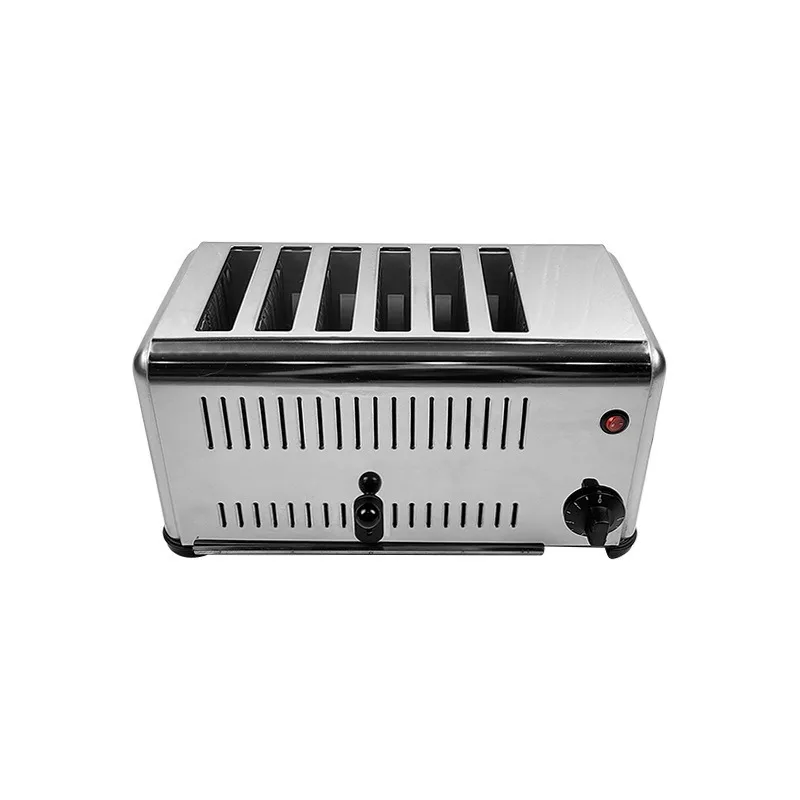
Why this bread toaster requires a configuration-controlled purchase
The TEBAK product record describes stainless steel electric bread bun and burger processing equipment. Its product-name field is “4/6 Slicer Bread Toaster,” while the title also uses “Electric Conveyor Commercial 4/6 Slice Bread Toaster” and “Electric bread maker toaster oven.” The material field is written as “Stainles Steel.” These are the source-controlled anchors for this guide.
The record does not provide rated power, voltage, frequency, slice thickness, conveyor speed, heating temperature, chamber dimensions, output, controls or certification. A buyer should not convert “4/6” into an assumed four- or six-slice capacity without a drawing. It may describe an option, a model family, a slice count or a listing shorthand. Ask the supplier to identify the exact configuration on the quotation, nameplate and pre-shipment inspection sheet.
This B2B buying guide is intended for importers, restaurant-equipment distributors, bakeries, burger shops, hotel kitchens and commissary operations comparing commercial bread handling and toasting equipment. It separates visible source facts from the RFQ items required to decide whether the machine fits the intended workflow.
1. Controlled identity from the source record
The queue identifies product ID 1601366181287. The title combines stainless steel construction, electric operation, bread bun and burger processing, commercial use, 4/6 slice language, conveyor wording and toaster-oven wording. The product-name field says “4/6 Slicer Bread Toaster,” and the material field says “Stainles Steel.”
Those phrases do not establish whether one machine slices bread, toasts sliced bread, feeds buns through a conveyor, or combines slicing and heating in one configured unit. The buyer must request a functional description and a process diagram. The purchase order should reference the selected drawing revision and the supplier’s model code, not only the broad marketplace title.
2. Source-confirmed specification table
The following table repeats the available source fields without adding estimates. “RFQ required” means the supplier must complete the value before sampling or ordering.
| Field | Source value or procurement control |
|---|---|
| Product ID | 1601366181287 |
| Product family | Stainless steel electric bread bun and burger processing equipment |
| Product name field | 4/6 Slicer Bread Toaster |
| Material field | Stainles Steel |
| Source title wording | Electric conveyor commercial 4/6 slice bread toaster; electric bread maker toaster oven |
| 4/6 interpretation | Not defined; confirm model option, slice count, capacity or other meaning |
| Rated voltage and power | RFQ required |
| Slice thickness and adjustment | RFQ required |
| Conveyor speed and heating dwell time | RFQ required |
| Output per hour | RFQ required |
3. Clarify the slicing function
The phrase “4/6 Slicer Bread Toaster” can create a serious purchasing ambiguity. Ask the supplier to state whether the machine slices whole loaves, separates buns, toasts pre-sliced bread, or performs multiple operations through interchangeable parts. Request a side elevation, top view and product-path diagram showing the infeed, cutting or heating area, transfer point and discharge.
If slicing is included, require the blade or cutter description, slice-thickness range, adjustment method, maximum loaf or bun dimensions, permitted product temperature, crumb collection method and cleaning procedure. Do not assume “4/6” means four or six blades. Confirm the number, arrangement and material of cutting elements from the approved drawing.
For burger buns, the buyer should test the actual bun diameter, height, softness and cut direction. For packaged bread, test loaf length, crust hardness and moisture. A machine that handles one product well may not be suitable for another without a different guide, blade, belt or setting. These change parts and settings should be listed in the quotation.
4. Clarify the toaster and heating function
The source title uses toaster and toaster-oven wording, but no heating method or temperature data is provided. Ask whether heating is by resistance elements, infrared elements, hot air, contact plates or another method. Request the number of heating zones, upper and lower control, chamber or conveyor width, temperature range, timer or dwell-time range and recovery behavior after loading.
If the equipment is conveyor-based, ask for belt material, usable belt width, speed adjustment, minimum and maximum dwell time, product spacing and discharge height. If it is a chamber toaster, ask for rack or tray dimensions, door clearance, loading method and the number of products per batch. The supplier should use one consistent definition for “capacity” in the quotation and sample report.
Request a heat-distribution test using the buyer’s bread or bun. Measure the front, center and rear positions and record the setting, product mass, initial temperature, loading pattern and dwell time. Do not publish a temperature, speed or output claim unless the supplier provides a product-specific test record or the buyer has measured it during acceptance.
5. Electrical and installation review
The source record does not provide voltage, frequency, phase, rated power, rated current, plug type, cable specification, breaker requirement or grounding arrangement. These are essential for commercial electric heating equipment. Ask the supplier for a rating-plate photograph, wiring diagram and installation sheet for the exact version being quoted.
The electrical package should identify heating elements, motors, speed controllers, switches, indicators, thermostats, over-temperature protection, earth points and emergency isolation where supplied. Confirm whether the quotation includes a plug, terminal block or bare cable, and whether the machine is intended for a dedicated circuit.
Before delivery, plan the equipment route and service clearance. Obtain external dimensions, net weight, gross weight, lifting points, conveyor height, ventilation requirements and access to control and heating components. A compact footprint does not guarantee that a commercial unit can be installed safely under an existing hood, counter or power circuit.
6. Stainless steel and food-contact review
The material field states “Stainles Steel,” but it does not identify a grade, thickness, finish or the surfaces where the material is used. Request a material schedule separating external panels, product-contact guides, trays, belts, fasteners, handles, guards and heating-chamber components. Ask the supplier to correct the spelling and provide the controlled material description on the quotation.
Food-contact suitability depends on the exact component and destination market. Request product-specific declarations or test documents where required. Do not treat a company-level ISO9001 statement as proof that this individual machine or every food-contact surface has a particular certification.
Cleaning access should be demonstrated with power isolated and heated parts cooled. Confirm whether belts, crumbs trays, guards, guides, knives, racks and product-contact surfaces can be removed safely. Request chemical compatibility, lubrication points and a schedule for removing crumbs, oil residue and baked-on material.
7. Safety and operator workflow
Commercial bread equipment combines moving product paths, cutters and hot surfaces. Ask the supplier to identify pinch points, cutting zones, hot surfaces, guards, interlocks, emergency stops, reset behavior and safe access for cleaning. If the machine accepts a removable cutter or guide, document the tool and lockout procedure.
Request a start-up and shutdown sequence, warm-up requirement, jam-clearing method and cool-down instruction. Confirm what happens when the conveyor stops while the heater remains energized. If there is a motor overload, thermal cutout or alarm, require the fault indication and reset method in the manual.
The buyer’s acceptance test should include empty running, loaded running, emergency isolation, guard inspection, jam simulation where safe, temperature verification and a post-run inspection of the product path. Record the exact configuration and test conditions so that a replacement or later batch can be compared fairly.
8. Capacity and product compatibility
No hourly output, tray count, conveyor width, loaf size or bun size is provided. Ask the supplier to define the maximum product dimensions and the recommended operating range. Capacity should be stated in a measurable unit such as pieces per hour, loaves per batch or kilograms per hour, with the product size and heating or slicing settings included.
For a bakery, ask whether the machine handles the planned bread length, crust, moisture and cooling condition. For a burger operation, test bun diameter, height, split direction and desired toast pattern. For a distributor, request several configuration options only when the model codes, accessories, price, lead time and performance conditions are separately identified.
Do not use the words “commercial” or “multifunction” as a substitute for a duty cycle. Ask for continuous-run limits, recommended rest intervals, motor duty, heater duty, ambient conditions and service access. These details help determine whether the unit fits a peak breakfast service, a low-volume shop or a central kitchen.
9. Controls and repeatability
The source does not specify controls. Request photographs of the panel and a control description showing power, heat, speed, timer, temperature, mode selection and alarms. Confirm whether settings are analog or digital, whether they can be locked, and whether the machine returns to a safe state after a power interruption.
Repeatability should be tested with the same product and settings over multiple cycles. Record slice thickness, cut alignment, toast color, surface temperature, conveyor speed and product loss where applicable. If the supplier claims automatic control, ask which sensor measures temperature or speed and where it is located.
For multi-market supply, request language options for the manual, warning labels, control panel and wiring marks. Keep the approved panel layout with the purchase order so a different control version is not substituted without written approval.
10. Sample and pre-shipment inspection
Order a sample or perform a video inspection using the exact model and options intended for production. Photograph the nameplate, frame, material surfaces, product guides, blades or heating chamber, belt, guards, controls, cable and included accessories. Verify the product ID and supplier model code against the quotation.
Run an empty test to check noise, vibration, belt tracking, motor response, cutter movement, control operation and hot-surface behavior. Then run the buyer’s bread or bun. Record product dimensions, input temperature, machine settings, cycle time, output, cut quality and toast result. Test the beginning, middle and end of a run for drift.
Pre-shipment inspection should compare the machine with the signed drawing, material schedule, wiring diagram and packing list. Any change to slice configuration, conveyor, heater, guide, plug, control or accessories should be approved before shipment. A generic product photograph is not sufficient evidence of configuration compliance.
11. Packaging, spares and service
Packaging details are not supplied. Request packed dimensions, gross weight, moisture protection, shock protection, restraint points and a detailed packing list. Protect blades, heating elements, controls, belts and stainless surfaces from movement and impact during transit.
Ask for a recommended spare-parts list covering cutters or blades if applicable, belts, guides, motors, switches, thermostats, heating elements, fuses, sensors, trays, crumb collectors and fasteners. Require part numbers, lead times, replacement instructions and whether a technician is needed.
For an importer or dealer, obtain a troubleshooting table for no power, no heat, uneven heating, belt drift, jammed product, poor slicing, abnormal noise, control failure and overheating. Agree warranty scope, response time, remote diagnosis method and replacement policy in writing.
12. RFQ checklist
- Confirm product ID 1601366181287, supplier model code and exact revision.
- Explain what “4/6” means and whether it is a model option, slice count or capacity statement.
- Confirm whether the unit slices bread, toasts sliced bread, processes buns or combines functions.
- Provide rated voltage, frequency, phase, power, current, plug or terminal arrangement and grounding method.
- Provide slice thickness, adjustment range, maximum product size and blade or cutter details if slicing is included.
- Provide conveyor width, belt material, speed range, heating zones, temperature range and dwell time if conveyor heating is included.
- Provide external dimensions, net/gross weight, product height, discharge height and service clearances.
- Provide material grade, thickness, finish and food-contact documentation for all relevant surfaces.
- Provide safety guards, interlocks, emergency isolation, jam-clearing and cleaning procedures.
- Agree sample test, pre-shipment inspection, packing list, spare parts, warranty and after-sales response.
13. Questions for the supplier
Ask the supplier to answer these questions in the quotation: Is this one machine for slicing and toasting, or is the title combining separate configurations? What does 4/6 mean? What bread, bun or burger dimensions are accepted? What are the voltage, frequency, power and current? What is the slice-thickness range? What are the conveyor width and speed? What heating method, zone arrangement and temperature range are used? What material grade is used on product-contact surfaces? What cleaning and food-contact documents are supplied? Which guards, sensors and emergency controls are included? What is the tested output under defined conditions?
If the supplier cannot provide these answers, keep the order at RFQ or sample-review stage. A low headline price cannot compensate for an incompatible slice setup, undersized electrical installation, undefined heating performance or difficult cleaning access.
14. Final procurement decision
This TEBAK product is a potential commercial solution for bread, bun and burger-related processing, but the source record is not a complete machine specification. The confirmed anchors are product ID 1601366181287, the “4/6 Slicer Bread Toaster” product-name field, the stainless steel material field and the electric conveyor/toaster wording in the title.
Approve a purchase only after the supplier identifies the exact function, model, electrical version, slice or heating configuration and product-contact materials in a signed quotation. Keep the product ID, drawing revision, nameplate photograph, inspection report and carton label together for traceability. This prevents a different toaster, slicer or conveyor configuration from being shipped under a broad marketplace title.
Editor’s note: Product facts in this guide are limited to the supplied Hoting queue record. Company-level statements are not treated as product-specific certification, performance evidence or customer proof.
Key specifications
- Product type
- Stainless steel electric bread bun and burger processing equipment
- Source product ID
- 1601366181287
- Product name field
- 4/6 Slicer Bread Toaster
- Material field
- Stainles Steel
- Source title wording
- Electric conveyor commercial 4/6 slice bread toaster / electric bread maker toaster oven
- Slice configuration
- 4/6 is stated in the source wording; confirm whether it means slice count, model option or capacity
- Bread and food applications
- Bread, buns and burger-related processing, subject to configuration confirmation
- Rated power and voltage
- Not provided in the source record; request nameplate data
- Slice thickness and opening size
- Not provided; request drawing and adjustment range
- Conveyor and heating parameters
- Not provided; request speed, temperature range, zones and dwell time
Frequently asked questions
- What does 4/6 mean in this product record?
- The record uses 4/6 wording but does not define whether it is a model option, slice count, capacity or listing shorthand. Require the supplier to explain it on the drawing and quotation.
- Is the product a slicer, toaster, conveyor oven or combination machine?
- The title and product-name field use several terms. Confirm the exact function, product path and included modules before ordering.
- What material is listed?
- The source material field says “Stainles Steel.” Ask the supplier to provide the controlled material grade, thickness, finish and food-contact documentation.
- What are the power and voltage requirements?
- They are not provided in the source record. Request the nameplate, rated power, current, phase, frequency, plug or terminal arrangement and grounding method.
- Can the machine process my burger buns or bread?
- Suitability must be confirmed with a sample test using the buyer’s product dimensions, moisture, crust, loading method and desired slicing or toast result.