
Source-control note before quotation
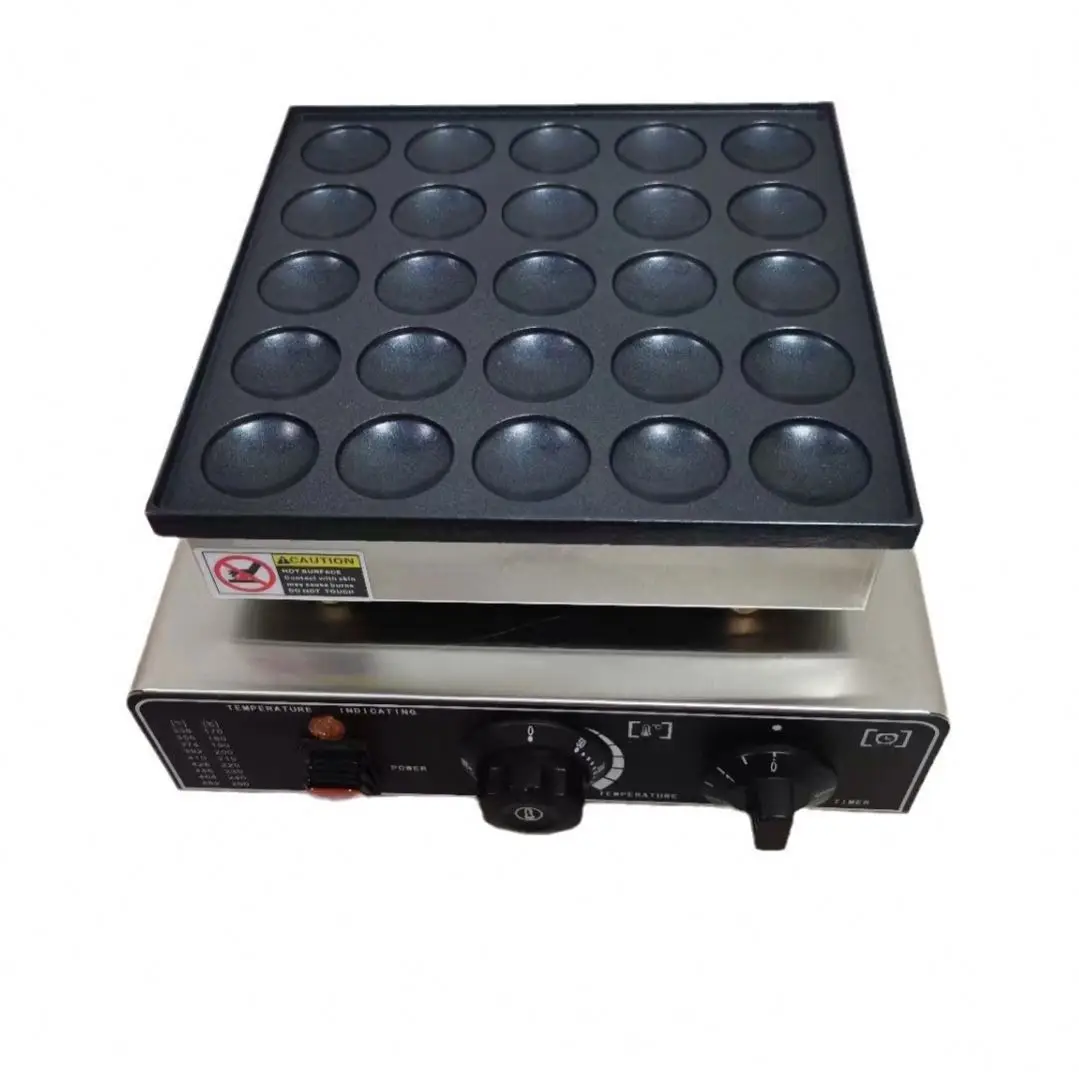
This TEBAK listing describes a stainless-steel nonstick mini pancake machine, also called an electric Dutch mini pancake machine and a 25-pancake maker. The source record contains useful procurement fields, but it also contains generic catalog labels and one power value that needs engineering confirmation. This guide preserves the source wording, separates declared values from verified facts, and gives the buyer an RFQ path before any order is approved.
Product ID 1601369044029 should be placed on the quotation, nameplate photograph, technical drawing, inspection record and packing list. The source title says “25 Pancake Maker”; the record does not provide plate pitch, cavity diameter, actual cavity count, cycle time or output rate. Do not convert the title into a guaranteed throughput claim.
| Source field | Source-recorded value | Procurement treatment |
|---|---|---|
| Applicable Industries | Food & Beverage Factory, Restaurant, Home Use, Retail, Food Shop | Declared application categories; confirm food-contact suitability and destination-market requirements. |
| Showroom Location | china | Supplier listing field; it is not a shipment origin or delivery promise by itself. |
| Video outgoing-inspection | Provided | Request the model-specific video and recording date; do not accept a generic video as inspection evidence. |
| Machinery Test Report | Provided | Request the report for product ID 1601369044029 and reconcile its model, voltage and power values. |
| Marketing Type | Ordinary Product | Catalog classification only; it is not a performance or certification claim. |
| Warranty of core components | 1 Year | Confirm covered parts, exclusions, claim route and whether labor or freight is included. |
| Core Components | Engine | Generic source label. Request the actual heating and control components, not only the word “Engine”. |
| Place of Origin | China | Source-recorded origin field; confirm the commercial documents and shipment origin. |
| Weight | 8KG | Confirm net or gross weight, included accessories and packed weight. |
| Warranty | 1 Year | Confirm start date, scope, remedy and replacement-part availability. |
| Key Selling Points | Sustainable | Unqualified marketing language; ask for the specific material or energy evidence behind the claim. |
| Condition | New | Confirm unused status, production date and whether the supplied unit is a current production model. |
| Voltage | 220v | Source-recorded value; confirm tolerance, phase, frequency, plug, grounding and nameplate. |
| Power | 850kw | High-risk source value. Treat as unverified until the supplier confirms whether the unit is 850W, 0.85kW or another value. |
| Dimension(L*W*H) | 600*320*240mm | Source-recorded external dimension; confirm assembled, working and packed dimensions. |
| Year | 2024 | Source-recorded year; confirm whether it means model year, production year or listing year. |
| Product name | Snacks Food Machine | Generic catalog label; use the exact pancake-machine model on the PO. |
| Application | Food Processing Machine | Generic category; validate actual food-contact process and permitted use. |
| Name | Commercial Baking Oven | Conflicting generic label; supplier must confirm the exact equipment identity. |
The record also contains generic descriptors such as multifunctional, food industry equipment and deck baking terminology. These do not establish a specific heating method, cavity layout, food-contact material, output, temperature range, energy efficiency or compliance status. The article therefore treats them as catalog context, not verified specifications.
1. Define the equipment identity
Before comparing prices, ask the supplier to reconcile the product title, product name, application and name fields. The title identifies a mini pancake maker, while the generic name says “Commercial Baking Oven.” A purchase order should name the exact mini pancake machine, its model, plate layout and electrical configuration.
Request a nameplate photograph showing model, voltage, frequency, power and manufacturer information. Match the nameplate to product ID 1601369044029 and the quotation.
Ask whether “25 Pancake Maker” means 25 cavities, a nominal batch size, a product-series name or a marketing phrase. Request a top-view drawing with cavity count, cavity diameter, cavity spacing and plate dimensions.
Confirm whether the machine is electric only, whether it has one or more heating zones, and whether the upper and lower plates heat independently.
Ask for the complete supply scope: machine body, heating plates, handles, thermostat, switch, cable, plug, feet, scraper, trays, manual and spare parts. Do not assume accessories are included because they appear in a product image.
Request a current production sample or video showing the exact quoted configuration. Generic footage of another mini pancake maker does not confirm the supplied unit.
Clarify whether the unit is intended for home use, food shops, restaurants, retail demonstrations or factory production. The source lists all of these industries, but the buyer still needs a realistic duty cycle.
Use product ID, model, plate count and voltage as the minimum identity block in every RFQ, pro forma invoice and inspection record.
2. Resolve the 850kw power anomaly
The source record states Power: 850kw. This value must not be treated as a verified operating specification. It may be a catalog-unit error, a missing decimal, a watt/kilowatt conversion problem or a field copied from another item.
Ask the supplier to confirm the power directly from the model nameplate and electrical drawing. Require the answer in both the original unit and a clear SI value, such as W or kW, without silently correcting the source.
Request rated running power, maximum input power, startup behavior, current, frequency, phase, breaker recommendation and cable specification.
Ask whether power is for the complete machine or one heating zone. Confirm whether thermostats, indicator lights, timers or motors add to the total.
Compare the confirmed power with the stated 220v supply and the actual current draw during a cold start and steady heating cycle. Record the test instrument and measurement conditions.
Do not publish an energy-cost estimate, circuit recommendation or production-capacity calculation until the supplier resolves the 850kw field.
Put a hold point in the PO: “Power value requires written supplier confirmation before production and shipment.” A quotation that repeats 850kw without explanation is incomplete.
If the supplier confirms a different value, retain the original source record in the internal audit trail and use only the signed, model-specific confirmation in the commercial specification.
3. Plate, cavity and nonstick-surface verification
The title says stainless steel and nonstick, but the structured fields do not specify the plate grade, coating type, coating thickness or food-contact declaration. Request these items explicitly.
Ask whether stainless steel refers to the outer housing, cooking plate, cavity surface or all food-contact surfaces. Request a material map or drawing.
Confirm the nonstick coating family, maximum continuous temperature, cleaning limitations, abrasion resistance and replacement policy. Do not infer coating chemistry from a photograph.
Request cavity diameter, depth, pitch, count and edge radius. Confirm whether all 25 cavities are identical and usable under the same temperature conditions.
Ask whether the upper plate is supplied, whether it matches the lower cavity layout, and how batter thickness is controlled.
Inspect the plate for sharp edges, exposed fasteners, gaps, coating defects, weld marks and cleaning traps. Food-contact parts must be easy to inspect and clean.
Run a coating sample test using the buyer's batter, oil, scraper and cleaning process. Record sticking, discoloration, blistering, peeling and residue.
Ask for a food-contact material declaration and any destination-market documents relevant to the buyer's country. A general company profile is not a product-specific declaration.
4. Electrical and temperature control
The source lists 220v but not frequency, phase, current, plug or tolerance. Confirm the full electrical specification on the nameplate and wiring diagram.
Ask whether the machine uses 50Hz, 60Hz or both. Confirm single-phase or another configuration and the destination-market plug.
Request thermostat type, setpoint range, temperature tolerance, sensor position, heating-zone control and indicator behavior.
Ask whether the stated control is mechanical, electronic or digital. Confirm whether the operator can set independent upper and lower temperatures.
Measure plate temperature at the center, edges and multiple cavities after warm-up. Record warm-up time, overshoot, recovery after loading and temperature difference between zones.
Do not promise uniform browning or repeatable cycle times unless the buyer's test demonstrates them with the intended batter and load.
Request over-temperature protection, thermal fuse, grounding, insulation, cable rating and safe shutdown behavior.
Confirm whether the machine can restart automatically after power loss. The safe behavior should be documented before installation.
Resolve the 850kw anomaly before selecting a socket, breaker, cable or generator. Do not base electrical installation on an obviously ambiguous catalog value.
5. Food process and output validation
The source title says 25 Pancake Maker, but it does not provide pieces per hour, cycle time, batter volume, recovery time or operator steps. These must be measured or confirmed.
Define the buyer's target product: diameter, thickness, weight, color, texture, filling and acceptable variation. A mini pancake machine may produce different results with different batter formulas.
Record batter temperature, viscosity, dosing method, fill mass, preheat condition, plate temperature, cooking time and release method.
Run at least a warm-up test, a nominal batch test and a sustained-duty test. Record actual pieces, rejected pieces, cycle time and recovery time.
Test all cavities rather than judging only the first cavity. Record hot spots, cold spots, sticking, overflow, underfill and uneven browning.
Separate theoretical cavity count from commercial output. Output depends on operator loading, batter dosing, cook time, cleaning and inspection.
Ask whether the machine is designed for continuous restaurant use or intermittent home/retail use. Confirm duty cycle, recommended rest periods and thermal protection.
Document the buyer's acceptance criteria with photographs and sample weights. Attach the test report to the quotation review.
6. Application and site planning
The source lists food and beverage factories, restaurants, home use, retail and food shops. These settings have different requirements for hygiene, ventilation, duty cycle, operator access and electrical installation.
Confirm the actual installation environment, countertop height, clearance, ambient temperature, ventilation, cleaning water access and storage for batter and finished pancakes.
The listed dimensions are 600*320*240mm. Confirm whether these are external assembled dimensions, plate-open dimensions or another reference. Request packed dimensions and service clearance.
Confirm the 8KG weight as net or gross and include cable, plug, handles and accessories in the placement review.
Request a drawing that shows the hot-surface envelope, handle travel, lid or upper-plate travel, cable exit and cleaning access.
Ask whether the unit requires a dedicated heat-resistant countertop, non-slip feet, splash protection or a separate extraction arrangement.
Do not assume a home-use listing is suitable for a factory line. Match the buyer's duty cycle to the supplier's written recommendation.
For retail or food-shop use, define operator training, batter refill, product transfer, cleaning frequency, queue management and safe shutdown.
7. Cleaning and hygiene controls
Request the cleaning procedure for nonstick plates, housing, handles, switches and gaps around the cooking surface. Confirm which tools and detergents are allowed.
Ask whether the plates are removable or fixed. Confirm how food residue is removed without scratching the nonstick surface.
Define cleanability requirements: smooth food-contact surfaces, accessible corners, no exposed crevices, drain behavior and inspection visibility.
Test the buyer's cleaning routine after batter overflow, sugar residue, oil buildup and burnt material. Record time, tools and coating condition.
Ask whether the unit may be sprayed, wiped only or cleaned after cooling. Do not expose electrical controls to water without a written procedure.
Request food-contact declarations, cleaning chemical compatibility and any sanitation instructions for the quoted model.
Confirm whether replacement plates, handles, thermostats, heaters and cables can be ordered separately. Record part numbers and lead times.
Keep a cleaning log and inspect the nonstick coating before each production shift. Stop using the unit if the coating is damaged or food-contact surfaces cannot be cleaned effectively.
8. Warranty and evidence review
The source lists one year for core-component warranty and one year for warranty. Treat these as source-recorded commercial fields, not as a complete warranty contract.
Ask which components are covered: heating elements, thermostat, switch, wiring, plate, coating, housing, handle, motor or control board.
Confirm warranty start date, evidence required, response time, replacement method, freight responsibility and whether local repair is permitted.
Request the promised video outgoing-inspection file and machinery test report for product ID 1601369044029. Verify that the model, serial number, voltage and power values match.
Ask whether “Provided” means available before shipment or only available on request. Put the required documents in the purchase order.
Do not use a generic warranty card or test report from another food machine. The evidence must identify the quoted unit.
Ask for spare heating plate, thermostat, fuse, cable, plug, handle and coating-related service options.
Record the supplier's support contact, escalation route and replacement-part price before paying the balance.
9. Safety assessment
Identify hot surfaces, moving upper plates, pinch points, electrical shock, batter overflow, grease, steam and cleaning hazards.
Request guard and handle design details. Confirm that the operator can open, close and lock the plate without reaching over an exposed hot area.
Ask for thermal protection, over-temperature cutoff, grounding, insulation and safe stop behavior.
Confirm whether the machine has an emergency stop, main isolation switch or only a power switch. The source does not provide this information.
Define PPE and training for hot-surface contact, batter handling, cleaning and electrical isolation.
Place the unit away from flammable packaging and maintain the supplier's required clearances. Do not cover ventilation openings.
Verify that the plug, cable and socket are suitable for the confirmed power and current. Resolve the 850kw source field before installation.
Require the operator to disconnect power and allow cooling before deep cleaning, plate inspection or service.
10. Acceptance test before shipment
Use product ID 1601369044029 and the supplier-confirmed model as the acceptance identity. Confirm title, plate count, dimensions, weight, voltage, power and warranty documents.
Inspect stainless-steel surfaces, nonstick areas, cavity geometry, handles, hinges, fasteners, feet, cable, plug, switch and nameplate.
Measure assembled dimensions and verify the source value 600*320*240mm. Record whether the measurement is with the plate closed or open.
Confirm 220v supply requirements and reconcile power from the nameplate, supplier test and live electrical measurement. Do not accept an unexplained 850kw entry.
Run a cold-start test, warm-up test, nominal batch and sustained batch using the buyer's batter or an agreed equivalent.
Record warm-up time, temperature at each cavity, cycle time, output, sticking, browning, recovery and operator actions.
Inspect the nonstick surface after testing and confirm that cleaning does not damage it.
Check video outgoing-inspection and machinery test report references against the actual unit. Photograph serial/model plate and all sides of the machine.
Record the final acceptance decision and all open RFQ items. Do not ship until safety, electrical identity and food-contact evidence are complete.
11. Packing, delivery and commercial terms
Confirm whether 8KG is net or gross weight and request carton dimensions, packing materials, number of cartons and shipping marks.
Protect the nonstick plate, handles, thermostat, switch and cable from impact. Request internal cushioning and a moisture-protection plan where relevant.
Ask for a packing list that names the machine, plates, handles, cable, plug, accessories, manual, test report and warranty documents.
Confirm whether the product is shipped assembled, whether plate alignment can move during transit and what inspection is required after unpacking.
Use product ID and confirmed model on carton and commercial documents. Photograph the package before dispatch and immediately after arrival.
Confirm price, MOQ, lead time, shipping term, insurance, duties, destination delivery, warranty and spare-part supply in writing.
Do not infer origin, delivery time or showroom location from the listing field “china.” Those details must be confirmed in the commercial documents.
Keep the quotation, drawings, test video, test report, inspection photos, packing list and signed acceptance record together.
12. RFQ checklist
- Confirm product ID 1601369044029 and the exact mini pancake-machine model.
- Reconcile title “25 Pancake Maker” with actual cavity count, diameter, spacing and plate drawing.
- Explain the generic “Commercial Baking Oven” name and confirm the equipment identity.
- Confirm plate and housing materials, stainless-steel grade and nonstick-coating specification.
- Confirm 220v phase, frequency, tolerance, plug, grounding and current.
- Resolve the source value `850kw` against the model nameplate and electrical test report.
- Confirm whether power applies to the complete machine or one heating zone.
- Provide thermostat range, accuracy, sensor, heating zones and thermal protection.
- Provide dimensions with plate closed/open, service clearance and packed dimensions.
- Confirm whether 8KG is net or gross weight and list included accessories.
- Provide cycle time, warm-up time, recovery time and measured output under agreed conditions.
- Provide food-contact declaration, cleaning procedure, test report, outgoing-inspection video and warranty terms.
- Provide spare-part list and prices for heaters, thermostats, plates, switches, cables and handles.
13. Questions for the supplier
What exact model and cavity layout correspond to product ID 1601369044029?
Does “25 Pancake Maker” mean 25 cavities, and what are the cavity diameter, depth and pitch?
Is the source power value really 850kw, or is it a unit/decimal error? Please send the nameplate and electrical test report.
What are the frequency, phase, current, plug, grounding and startup-current requirements for the 220v unit?
Which surfaces are stainless steel and which surfaces are nonstick? What are the grades, coating type and food-contact documents?
What temperature range, tolerance, warm-up time and recovery time should the buyer expect?
What are the measured pieces-per-hour output and cycle conditions for the 25-cavity configuration?
Is 600*320*240mm the closed-machine external size? What are the open and packed dimensions?
Is 8KG net machine weight or gross shipping weight, and what accessories are included?
What exactly is covered by the one-year core-component warranty and one-year warranty?
Can you provide the model-specific outgoing-inspection video, machinery test report, manual and food-contact declaration before shipment?
14. What not to assume
Do not assume the generic fields “Snacks Food Machine” or “Commercial Baking Oven” describe the exact equipment.
Do not assume “25 Pancake Maker” proves cavity count, output rate or production capacity.
Do not assume the 850kw power field is correct. It requires written engineering confirmation.
Do not assume 220v identifies frequency, phase, plug or current.
Do not assume stainless steel means every food-contact surface is stainless steel.
Do not assume nonstick means a specific coating, service life or food-contact approval.
Do not assume “Provided” test reports or videos are model-specific until their identifiers are checked.
Do not assume one-year warranty covers plates, coating, heating elements, freight or labor.
Do not assume 8KG is net weight or 600*320*240mm is the packed shipping size.
Do not approve the order without a buyer-sample test and electrical identity check.
15. Final procurement decision
The source baseline is a TEBAK stainless-steel nonstick mini pancake machine listed for food factories, restaurants, home use, retail and food shops, with a 220v field, 600*320*240mm dimension field, 8KG weight field, one-year warranty fields, and a title that references a 25-pancake maker.
The listing is suitable for RFQ preparation, not final engineering approval. The 850kw power field, generic equipment names, cavity specification, food-contact evidence, temperature control, output and duty cycle must be resolved with model-specific documentation and a buyer-sample test.
Editor's note: This guide uses the supplied Hoting queue fields and product image, preserves source values and generic labels, and marks conflicting, ambiguous or unreturned engineering and commercial information as supplier-confirmation items.
Key specifications
- Applicable Industries
- Food & Beverage Factory, Restaurant, Home Use, Retail, Food Shop
- Showroom Location
- china
- Video outgoing-inspection
- Provided
- Machinery Test Report
- Provided
- Marketing Type
- Ordinary Product
- Warranty of core components
- 1 Year
- Core Components
- Engine
- Place of Origin
- China
- Weight
- 8KG
- Warranty
- 1 Year
- Key Selling Points
- Sustainable
- Condition
- New
- Voltage
- 220v
- Power
- 850kw
- Dimension(L*W*H)
- 600*320*240mm
- Year
- 2024
- Product name
- Snacks Food Machine
- Application
- Food Processing Machine
- Name
- Commercial Baking Oven
Frequently asked questions
- What power value should be used for the quotation?
- The source record says 850kw, but this is an ambiguous high-risk field. Require the supplier to confirm the nameplate value and unit before ordering.
- Does the title prove there are 25 cavities?
- No. The title references a 25 Pancake Maker, but cavity count and dimensions need a supplier drawing or inspection.
- What voltage is listed?
- The source lists 220v. Confirm frequency, phase, current, plug, grounding and tolerance for the destination market.
- What warranty is listed?
- The source lists one year for core components and one year warranty. Confirm covered parts, exclusions, freight and claim procedure.
- What should be verified before shipment?
- Verify model identity, power, cavity layout, food-contact surfaces, temperature control, output, dimensions, documents and a buyer-sample test.