
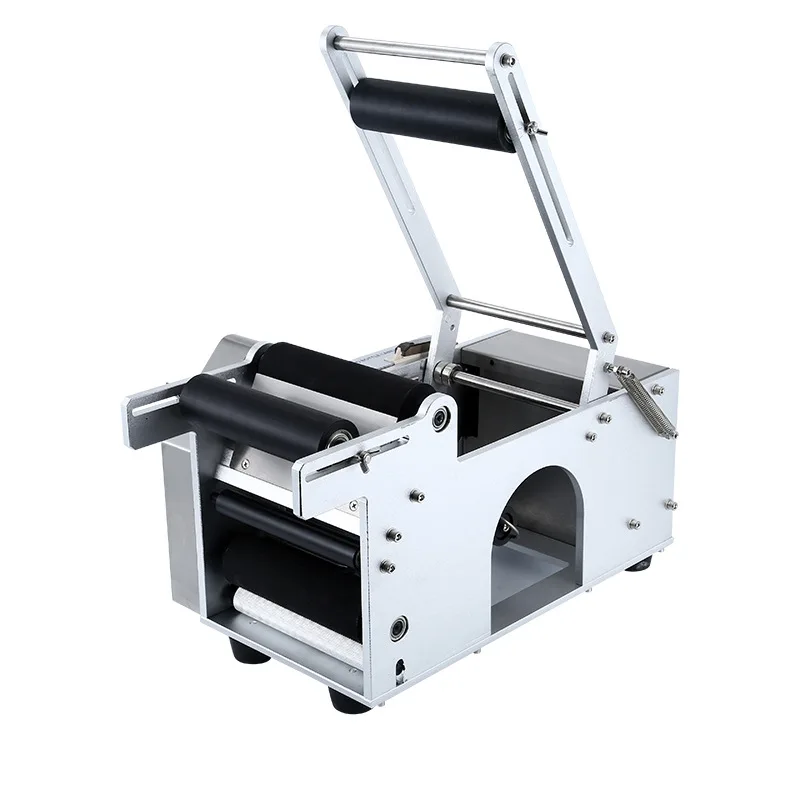
What the source record confirms
The TEBAK source record describes a manual round-bottle adhesive sticker and label applicator for plastic and glass bottles or jars. The product ID is 1601251631145. The product title includes “SY-50”, while the structured Model field says “ZYMT-50”. This identity difference must be resolved with the supplier before a quotation or purchase order is approved.
| Source field | Confirmed value | Procurement meaning |
|---|---|---|
| Model | ZYMT-50 | Structured model value; reconcile with the SY-50 wording in the title. |
| Voltage | 220V/50HZ | Declared electrical field; confirm whether this applies to the quoted configuration and whether a power supply is included. |
| Applicable Bottles of Diameter | 15-120 mm | Declared bottle-diameter range; verify how diameter is measured and whether it covers the buyer's bottle body. |
| Label Roll External Diameter | 275 mm | Declared maximum outer roll diameter; confirm material core, winding and tolerance. |
| Label Roll Inner Diameter | 75 mm | Declared inner roll diameter; confirm core compatibility and spindle arrangement. |
| labeling speed | 20-40 pcs/min | Declared speed range; confirm label size, bottle, operator method and acceptance conditions. |
| Accuracy of labeling | ±0.5 mm | Declared accuracy value; define reference edge, measurement method and repeatability. |
| Weight | 18 kg | Declared product weight; confirm whether accessories and roll holder are included. |
| Dimension(mm) | 450*300*760mm | Declared dimensions; confirm assembled orientation, working clearance and packed dimensions. |
The source does not provide label width or height limits, bottle height, bottle material restrictions beyond the title, label adhesive requirements, power consumption, sensor type, label gap, roll direction, operator training, safety documents, certification, warranty or spare-parts data. These are RFQ confirmation items.
1. Procurement identity and scope
Use the exact product identity in the inquiry: TEBAK SY-50 Plastic and Glass Bottle/Jar Manual Adhesive Sticker Round and Adhesive Sticker Label Applicator Labeling Machine. Include product ID 1601251631145 and ask the supplier to confirm whether the structured model ZYMT-50 is the correct model for the title-listed SY-50 unit.
Ask for a model photograph showing the nameplate, label holder, bottle support, guide, dispensing edge and adjustment controls. The quotation, drawing, manual, packing list and inspection record should use one consistent model designation.
Clarify whether this is a fully manual applicator, a hand-operated machine with powered dispensing, or a manual bottle-placement unit with another assisted function. The title says manual, but the source does not describe the operating sequence or drive system.
Define the product format before requesting a price: round plastic bottle, round glass bottle, jar, can or another cylindrical container. A bottle may be round in one section and irregular at the shoulder or base.
Confirm whether the machine applies one wraparound label, one partial label, a front label, a back label or another format. The source states round-bottle adhesive sticker application but does not define the label path.
Keep product ID 1601251631145 on all test samples and documents. Do not approve a visually similar applicator without resolving the SY-50 versus ZYMT-50 identity difference.
2. Bottle compatibility and diameter range
The structured record lists an applicable bottle diameter of 15-120 mm. Ask the supplier to define the measuring points and whether this is the body diameter, the maximum diameter, the minimum contact diameter or an allowable range for a particular bottle shape.
Provide a dimensioned bottle drawing for every intended SKU. Include body diameter, shoulder, neck, base, height, taper, seam, grip, ovality, surface texture and filled or empty condition.
Test both plastic and glass bottles if both materials are planned. Surface friction, stiffness, weight and breakage risk can change bottle tracking and label placement.
Confirm whether the machine can handle jars with short bodies, wide shoulders, recessed bases or heavy glass walls. Do not infer jar compatibility from the phrase “bottle/jar”.
Ask for the minimum and maximum bottle height, supported orientation, clearance above the label area and distance from the bottle base to the label centerline. These fields are not supplied.
Check bottle diameter repeatability and ovality. A nominal diameter within 15-120 mm may still produce placement variation if the bottle is not truly cylindrical.
Provide sample bottles, including the smallest, largest, lightest, heaviest and most difficult shape. Request a signed compatibility matrix showing each sample, label and result.
Do not claim the full 15-120 mm range will deliver the same accuracy or speed. The source gives a range, not a performance guarantee across every size.
3. Label roll and material compatibility
The source lists a label roll external diameter of 275 mm and inner diameter of 75 mm. Confirm whether these are maximum and nominal values, and whether the roll holder has adjustable or fixed side guides.
Request the spindle drawing, core support, roll-width range, maximum roll mass, unwind direction and label feed direction. Roll diameter alone does not establish compatibility.
Provide label construction details: face material, liner, adhesive, thickness, width, length, die-cut shape, gap, winding direction and storage condition.
Test transparent labels, paper labels, film labels and textured labels separately if they are part of the planned product range. Adhesive release and liner stiffness can affect dispensing.
Confirm whether labels must be supplied on a continuous liner and whether the machine can detect a gap or a registration mark. The queue does not provide sensor or label-gap specifications.
Ask for the maximum label width and height, maximum wrap length and minimum gap. Do not derive these limits from the 450*300*760mm machine dimensions.
Confirm the allowable roll runout, telescoping, splice position and leading-edge condition. Request a roll-loading procedure and safe correction method for a skewed roll.
Use the exact 275 mm outer diameter and 75 mm inner diameter in the RFQ, then obtain a supplier drawing before buying labels in bulk.
4. Labeling speed and accuracy validation
The source states a labeling speed of 20-40 pcs/min and accuracy of ±0.5 mm. These figures need a defined bottle, label, operator method, speed setting and measurement reference.
Ask whether 20-40 pcs/min means operator cycle rate, machine dispensing rate or completed accurately labeled bottles. Confirm whether loading, positioning, pressing and removal are included.
Define the accuracy reference: label leading edge, centerline, top edge, overlap, seam position or another datum. Ask how the ±0.5 mm value was measured.
Run at 20, target and 40 pcs/min where permitted. Record label position, skew, overlap, wrinkles, bubbles, lifting edges and rejected pieces at each setting.
Test at least three consecutive rolls or a statistically meaningful sample agreed with the supplier. Record first-piece setup and steady-state results separately.
Measure accuracy on each bottle type and label type. Do not transfer the result from a rigid plastic bottle to a flexible bottle or from paper labels to clear film.
Confirm whether the claimed accuracy includes manual bottle placement variation. A manual applicator can be limited by operator alignment even when the dispensing mechanism is repeatable.
Write the speed and accuracy acceptance criteria into the purchase order. The source values should be treated as declared baseline values until the buyer's samples pass the agreed test.
5. Manual operating sequence and ergonomics
Request the complete operator sequence: install roll, thread liner, adjust bottle guide, place bottle, rotate or actuate handle, press label, remove bottle and inspect the result.
Clarify whether the bottle is rotated by hand, by a roller, by a crank or by another mechanism. Confirm the required operator force and the number of hand actions per bottle.
Ask for handle height, working height, grip position, bottle access and recommended counter arrangement. The queue provides machine dimensions but no ergonomic data.
Use the declared dimensions of 450*300*760mm for initial space planning only. Confirm whether these dimensions are assembled outer dimensions and whether the roll holder or handle extends beyond them.
Measure operator cycle time and fatigue during a representative shift. Record whether the operator must hold the bottle, rotate it, press the applicator and remove it with one or two hands.
Confirm how the machine is secured to a bench and whether rubber feet, clamps or fasteners are supplied. A lightweight manual unit may move if the bottle or handle requires force.
Define the safe response to a jammed label, misfed liner, bottle breakage, adhesive spill or roll change. Provide lockout or isolation instructions if any powered component is present.
Train operators to inspect the first piece after every roll change, guide adjustment, bottle change and label change.
6. Electrical and powered-component confirmation
The source lists 220V/50HZ even though the title describes the applicator as manual. Ask the supplier to explain which component requires power and whether the quoted machine includes a motor, sensor, controller, lamp or other powered part.
Request rated power, current, phase, plug, cable length, fuse, grounding, switch and voltage tolerance. The queue provides voltage and frequency only.
Confirm whether 220V/50HZ is a single-phase supply and whether a destination-market plug is included. Do not assume the plug or phase from the voltage notation.
Ask for a wiring diagram and nameplate photograph. Match the nameplate to model ZYMT-50 or the supplier-confirmed alternative designation.
Confirm whether the machine can be operated without power and what functions become unavailable when power is disconnected. This is important because the commercial title uses the word manual.
Check electrical protection around adhesive, cleaning liquid and broken glass. Request the applicable enclosure or insulation details where relevant.
Do not claim low power consumption, electrical safety certification or manual-only operation unless model-specific evidence supports it.
7. Adhesive, label application and quality control
Identify the adhesive type and the intended bottle surface. Plastic, glass, coated metal and textured containers can require different tack, temperature and dwell conditions.
Ask whether the machine applies labels to clean, dry bottles only. Define acceptable dust, oil, condensation, frost and surface-treatment conditions.
Test label adhesion after application and after the expected storage period. Record edge lift, bubbles, wrinkles, tunnel effect, skew and peel strength where applicable.
Confirm the label overlap or gap requirement for wraparound labels. The source provides accuracy but does not define overlap or seam acceptance.
Inspect the bottle guide and dispensing edge for scratches or pressure marks on glass and soft plastic. Request replacement or adjustment procedures for contact parts.
Define inspection lighting, sample size and defect classification. Separate placement error from label printing defects, liner damage and bottle defects.
Ask for a changeover checklist when switching bottle diameter, label width, roll core, roll direction or adhesive. Record every adjustment that affects repeatability.
Do not assume the stated ±0.5 mm accuracy means the label will remain attached or wrinkle-free; placement accuracy and adhesion quality are separate acceptance criteria.
8. Installation and maintenance
Request an installation drawing that confirms the 450*300*760mm dimensions, roll-holder clearance, operator access, bottle entry and label exit space.
Confirm leveling requirements, bench strength, fixing points, feet, guide adjustment and any assembly required after delivery.
Ask for cleaning instructions for the frame, guide, roller, dispensing edge and label-contact surfaces. Confirm approved solvents and prohibited cleaners.
Define maintenance points for bearings, rollers, springs, sensors, switches, guides, spindle and cutting or dispensing components if included.
Request inspection criteria for adhesive buildup, worn rollers, loose guides, damaged spindle, inaccurate placement, electrical cable damage and frame movement.
Ask for part numbers, prices and lead times for rollers, guide components, spindle parts, sensors, switches and other wear items.
Confirm whether maintenance can be carried out by the buyer or requires supplier service. Keep the product ID and model designation on the service record.
Store labels and liners under the supplier's recommended conditions. Roll deformation or adhesive aging can create failures that are not caused by the applicator.
9. Safety, glass handling and workplace controls
For glass jars or bottles, define breakage prevention, fragment containment, hand protection and cleanup. Do not assume a manual applicator is risk-free.
Identify pinch points at the roller, guide, spindle, handle and bottle support. Request guards or safe-handling instructions where applicable.
Confirm that the 18 kg declared weight is the product net weight and does not represent a safe lifting limit for one operator in the packed condition.
Ask for safe roll loading and unloading steps. A 275 mm roll may require a different handling method from a small replacement roll.
Keep adhesive and cleaning chemicals away from unprotected electrical parts. Define spill response and ventilation requirements for the actual adhesive.
Provide labels, warnings, training and emergency procedures in the destination language where required.
Inspect the machine during acceptance for sharp edges, exposed wiring, unstable feet, loose fasteners, cracked guides and uncontrolled moving parts.
10. Acceptance test before shipment
Write an acceptance test around product ID 1601251631145 and the supplier-confirmed model designation. The test should explicitly resolve the title's SY-50 wording versus the structured ZYMT-50 model.
Verify the nameplate, voltage 220V/50HZ, product dimensions, net weight and supplied roll holder against the quotation.
Use the buyer's smallest and largest bottles within the declared 15-120 mm range. Include both plastic and glass where relevant.
Use the buyer's actual label rolls, including 275 mm outer diameter and 75 mm inner diameter if those are the planned roll specifications. Record roll width, core, adhesive and liner details.
Run the declared 20-40 pcs/min range and record completed good pieces per minute, operator cycle, setup time, rejects and interruptions.
Measure placement against the agreed datum and record whether results meet the declared ±0.5 mm baseline under the agreed conditions.
Check label adhesion, wrinkles, bubbles, overlap, bottle scratches, glass breakage and repeatability after roll changes and bottle-size changes.
Inspect controls, powered functions, grounding, cable, guides, spindle, rollers, frame stability and cleaning access.
Photograph the tested configuration, nameplate, bottle samples, labels, roll, measurement method and packing. Attach the signed record to the purchase order.
Define remedies for wrong model, incompatible bottle range, incorrect roll core, failed speed, failed accuracy, unstable frame or missing parts.
11. Packing, delivery and commercial terms
The source confirms net weight of 18 kg and assembled dimensions of 450*300*760mm, but it does not provide packed dimensions or gross weight. Request both before booking transport.
Ask for the packing method, moisture protection, shock protection, lifting points and protection of the spindle, guide, rollers and label-dispensing edge.
Request a packing list naming the base machine, roll holder, spindle, guides, tools, manual, electrical parts, fasteners and spare parts.
Confirm whether the machine is assembled or requires guide, handle, spindle or electrical installation at the buyer's site.
Match package markings to product ID 1601251631145 and the supplier-confirmed model. Photograph the package before dispatch and on arrival.
Confirm price, MOQ, lead time, shipping term, insurance, duties, destination delivery, warranty and after-sales support in writing.
Ask whether replacement rollers, guides, sensors and spindle components are stocked and how long they take to ship.
Keep the quotation, model-confirmation statement, drawing, sample test, inspection report, packing list and manual together.
12. RFQ checklist
- Confirm product ID 1601251631145 and reconcile title designation SY-50 with structured model ZYMT-50.
- Repeat voltage 220V/50HZ and confirm power, current, phase, plug, cable, grounding and powered components.
- Confirm bottle diameter range 15-120 mm and define the measurement point and bottle-height limits.
- Provide compatibility results for the buyer's plastic, glass, bottle and jar samples.
- Confirm label roll outer diameter 275 mm and inner diameter 75 mm, plus roll width, mass, core and winding direction.
- Confirm labeling speed 20-40 pcs/min and define loading, positioning, application and removal conditions.
- Confirm ±0.5 mm accuracy and define datum, sample size, measurement method and repeatability.
- Confirm net weight 18 kg, dimensions 450*300*760mm, packed dimensions and gross weight.
- Provide label width, height, gap, adhesive, liner and label-shape limits.
- Provide operating sequence, adjustment method, cleaning, maintenance, safety and training instructions.
- Provide model-specific certificates, warranty, spare parts, MOQ, lead time and shipping terms.
- Attach a signed bottle-and-label acceptance test to the purchase order.
13. Questions for the supplier
Is the correct model designation SY-50 or ZYMT-50 for product ID 1601251631145, and why do the title and structured field differ?
Which components require the stated 220V/50HZ supply, and what are the rated power, current, phase, plug and grounding requirements?
How is the 15-120 mm bottle-diameter range measured, and what bottle height, taper, ovality and shoulder limits apply?
Can you test the buyer's plastic, glass and jar samples and provide a compatibility matrix?
What label widths, heights, gaps, adhesive types, liner materials and winding directions are supported?
Do the 275 mm outer and 75 mm inner roll diameters represent maximum and nominal values, and what is the maximum roll mass?
How are 20-40 pcs/min and ±0.5 mm measured, and do those values include manual loading and removal?
What are the assembled and packed dimensions, net and gross weights, bench-fixing requirements and working clearances?
Which rollers, guides, sensors, spindles and electrical parts are included and available as spares?
What model-specific safety, food-contact, electrical, warranty and destination-market documents are supplied?
14. What not to assume
Do not assume SY-50 and ZYMT-50 are interchangeable until the supplier confirms the model identity in writing.
Do not assume 220V/50HZ identifies phase, plug, current, power consumption or destination-market compliance.
Do not assume every round bottle or jar within 15-120 mm will achieve the same speed or accuracy.
Do not assume 275 mm and 75 mm roll diameters define label width, mass, winding direction or adhesive compatibility.
Do not assume 20-40 pcs/min includes all manual handling time or represents completed good bottles.
Do not assume ±0.5 mm accuracy proves adhesion, wrinkle-free application, correct overlap or bottle safety.
Do not assume 450*300*760mm is the packed size or that 18 kg is the gross shipping weight.
Do not assume a manual title means there are no powered components or electrical safety requirements.
Do not approve the applicator without testing the buyer's actual bottles, labels, rolls and operating method.
15. Final procurement decision
The source-confirmed baseline for this TEBAK round-bottle labeling machine is model ZYMT-50 in the structured record, with a title designation of SY-50 that requires reconciliation, voltage 220V/50HZ, applicable bottle diameter 15-120 mm, label roll outer diameter 275 mm, inner diameter 75 mm, labeling speed 20-40 pcs/min, labeling accuracy ±0.5 mm, net weight 18 kg and dimensions 450*300*760mm.
Proceed to purchase only after the supplier confirms the model identity and provides bottle-and-label compatibility results, roll and label limits, electrical data, operating method, acceptance test, safety documents, packed configuration, spare parts and commercial terms. The purchase order should identify product ID 1601251631145 and attach the signed sample test.
Editor's note: This guide uses the supplied Hoting queue fields, preserves the SY-50 versus ZYMT-50 discrepancy, and marks unreturned engineering, safety and commercial information as supplier-confirmation items.
Key specifications
- Model
- ZYMT-50
- Voltage
- 220V/50HZ
- Applicable Bottles of Diameter
- 15-120 mm
- Label Roll External Diameter
- 275 mm
- Label Roll Inner Diameter
- 75 mm
- labeling speed
- 20-40 pcs/min
- Accuracy of labeling
- ±0.5 mm
- Weight
- 18 kg
- Dimension(mm)
- 450*300*760mm
Frequently asked questions
- What model is confirmed in the structured source fields?
- The structured Model field says ZYMT-50, while the title says SY-50. The supplier must reconcile this discrepancy before purchase.
- What bottle diameter range is listed?
- The source lists applicable bottle diameter of 15-120 mm. Confirm the measurement point, bottle height, taper and sample compatibility.
- What label roll sizes are listed?
- The source lists a 275 mm external diameter and 75 mm inner diameter. Confirm roll width, mass, core, winding and label limits.
- What speed and accuracy are stated?
- The source states 20-40 pcs/min and ±0.5 mm. Define the operator method, bottle, label and measurement method before treating them as acceptance values.
- What should the RFQ include?
- Include model reconciliation, bottle and label samples, roll dimensions, electrical data, speed and accuracy test, dimensions, weight, safety, spare parts and warranty.