
Why a small chocolate melting machine needs a clear RFQ
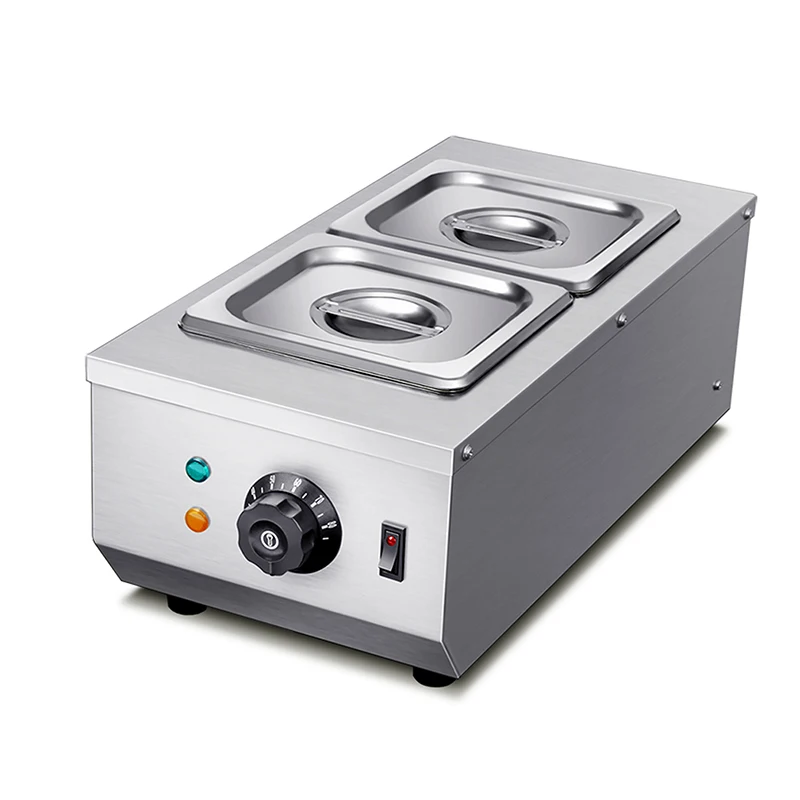
The TEBAK table-top commercial chocolate machine is described as a stainless steel heating and melting pot that processes chocolate through a water-separation furnace design. The source record gives an 800W rated power, 220V/110V rated voltage, two cylinders, 2*1.5L capacity, a 30-85 degrees Celsius temperature control range and a 448*220*170mm product size.
These fields describe the supplied two-cylinder configuration. The same source also states that customers needing three cylinders should contact customer service. That sentence is an option note, not a specification for the standard machine. A buyer should therefore quote the two-cylinder unit and the three-cylinder alternative separately, with separate photos, dimensions, electrical details, capacity, price and packing information.
The source instructs direct-order buyers to note plug, voltage and Hertz. This is a critical export-control item. “220V/110V” does not, by itself, confirm the destination frequency, phase, plug type or factory wiring. Confirm those details before payment and make sure the nameplate, pro forma invoice and packing list describe the same configuration.
1. Controlled product identity
The source product ID is 1601271612159. The listing title identifies a table-top, commercial, stainless steel chocolate furnace, heating and melting pot, and mini chocolate tempering machine. The detailed description uses water-separation furnace wording. These terms should be preserved as source descriptions rather than expanded into unsupported claims about automatic tempering cycles, tempering accuracy, food certifications or continuous production capacity.
The source-confirmed configuration has two cylinders with a combined stated capacity of 2*1.5L. The safest RFQ interpretation is two containers at 1.5L each, but the source does not explicitly define whether this is working capacity, nominal container volume or another catalog convention. Ask the supplier to confirm the capacity per cylinder, recommended fill level and total usable working volume.
The source lists a 30-85 degrees Celsius control range. It does not specify measurement location, display resolution, hysteresis, independent control for each cylinder, warm-up time or temperature uniformity. Request those details if the machine will be used for repeatable chocolate handling. Do not turn the stated range into a claim that every chocolate recipe will be tempered correctly.
2. Source-confirmed specification table
| Field | Source value | Procurement interpretation |
|---|---|---|
| Rated power | 800W | Confirm whether this is total input power for the two-cylinder configuration. |
| Rated voltage | 220V/110V | Confirm selected wiring, frequency, phase, plug and destination compatibility. |
| Capacity | 2*1.5L | Confirm per-cylinder volume, usable working volume and recommended fill level. |
| Number of cylinders | 2 | Default source configuration; quote any three-cylinder option separately. |
| Temperature control range | 30-85 degrees Celsius | Confirm sensor position, resolution, uniformity and actual test conditions. |
| Product size | 448*220*170mm | Confirm order of length, width and height and whether the value is machine size. |
| Heating method | Water-separation furnace wording in source | Confirm water-bath layout, drainage, heating element and cleaning procedure. |
The table separates catalog values from questions that must be confirmed. It does not add a material grade, certification, heating speed, temperature accuracy, output rate or packaging specification because those fields are not supplied in the queue record.
3. Two-cylinder configuration and capacity control
The two-cylinder configuration is the base specification in the source record. With a stated capacity of 2*1.5L, the buyer should ask whether both cylinders are identical, independently heated and independently controlled. Confirm whether one cylinder can run while the other is empty, whether each cylinder has its own temperature control, and whether the machine requires both water jackets to be filled during operation.
Capacity should be defined in the quotation using three fields: cylinder count, nominal cylinder volume and recommended working volume. If the supplier confirms two 1.5L containers, ask for the minimum and maximum chocolate load per cylinder. A nominal volume is not necessarily the permitted product load, especially when space is needed for stirring, expansion or safe movement.
Ask whether the 2*1.5L value includes the water-separation chamber or only the chocolate containers. Request a labeled drawing or photo showing the product vessel, water jacket, lid, drain, control panel and heating zone. This prevents a catalog capacity field from being misunderstood at installation.
For procurement planning, record the quantity of chocolate handled per batch only after a supplier test with the buyer's product. The queue provides capacity but no batch time, recovery time, viscosity range or temperature stability. Do not calculate daily output from the 1.5L value alone.
4. Three-cylinder option: quote separately
The product description says, “If you need 3 cylinders, please contact customer service.” This is useful customization information, but it is not a three-cylinder specification. The source does not give the optional capacity, product size, power, voltage, temperature-control arrangement, weight or price for that version.
If a buyer needs three cylinders, request a separate configuration sheet. It should state cylinder count, volume per cylinder, usable volume, total rated power, electrical connection, control zones, external dimensions, shipping dimensions, net weight, gross weight, included accessories and lead time. Ask for a photo or drawing of the exact three-cylinder unit rather than relying on the two-cylinder image.
Do not assume the three-cylinder model retains 800W or the 448*220*170mm size. Additional cylinders may change heating load, wiring, frame size and controls. Those values require supplier confirmation and should not be copied into a purchase order from the base model.
5. Heating method and water-separation procurement questions
The source describes heating and melting chocolate through a water-separation furnace machine. In a buying specification, define the heating medium and the product path. Ask whether water surrounds the chocolate vessel, whether the water level is visible, whether a drain is provided, and whether the operator must refill or replace water during a production shift.
Confirm the heating element location, dry-run protection, over-temperature protection and restart behavior after power interruption. These safety and operating fields are not included in the source record, so they should be treated as RFQ questions, not implied features.
Ask how the machine handles water condensation, splashing and cleaning. The buyer should know whether the chocolate container, lid, stirrer or nozzle can be removed, and whether water can enter an electrical compartment during cleaning. Request the supplier's cleaning instructions for both the product-contact parts and the water-separation chamber.
Clarify whether “melting pot” and “tempering machine” describe the same operating mode or two different functions in the listing. The source gives a temperature control range but does not provide a tempering program, staged cooling cycle or automatic crystallization control. Avoid promising finished tempering quality without a sample test and a written control description.
6. Temperature control range: what to verify
The stated control range is 30-85 degrees Celsius. Ask whether the range applies independently to each cylinder and whether the displayed value is measured in the water jacket or inside the chocolate. These locations can produce different readings. Request the sensor type, display increment, control tolerance, heating hysteresis and temperature uniformity between cylinders.
Run a temperature acceptance test at several setpoints within the stated range. Record the setpoint, displayed temperature, independent reference reading, time to reach the setpoint, overshoot, recovery after adding product and difference between the two cylinders. The supplier should define the test instrument and measurement position. Without those conditions, “30-85 degrees Celsius” is a range setting rather than a validated process result.
Chocolate handling may require product-specific temperature control. The queue record does not identify chocolate type, viscosity, cocoa-butter content or recipe. Ask the buyer to provide the intended product and target operating temperatures for a pre-shipment test. Do not infer a universal recipe from the machine's control range.
Confirm whether the control system supports a fixed setting only or includes a thermostat, digital display, independent switches, timer or alarm. None of these control details are supplied in the source. They belong in the model-specific quotation.
7. Electrical configuration for international orders
The source lists 220V/110V and explicitly asks direct-order buyers to note plug, voltage and Hertz. Treat this as a mandatory selection step. A buyer in a 220V market and a buyer in a 110V market may require different wiring, plug, fuse, cable, switch, nameplate and test configuration.
Request the exact electrical option in writing: selected voltage, frequency in Hertz, phase, plug standard, rated current, grounding method and power-cord length. Confirm whether 220V/110V is selectable by the user, factory-configured, or dependent on a different version. Do not switch voltage without supplier instructions.
Ask for a nameplate photograph of the selected unit before shipment. The nameplate should agree with the pro forma invoice, packing list, inspection report and manual. If the buyer is ordering a three-cylinder option, request a new nameplate image because the rated power may differ from the 800W base model.
Check the destination electrical installation, breaker rating, socket type and ventilation clearance. The source provides rated power but no current or protective-device requirement. Those installation values must come from the supplier's electrical documentation or a qualified local installer.
8. Product size, bench layout and shipment dimensions
The stated product size is 448*220*170mm. Confirm whether the order is length by width by height, whether controls, handles and protruding fittings are included, and whether the measurement is for the machine body or a working envelope. Ask for a dimension drawing before preparing a bench or packing plan.
Leave access around the machine for loading chocolate, checking water level, removing containers, draining, cleaning and reading the controls. The product is described as table-top, but the source does not give machine weight, bench load, clearance, water volume or cable exit position. These should be confirmed before installation.
Request packed dimensions and gross/net weights separately. The 448*220*170mm value should not be used as a shipping-carton dimension unless the supplier confirms it. Ask whether cylinders, lids, accessories or spare parts are packed inside the main carton and whether any assembly is required on arrival.
For the optional three-cylinder version, require a separate dimension and packing list. Do not use the two-cylinder footprint for container loading or warehouse planning.
9. Stainless steel and product-contact material questions
The title and description use stainless steel wording, but the source excerpt does not identify a steel grade, surface finish or which components are stainless. Request a parts list identifying the product-contact vessel, lid, stirrer, nozzle, drain and water chamber materials.
If the machine will be used in a food-production environment, ask for the supplier's available material documentation and cleaning guidance. Do not claim a food-contact certification or a particular stainless grade unless the supplier provides it. Surface finish, weld treatment, crevice control and removable-part design can affect cleaning and residue management.
Confirm whether the water-separation chamber and chocolate vessel are made from the same material. Ask whether gaskets, seals, handles and electrical insulation are exposed to heat or product splash. The source does not provide seal material or maximum continuous temperature, so include both in the RFQ.
Inspect the vessel interior, lid fit, drain, control panel and welds during pre-shipment inspection. Photograph the exact machine and record serial or batch information when available.
10. Chocolate changeover, cleaning and maintenance
Procurement should cover the full changeover path, not only the heater. Ask how the operator removes remaining chocolate, whether the vessel can be emptied without tilting the machine, whether a drain or outlet is provided, and how the water jacket is drained and cleaned.
Request a daily and periodic maintenance schedule. It should identify water replacement, vessel cleaning, seal inspection, cable inspection, thermostat checking and descaling if water is used as the heating medium. The queue record does not provide service intervals, so the supplier must supply them.
For multiple chocolate types or flavors, confirm whether separate vessels or validated cleaning is required. Ask for the recommended cleaning agents and prohibited methods. Do not use abrasive cleaning or immerse electrical components without written instructions.
Confirm spare-part availability for heating elements, thermostats, switches, sensors, seals, vessels and lids. Ask for part numbers, prices, warranty coverage and response procedure. These items are more useful than a generic warranty statement when the machine is used in a commercial kitchen or production room.
11. Acceptance test before shipment
Use the exact ordered configuration for the acceptance test. For the base unit, the record should show two cylinders, 2*1.5L capacity, 800W and the selected voltage/frequency. If a three-cylinder version is ordered, the test sheet must be rewritten with its own values rather than copied from the two-cylinder model.
Test both cylinders independently and together if the controls allow it. Record start temperature, setpoint, time to reach temperature, displayed reading, independent reference reading, overshoot, recovery and difference between cylinders. Add the buyer's chocolate or a mutually agreed test material and document the quantity loaded per cylinder.
Inspect the water-separation system for leaks, overflow, drain access and heating behavior. Check lid fit, vessel removal, control operation, emergency stop or power-off behavior if provided, and restart after a controlled power interruption. The test should also verify that the machine does not expose product to water.
Photograph the nameplate, plug, controls, two-cylinder layout, product vessels and packed accessories. Keep the inspection report with the model-specific quotation. The source does not state a formal certification, so the buyer should not mark the product as certified without separate documentation.
12. RFQ checklist for the base model
- Confirm product ID 1601271612159 and the exact two-cylinder configuration.
- Confirm rated power as 800W and state whether this is total machine input power.
- Select 220V or 110V and specify frequency in Hertz, phase, plug standard and nameplate.
- Confirm capacity as 2*1.5L, including capacity per cylinder and recommended working fill.
- Confirm two cylinders and whether each cylinder has independent temperature control.
- Confirm the 30-85 degrees Celsius control range and provide control tolerance, sensor position and display resolution.
- Confirm product size 448*220*170mm, measurement order, units and whether fittings are included.
- Explain the water-separation furnace layout, drain, water level, dry-run protection and cleaning procedure.
- Identify stainless-steel grades or materials for every product-contact component if documentation is available.
- Provide machine weight, packed dimensions, gross/net weights, accessories and installation requirements.
- Supply a model-specific quotation, manual, spare-parts list, warranty and pre-shipment test report.
13. RFQ checklist for the three-cylinder option
For three cylinders, ask for a complete replacement specification rather than an add-on sentence. Confirm the number of cylinders, capacity per cylinder, total working volume, rated power, voltage options, frequency, control zones, product size, packed dimensions, net/gross weights, material list and included accessories.
Ask whether all three cylinders can heat simultaneously and whether they share one thermostat or have independent controls. Confirm whether the 30-85 degrees Celsius range remains valid and whether the product size remains 448*220*170mm. Neither point is supplied for the optional version.
Request a new photo of the three-cylinder machine, a new nameplate photo and a separate price. Ensure the invoice does not show two cylinders while the listing image or packing list shows three. Treat the option as a new configuration until the supplier's documents prove otherwise.
14. Questions for the supplier
Ask: Is the quotation for the standard two-cylinder unit or the optional three-cylinder version? Does 2*1.5L mean two vessels at 1.5L each, and what is the usable working volume? Is 800W the total rated input for both cylinders? Which voltage and Hertz will be wired at the factory? Which plug will be supplied? Are the two cylinders independently controlled? Where is the temperature sensor located? What tolerance and display resolution apply across 30-85 degrees Celsius?
Also ask: What exactly does water-separation furnace mean in the machine layout? How is the water jacket drained and cleaned? What parts contact chocolate? What are the machine and packing weights? Is 448*220*170mm the body size or the shipping size? What documentation is available for stainless material, safety protection and warranty? If three cylinders are required, what are the new power, capacity, size and price fields?
Request a video or test report using the buyer's intended chocolate and loading quantity. Confirm the temperature readings, heating time, cylinder uniformity, water leakage check, cleaning procedure and nameplate. A supplier who cannot provide a model-specific document should not be treated as having confirmed the optional configuration.
15. Final procurement decision
The TEBAK table-top chocolate melting machine has a clearly defined source configuration: 800W, 220V/110V, two cylinders, 2*1.5L capacity, 30-85 degrees Celsius control range and 448*220*170mm product size. Those values are suitable for a structured RFQ when they are paired with the selected electrical option, capacity definition, temperature test method and machine dimensions.
The three-cylinder statement is an available-contact option, not a default specification. Keep it separate from the two-cylinder model until the supplier provides its own power, capacity, control, dimension, price and packing details. Confirm plug, voltage and Hertz before ordering, as the source explicitly instructs.
Editor's note: This guide uses only the supplied Hoting queue fields. It does not add unsupported certification, steel grade, temperature accuracy, production capacity, automatic tempering program or customer case study. Missing technical and commercial details remain supplier-confirmation items.
Key specifications
- Source product ID
- 1601271612159
- Product type
- Table-top commercial stainless steel chocolate melting and heating machine
- Rated power
- 800W
- Rated voltage
- 220V/110V
- Source configuration
- 2 cylinders, capacity 2*1.5L
- Temperature control range
- 30-85 degrees Celsius
- Product size
- 448*220*170mm
- Optional configuration note
- Source states that a 3-cylinder version is available by contacting customer service; it is not the default 2-cylinder specification
- Electrical confirmation
- Confirm plug, voltage and Hertz before placing a direct order
- Process description
- Source describes chocolate heating and melting through a water-separation furnace machine
Frequently asked questions
- What is the source-listed standard configuration?
- The source lists 800W, 220V/110V, two cylinders, 2*1.5L capacity, a 30-85 degrees Celsius temperature control range and 448*220*170mm product size.
- Is the three-cylinder version included by default?
- No. The source says customers needing three cylinders should contact customer service. Quote and verify that option separately.
- What electrical details must be confirmed?
- Select 220V or 110V and confirm frequency in Hertz, phase, plug standard, nameplate and factory wiring before ordering.
- Does the temperature range prove automatic tempering performance?
- No. It is a source-listed control range. Ask for sensor position, tolerance, uniformity and a test with the buyer's chocolate.
- What does 2*1.5L mean?
- The source lists two cylinders and 2*1.5L. Confirm whether this means two vessels at 1.5L each and ask for usable working volume and fill limits.