
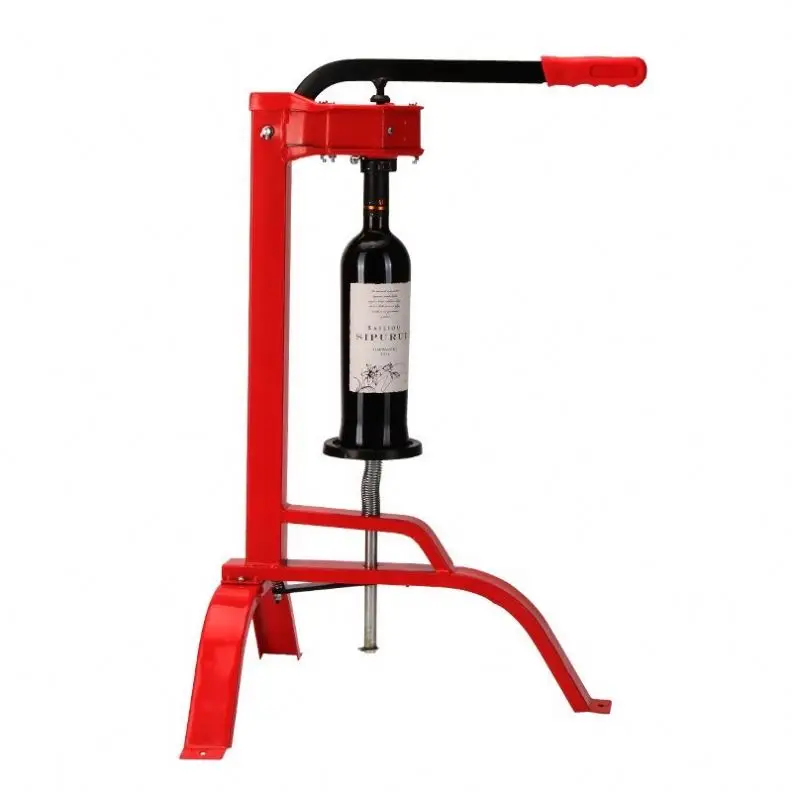
Why a manual wine corker needs a bottle-specific purchase check
The TEBAK Wine Bottle Sealing Machine is described as a manual wine bottle corker and champagne corker for pressing a cork into a bottle mouth. The source fields identify an Iron frame, Red color, 720X430MM size, MOQ of 1 PC and OEM/ODM availability. The description also states that the pressure bar is stainless steel, the handle is plastic with an anti-slip design, the chassis is adjustable and the base is triangular.
These are useful purchase anchors, but they do not establish compatibility with every wine bottle, champagne bottle or cork format. The source record does not provide bottle-height range, neck diameter, cork diameter, maximum cork hardness, pressing force, stroke, working clearance, cycle time or dimensional drawing. A buyer should confirm those values with a sample bottle and a supplier-approved drawing before ordering.
This B2B buying guide is for wineries, beverage distributors, small bottling lines, tasting rooms, restaurants, hospitality suppliers and packaging-equipment dealers. It separates the visible source facts from the RFQ items needed to decide whether this manual press fits the intended bottle and cork workflow.
1. Controlled identity from the source record
The source product ID is 1601277190006. The product-name field is “Wine Bottle Sealing Machine Manual Wine Bottle Corker Champagne Corker.” The title also uses manual corker, portable wine cork press and bottle corking capping machine wording. These terms indicate a hand-operated bottle-mouth pressing tool, but they do not prove that the same configuration supports both standard wine corks and champagne-style closures.
The source material is Iron and the listed color is Red. The size is written as 720X430MM; request the supplier to clarify whether this is overall height by width, a frame dimension, a packed size or another measurement. Do not use the raw string as a confirmed installation footprint until a drawing is supplied.
2. Source-confirmed specification table
The following table repeats the available queue fields and the mechanical features stated in the description. Open fields remain RFQ requirements.
| Field | Source value or procurement control |
|---|---|
| Product ID | 1601277190006 |
| Product type | Manual wine bottle sealing machine; wine bottle corker; champagne corker |
| Frame material | Iron |
| Color | Red |
| Source size | 720X430MM; confirm dimension definition and unit order |
| MOQ | 1 PC |
| OEM/ODM | Warmly welcome |
| Pressure bar | Stainless steel; wear-resistant and pressure-resistant wording appears in the source description |
| Handle | Plastic anti-slip handle |
| Base | Triangle base; source describes firm and stable support |
| Bottle, cork, force and output range | RFQ required |
3. Confirm the closure and bottle format
Ask the supplier to identify the closure types supported by the quoted machine: natural cork, agglomerated cork, synthetic cork, champagne-style cork or another closure. “Wine bottle corker” and “champagne corker” are not interchangeable performance specifications. Request the compatible cork diameter, length, hardness and surface treatment.
Provide the supplier with the buyer's actual bottle drawings or samples. Confirm neck outside diameter, internal diameter, lip shape, bottle height, shoulder position, glass tolerance and the clearance required around the mouth. The adjustable chassis should be tested across the complete bottle-height range, not just one sample.
Ask whether the bottle is held by the base, a neck guide, a clamp or an operator. Confirm how the press prevents bottle tipping and whether the triangle base requires a fixed bench, non-slip feet or additional bolting. A stable base reduces risk but does not replace a bottle-specific holding test.
4. Mechanical pressing sequence
The source describes a pressure bar, a plastic anti-slip handle and an adjustable chassis. Request an illustrated sequence showing bottle placement, cork alignment, pressure-bar travel, end position and bottle removal. Confirm whether the operator pre-compresses the cork, centers it manually or uses a guide.
Pressing force, stroke length, leverage ratio and cycle time are not provided. Request a test report with the selected cork and bottle. Record the force or handle condition if measured, the number of strokes, the final cork position, bottle damage and seal appearance. Do not convert “labor saving” wording into a numeric force or productivity claim.
Inspect the pressure bar for straightness, surface finish, contact diameter and replaceability. The description identifies stainless steel, but it does not provide grade, diameter or thread. Request the material and maintenance specification for the pressure bar and any contact pad.
5. Adjustable chassis and installation
The adjustable chassis is a key configuration feature. Ask for the adjustment method, range, locking mechanism, reference scale and required tools. Confirm whether adjustment is made for bottle height, bottle neck position, cork length or a combination. The quote should include a drawing showing the minimum and maximum working envelope.
The 720X430MM source size needs clarification before installation. Request overall height, width, depth, base footprint, working clearance, handle swing, bottle access and packed dimensions. Measure the actual bench and operator space. A hand-operated press can require more clearance than its frame footprint because the handle travels through an arc.
For a small bottling line, define the position of the operator, incoming bottles, corks and finished bottles. Ensure that the base remains stable while the handle is pulled. If the supplier recommends bolting or clamping, request the hole pattern and fastener details before placing the order.
6. Bottle protection and quality acceptance
The source says the machine fixes the bottle mouth so the cork can be pressed accurately and helps prevent smashing from improper positioning. This is a design intention, not a guaranteed result for every bottle. Test the actual glass bottle and closure combination at the intended setting.
Acceptance should inspect cracks, chips, scratches, tilted bottles, broken corks, torn cork surfaces, excessive insertion depth and loose closures. Record the bottle lot, cork batch, operator, adjustment setting and number of successful cycles. Include a reject definition in the inspection sheet.
Use a gradual sample test: empty mechanical movement, bottle positioning without a cork, cork insertion at low volume, repeat cycles and an extended operator trial. Stop immediately if glass damage or unsafe movement appears. Do not continue a pressure test after the bottle or press shows abnormal resistance.
7. Materials, corrosion and cleaning
The frame is listed as Iron, the pressure bar as stainless steel and the handle as plastic. The source does not provide frame coating, stainless grade, fastener material, surface treatment or corrosion-resistance data. Request a material schedule for the frame, pressure bar, guides, base, adjustment parts, pins and fasteners.
Wine and cleaning liquids can contact working surfaces. Ask which surfaces may be wiped with the buyer's detergent or sanitizer and which must remain dry. Confirm drainage, residue traps, lubrication points and the procedure for preventing oil from reaching the bottle or cork.
Inspect red coating or paint for chips, sharp edges and exposed metal. Ask for touch-up guidance, storage conditions and protection against humid cellar or bottling-room environments. Do not claim food-contact compliance from the color or the stainless pressure-bar wording alone.
8. Operator safety
Manual pressing equipment has pinch and crush points around the pressure bar, chassis, bottle neck and handle. Ask the supplier to identify these points and provide guard, hand-clearance and operating instructions. Confirm whether the handle has a safe rest position and whether the press can move unexpectedly after adjustment.
Operators should keep hands away from the bottle mouth and pressure path, use the supplied handle and inspect each bottle before pressing. The training sheet should cover bottle rejection, broken-cork cleanup, glass-breakage response and isolation of the press before adjustment.
Test the triangle base, feet, bench stability and handle swing under the highest intended pressing resistance. If the buyer needs a fixed installation, document the anchoring method. A “firm and stable” description should be verified on the actual bench, not assumed from the listing text.
9. Portable use and workflow
The title uses “portable wine cork press,” but the source does not state net weight, carrying handles, packed size or whether the machine is designed for frequent relocation. Request those details. A 720X430MM frame may be movable for storage yet still require a stable work surface during pressing.
For tasting rooms or small wineries, count the operator movements: pick bottle, place cork, align bottle, press, inspect, remove and transfer. Measure the observed cycle time with the buyer's bottle and cork. Do not publish a pieces-per-hour claim unless the same workflow and quality criteria are stated.
For distributors, ask whether the adjustment can be reset consistently after relocation. A reference scale, lock, or setup gauge may be needed. Request the setup procedure and a short acceptance video using the selected bottle format.
10. OEM/ODM and private-label control
The source says OEM/ODM is warmly welcome. Treat this as an availability statement, not a confirmed customization scope. Ask which items can be customized: color, logo, handle, pressure-bar finish, base, packing, labels, manual and accessories. Confirm MOQ, sample charges, artwork approval, lead time and inspection criteria for each change.
For a Red frame, approve a color sample or reference code. Confirm logo position, label material, warning language and carton marks. Any change to the pressure bar, bottle guide, chassis or base should trigger a new drawing and sample approval because it may change fit or safety.
Keep the OEM/ODM version separate from the standard model in the purchase order. Record model code, drawing revision, color, material schedule and included accessories so a standard red unit is not substituted for a customized version.
11. MOQ, packaging and spares
The source MOQ is 1 PC, which is useful for a sample or low-volume purchase. Confirm whether the MOQ applies to the standard Red version only or also to OEM/ODM customization. Ask for sample price, production lead time, inspection terms and the point at which customization charges apply.
Packaging details are not included in the record. Request packed dimensions, gross weight, crate or carton construction, moisture protection, handle restraint, pressure-bar protection and base immobilization. The adjustable chassis and handle should be secured so they cannot move during transport.
Request spare part numbers for pressure bar, handle, pins, guides, adjustment hardware, feet, base components and fasteners. Confirm whether the supplier provides a tool kit, setup gauge, replacement handle or bottle guide. Agree warranty response and replacement-part lead times in writing.
12. RFQ checklist
- Confirm product ID 1601277190006, model code and exact manual configuration.
- Identify supported bottle types, bottle heights, neck diameters, lips and cork formats.
- Explain whether “wine bottle corker” and “champagne corker” refer to one setup or separate options.
- Provide overall dimensions, clarify 720X430MM, and show the working clearance and handle swing.
- Provide pressure-bar diameter, travel, force, material grade and replaceability.
- Provide chassis adjustment range, locking method, scale and setup instructions.
- Provide frame coating, stainless grade, fastener materials and cleaning guidance.
- Demonstrate bottle protection, stability, bottle holding and reject handling with the buyer's samples.
- Confirm MOQ 1 PC, OEM/ODM scope, color, logo, packaging and lead time.
- Agree pre-shipment inspection, spares, warranty, service and packing requirements.
13. Questions for the supplier
Ask the supplier to answer these questions in the quotation: What bottle heights and neck diameters are supported? Which corks are compatible? Does the same configuration work for wine and champagne closures? What does 720X430MM measure? What is the adjustment range? What is the pressure-bar material grade and travel? How is the bottle held? What are the frame coating and fastener materials? How is the press cleaned and lubricated? What sample test proves bottle safety and cork position? What does OEM/ODM include at MOQ 1 PC?
If the supplier cannot provide these answers, keep the order at RFQ or sample-review stage. A low MOQ and portable wording do not prove closure compatibility, safe pressing force or stable operation on the buyer's bottle.
14. Final procurement decision
This TEBAK manual corker is a candidate for small wineries, beverage distributors and hospitality operations that need hand-operated bottle-mouth pressing. The source-confirmed anchors are product ID 1601277190006, Iron frame, Red color, 720X430MM source size, MOQ 1 PC, OEM/ODM availability, stainless steel pressure bar, plastic anti-slip handle, adjustable chassis and triangle base.
Approve the order only after the supplier confirms the bottle and cork range, working envelope, pressing method, material schedule, safety instructions, sample results and packaging. Keep the product ID, drawing revision, bottle sample reference and inspection report together for traceability. This prevents a different manual corker or an incompatible closure setup from being shipped under a broad wine-bottle title.
Editor's note: Product facts in this guide are limited to the supplied Hoting queue record. Company-level statements are not treated as product-specific certification, performance evidence or customer proof.
Key specifications
- Product type
- Manual wine bottle sealing machine; manual wine bottle corker; champagne corker
- Source product ID
- 1601277190006
- Frame material
- Iron
- Color
- Red
- Source size
- 720X430MM; confirm measurement definition and unit order
- MOQ
- 1 PC
- OEM/ODM
- Warmly welcome
- Pressure bar
- Stainless steel; source description says wear-resistant and pressure-resistant
- Handle
- Plastic anti-slip handle
- Base and adjustment
- Adjustable chassis; triangle base; source describes labor saving, firm and stable support
- Bottle compatibility, force and cycle time
- Not provided; request drawing and test data
Frequently asked questions
- What material and color are listed?
- The source lists an Iron frame and Red color. It separately describes a stainless steel pressure bar and plastic anti-slip handle.
- What does 720X430MM measure?
- The source provides the string but does not define the dimension order or whether it is the frame, working or packed size. Request a dimensioned drawing.
- Can one machine press wine and champagne corks?
- Do not assume so. Confirm compatible closure types, cork dimensions, bottle necks and whether separate guides or settings are required.
- What is the MOQ?
- The source MOQ is 1 PC. Confirm whether this applies to the standard Red version and to any OEM/ODM customization.
- Is the adjustable chassis sufficient for different bottles?
- The description states an adjustable chassis, but the range and locking method are not provided. Verify with the buyer's actual bottle samples and a drawing.