
Source-controlled product identity
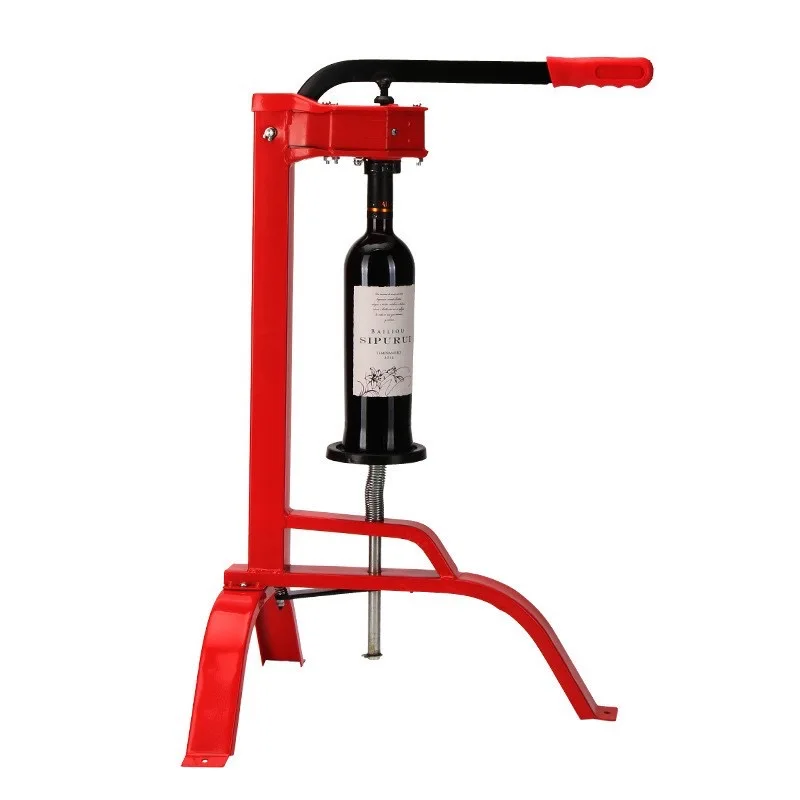
The Hoting queue record identifies a TEBAK manual wine bottle sealing machine, wine bottle corker and champagne corker. The structured fields confirm the product name, iron material, red color, 720X430MM listed size, MOQ of 1 PC and an OEM/ODM option described as warmly welcome. These are the verified commercial fields available for this buying guide.
The source description also presents a stainless-steel pressure bar, a plastic handle, an adjustable chassis, a bottle-mouth fixing arrangement and a triangle base. These are product-description claims that should be checked on the exact quotation and sample. The record does not provide cork diameter, bottle-height range, bottle-neck standard, pressing force, cycle time, operator height, net weight, package size, certification, warranty or production capacity. Those items remain supplier confirmation points.
Product ID 1601271986231 should be printed consistently on the quotation, product label, inspection record and packing list. This guide is for wineries, beverage bottlers, hospitality suppliers, tasting rooms, small beverage producers, distributors and buyers sourcing a manually operated bottle-corking tool.
Confirmed fields and open RFQ questions
| Information | Recorded value or status | Buyer action |
|---|---|---|
| Product ID | 1601271986231 | Require the same ID on the quotation, label, inspection sheet and shipping documents. |
| Product name | Manual wine bottle corker / champagne corker | Confirm the exact operating sequence and whether the quoted unit is manual only. |
| Material | Iron | Request frame grade, coating, corrosion protection and food-contact parts information. |
| Color | Red | Confirm finish, color reference, coating durability and acceptable visual variation. |
| Listed size | 720X430MM | Confirm whether these are overall dimensions, footprint or a packed/working dimension. |
| MOQ | 1 PC | Confirm whether the MOQ applies to the red standard version and the requested destination. |
| OEM/ODM | Warmly welcome | Define logo, color, packaging, label, drawing, sample and tooling requirements in writing. |
| Pressure bar | Stainless steel claim in description | Confirm grade, diameter, surface finish, adjustment and replacement-part specification. |
| Handle | Plastic handle claim in description | Confirm material, grip dimensions, attachment and resistance to cleaning chemicals. |
| Adjustable chassis | Description claim | Request adjustment range, locking method, bottle support and repeatability test. |
Define the bottling application before selection
A manual wine bottle corker should be selected from the bottle, closure and operating method, not from the word “champagne” in a title alone. Record the bottle material, neck finish, internal neck diameter, outside neck diameter, bottle height, shoulder shape, base stability and the cork or closure specification.
Describe the intended work as a repeatable test: bottle model, empty and filled weight, closure material, closure diameter and length, insertion depth, operator position, acceptable seating height, allowable cosmetic marks and the expected number of bottles per shift. The same bottle and closure should be used for supplier testing and incoming acceptance.
For a winery, prioritize consistent cork seating, clean contact surfaces and fast changeover between bottle formats. For a tasting room or small producer, prioritize safe handling, stable support and easy cleaning. For a distributor, specify bottle compatibility and accessory configuration per customer rather than treating one listed size as universal.
Ask the supplier whether the machine is intended for natural corks, agglomerated corks, synthetic corks, champagne-style closures or another closure family. Do not infer compatibility from the product name.
720X430MM: verify what the dimension represents
The structured size is 720X430MM. The source does not state whether this is the overall height and width, the base footprint, the working envelope or a package dimension. Request a dimensioned drawing with all three axes, support points, handle travel, bottle clearance and adjustment limits.
Measure the receiving route, bench or floor area, operator access, bottle loading zone and space needed to remove a finished bottle. Confirm whether the base is intended for a workbench, floor mounting or another support. Ask for the net weight and center of gravity before selecting a stand or shipping method.
Check whether the pressure bar or handle extends beyond the listed envelope during operation. Record the maximum bottle height and the clear area around the neck. A static dimension can be correct while the working envelope is too small for the buyer's bottle.
At incoming inspection, photograph the crate or carton before opening, then record the actual frame dimensions, support points, handle movement and any adjustable members. Compare the result with the approved drawing and packing list.
Bottle-neck and cork compatibility
The source does not provide a bottle-neck diameter range, closure size, insertion depth or compatible standards. These are critical procurement fields. Ask for a compatibility table covering the buyer's exact bottle and closure references.
Request the opening or compression geometry, guide dimensions, bottle support height and any centering feature. Confirm how the bottle is held during insertion and how the mechanism prevents lateral loading, glass contact or bottle tipping.
Test at the smallest and largest intended bottle formats, including tolerance limits. Measure closure seating depth, verticality, surface damage, neck damage and leakage after handling. If the buyer uses multiple formats, define the changeover parts, tools and adjustment steps.
Do not approve “wine bottle” compatibility without a sample run. Wine bottles vary by glass design, neck finish, shoulder, height and weight. The corker should be approved against the actual bottle and closure combination.
Pressure bar, handle and force verification
The description mentions a stainless-steel pressure bar and a plastic handle, but no force, stroke, bar diameter, handle length or ergonomic limit is supplied. Ask the supplier to identify the load path and the point where the pressure is applied.
Request the pressure-bar material grade, surface finish, straightness, replaceability and contact geometry. Confirm whether the bar contacts a closure, a guide, a bottle support or another part. Check that the bar is aligned with the bottle axis throughout the stroke.
Measure the operator force required for the intended closure at the beginning, middle and end of the insertion stroke. Record the bottle support, closure lubrication if any, insertion speed and final seating result. A nominally strong frame does not prove that the process is comfortable or repeatable.
Inspect the plastic handle for secure attachment, sharp edges, grip comfort and resistance to the buyer's cleaning method. Request replacement-handle information and verify that the handle cannot loosen during normal cycling.
Adjustable chassis and bottle support
The source describes an adjustable chassis intended to accommodate different bottle heights, but no range or locking method is recorded. Ask for the adjustment drawing, scale markings, locking hardware and the maximum safe load.
Check whether the chassis supports the bottle body, base or neck. Confirm the contact material and whether it can scratch labels or glass. The support should keep the bottle centered and stable while the closure is inserted.
Run a repeatability test after changing the chassis setting. Record the number of turns, reference marks, locking force and resulting closure height. Verify that vibration, handle movement and cleaning do not change the setting.
If different customers use different bottle families, ask for optional supports or adapters and list them separately on the quotation. Never assume that an adjustable chassis includes every adapter shown in a product image.
Iron frame and hygiene requirements
Iron is the recorded primary material. Ask for the frame construction, surface treatment, coating thickness or finish, corrosion resistance and cleaning limitations. The buyer should know which areas are painted, plated, stainless steel or polymer.
For beverage environments, distinguish food-contact or near-contact parts from structural parts. Request the material and cleaning information for the pressure bar, bottle support, closure guide and any part that may contact the bottle neck or closure.
Inspect welds, corners, fasteners, threaded adjustments and recesses where liquid or cork particles could collect. Prefer surfaces that can be wiped and dried without damaging the finish. Confirm whether the frame can be cleaned with the buyer's approved detergent and sanitizer.
Do not claim food-grade status, stainless-steel construction or corrosion-proof performance unless the supplier provides the relevant material and compliance documents for the exact configuration.
Manual workflow and operator safety
Ask for the complete operating sequence: place the bottle, position the closure, adjust the support, actuate the handle, release the bottle and reset the mechanism. Confirm whether the operator must hold the bottle, and whether that creates a pinch or glass-breakage risk.
Identify moving parts, pinch points, stored mechanical energy, handle return behavior and bottle-release movement. Request guards or safe hand positions where appropriate. Operators should use suitable eye protection and follow the supplier's instructions for glass and closure handling.
Test an empty bottle, a filled bottle and a representative closure only under a controlled procedure. Record whether the bottle remains stable, whether the closure enters squarely and whether the handle can return without striking the operator.
For a shared production area, define training, cleaning, inspection and lockout or isolation steps. For a small operation, place the unit on a stable surface and keep the working area free from broken glass, loose corks and spilled liquid.
Capacity and cycle-time questions
The source does not provide bottles per hour, cycle time or recommended duty cycle. Request a measured cycle time using the buyer's bottle and closure, including loading, adjustment and removal—not only the handle stroke.
Ask whether the quoted cycle time assumes one trained operator, a particular closure, fixed bottle height and a clean dry surface. Record operator fatigue, misfeeds, re-adjustments and rejected closures during a longer trial.
Do not convert a manual stroke into a guaranteed production rate. A reliable buying specification should state the tested bottle, closure, operator method, acceptance rate and shift conditions. For a distributor, offer a sample test before promising output to an end customer.
OEM and ODM procurement
The source lists OEM/ODM as warmly welcome. Treat this as an invitation to discuss customization, not as proof that every option is available. Define the requested logo, frame color, label, handle material, packaging, manual language, barcode and spare-parts marking.
Request an approval drawing or sample before mass production. Confirm which changes affect the frame, bottle support, pressure bar, tooling, packaging or inspection criteria. Record the final revision number on the purchase order.
For a private-label program, specify artwork ownership, logo placement, color reference, print durability, carton marks and whether a neutral carton is required. Ask how customized parts affect MOQ, lead time, replacement parts and warranty.
Keep the standard red iron configuration and the customized configuration as separate line items. This prevents a generic catalog photo from being treated as the final approved product.
Incoming inspection and packaging
The source does not provide package dimensions, gross weight, packaging method or included accessories. Request carton or crate size, protection materials, pallet requirement, lifting instructions and package markings before booking freight.
Inspect the package for impact, moisture, crushed corners and exposed metal. Photograph the package labels and product ID before opening. After unpacking, check the frame, pressure bar, handle, chassis, fasteners, coating and any adjustment hardware.
Match the packing list to the order. Confirm whether the shipment includes a manual, tools, adapters, spare pressure parts, bottle supports, fasteners and cleaning guidance. Product images are not an accessory list.
After assembly, verify that the unit is stable, the handle moves smoothly, the chassis locks and the pressure bar is aligned. Record actual dimensions and any cosmetic or functional deviation before production use.
Factory acceptance test proposal
- Verify product ID 1601271986231, exact model, label and approved red finish.
- Verify iron frame construction, coating, welds, fasteners and corrosion-protection specification.
- Verify the 720X430MM dimension and provide a complete three-axis operating drawing.
- Verify pressure-bar material, grade, contact geometry, alignment and replacement part.
- Verify handle material, attachment, grip and safe return movement.
- Verify adjustable chassis range, lock, bottle support and repeatability after adjustment.
- Run the buyer's bottle and closure at the smallest and largest approved formats.
- Measure closure seating depth, verticality, bottle stability, surface marks and leakage result.
- Measure operator force and cycle time using the agreed work method.
- Check pinch points, glass-contact risks, cleaning access and safe hand positions.
- Verify packing list, package protection, manual, tools, spare parts and shipping marks.
- Review MOQ 1 PC for the requested configuration and document OEM/ODM change controls.
RFQ checklist
- Product ID 1601271986231 and exact model/nameplate photograph.
- Product name: manual wine bottle sealing machine, wine bottle corker and champagne corker.
- Iron frame grade, coating, finish, corrosion protection and cleaning limits.
- Red color reference, acceptable variation and private-label finish options.
- 720X430MM definition, unpacked dimensions, operating envelope and installation clearances.
- Compatible bottle height, neck diameter, neck finish, bottle weight and closure dimensions.
- Compatible closure materials, insertion depth, seating tolerance and leakage test.
- Pressure bar material, grade, diameter, force, stroke, alignment and replacement part.
- Handle material, grip, attachment, return movement and cleaning resistance.
- Adjustable chassis range, locking method, bottle support and optional adapters.
- Cycle time, recommended duty cycle, operator method and measured acceptance rate.
- Net weight, gross weight, package size, carton or crate method and lifting instructions.
- MOQ confirmation: 1 PC for the exact standard or customized configuration.
- OEM/ODM scope, artwork, logo, packaging, manual, samples, revision and change control.
- Spare parts, warranty, inspection terms, lead time, destination documents and after-sales contact.
Buyer decision framework
This candidate is a manually operated TEBAK wine bottle sealing and corking machine with recorded iron construction, red color, 720X430MM listed size, MOQ 1 PC and OEM/ODM availability. The product description additionally identifies a stainless-steel pressure bar, plastic handle, adjustable chassis and triangle base, but those details should be confirmed on the quoted configuration.
Approve the unit only after the supplier demonstrates the buyer's exact bottle and closure, defines the operating dimensions, confirms the manual force and cycle method, documents the frame and contact materials, and supplies packaging and spare-parts information. The most important open questions are bottle compatibility, closure seating, chassis range, pressure-bar alignment, actual dimensions and safe operator workflow.
Frequently asked questions
Is the 720X430MM size the machine footprint?
The source records 720X430MM but does not define the measurement. Request a dimensioned drawing showing overall size, base footprint, working envelope and handle travel.
Can it cork every wine or champagne bottle?
Compatibility is not confirmed by the title. Test the exact bottle neck, bottle height, closure and insertion depth, and request the supplier's compatibility range.
What is the machine made from?
The structured field records iron. The description separately mentions a stainless-steel pressure bar and plastic handle. Request the material and finish for every bottle-contact and structural part.
Does MOQ 1 PC include OEM branding?
The record lists MOQ 1 PC and says OEM/ODM is warmly welcome, but it does not define customized MOQ or cost. Confirm the MOQ for the exact logo, color, packaging and drawing.
What production capacity should the buyer expect?
No capacity or cycle time is recorded. Request a timed sample test using the buyer's bottle and closure, including loading, adjustment, insertion and removal.
Source and contact
This guide is based on the Hoting queue record for product ID 1601271986231. The recorded fields are the manual wine bottle sealing machine product name, iron material, red color, 720X430MM size, MOQ 1 PC and OEM/ODM warmly welcome. Before purchase, request the current quotation, dimensioned drawing, bottle and closure compatibility table, pressure-bar and chassis data, measured operator test, packaging details, spare-parts list, warranty and destination-market documents. For sourcing questions, contact the TEBAK sales team through the site's current inquiry channel.
Key specifications
- Product Name
- Wine Bottle Sealing Machine Manual Wine Bottle Corker Champagne Corker
- Material
- Iron
- Color
- Red
- Size
- 720X430MM
- MOQ
- 1 PC
- OEM/ODM
- Warmly welcome