
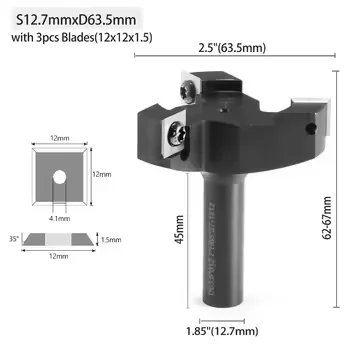
A woodworking router bit should be purchased from a verified cutting profile, shank interface, blade configuration, speed range, and workpiece requirement. The TEBAK Hoting queue record identifies product ID 1601292762530 with the title wording “TEBAK Factory Direct Supply Cheap T-milling Cutter with Three Blades for Woodworking.” The same record's Product Name field reads “12 Shank1/2" shank Round Over Rail & Stile with Cove Panel Raiser 1Bit Router Bit.”
Those two descriptions do not establish one unambiguous product. The title says three blades, while the Product Name says 1Bit. The Product Name also begins with “12 Shank,” followed by “1/2" shank,” which may be a formatting error or a separate size reference. The source provides Yellow painted colour, wood trimming and carving application, size 5*5*9.2cm, and Plastic Box sample packaging. This guide preserves the conflicts and turns them into RFQ and sample-approval controls.
1. What product ID 1601292762530 confirms
Use product ID 1601292762530 on the quotation, drawing, tool label, inspection report, packing list, and purchase order. The queue record confirms woodworking trimming and carving wording plus several commercial description fields, but it does not provide the dimensional and cutting data needed to qualify a router bit for production.
| Recorded field | Source value | Buyer action |
|---|---|---|
| Brand | TEBAK | Use TEBAK and product ID 1601292762530 on all technical and commercial records. |
| Title wording | T-milling cutter with three blades for woodworking | Confirm whether this is the actual supplied geometry and whether the cutter has three cutting edges. |
| Product Name wording | 1/2" shank Round Over Rail & Stile with Cove Panel Raiser 1Bit Router Bit | Confirm the profile, shank, cutter type, and one-bit versus three-blade configuration. |
| Colour | Yellow painted | Use as an appearance identifier only; do not treat paint as a coating or material specification. |
| Application | Wood trimming and carving | Confirm wood species, machine type, profile, feed, RPM, and acceptable finish. |
| Size | 5*5*9.2cm | Define whether it is tool size, cutting envelope, overall dimension, or sample package dimension. |
| Sample package | Plastic Box | Confirm whether the plastic box is included in every order and protects the cutting edges. |
2. Resolve the product-description conflict first
The title says “T-milling Cutter with Three Blades,” while the Product Name says “1Bit Router Bit.” A three-blade cutter and a one-bit router bit can refer to different tool constructions, but the source does not explain the terminology. Do not publish or purchase on the assumption that “1Bit” means one cutting edge, one tool, or one piece.
Ask the supplier to provide one controlled product name and a marked drawing. The drawing should show cutting edges, profile, body, shank, bearing if any, cutting height, outside diameter, and the direction of rotation. Request a front view and a section view so the buyer can distinguish a three-edge cutter from a single-profile bit.
Include the conflict in the purchase-order clarification: “Title and Product Name contain different blade-count and tool-type descriptions. Supplier must confirm the supplied geometry and label the sample before production.” This prevents a visually similar but functionally different router bit from being shipped.
3. Confirm the 1/2 inch shank and the “12 Shank” wording
The Product Name includes “1/2" shank,” but it also begins with “12 Shank1/2" shank.” The leading “12 Shank” may be a data-entry artifact, a count, or another dimension. Treat it as unresolved. Ask for the exact shank diameter in millimetres and inches, tolerance, length, usable clamping length, and minimum insertion depth.
Check the router, spindle, collet, or tool holder used by the buyer. A 1/2 inch shank cannot be assumed compatible with a metric collet or with a machine that accepts only 1/4 inch tools. Confirm runout, collet condition, tightening method, and whether an adapter is prohibited.
Request a shank drawing with chamfer, relief, insertion mark, and any non-clamping area. Verify that the shank is straight, free from paint or burrs in the clamping zone, and long enough for the buyer's collet without bottoming out. Do not solve the ambiguity by silently converting the value.
4. Profile and application wording
The Product Name mentions Round Over, Rail & Stile, Cove Panel Raiser, and Router Bit. These profile terms imply different woodworking operations and should be confirmed separately. Ask the supplier to identify the intended finished profile and provide a sample cut or profile drawing.
Confirm whether the tool is for edge rounding, rail-and-stile joinery, panel raising, trimming, carving, or a combination. The application field says wood trimming and carving, but it does not specify solid wood, plywood, MDF, laminate, veneer, or another board material.
Use a buyer-approved test board. Record material, thickness, moisture or condition if relevant, spindle speed, feed rate, pass depth, climb or conventional direction, number of passes, and finish result. A profile photograph cannot prove the tool will produce the buyer's required joint or edge.
5. Cutting geometry and blade count
Because the title says three blades and the Product Name says 1Bit, request the exact cutting-edge count, flute form, cutting direction, rake, clearance, brazed or replaceable construction, and whether the tool is balanced for the intended spindle speed.
Ask for outside diameter, cutting height, profile radius, shoulder dimensions, pilot or bearing diameter, bearing position, and the distance between the cutting profile and the shank. These values determine whether the tool can reach the workpiece and form the required profile.
Inspect the sample under magnification. Count cutting edges, check symmetry, look for chipped carbide or rough brazing, verify the bearing if shown, and compare the physical tool with the approved drawing. Photograph the sample and retain a master sample for future lot comparison.
6. Material and yellow-painted appearance
The queue record states Yellow painted but does not state tool-body material, carbide grade, coating, brazing alloy, or surface treatment. Yellow paint is an appearance field only. Request the body material and cutting-edge material for the exact model.
Confirm whether the tool uses solid carbide, carbide inserts, brazed carbide, high-speed steel, alloy steel, or another construction. Ask for the approved regrinding limit and whether the paint must be removed or protected around the shank. Do not describe the tool as carbide, coated, hardened, or rustproof without product-specific evidence.
Check the paint for overspray on the shank, bearing, cutting edge, and reference surfaces. Paint on a clamping zone can affect runout and grip. Confirm the storage oil, corrosion protection, and cleaning agent that will not damage the painted surface or cutting edge.
7. Size 5*5*9.2cm clarification
The source lists Size as 5*5*9.2cm, but it does not define the measurement points. Ask whether the dimensions are overall packed size, tool body size, maximum diameter and height, or a product-display measurement. Do not convert the value into cutting diameter, cutting height, or working range without a drawing.
Request a dimensioned drawing that separates overall length, shank length, cutting diameter, cutting height, profile dimensions, bearing dimensions, and clearance. Compare those dimensions with the router collet, guard, workpiece, fence, template, and intended cut.
Check whether the plastic box dimensions are included in the same 5*5*9.2cm value. If the value is package size, record it separately from the tool dimensions for logistics and machine-clearance decisions.
8. Speed, feed, and safe operation
No maximum RPM, recommended RPM, feed rate, chip load, pass depth, or cutting direction is provided. Ask for the safe operating envelope for the exact blade count, profile, material, and shank. Do not infer speed from a similar router bit.
Set the test procedure with a guarded machine, correctly tightened collet, balanced tool, suitable workpiece support, and approved extraction. Begin with conservative settings and inspect the cut and tool after each pass. Stop for vibration, burning, chatter, loose workholding, damaged edge, or abnormal sound.
Keep hands, loose clothing, cables, and packaging away from the rotating tool. Confirm whether the tool is intended for handheld routing, table routing, CNC routing, or a machining center. The source only says woodworking trimming and carving, so the machine class must be confirmed before operation.
9. Workpiece compatibility and finish
Wood species and board construction strongly affect a router bit. Request the recommended materials, maximum thickness, grain direction, moisture condition, veneer or laminate limitations, and expected finish.
Test the target material for tear-out, burning, fuzzing, chipping, profile accuracy, edge breakage, and dimensional drift. Compare climb and conventional passes where the machine and safety procedure allow. Record whether the three-blade wording or the 1Bit wording is consistent with the observed surface finish.
Do not claim universal woodworking compatibility. A tool that trims softwood may not deliver the same result on hardwood, MDF, plywood, coated panels, or glued assemblies. Write the approved material list into the quotation or process sheet.
10. Router, CNC, and collet compatibility
Confirm whether the tool is intended for handheld router, router table, CNC router, or another machine. Request the spindle or router power range, collet type, tool-change method, guard requirement, and clearance envelope.
Check that the collet grips the shank over the full recommended length and that no cutting geometry enters the collet. Verify tool balance, runout at the cutting edge, and the condition of the holder. Do not use a visually matching adapter without a runout and safety review.
For CNC use, confirm tool length measurement, tool offset, rotation direction, spindle acceleration, extraction, program feed, and emergency stop. For handheld use, confirm the base, fence, guide, and operator control. Machine compatibility is a system question, not a colour or title question.
11. Runout, balance, and inspection
The source does not provide runout, balance grade, concentricity, profile tolerance, or inspection method. Request these values when the tool is used for repeatable joinery or a visible finished edge.
Measure shank runout and cutting-edge runout in the buyer's approved holder. Inspect the profile against a drawing or gauge. Record tool temperature, holder, measurement position, and instrument. If the tool has a bearing, inspect bearing radial play, noise, smoothness, and axial retention.
Set rejection criteria for bent shank, excessive runout, chipped edge, uneven blade height, damaged bearing, paint in the clamping zone, missing label, and mismatch between approved and received blade count.
12. Bearing, pilot, and profile components
The Product Name includes profile terms but does not confirm whether a bearing or pilot is included. Ask for a parts list showing bearing type, diameter, position, shield, lubrication, replacement method, and whether the bearing is part of the purchased tool.
If the tool uses a bearing, check its free rotation, radial play, axial movement, seal condition, and contact with the guide or template. Confirm the guide radius and whether the bearing can withstand the intended feed and material.
If there is no bearing, confirm the fence, template, pilot, or workpiece reference used to control the cut. Do not assume “Round Over Rail & Stile” includes the matching guide component.
13. Maintenance, regrinding, and service life
Request cleaning, storage, regrinding, inspection, and replacement instructions for the exact tool. Confirm whether the cutter can be reground and how regrinding changes profile, diameter, cutting height, balance, and tool offset.
Keep the tool in the stated Plastic Box or another approved protective case. Separate cutting edges from metal parts that can cause impact damage. Remove resin and dust with an approved method; do not scrape a cutting edge or use a chemical that damages paint, brazing, bearing seals, or carbide.
Set a service-life inspection based on cut quality, edge condition, runout, vibration, and profile measurement rather than a made-up number of workpieces. Record sharpening or replacement history against product ID 1601292762530.
14. Packaging and incoming inspection
The sample package description is Plastic Box. Confirm whether the box is included in every unit, whether the tool is immobilized, and whether the cutting edge is protected from shock and corrosion.
At receipt, verify product ID, model description, blade count, shank marking, colour, dimensions, cutting profile, bearing or pilot, box, label, and visible damage. Compare the received tool with the approved drawing and sample. Do not release a tool when the title says three blades but the physical sample has one cutting edge, or vice versa, until the supplier resolves the record.
Photograph the package, tool, shank, cutting edge, profile, and label. Measure the critical dimensions after cleaning and before machine installation. Retain the incoming inspection record with the supplier's drawing and any material or balance evidence.
15. Supplier and company-profile verification
The product description identifies Hengshui Mengshang Trading Co., Ltd. as a professional supplier and describes TEBAK as its brand for design and sales. Treat those statements as supplier information requiring due diligence. They do not prove the tool's blade count, material, balance, or machine compatibility.
Request the legal entity on the quotation, invoice, packing list, warranty, and inspection record. Confirm whether the supplier manufactures, designs, distributes, or coordinates the router bit. Ask for the technical contact, drawing control, replacement route, regrinding service, spare-part policy, and change-notification process.
If a company certification is presented, verify holder, scope, issuer, validity, and entity match. Keep company-level evidence separate from cutter geometry, shank, material, speed, balance, and cutting-test evidence.
16. RFQ checklist for product ID 1601292762530
- Confirm TEBAK product ID 1601292762530, exact model, revision, and quantity.
- Resolve title wording “three blades” versus Product Name wording “1Bit.”
- Clarify “12 Shank1/2" shank” and provide exact shank diameter, tolerance, length, and usable clamping length.
- Provide front, side, section, and profile drawings for the Round Over, Rail & Stile, Cove Panel Raiser, or other confirmed geometry.
- Confirm cutter diameter, cutting height, profile radius, body diameter, overall length, and the meaning of 5*5*9.2cm.
- Confirm body material, cutting-edge material, carbide or insert grade, brazing, coating, and regrinding limit.
- Provide recommended RPM, feed, chip load, pass depth, cutting direction, machine class, and workpiece material.
- Confirm whether a bearing, pilot, fence, template, or other guide component is included.
- Provide runout, balance, concentricity, blade-height, profile, and inspection requirements.
- Confirm compatibility with the buyer's router, spindle, collet, holder, guard, extraction, and tool-offset workflow.
- Provide sample cut or inspection evidence on the buyer's target wood or board material.
- Confirm Yellow painted appearance, paint location, corrosion protection, and cleaning restrictions.
- Confirm Plastic Box inclusion, edge protection, packed size, labels, and shock protection.
- Provide maintenance, cleaning, storage, regrinding, replacement, warranty, and change-control procedures.
- If company certifications are claimed, provide certificate holder, scope, issuer, validity, and entity match; do not treat them as cutter certification.
17. Comparing woodworking router-bit offers
Compare offers by exact profile, blade count, shank, cutter dimensions, material, cutting-edge grade, bearing or pilot, runout, balance, recommended speed, target material, finish, machine compatibility, packaging, service, traceability, and warranty. Do not rank a tool by “cheap,” “factory direct,” or a broad series title.
Normalize each quotation into cutter body, cutting edges, bearing, pilot, shank, box, protective cap, drawing, inspection report, sample cut, spare parts, regrinding, packaging, and warranty. A low price may cover a single router bit while excluding the guide, bearing, matched profile, inspection evidence, or machine setup support.
Keep the title and Product Name conflict visible until resolved. The approved purchase line must state the exact blade count and profile, because a visually similar bit can produce a different joint, edge, or safety behavior.
18. Purchase-order wording
A purchase order can state: “TEBAK woodworking router or T-milling cutter, product ID 1601292762530, exact confirmed profile and blade count, exact confirmed shank, Yellow painted appearance if required, wood trimming and carving application, approved dimensions, Plastic Box packaging, drawing, sample-cut approval, inspection report, and warranty.”
Add the resolution of “three blades” versus “1Bit,” the interpretation of “12 Shank1/2" shank,” cutter geometry, body and cutting-edge material, speed and feed limits, bearing or pilot, runout, balance, workpiece material, acceptance test, and rejection criteria. State that the source title alone does not define the supplied tool.
19. Frequently asked questions
Is this definitely a three-blade cutter?
The title says three blades, but the Product Name says 1Bit. The supplier must confirm the physical cutting-edge count and provide a drawing or sample.
Is the shank definitely 1/2 inch?
The Product Name contains 1/2" shank, but also begins with “12 Shank.” Confirm the exact diameter, tolerance, and usable clamping length.
What is the tool used for?
The source states wood trimming and carving and uses Round Over, Rail & Stile, Cove Panel Raiser, and Router Bit wording. Confirm the actual profile and target operation.
What does 5*5*9.2cm measure?
The source labels it Size but does not define the measurement points. Confirm whether it is tool size, cutting envelope, overall size, or package size.
Does Yellow painted describe the tool material?
No. It is an appearance description. Request body, cutting-edge, coating, and brazing information separately.
Is the Plastic Box included in every order?
The source calls it the Sample Package Description. Confirm whether it is included in the production quotation and whether it protects the cutting edges.
Supplier inquiry template
Hello, we are evaluating TEBAK product 1601292762530. The title says a T-milling cutter with three blades, while the Product Name says “12 Shank1/2" shank Round Over Rail & Stile with Cove Panel Raiser 1Bit Router Bit.” Please resolve the blade-count, tool-type, and “12 Shank” conflicts with one controlled model name and drawing. Confirm the exact shank diameter and tolerance, profile, cutter diameter, cutting height, overall dimensions, body and cutting-edge materials, bearing or pilot, runout, balance, recommended RPM, feed, pass depth, machine class, and target wood or board material. The source lists Yellow painted, wood trimming and carving, 5*5*9.2cm, and Plastic Box; please define each field and confirm the package contents. Please provide a sample cut or inspection report and state the acceptance method before production.
Key specifications
- Brand
- TEBAK
- Product ID
- 1601292762530
- Title wording
- Factory Direct Supply Cheap T-milling Cutter with Three Blades for Woodworking
- Product Name wording
- 12 Shank 1/2" shank Round Over Rail & Stile with Cove Panel Raiser 1Bit Router Bit
- Blade-count conflict
- Title says three blades; Product Name says 1Bit; supplier must confirm the actual cutter and blade count
- Shank wording
- 1/2" shank; the leading "12 Shank" wording is ambiguous and must be confirmed
- Colour
- Yellow painted
- Application
- Wood trimming and carving
- Size
- 5*5*9.2cm; confirm whether this is product size, cutting envelope, or package size
- Sample package description
- Plastic Box
- Unspecified buyer-critical fields
- Cutter diameter, cutting height, bearing, profile, carbide grade, body material, maximum RPM, feed rate, runout, balance, workpiece thickness, packaging dimensions, MOQ, warranty, and compliance documents
- Company profile
- Hengshui Mengshang Trading Co., Ltd.; TEBAK is described as its brand for design and sales
Frequently asked questions
- Is this definitely a three-blade cutter?
- The title says three blades, but the Product Name says 1Bit. The supplier must confirm the physical cutting-edge count and provide a drawing or sample.
- Is the shank definitely 1/2 inch?
- The Product Name contains 1/2" shank, but also begins with “12 Shank.” Confirm the exact diameter, tolerance, and usable clamping length.
- What is the tool used for?
- The source states wood trimming and carving and uses Round Over, Rail & Stile, Cove Panel Raiser, and Router Bit wording. Confirm the actual profile and target operation.
- What does 5*5*9.2cm measure?
- The source labels it Size but does not define the measurement points. Confirm whether it is tool size, cutting envelope, overall size, or package size.
- Does Yellow painted describe the tool material?
- No. It is an appearance description. Request body, cutting-edge, coating, and brazing information separately.
- Is the Plastic Box included in every order?
- The source calls it the Sample Package Description. Confirm whether it is included in the production quotation and whether it protects the cutting edges.