
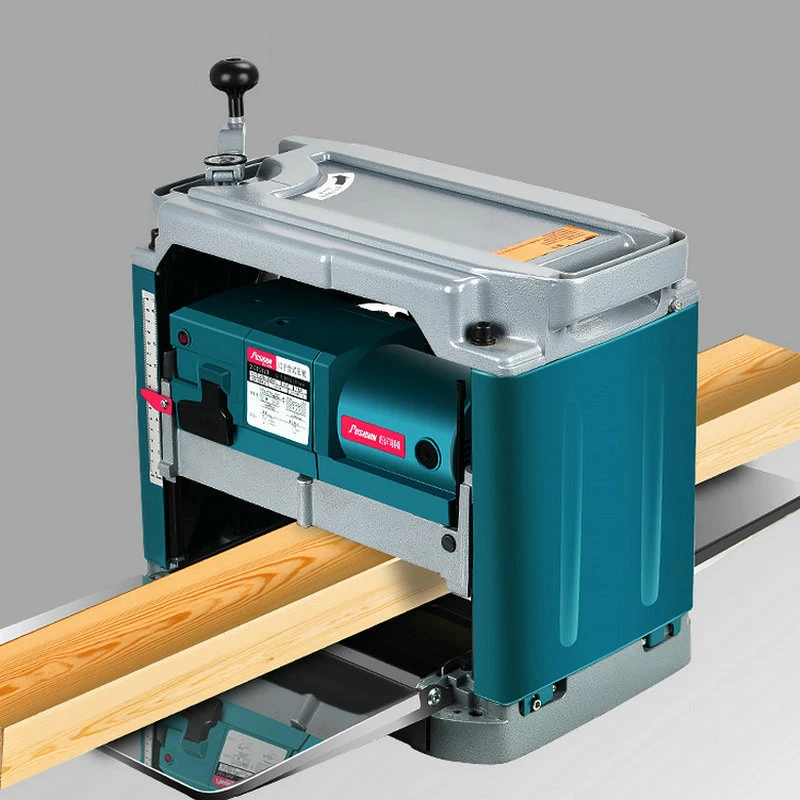
Source-controlled product identity
This TEBAK Hoting queue record describes a woodworking wood planer and thicknesser, also presented as a multifunctional woodworking power tool and manual wooden thickness planer. The structured record provides six operating and handling values: a no-load speed of 8500 r/min, a feed speed of 6 m/min, a planing width of 305 mm, a planing height of 160 mm, a planing depth(-times) of 0-3 mm, and a net weight of 26.5kg.
Product ID 1601247308671 should stay on the quotation, drawing, sample inspection record, carton label and packing list. This guide preserves the field names and units exactly as recorded. The source does not provide voltage, motor power, cutter-head configuration, blade count, table dimensions, dust extraction requirements, dimensional tolerance, packaging weight or certification. Those items are procurement questions, not assumptions.
Recorded specifications
| Source field | Recorded value | Procurement treatment |
|---|---|---|
| No-load speed | 8500 r/min | Source-recorded rotational speed; confirm whether it refers to the cutter head or another rotating component and define the measurement condition. |
| Feed speed | 6 m/min | Source-recorded feed value; confirm whether it is fixed or adjustable, and identify the wood species, thickness and surface condition used for the figure. |
| Planing width | 305 mm | Source-recorded width; confirm maximum stock width, usable width after guards or guides, and the required edge clearance. |
| Planing height | 160 mm | Source-recorded height; confirm whether it is maximum workpiece height, opening height or another dimension, and how it is measured. |
| Planing depth(-times) | 0-3 mm | Source-recorded range and label; confirm whether “-times” means per pass, number of passes or a source-label error before using it as a removal specification. |
| Net weight | 26.5kg | Source-recorded net weight; request gross packed weight, carton dimensions, lifting points and final freight data separately. |
What buyers should clarify about a planer-thicknesser
A buyer should first define whether the machine will be used as a surface planer, thickness planer, or a combined woodworking unit. The listing uses both planer and thicknesser language, but the queue record does not include a machine layout or a changeover procedure. Ask the supplier for a labeled drawing that identifies the infeed table, outfeed table, thicknessing bed, cutter head, fence, height adjustment, feed rollers and dust outlet.
Request a process diagram for the two expected operations. For surface work, confirm how a reference face and edge are established. For thicknessing, confirm how the finished thickness is set and how the workpiece is supported. Do not assume that the recorded 305 mm planing width applies identically to every operating mode.
Ask the supplier to demonstrate the machine with the buyer's intended stock. The record does not specify hardwood, softwood, engineered board, reclaimed timber or wet stock. Confirm the acceptable moisture condition, grain direction, knots, resin, glue lines and end-grain limitations before selecting the machine for production.
No-load speed: define exactly what 8500 r/min represents
The source records “No-load speed” as 8500 r/min. This is a no-load rotational value, not a guaranteed cutting speed under material load. Ask the supplier to identify the rotating assembly measured, the measurement method, the permitted tolerance and whether the value is measured at nominal voltage, nominal frequency or another condition.
Request the cutter-head specification that corresponds to the speed: cutter-head diameter, cutter-block arrangement, blade or knife count, permitted knife projection and balancing requirement. None of those details is provided in the source record. They must be confirmed in the technical drawing and quotation rather than inferred from the speed field.
For acceptance testing, measure no-load speed using an agreed tachometer method after the machine reaches steady state. Record the instrument, measurement location, operating supply and result. Then test under a defined timber load and document sound, vibration, surface finish, feed stability and any speed drop. A no-load value alone cannot establish removal capacity or surface quality.
Ask whether 8500 r/min is compatible with the proposed blades, cutter blocks and replacement parts. Confirm the maximum permitted speed printed on each rotating component and the procedure for installing, balancing and securing knives. Request a written prohibition on incompatible tooling if the supplier has one.
Feed speed: verify the meaning of 6 m/min
The source records “Feed speed” as 6 m/min. Ask whether this is a fixed nominal speed, a selectable setting, a maximum rate or an average measured during a test. Request the test conditions: stock width, stock height, cut depth, timber species, grain direction, moisture, number of boards and whether the operator stopped for measurement.
Feed speed should be evaluated together with surface finish and dimensional consistency. Ask the supplier to run a representative batch at the stated rate and record actual infeed and outfeed behavior. Inspect snipe at the leading and trailing ends, tear-out, chatter, burn marks, feed slip and variation in finished thickness. The queue data does not state a tolerance for any of these results.
Confirm whether the feed mechanism is powered by rollers, a chain, a belt or another arrangement. Ask for roller diameter, roller surface, pressure adjustment, minimum stock length, minimum stock thickness and anti-kickback provisions. These are not provided and should not be added to the listing as facts.
If the buyer needs multiple feed rates, ask for a control diagram and the available settings. If the machine has only one rate, ask how the supplier recommends handling difficult grain, wide stock, deep cuts or finishing passes. Include the buyer's preferred feed strategy in the acceptance test instead of treating 6 m/min as a universal production rate.
Planing width: working boundary for 305 mm
The recorded “Planing width” is 305 mm. Confirm whether this means the nominal cutter width, maximum workpiece width or usable width after the fence, guards and edge-clearance requirements are installed. Ask for a dimensioned top view showing the actual cutting span and the material-support area.
Test the machine with material close to the 305 mm boundary as well as with narrower stock. Record whether the feed rollers maintain even pressure across the workpiece, whether the board can be kept parallel, and whether the surface finish changes from the center to the edges. A stated width does not by itself guarantee uniform results at the maximum.
Request the minimum and maximum workpiece length, thickness and width for both surface-planing and thicknessing modes. The source only provides width and height fields, so these additional limits require supplier confirmation. Confirm how short boards are handled and whether a second operator or a support table is required for long stock.
Ask whether the 305 mm value includes a fence or guide arrangement. Confirm the fence angle range, fence height, support length and adjustment scale if edge-jointing is required. If the unit is intended only for thicknessing, request written clarification so the buyer does not purchase the wrong configuration.
Planing height: define the 160 mm dimension
The source records “Planing height” as 160 mm. Ask whether this is the maximum finished opening, the maximum recommended workpiece height, the distance from the bed to the cutter head, or another catalog dimension. A drawing should show the upper reference surface and the measurement points.
Confirm the minimum thickness that can be fed safely and the adjustment resolution across the 160 mm range. Request the height-adjustment mechanism, scale graduation, locking method and repeatability. The source does not provide any of these details.
Use a calibrated thickness sample for the acceptance test. Measure the selected setting before and after a sequence of passes, then compare the actual finished thickness at the leading edge, center and trailing edge. Record whether the 160 mm boundary can be used with the selected feed and cut settings without unstable feeding.
Ask for clearance around the height adjustment, access for cleaning, and the procedure for changing from a tall roughing operation to a thinner finishing pass. Confirm whether the machine needs a manual reset, a gauge block or a separate thickness reference.
Planing depth(-times): resolve the ambiguous source label
The queue field is written “Planing depth(-times)” with a recorded value of 0-3 mm. Preserve the label exactly and ask the supplier to clarify its meaning. It may refer to material removed per pass, a depth range, a number of passes, or a field that was combined or mistranslated in the source listing. It should not be rewritten as a guaranteed 3 mm cutting depth until the supplier confirms the definition.
Request a technical drawing or manual page that defines the adjustment. Ask whether 0-3 mm is a maximum removal per pass, a total planned removal, an adjustable range, or a recommended range dependent on wood species and width. Confirm the setting scale and actual accuracy at 0.5 mm, 1 mm, 2 mm and 3 mm if those positions are intended.
Run a controlled test with the buyer's sample material. Record initial thickness, selected depth, actual removed material, final thickness, surface condition and the number of passes. Repeat at narrow and near-maximum width. Document whether the machine can maintain the stated result without excessive vibration, feed slip, tear-out or motor overload.
Ask if a shallower finishing pass is required after a roughing pass. Confirm the supplier's recommended relationship between feed speed, stock width, depth and grain direction. Because the source does not provide motor power or cutter geometry, do not use the 0-3 mm field to estimate production capacity.
Net weight and installation planning
The source records a net weight of 26.5kg. Treat this as the machine's net value only. Request gross shipping weight, package dimensions, pallet or carton type, lifting instructions and the center of gravity. Freight and handling calculations should use the supplier's final packing data, not the net value alone.
Ask for the complete footprint, working height, table dimensions, stand requirements, floor-clearance requirement and recommended space for long boards. None of these dimensions is listed in the structured record. Confirm whether a stand, extension tables, fence, dust hose, push blocks, gauges or other accessories are included.
Before installation, verify that the floor and bench can support the machine and that the 26.5kg handling task can be completed safely. Ask whether leveling, anchoring or vibration isolation is required. Request a packing list that separates the main machine, loose tools, guards, manuals and spare parts.
Power, dust and tooling information to request
The source does not provide voltage, frequency, motor power, current, plug type, phase, dust extraction volume or cutter tooling details. Ask for a complete electrical nameplate and wiring diagram before purchase. Confirm the target market's electrical requirements and whether the supplier offers a compliant plug or only a bare lead.
Request the dust-outlet diameter, extraction airflow requirement and compatible hose arrangement. Wood dust management is a procurement and safety issue, but no extraction specification is supplied in the queue record. Confirm whether the dust hood, adapter or hose is included.
Ask for the blade or knife specification, cutter-head type, knife dimensions, sharpening method, replacement part number and permitted material. Confirm whether the buyer can source replacement knives locally. Obtain prices, lead times and recommended stock for wear parts before approving a regular production setup.
Do not infer a CE, ISO or other certification from the product description. Request copies of any applicable declarations, test reports, safety instructions and labels for the exact quoted configuration. If no certification is supplied, record that gap explicitly in the purchase file.
Surface quality and dimensional acceptance
Define acceptance using the buyer's material and end use. Ask the supplier to agree on finished thickness tolerance, width tolerance, flatness, straightness, surface roughness or visual criteria, depending on the application. The source provides no quality tolerances.
For a surface-planing test, inspect the reference face, edge straightness, fence alignment, tear-out and snipe. For thicknessing, measure thickness at several positions along and across the board. Use multiple boards rather than one favorable sample. Record the 305 mm width, 160 mm height, selected feed speed of 6 m/min and selected planing-depth interpretation for every run.
Ask for the supplier's correction procedure when the result is out of tolerance. Confirm whether the cause is knife setting, roller pressure, fence alignment, bed adjustment, feed speed, material condition or operator technique. A useful acceptance report should distinguish machine capability from sample preparation.
Safety and operator workflow
Request a complete operating sequence covering inspection, stock preparation, fence adjustment, height setting, depth setting, feeding, stopping, cleaning and knife replacement. Confirm where the operator's hands must remain and which push blocks or guards are required. The source does not list safety accessories.
Inspect the feed path for pinch points, cutter-head access, anti-kickback protection, guards, emergency-stop arrangements and safe isolation during maintenance. Ask for procedures for jammed stock, power loss, abnormal vibration and damaged knives. If powered feed is present, confirm how the operator stops the machine before reaching the work area.
Plan training around grain direction, knots, end grain, short stock, long stock and irregular boards. Ask whether the supplier provides an English manual, setup video, parts diagram or remote commissioning support. These support items are not guaranteed by the queue data and must be written into the quotation if required.
Factory acceptance test proposal
- Verify the model description, product ID 1601247308671, nameplate, drawing revision, included accessories and final packing list.
- Measure the no-load speed and confirm the meaning and measurement condition of 8500 r/min.
- Run representative stock at the recorded feed speed of 6 m/min and document actual feed behavior, finish and dimensional results.
- Test stock near the 305 mm planing-width boundary and record support, tracking, surface quality and edge behavior.
- Clarify and test the 160 mm planing-height boundary with a dimensioned gauge or sample workpiece.
- Define the “Planing depth(-times)” field, then verify selected depth settings including a controlled 0-3 mm test range if applicable.
- Confirm the net weight and separately verify gross packed weight, carton dimensions, lifting points and included parts.
- Inspect guards, anti-kickback features, emergency stop, dust extraction connection, knife access and maintenance instructions.
RFQ checklist
- Exact machine configuration and product ID 1601247308671 on quotation, drawing and packing list.
- Definition and tolerance of No-load speed 8500 r/min, including measured component, supply condition and tachometer method.
- Definition of Feed speed 6 m/min: fixed or adjustable, test material, cut setting, average method and available alternatives.
- Definition of Planing width 305 mm: maximum stock width, usable cutter width, mode-specific limit and edge clearance.
- Definition of Planing height 160 mm: measurement points, minimum thickness, adjustment range, scale and repeatability.
- Clarification of “Planing depth(-times) 0-3 mm”: per-pass removal, total removal, range, number of passes or source-label issue.
- Motor power, voltage, frequency, phase, current, plug, overload protection, emergency stop and electrical nameplate.
- Cutter-head diameter and type, knife count, knife dimensions, projection, balancing, sharpening and replacement part numbers.
- Feed rollers, pressure adjustment, minimum stock length/thickness, anti-kickback design and feed-speed control.
- Table, fence, bed, stand, extension table, working height, footprint, clearance and anchoring requirements.
- Dust-outlet diameter, required airflow, hood/adapter inclusion and recommended extraction setup.
- Surface-quality and dimensional acceptance criteria for the buyer's wood species and sample sizes.
- Net and gross weight, package dimensions, packing method, lifting points, MOQ, lead time, warranty and support.
- Applicable safety documentation, labels, declarations, manuals, training, spare parts and after-sales response.
Buyer’s decision framework
This listing is a starting point for a buyer comparing a TEBAK manual woodworking planer-thicknesser for stock preparation and thickness control. Its strongest source-backed boundaries are 8500 r/min no-load speed, 6 m/min feed speed, 305 mm planing width, 160 mm planing height, an ambiguously labeled 0-3 mm planing-depth field and 26.5kg net weight. Approve the machine only after the supplier defines the ambiguous depth label, provides the missing power and tooling data, demonstrates the buyer's stock, and signs the agreed acceptance criteria.
Frequently asked questions
Is 8500 r/min the cutting speed?
No. The source calls it “No-load speed” and records 8500 r/min. Confirm the measured rotating component and test condition before using it for cutting-performance comparisons.
Can the machine feed at a different speed than 6 m/min?
The source records 6 m/min but does not state whether it is fixed, nominal, maximum or adjustable. Ask for the feed-control specification and test conditions.
Does 305 mm mean every board can be planed at that width?
It is the recorded planing-width value, but usable width, support, wood condition and mode-specific limits are not supplied. Validate with a near-305 mm sample.
What does “Planing depth(-times) 0-3 mm” mean?
The label is ambiguous. Ask the supplier to define whether it means removal per pass, total removal, an adjustable range or another catalog field.
Is the net weight 26.5kg the shipping weight?
No conclusion should be made from the net value. Request gross packed weight and carton dimensions for freight and handling planning.
Source and contact
This guide is based on the Hoting queue record for product ID 1601247308671. Before purchase, request the current quotation, technical drawing, electrical nameplate, cutter and knife data, dust-extraction requirements, sample test report, safety documents, packing list and spare-parts offer. For sourcing questions, contact the TEBAK sales team through the site's current inquiry channel.
Key specifications
- No-load speed
- 8500 r/min
- Feed speed
- 6 m/min
- Planing width
- 305 mm
- Planing height
- 160 mm
- Planing depth(-times)
- 0-3 mm
- Net weight
- 26.5kg