
Ten parameters, and three of them do not survive contact
Product ID 1601241753237 is titled as a hand-held battery marking machine for vehicle identification numbers and publishes ten parameters. That is more than most records in this family publish, and the extra lines do not all help. Three of the ten cannot be used as written.
The repeat-accuracy field holds nothing
The parameter labelled Repeat Marking accuracy has a value consisting of an empty pair of angle brackets. Not a figure, not a dash, not the words to be confirmed: an empty tag, which is what is left when a field is templated but never filled. Beside it, a different line labelled Marking Accuracy carries 0.01 millimetres.
Those two labels describe different things, and the one that is missing is the one a production buyer needs. Accuracy is how close a mark lands to where it was meant to be; repeatability is how closely one mark follows another on the same setup. On a marking tool used for identification numbers, repeatability is what determines whether the first character starts in the same place every time, and therefore whether a fixture can be specified or whether the operator has to judge each mark by eye. The record supplies the less useful of the two and leaves the useful one blank.
There is a further reason to treat the surviving figure with care. The same 0.01 millimetres also appears as the lower bound of the marking depth range, and as noted in the companion guides in this series, a lower depth bound of ten micrometres is not a mark that can be read or verified. A value that recurs as a resolution and as a software default, in three places, is a default value rather than a measurement. Ask for the mark-to-datum tolerance measured on the buyer's own parts, ten marks from one datum, and treat that spread as the figure that matters.
The battery is quoted in amp-hours with no voltage
Battery capacity is given as 6AH. Amp-hours alone do not describe a battery's energy; they describe charge, and charge only becomes energy when multiplied by voltage. Six amp-hours at twelve volts is seventy-two watt-hours; the same six amp-hours at twenty-four volts is one hundred and forty-four, a factor of two. The record gives one of the two numbers needed and omits the other, so the runtime of the machine cannot be calculated from it at all.
The omissions continue from there. There is no runtime per charge, no charge time, no number of batteries supplied, no price for a spare, no charger input voltage and no plug type. For a battery machine those are not accessories, they are the specification: a production tool's shift plan is built from how long a battery lasts and how long it takes to refill, and the number of batteries per operator follows from the ratio of those two figures. Ask for runtime measured at the buyer's own character height and depth, for the charge time, and for the price and lead time of spare batteries and a charger.
The machine is listed at sixteen kilograms and called hand-held
The weight parameter reads 16kg and the machine type parameter reads LCD Control plus handheld marking, while the title calls the machine hand-held. Sixteen kilograms is not a hand-held tool in any practical sense. For comparison, a hand-held marking machine in this same queue is listed at five point eight kilograms, and even that is enough to make balance and daily holding time a real question. Sixteen kilograms is the weight of a bench machine.
The size parameter reads 50 by 40 by 40 centimetres, which is eighty litres, and it is not labelled as either the machine or the carton. That figure is larger than every machine in the record's own twelve-model table, whose largest entry measures 310 by 195 by 260 millimetres, so the eighty-litre figure is most plausibly the packed carton rather than the machine. Working the freight from it: eighty thousand cubic centimetres divided by six thousand gives a volumetric weight of thirteen point three kilograms, and divided by five thousand gives exactly sixteen, so under either common divisor the shipment is charged on its actual weight rather than on its volume, and the stated sixteen kilograms is the figure the freight will be based on. If that sixteen kilograms is the packed weight, the machine itself may be lighter, and the buyer should require the split: machine with battery, machine without battery, packed gross weight, and carton dimensions.
The description field, for completeness, repeats the same ten parameters under bare headings and then lists Packing/Shipping, Company introduction and FAQ as headings with nothing under any of them, so the page offers no packing detail, no company detail and no answers.
The speed is quoted per minute, and the slow end of the range is the real constraint
Marking speed is given as five to one hundred and twenty characters per minute. Two things about that line deserve attention, and the second is the one that decides whether the machine can do the job.
The first is the unit. Characters per minute is a much less flattering unit than characters per second, and it is easy to misread at a glance. One hundred and twenty characters per minute is two characters per second. A buyer who is used to seeing marking rates expressed per second will read one hundred and twenty as a fast machine without noticing that the time base has changed.
The second is the width of the range. Twenty-four separates the top of it from the bottom, and a range that wide means the rate depends on something the record does not name: character size, marking depth, or material. Working both ends through for a seventeen-character vehicle identification number, which is the application in the title:
| Rate as quoted | Time for 17 characters | Characters per 8-hour shift | VINs per shift, marking only |
|---|---|---|---|
| 120 characters/min | about 8.5 seconds | about 57,600 | about 3,388 |
| 60 characters/min | about 17 seconds | about 28,800 | about 1,694 |
| 20 characters/min | about 51 seconds | about 9,600 | about 565 |
| 5 characters/min | about 3 minutes 24 seconds | about 2,400 | about 141 |
At the top of the range the machine can support a fast line. At the bottom of it, a single chassis number takes three and a half minutes of marking, and even a full shift with no breaks, no positioning and no rework yields about one hundred and forty vehicles. That is the difference between a tool that fits a vehicle line and a tool that does not, and the record offers both figures without saying which condition produces which. The number the buyer needs is the rate at the character height and depth the buyer actually requires, on the buyer's own material, and the honest way to obtain it is to require a timed sample on a real part rather than a range on a page.
The remaining parameters that bear on throughput are all missing: the dot frequency with which the head strikes, the dot pitch it is set to, and the time the operator needs to position the head and trigger it. Without the last of those, even the eight-and-a-half-second figure at the top of the range is optimistic, because it counts marking time only.
The model in the title is not in the record's own twelve-model table
The third and fourth gallery images are a Chinese-language table headed, in translation, own factory, several models available, with twelve rows of marking machines. It is the most detailed specification anywhere in the record. It is also not about this machine.
The twelve models are XY/F19030, XY/F19030 again, XY/F19025-D, XY/F39025-D, XY/C112040, XY/C312040, XY/C115040, XY/C315040, XY/G2, XY/BD-2, XY/SD-3 and XY/M6-D. The product in this listing is XY-01. It does not appear in the table, and no row carries the working area this listing quotes, thirty by one hundred and twenty millimetres. The windows in the table are ninety by thirty, ninety by twenty-five, one hundred and twenty by forty, one hundred and fifty by forty, one hundred and sixty by ninety, one hundred and sixty by eighty and two hundred by one hundred and twenty. The nearest to this listing's area is one hundred and twenty by forty, which is a different window.
Two further differences run down the whole table. Every one of the twelve rows quotes an engraving depth of nought point one to one millimetre, while this listing quotes nought point nought one to one millimetre, a lower bound ten times smaller. And the table's size column is labelled head size in the first two rows and machine size in the remaining ten, so a buyer reading it cannot tell whether a given figure describes the marking head or the complete machine.
The table is also entirely in Chinese. The listing it belongs to is written in English and carries no translation of it, so the only model comparison in the record is unreadable to a buyer who does not read Chinese, and the English parameter list at the top of the listing cannot be reconciled with it without translating the table by hand.
The table's model numbers decode, and one of them is used twice
For all its problems the table is consistent enough to be decoded, and the decoding is worth doing because it tells a buyer what to ask for.
- The prefix XY and a slash are followed by a family letter: F, C, G, or one of the two-letter families BD, SD and M.
- In the F and C families a single digit follows the letter, and it distinguishes whether the machine has its own controller. In every row where that digit is one, the buyer must provide a computer and an air pump; in every row where it is three, the buyer must provide the air pump only. The machine's own control is what the one and the three separate.
- The four digits that follow are the working window in millimetres. F19030 gives ninety by thirty, F19025-D gives ninety by twenty-five, C112040 and C312040 both give one hundred and twenty by forty, and C115040 and C315040 both give one hundred and fifty by forty. The rule holds in every row where it applies and does not apply to G2, BD-2, SD-3 or M6-D, whose numbers do not encode a window.
- A trailing D marks a variant, and the parenthetical word after BD-2 and SD-3 marks those two as electric, which is consistent with their requiring neither a computer nor an air pump.
The exception is the first pair of rows, and it is the kind of exception that costs a buyer money. Rows one and two both carry the model number XY/F19030, and both quote the same window, depth and head size. But row one requires the buyer to provide a computer and an air pump, while row two requires the air pump alone. Under the rule above those two configurations have different model numbers, one with the digit one and one with the digit three, so row two's number is missing its distinguishing digit. The practical consequence is direct: a purchase order that specifies XY/F19030 does not determine whether the machine arrives with its own controller or arrives needing a computer beside it, because the record uses that one number for both.
There is a second consequence, and it is the larger one. Ten of the twelve rows require the buyer to provide something, and eight of them require an air pump. A listing titled as battery operated and described as hand-held sits alongside a model table in which most machines are pneumatic. If the buyer's enquiry is answered by reference to the table rather than to this listing, the machine quoted may well be one that needs an air line, which is the opposite of the reason a battery machine is bought.
The gallery contains three different machines, and two images belong to another shop
The eight gallery images do not all show the product in the title, and the way they are mixed is worth setting out because a buyer comparing listings will otherwise attribute the wrong machine's abilities to this one.
- The first image shows a stainless enclosure with a carrying handle on top, a battery pack below it with a red release catch, and a marking head protruding at the front through an open frame. There is no display visible from that angle.
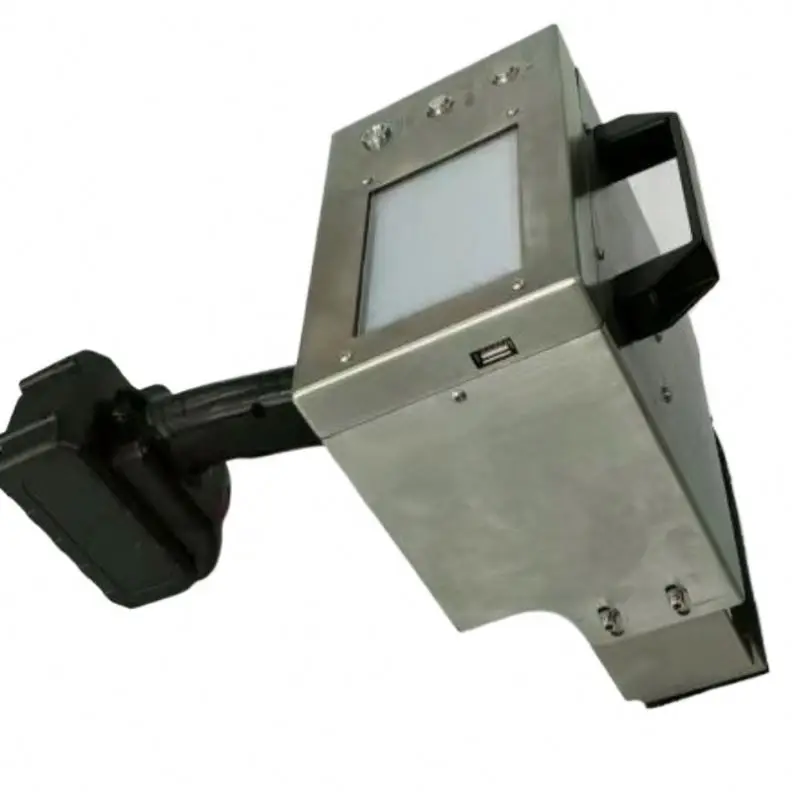
- The second image shows a stainless enclosure with a display on its face, a USB socket below the display, a handle at the rear and the battery mounted on an arm to the side. A USB socket implies that a file can be transferred to the machine, which is how a list of numbers would be loaded, but the record says nothing about file formats, list loading, validation or logging.
- The fifth image, captioned Product Display, shows a completely different arrangement: an angular marking head on a stand, a long flexible tube, and a separate control box with a rotary knob, a green button and a red button. The head is labelled, in English, industry intelligent marker, and the machine is clearly a pneumatic unit with its own controller rather than the battery hand-held tool in the title.
So the gallery shows at least three configurations, and only the second is consistent with the parameter that reads LCD Control plus handheld marking. The record never states which one a buyer receives.
Two images carry another shop's watermark
Both the fifth image and the sixth carry a watermark across the bottom reading shop0128x84801286.1688.com, which is a storefront address on the Chinese domestic wholesale platform 1688, not on this listing's platform and not this supplier's own address. Two of the eight images in the record are therefore material that was published by a different seller, and the machine in the fifth of them is not the machine in the title. This does not by itself say anything about the machine that would be shipped, and it is not evidence of wrongdoing; it does mean the gallery cannot be treated as product photography. What it is evidence of is that the images were assembled rather than taken, and therefore that no image in the record proves what the delivered unit will look like or what it can do.
How much of this gallery is shared across the queue
The two remaining images can be checked directly, because their addresses are identical to those used by other records. The shipping and payment badge panel is used by one hundred and nineteen records out of the five hundred and twelve in this queue, and the factory gate photograph is used by eighteen, including two records in this very series. That is a little under a quarter of the queue sharing one identical image. The remaining six images, including all the ones that show a machine, are unique to this record. A buyer who wants to know whether a photograph belongs to the product rather than to the supplier's template can now tell the two apart without leaving the page.
The samples, and the third-party mark they carry again
The sixth image is captioned Display of printing effect and shows the marks the machine is said to have produced. It contains serial strings, part numbers and identification numbers, several of them delimited at both ends by a star symbol, which is the correct convention for a vehicle identification number because the delimiter prevents characters being appended to it later. Whether the machine inserts that delimiter automatically around the variable field, or whether the operator types it, is not stated and belongs in the specification, because the second is where a missing delimiter comes from.
The panel also contains a three-phase asynchronous motor nameplate, which is a sensible demonstration for a marking machine, and a shield-shaped crest belonging to a well-known German sports car manufacturer, reproduced as a marked sample. This is the third record in this queue whose sample images include an automotive marque, after a three-pointed star and a Japanese manufacturer's name in the preceding items. Two of those three also carry the storefront watermark discussed above.
A buyer whose work is original-equipment marking must hold authorisation for every mark it produces, and a supplier that shows a trademarked sample is a supplier worth asking a direct question about early: whether the machine and the sample material supplied with it can be delivered without any third-party mark on them. For a buyer working in the aftermarket or on unbranded parts, the same question has the same answer, and asking it before the order is cheaper than correcting it afterwards.
What the record does not state at all
- Which machine the eight gallery images are of, and which configuration the buyer receives.
- The repeat accuracy, which is the field containing the empty tag, and the mark-to-datum tolerance.
- The battery voltage, and therefore its energy; plus runtime per charge, charge time, number of batteries and chargers, and spare prices.
- The charger's input voltage and plug type for the destination market.
- Weight split: machine with battery, machine without battery, packed gross weight, and carton dimensions.
- The rate at a named character height, depth and material, as distinct from the five-to-one-hundred-and-twenty range.
- Dot frequency and dot pitch.
- What the three-hundred-and-sixty-degree direction adjustment actually rotates: the head mechanically, or the layout in software, and whether it is indexed or free to set.
- Whether the machine needs a computer and an air pump. The listing implies neither; ten of the twelve rows in its own table require one or both.
- How a string is entered, whether a list can be loaded through the USB socket shown on one machine, and in what format.
- Whether the entry is validated for the length and format of a vehicle identification number, whether a duplicate can be refused, whether an audit log with timestamps is kept, and whether settings can be locked against operator change.
- Whether a repeat function exists so the same number can be marked a second time on the same vehicle without being retyped.
- Pin material, grade, part number, life, spare price and minimum order.
- Achievable depth on the buyer's own material and thickness, and the number of passes.
- Vibration emission with the standard it was measured to, and noise at the operator's position.
- Duty cycle, and whether continuous line use is permitted.
- Warranty period and coverage; spare parts horizon; service in the destination country.
- Electrical certification for the destination market and battery transport documentation.
- The applicable vehicle identification requirement in the buyer's market, and whether an indented-dot mark satisfies it.
Incoming inspection when the machine arrives
- Record the model number on the machine and on the carton, and note that the listing's model appears nowhere in the record's own twelve-model table, so the nameplate is the only authoritative statement of what was supplied.
- Weigh the machine with and without the battery, and weigh the packed case or carton, then compare all three against the single sixteen-kilogram figure in the listing.
- Read the battery label and record its voltage and its capacity in amp-hours, since the listing gives only the second, and note the date code, because a battery held in stock loses capacity.
- Check the charger's input voltage and plug against the destination supply before it is connected.
- Confirm whether a computer and an air pump are required. Run the machine with no air connection and with no computer attached, and record what it does, because this is the claim most likely to be wrong given the model table.
- Measure the actual marking window by moving the head to each limit and measuring with a steel rule, then subtract the clearance the operator will need.
- Time a full seventeen-character string on a piece of the real rail material, including the operator's positioning, and record the result against both ends of the quoted range.
- Mark ten strings from the same datum and measure the spread of the first character, then compare that spread with the quoted accuracy figure and with the empty repeatability field.
- Measure the marking depth with a depth gauge at the setting used, and check the number of passes required.
- Check the three-hundred-and-sixty-degree direction adjustment at several settings and confirm the mark stays inside the window at each.
- Load a list through the USB socket, if one is fitted, and confirm the format accepted, whether entries are validated, and whether a duplicate is refused.
- Inspect the pin under magnification before first use and after the trial, and record the wear, because the pin is the consumable that sets running cost.
- Confirm the manual's language and edition against the firmware fitted.
- Check the machine and the supplied sample material for any third-party mark, and record what is found.
The specification to send before ordering
| Item | What to require in writing |
|---|---|
| Machine identity | The model number, the working window in millimetres, and confirmation that the machine is battery operated and needs neither a computer nor an air pump. The same number must appear on the proforma invoice, the carton and the nameplate. |
| Window and character geometry | Working window, character width, character height range, inter-character pitch and the maximum number of characters in one line. |
| Depth | Achievable depth on the buyer's own material and thickness, the number of passes, and the depth tolerance. Ask which reading applies, the nought point nought one in the listing or the nought point one in the table. |
| Rate | Characters per minute at the required character height and depth on the buyer's material, plus a timed sample of one full string including positioning. |
| Repeat accuracy | The mark-to-datum tolerance observed in a trial of ten marks, since the listing's repeat field is empty. |
| Battery and charger | Voltage, capacity, energy in watt-hours, runtime at the required setting, charge time, number of batteries and chargers, spare prices, charger input voltage and plug, and the battery's operating and charging temperature windows. |
| Weight | Machine with battery, machine without battery, packed gross weight and carton dimensions. |
| Direction adjustment | What rotates, how it is set and whether it is indexed. |
| Data path | How a string is entered, whether a list can be loaded and in what format, whether entries are validated, whether a duplicate is refused, whether an audit log exists, and whether settings can be locked. |
| Delimiter | Whether the start and stop symbol is inserted automatically around the variable field. |
| Pin | Material, grade, part number, life on the buyer's material at the buyer's depth, spare price and minimum order. |
| Exposure and compliance | Vibration emission with the standard used, noise at the operator's position, electrical certification for the destination market, battery transport documentation, and confirmation that neither the machine nor the sample material carries a third-party mark. |
| Commercial | Packing, delivery term, lead time for the machine and for spare pins, warranty period and coverage, and the spare parts horizon. |
Frequently asked questions
Is this machine really hand-held if it weighs sixteen kilograms?
That is the question to put to the supplier, because the two statements in the record contradict each other. Sixteen kilograms is a bench machine's weight, and the size parameter, eighty litres, is larger than any machine in the record's own twelve-model table, which suggests it is the packed carton rather than the machine. Ask for the weight with and without the battery before deciding whether the tool can be carried to the vehicle.
The repeat accuracy field is empty. Can the accuracy figure be used instead?
No, they are different quantities. Accuracy is how close a mark lands to its intended position; repeatability is how closely successive marks agree with each other, and it is repeatability that decides whether a fixture can be specified. The only usable substitute is a measured spread from ten marks made from the same datum on the buyer's own parts.
The battery is six amp-hours. How long will it run?
It cannot be worked out from the record, because amp-hours without a voltage is charge rather than energy. Six amp-hours at twelve volts is seventy-two watt-hours and at twenty-four volts is one hundred and forty-four. Ask for the voltage, then for runtime at the required character height and depth, then for charge time, because the number of batteries per operator follows from the ratio of the two.
The speed says one hundred and twenty characters per minute. Is that fast?
It is two characters per second, so a seventeen-character chassis number is about eight and a half seconds at that end of the range. The other end of the range is five characters per minute, which is three minutes and twenty-four seconds for the same string. A range spanning a factor of twenty-four has to be pinned down to a condition before it means anything, and the condition to pin it to is the buyer's own character height, depth and material.
Does the machine need an air supply or a computer?
The listing calls it battery operated and its own model table says otherwise. Ten of the twelve rows in that table require the buyer to provide a computer, an air pump, or both, and most of those require the air pump. Only the three electric models require neither. The listing's model does not appear among the twelve, so the only reliable answer is the one the supplier gives in writing, confirmed by a trial with no air line and no computer connected.
Why is one image watermarked with a 1688 address?
Because at least two of the eight gallery images were taken from a Chinese domestic wholesale storefront rather than produced for this listing, and the machine shown in one of them is a pneumatic unit labelled industry intelligent marker rather than the battery tool in the title. The gallery is assembled, so it should not be read as product photography. Ask for photographs of the actual unit that will be shipped, with its nameplate legible.
The sample images show a car manufacturer's crest. Does that matter to me?
It matters if the buyer intends to mark components for that manufacturer, or for anyone else, because a mark on a part implies authorisation to make it. Ask whether the machine and any sample material can be supplied free of third-party marks, and record the answer. The same question is worth asking of any supplier whose samples carry a marque.
Can it mark a full seventeen-character chassis number?
The quoted window, one hundred and twenty millimetres by thirty, is long enough for seventeen characters at a character width of four to five millimetres with spacing, which leaves a workable margin. Whether the resulting indented-dot mark satisfies the identification requirement of the buyer's own market is a separate question for the buyer's authority, and it should be settled before the order rather than after the first rejected part.
Source, scope and what this guide does not claim
Everything here comes from the record for Product ID 1601241753237 as it stands: ten published parameters, a description field that repeats those parameters under headings with no content, and eight gallery images. The twelve-model table discussed throughout is the Chinese-language table in the record's own third and fourth gallery images, and the model numbers, windows, depths, sizes, buyer-provided items and application notes are as printed there. The watermarks, the machine configurations, the display, the USB socket and the sample marks are described from those images. The reuse counts of one hundred and nineteen records and eighteen records were obtained by comparing the image addresses of this record against every record in the queue of five hundred and twelve, so they are counts of shared addresses, not estimates.
The arithmetic is this guide's own and is marked as such. The throughput table divides seventeen characters by each quoted rate and converts to seconds and minutes; the shift column multiplies the rate by four hundred and eighty minutes; the freight paragraph divides eighty thousand cubic centimetres by six thousand and by five thousand; and the amp-hour comparison multiplies six amp-hours by twelve and by twenty-four volts. No figure has been taken from any source other than the record, and no measurement has been made of any machine.
Nothing here is a claim that the supplier's product is defective, and nothing asserts that any party acted improperly: the watermarked images, the duplicated model number, the empty parameter and the contradiction between the listing and its own table are recorded as facts a buyer must resolve in writing, and each is turned into a question rather than a conclusion. Authorisation to reproduce a trademark is a matter between the buyer and the rights holder, and it is raised here only so that a buyer knows to raise it. Nothing here establishes that any mark shown in the samples was made without authority.
Key specifications
- Marking Area
- 30*120mm
- Machine Type
- LCD Control+handheld Marking
- Marking Accuracy
- 0.01mm
- Repeat Marking accuracy
- <> - the value is an empty pair of angle brackets
- Marking Depth
- 0.01~1mm (depends on material hardness)
- Marking Speed
- 5-120 characters/min
- Printed direction
- 360-degree adjustment
- Battery capacity
- 6AH, with no voltage stated
- weight
- 16kg
- Size
- 50*40*40CM, not labelled as machine or carton
- Depth in the record's own 12-model table
- 0.1-1MM for every model, against the 0.01~1mm above
- Model in the record's own 12-model table
- XY-01 does not appear; the table lists F19030, F19025-D, F39025-D, C112040, C312040, C115040, C315040, G2, BD-2, SD-3 and M6-D
- Windows in the 12-model table
- 90*30, 90*25, 120*40, 150*40, 160*90, 160*80, 200*120 - none is 30*120
- Buyer-provided items in the 12-model table
- most rows require the buyer to provide a computer and an air pump; only the three electric models require neither
- Noise, vibration, duty cycle, runtime, charge time
- not stated anywhere
- Data entry, validation, logging, software
- not described, although a USB port is visible on one machine in the gallery