
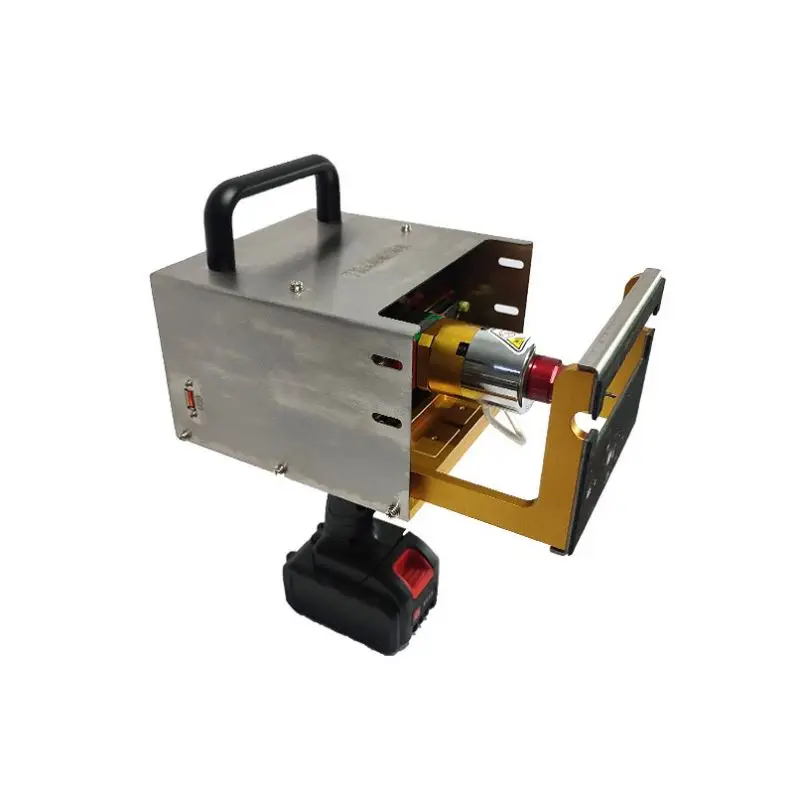
A model number the record's own catalogue does not contain
Product ID 1601241564690 sells a handheld marking machine for vehicle identification numbers, and its title names a model: XY-06. Everything else in the record is silent on it. There is no model parameter at all among the six rows, so the code does not exist in a field, and the description text does not introduce it either beyond repeating the title at the top of the field. As far as this record's structured data goes, the machine has no model number.
What it does have is a catalogue. Two of the eight gallery images are a model panel listing six machines with their codes, dimensions and applications, numbered one to six:
| Card | Code | Print range | Engraving depth | Machine size | Customer provides |
|---|---|---|---|---|---|
| 01 | XY/SD-1 | 90 x 30 mm | 0.1 to 1 mm | 160 x 170 x 280 mm | Computer |
| 02 | XY/M2-D | 200 x 120 mm as printed | 0.1 to 1 mm | 300 x 215 x 325 mm as printed | Computer |
| 03 | XY/M6-D | 200 x 120 mm | 0.1 to 1 mm | 300 x 215 x 325 mm | None |
| 04 | XY/BD-2 | 160 x 80 mm as printed | 0.1 to 1 mm as printed | 275 x 165 x 284 mm | None |
| 05 | XY/SD-2 | 90 x 30 mm | 0.1 to 1 mm | 167 x 115 x 274 mm | None |
| 06 | XY/TD-2 | 160 x 90 mm | 0.1 to 1 mm | 365 x 360 x 750 mm | None |
Six codes, and none of them is XY-06. The panel's numbers one to six are card numbers, not model numbers, and the sixth card's code is XY/TD-2, which the panel describes as a machine 365 by 360 by 750 mm with a 160 by 90 mm range. That is a column machine, and it is nothing like the handheld tool this record sells.
Two explanations fit what is visible, and the record does not choose between them. The first is that the title's XY-06 was made by combining the family prefix XY with the catalogue's own card number six, which would mean the model number in the title is an artefact of the catalogue's layout rather than a model. The second is that XY-06 is a real model that this record simply does not show, in which case its data sheet, its window and its place in the range are all still unknown. Both explanations lead to the same question, which is which code the supplier will write on the quotation, and it is worth asking before comparing prices, because a quotation for a code that neither the catalogue nor the title matches is a quotation for nothing in particular.
One piece of context makes this less surprising than it sounds. Across the five hundred and twelve records in this queue, four hundred and seventeen have no model-like field at all, which is eighty-one per cent, so the absence of a model parameter is the norm here rather than an oddity. What is unusual in this record is not that the fields omit a model but that a model code appears in the title and exists nowhere else, so the only place a buyer will find XY-06 is the sentence used to advertise the machine.
The window narrows it down, and the photographs narrow it further
The parameter block states a marking range of ninety by thirty millimetres. In the catalogue panel, that window belongs to two of the six cards: XY/SD-1 and XY/SD-2 both print 90 by 30 mm. The other four models offer 160 by 80, 160 by 90, 200 by 120 and, on the card as printed, 200 by 120 again. So the record's own window points to two candidates out of six.
The photographs then point to one of those two. The first gallery image shows a machine built as a stainless steel box with a carrying handle on top, a battery pack clipped underneath, and an adjustable bracket in a brass finish holding the marking head at the right. The catalogue card for XY/SD-2 shows the same arrangement: a stainless box, a handle at one end, a battery pack at the other, a gold bracket, and the same blue-and-silver head. The card for XY/SD-1 shows a different machine, a blue box with a black handle and no battery pack. So the machine photographed in this listing corresponds to the catalogue's XY/SD-2, not to the title's XY-06 and not to XY/SD-1.
That identification should be put to the supplier rather than treated as settled, and it is worth the trouble for three reasons. It tells the buyer which row of the catalogue is being quoted, so the other figures on that row can be checked. It makes the model's real code visible, which is the code that will appear on a data sheet and on spare-parts paperwork. And it flags that this record's title, its window and its photograph do not all point at the same model, which is the kind of mismatch that turns into the wrong machine arriving.
The window itself is also worth putting in proportion, in both directions. In the parameter fields of the whole queue, only seven of five hundred and twelve records state a marking window at all, which is one and a half per cent, and this record's is the only one whose value contains both ninety and thirty. So a stated window is a scarce and useful thing, and this record has one. But the same window is sold under other codes elsewhere in this series: the article published for product ID 1601247239713 in this same series recorded the model codes XY/SD-4-9030 and XY/SD-4-12030, whose last four digits read as a ninety by thirty and a one hundred and twenty by thirty window in millimetres, and two further records in this queue carry that same pair of codes. Reading the codes as window sizes is this guide's reading and not the supplier's statement, but if it is right, then the same ninety by thirty millimetre window is offered under at least three different code families in one catalogue, and a buyer comparing quotations by code alone may be comparing the same window three times.
Ninety millimetres of travel, one hand, and the magnetic feet nobody mentions
A marking window is a promise about positioning. On a machine where the head is carried on a carriage, the window is the travel of that carriage, and holding a position inside it is the machine's job. On a handheld machine the head is carried by a person, and the operator is the positioning system. A ninety by thirty millimetre window on a tool that weighs four and a half kilograms is therefore a claim that has to be made good by something other than the hand, because no one holds a four and a half kilogram tool against a vehicle panel and moves it through ninety millimetres while keeping the depth inside a range measured in hundredths of a millimetre.
The record never says what provides that. But one of its own gallery images shows the answer the family uses. The second image is a different member of the same range: a box with a screen on top and a control panel with an emergency stop, a selector, an indicator lamp and a red isolating switch, and underneath it two grey magnetic blocks with the marking head pointing down between them. Those two blocks are the machine's location system. The head is fixed relative to the magnets, the magnets are placed on the workpiece, and the marking happens where the magnets decide. That is how a window becomes meaningful on a tool that has no carriage.
Nothing in the parameter block mentions magnets. So the questions are direct. Does the delivered machine come with magnetic feet or a magnetic base. Are they included in the price or quoted separately. What is the holding force of each foot, and does it depend on the sheet thickness of the workpiece, since a magnet that holds on a thick frame will hold poorly on a thin panel. Can the feet be positioned to set the window, and is there a scale or a stop for doing it repeatably. And what is supplied for work that is not ferromagnetic, because magnets hold steel and iron and not aluminium, not brass, not austenitic stainless, and not the plastic parts named in this machine's own catalogue as an application. That last point decides whether the machine can do the job at all on a given vehicle or a given plate, and it takes one question to settle.
Two smaller consequences belong with the same question. On a painted or galvanised panel a magnetic foot can mark or scratch the surface, and on a curved surface such as a chassis rail or a cylinder the two feet may not both seat, which tilts the head and varies the depth across the window. And on a thin panel the workpiece itself may deflect under the marking force, which changes the depth at the edges of the window relative to the centre. Both are ordinary problems for this kind of tool and both are answered by the fixturing, so an order for this machine should name the fixturing as well as the machine.
Six parameters, four figures and two statements
The parameter block has six rows. Four of them are figures: a window of ninety by thirty millimetres, a depth of 0.01 to 2 millimetres, a driving voltage of twenty-four volts direct current, and a supply described as single-phase one hundred and ten to two hundred and forty volts universal. The other two are not figures. One states the print content as any Chinese and English characters and numbers plus graphics, which is a statement of capability with no number in it. The other states the print effect as clear and beautiful.
An adjective in a parameter field is not a small matter. Parameters exist so that a purchase order can specify something and a delivery can be checked against it. Clear and beautiful cannot be measured, cannot be accepted, and cannot be rejected, so if it appears on a purchase order it will be satisfied by anything and will prove nothing. It also sits where a number belongs, which is the row a reader scans for a quality figure, and what they find instead is a promise. Across the whole five hundred and twelve record queue, thirteen parameter values contain a subjective quality word, and the commonest of them is the phrase high quality used as a marketing type or an advantage; this record's is the only one in the queue that puts an aesthetic judgement on the marking itself. So the practice is not unique, and neither is the gap it leaves.
What is missing instead is the list a buyer needs before a trial: marking speed, positioning accuracy or repeatability, marking force, the pin's grade and life, the workpiece hardness range, the air or electrical requirements beyond the input, the battery's specification, the fixturing, and the weight and dimensions in the fields rather than in prose. The depth figure needs a material attached to it for the same reason it did on the two previous records in this series, because a range of 0.01 to 2 millimetres means one thing on steel and another on the aluminium and plastic parts this family's own catalogue claims: two millimetres into a plastic panel is not a mark, it is a hole.
Weight and dimensions that exist only in the prose
The description field states the machine's weight as four and a half kilograms and its dimensions as twenty-eight by fourteen and a half by ten and a half centimetres. Neither figure is in the parameter block. The catalogue panel, meanwhile, gives one hundred and sixty-seven by one hundred and fifteen by two hundred and seventy-four millimetres for the card that the photographs match. Those are the same order of size and not the same numbers: the description's longest side is two hundred and eighty millimetres and the catalogue's is two hundred and seventy-four, while the other two sides differ by more, and the record does not say whether it is measuring the same surfaces, whether the handle and the bracket are included, or whether one of the two figures is a carton. State the dimensions in the order as three figures with the surfaces named, because a machine that has to fit into a vehicle footwell or a technician's case is bought on those numbers.
The weight supports two useful calculations and one practical caution. Taking the description's dimensions as the machine's own envelope gives four thousand two hundred and sixty-three cubic centimetres, or four and a quarter litres, so four and a half kilograms in that volume is about one and a sixth kilograms per litre, which is roughly the density of water and is what a steel box containing a battery should weigh. It is therefore a plausible figure rather than a suspicious one.
On freight, the same numbers invert the arithmetic that applies to bulky products. A volume of four and a quarter litres gives a volumetric weight of about seven tenths of a kilogram at a divisor of six thousand and about eight tenths of a kilogram at five thousand, against four and a half kilograms actual weight. So the actual weight governs by a factor of about six, and air freight on this machine is charged on weight rather than volume, which is the opposite of the case for a large light product. The caution is that the four and a half kilograms is the machine, and the shipment also contains a battery, a charger, a bracket, a pin or pins, tools and a case, none of which the record enumerates. No gross weight and no carton dimensions are given, so the shipping weight is unknown and the air quote cannot be built from the record.
The practical caution is about handling. Four and a half kilograms held against a panel, at arm's length, for a window ninety millimetres long, is a load that a technician will feel on the twentieth vehicle. The only grip shown in the photographs is a carrying handle on top, which is a grip for carrying rather than for pressing. So ask whether a bracket, a stand, a counterweight, a two-handed arrangement or a belt or arm support is available, and whether the machine can be fitted with a mount that takes the weight so that the operator only guides it. For a shop marking a few plates a day this is a comfort question; for a line marking vehicle frames it decides whether the tool is usable at all.
A battery machine with no battery specification
The description field's heading calls this a lithium battery operated handheld marking machine, and the photograph agrees: a battery pack is clipped under the housing with a release catch, in the style a power tool uses. So the battery is not an accessory; it is the machine's power source and the part that wears out.
The parameter block says nothing about it. It gives a driving voltage of twenty-four volts direct current and a supply of one hundred and ten to two hundred and forty volts universal, which is the input side of a mains adapter, and beyond that there is no battery specification at all: not the pack's voltage, not its capacity in amp-hours, not its chemistry beyond the word lithium, not the runtime per charge, not the charge time, not the number of packs supplied, not whether a charger is included, not the charger's input range, and not the pack's cycle life or its expected replacement interval.
This is the gap that matters most on a battery tool, because the battery is what decides whether the machine works for a shift. A technician marking frames all day needs to know how many plates a charge covers and whether one pack is enough, and a shop running the tool continuously needs to know whether it can work through a charge cycle or whether it needs a second pack and a second charger. Ask for the runtime measured on a stated character count, not in the abstract: plates per charge at seventeen characters, at the depth and material intended. Ask for the charge time, whether the charger can be supplied for the destination's voltage and plug, the pack's part number and price, and whether the pack is a standard tool battery that can be bought locally or a proprietary one that only the supplier stocks. That last question decides the machine's long-term cost more than the machine's price does.
Two further points belong to the battery. Lithium packs are regulated goods for carriage, particularly by air, and a buyer importing them needs the documentation the carrier requires; the record does not mention it, so ask whether the pack ships with the machine or separately, what the state of charge is as shipped, and what documentation accompanies it. And the phrase single-phase one hundred and ten to two hundred and forty volts universal is worth reading twice, because the record's wording renders it as single exchange, which reads as a mistranslation of single-phase alternating current. Ask for the adapter's specification explicitly, stating whether the input is alternating current, what the output is, and whether the machine can also run from the mains without the battery fitted. A buyer who assumes that a tool sold with a universal supply will run in any country should have that in writing rather than in a description line.
The catalogue panel's own figures are mangled where they were annotated
The model panel carries the family's specifications, and four of its figures have been damaged by whatever produced the panel. On the second card the print range reads as a stray numeral, a space, and then the figure, and the machine size reads as a stray colon, a stray numeral, a space and a pair of asterisks inside the number. On the fourth card the print range has a pair of asterisks inside it and the engraving depth has a lead colon. Transcribing these rows as printed gives a print range of two thousand two hundred by one hundred and twenty millimetres on the second card, and a machine size of two hundred and fifteen by three hundred and twenty-five millimetres on the same card.
That is a contradiction within a single row, and it is worth spelling out because it shows why the artefacts matter rather than merely looking untidy. A two thousand two hundred millimetre window is two metres and twenty centimetres wide, and the same card describes the machine itself as three hundred by two hundred and fifteen by three hundred and twenty-five millimetres. A machine thirty centimetres long cannot offer a window two metres and twenty centimetres wide. So one of the two numbers on the card is wrong, and the artefact is what made it wrong; the plausible reading is that a two hundred by one hundred and twenty millimetre window lost its separator and gained a stray digit from the card's own numbering. The same pattern appears on the fourth card, where a stray pair of asterisks sits inside a print range that is otherwise identical to a machine of a similar size.
The practical rule that follows is simple and it is not only about this listing. When a figure is read out of a panel image rather than out of a field, check it against another figure on the same image before using it. A window against a machine size, a weight against a volume, a depth against a material. In this panel, checking one figure against the other would have caught the error in a second, and in the record published immediately before this one the same class of defect appeared in a different form, where the parameter values had been stored with their HTML entity codes still in them so that the field read out as an entity string instead of a symbol. Both are text handling defects, and both end up in a purchase order if the buyer transcribes without checking.
The maker is named on the panel, and three records now converge on it
The fifth gallery image is a sales panel headed Four reasons for choosing us, and across its top runs a red badge carrying a company name: Jinan Xuanyi CNC Equipment Company Limited. That name is not the company named in this record's description field, which is a trading company with a brand of its own, and it is not the brand in the title. It is, however, a name that has now appeared three times in this series, in three different forms.
The article published for product ID 1601266322802 recorded that the machines in that record's own photographs carry a red label naming Jinan Xuanyi CNC Equipment Company Limited. The article published for product ID 1601247392471 recorded that the marking software visible on that machine's screen identifies itself with a mark whose romanisation corresponds to the same name, and that the record's model codes carry the same two-letter prefix that this record's title carries. And now the badge on this record's own sales panel states the name outright, on a machine whose title carries the same prefix and whose gallery carries the same catalogue as those records.
Nothing about that is improper. Machines are routinely made by one firm, supplied by a second and sold under a third's brand, and a supplier that puts its maker's panel in its own listing is being more transparent than one that does not. What it gives the buyer is a route, because the maker is the party that holds the drawings, the model codes that appear on data sheets, and the spare parts. So the questions are the ones a named maker makes answerable: ask the manufacturer for the data sheet and the model code for this configuration, for the spare-parts list covering the pin, the chuck, the guides, the battery pack and the charger, and for confirmation of which of the catalogue's six codes corresponds to the machine in these photographs. Ask the supplier whether the same machine is available under the maker's own code, and whether the price differs. And ask who provides technical support and training, and in what language, because on a machine whose manual is not in the buyer's language the maker's own documentation is often the only complete one.
Throughput: the speed claims range from one hundred to two hundred and forty characters a minute
This record's own panel claims, as its first reason to buy, fast and precise carving at up to four characters per second. Four characters per second is two hundred and forty characters per minute. The record published immediately before this one in this series carried a parameter block stating three to four characters per second, which is one hundred and eighty to two hundred and forty per minute, and in the same record a gallery panel stated one to one hundred characters per minute. So across two records of one series and one supplier, the same family of machines is advertised at rates between one hundred and two hundred and forty characters per minute depending on which panel is read, a factor of two and a half.
The rate matters less than it looks, and the arithmetic shows why. A vehicle identification number is seventeen characters. At the fastest claimed rate that is about four and a quarter seconds of marking, and at the slowest it is about ten seconds. The same panel that stated one hundred characters per minute also stated a beat of one minute per piece, which is the figure that matters for planning, because it includes everything the marking time leaves out: finding the plate, cleaning it, locating the machine on it, marking, checking the result and moving on. So the marking itself is between four seconds and ten seconds of a cycle that the supplier's own panel puts at one minute, and the cycle is set by handling rather than by the character rate.
For a handheld machine that is the central point of the whole purchase, and it returns to the fixturing. A machine that marks four times faster but takes the same minute to position saves nothing, and a machine with a locating aid that cuts positioning from fifty seconds to fifteen saves most of the cycle even if its marking rate is unchanged. So the question to put is not what the character rate is, and it is not even what the beat is, but what the beat becomes with the fixture that will actually be used, measured on the buyer's own workpiece. Ask for that number, and ask for it in writing, because it is the only figure that decides how many plates an hour the machine will produce in the buyer's own shop.
What the panels claim, and what the pictures show
The four-reasons panel makes four claims and supports each with a picture. It claims fast and precise carving, showing a marking head engraving a cylinder. It claims high precision marking, showing a collage of marked parts. It claims easy operation with the sentence that a buyer can learn it in ten minutes, showing workers at a bench with a machine and a laptop. And it claims a wide application range, listing steel, iron products, aluminium products, alloy products, plastic products and other materials, showing a marking machine mounted over a conveyor line.
The collage is the part to read carefully, because it is the evidence offered for two of the four claims and every part in it belongs to somebody else. It shows a dark plate with a repeated alphanumeric string, a stainless plate with a column of vehicle-style numbers, a nameplate from a Chinese electric tricycle maker with a model, a motor figure, a battery figure and a date, a wheel rim marked with the word that means the tyre needs no inner tube, a curved stainless plate carrying a coffee company's name and its founding year, a plate marked with a phrase about surgeons, a gas cylinder, and a saw blade. These are other firms' parts, and their presence in a supplier's panel of samples is entirely normal in this trade; the point is not that they are there but what they can and cannot tell a buyer. They show what the machine has done on surfaces and shapes somebody else chose. They cannot show what it will do on the buyer's material, at the buyer's character size, with the buyer's fixturing, which is why the only useful sample is a sample on the buyer's own part.
The same applies to the two installation photographs: workers at a bench, and a machine over a conveyor. Both are pictures of a production environment and neither is a specification. What they establish is that the machine mounts on installations the record does not sell by name, which is worth noting because the catalogue's six cards give machine sizes but not mountings, and this record's own machine appears in the gallery on at least three different bases: as the handheld unit photographed on its own, on a bench, and, in the panel, in a cabinet configuration with a screen. Ask which mounting is included in the price and which are extras, and if the machine is to be integrated into a line, ask for the mounting's dimensions and its fixings, none of which the record provides.
Two shared panels, one of them proven to travel under two addresses
Two of the eight images are not this machine's own. One is a panel headed shipping service with payment methods and courier logos, and one is a gate photograph. Both have appeared in the two preceding articles in this series, and the counts are worth stating precisely because this record adds something new to them.
| Panel | Address A | Address B | Union |
|---|---|---|---|
| Payment and courier logos | 119 records | none found | 119 of 512, 23.2% |
| Six-question FAQ | 58 records | 10 records | 68 of 512, 13.3% |
| Gate photograph | 77 records | 18 records | 95 of 512, 18.6% |
The payment panel appears once in the queue, under one address, at one hundred and nineteen records. The other two travel under at least two addresses each, and this is the new finding: the gate photograph in this record is visually the same photograph of the same company's gate as the one used by the two previous records in this series, but it is a different file at a different address, six hundred and twelve kilobytes against one hundred and forty-nine kilobytes, with different content digests, so the same picture is stored twice in different resolutions. Counting both addresses, ninety-five of the five hundred and twelve records use that gate photograph, which is nearer one in five than the one in six that a single-address count suggests. The six-question panel behaves the same way, at fifty-eight records under one address and ten under another for a union of sixty-eight.
The method behind all three rows is a comparison of image addresses across every record in the queue, which is why every number in the table is a lower bound: a panel re-exported to a new address, as the gate photograph demonstrably has been, is counted separately under each one, and further addresses may exist that this queue does not contain. The conclusion for a buyer is not really about this record. It is that on this catalogue the panels carrying the payment terms, the questions and the company photograph are supplier furniture rather than descriptions of the thing being sold, and the figures that matter are in the machine's own images, in the fields, and in the quotation.
What the record does not state at all
- A model number in a field. There is no model parameter, and the title's XY-06 does not appear anywhere else in the record and is not one of the six codes in the record's own catalogue panel.
- Which of the catalogue's six codes the quotation covers, and which code the photographs correspond to.
- Marking speed, positioning accuracy or repeatability, and marking force.
- The pin's material grade, diameter, tip geometry, quantity supplied and replacement price.
- The workpiece hardness range, and the depths that are achievable on each material.
- Battery voltage, capacity in amp-hours, chemistry beyond the word lithium, runtime per charge, charge time, cycle life, number of packs and charger details.
- Whether the charger suits the destination's voltage and plug, and the documentation required for carrying lithium cells.
- Whether the machine can run from the mains without a battery fitted.
- The weight and the dimensions as parameters. Both appear in the description prose only, and the panel's figure for the matching model differs from the prose figure.
- Gross weight, carton dimensions, carton count, and whether the machine ships in a case.
- What positions the machine on the work: no mention of magnetic feet, clamps, a template, a guide rail or a locating fixture.
- What is supplied for non-ferromagnetic work such as aluminium, brass, austenitic stainless or plastic.
- Whether the handle is the only grip, and whether a stand, bracket or counterweight is available.
- Which mounting is included in the price, given that the gallery shows the machine handheld, on a bench and in a cabinet configuration.
- The software or control arrangement for a handheld machine, how a program is loaded, and whether a computer is required, which the catalogue's own cards indicate it is for two of the six models.
- The character set beyond the parameter's phrase about any Chinese and English characters and numbers, and the largest character height.
- Electrical safety certification for the destination market, and the adapter's approvals.
- Warranty period and scope, spare parts availability, and who performs service and training.
- Delivery term, port pair, production lead time and transit time.
Incoming inspection when the machine arrives
- Before unpacking, weigh the parcel and compare it against the four and a half kilograms the description states for the machine, so that the carton weight and the shipping weight are both known rather than assumed.
- Measure the machine's three dimensions with the handle and the bracket fitted and with them removed, and record which measurement the supplier's figure refers to.
- Confirm the model code on the delivery note and on any nameplate, and compare it with the code on the quotation, since this record offers three possible answers and none of them is certain from the listing.
- Count the battery packs, the charger and the accessories, and record the pack's part number and its markings so that a replacement can be ordered from the label rather than from a photograph.
- Charge a pack from empty and time it, then mark a measured number of seventeen-character plates on one charge at the intended depth and material, which gives the runtime figure the record does not provide.
- Measure the marking window by marking a test pattern that reaches the corners of the claimed ninety by thirty millimetres, and record where the depth changes across the window.
- Mark at the shallow end and at the deep end of the stated range on steel, and repeat on a plastic and an aluminium sample if those materials are intended uses, recording what each depth actually does to each material.
- Time a full plate cycle from picking up the machine to setting it down, including finding and cleaning the plate, and compare it with the one-minute beat the family's panel claims.
- Count characters actually marked per minute over a timed run, and compare with both the four characters per second claimed on this record's panel and the hundred characters per minute claimed on the previous record's panel.
- Check whether magnetic feet, clamps or a template are supplied, and if they are, test the holding force on the thinnest and the thickest workpiece expected, and on a painted surface.
- Place the machine on a curved surface such as a chassis rail or a cylinder and test whether both locating points seat and whether the depth stays even across the window.
- Test the machine on a non-ferromagnetic material if one is expected, and record how the machine is positioned if magnets cannot be used.
- Inspect the marking head and the pin, record the pin's tip geometry and any markings, and mark a known number of characters to begin verifying the pin life figure, which this record does not state.
- Verify the adapter's input and output markings against the destination's supply, and check the earth continuity where an earth is provided.
- Check whether the machine runs from the mains without a battery fitted, which the record leaves open.
- Photograph the delivered machine and its accessories, and file the photographs with the inspection sheet, so that a later delivery and a spare-parts order can be compared against it.
The specification to send before ordering
| Item | What to require in writing |
|---|---|
| Model | The code that will appear on the quotation and the delivery note, stated explicitly, and which of the catalogue's six codes it corresponds to, given that the title's code is not among them. |
| Marking range | The window confirmed as ninety by thirty millimetres, with the surfaces it is measured on and whether it applies with the locating aid fitted. |
| Depth | The achievable depth range stated per material for the materials actually intended, including steel, aluminium and any plastic. |
| Positioning | What locates the machine on the work, whether magnetic feet, clamps, a template or a guide are included, their holding force, and what is supplied for non-ferromagnetic work. |
| Speed and accuracy | The marking rate in characters per minute and the positioning accuracy or repeatability, with the condition each was measured under, and the cycle time per plate with the fixture intended. |
| Pin | Material grade on a verifiable scale, tip geometry, diameter, number supplied, expected life in characters on a named material, and the replacement price. |
| Battery and charger | Pack voltage and capacity in amp-hours, runtime per charge measured on a stated character count, charge time, cycle life, number of packs, charger input range and plug, the pack's part number and price, and whether the pack is a standard tool battery or proprietary. |
| Supply | The adapter's input and output stated plainly, whether the input is alternating current, and whether the machine runs from the mains without a battery. |
| Weight and dimensions | Net weight and dimensions as parameters, with the surfaces measured and whether the handle and bracket are included, plus gross weight, carton dimensions and carton count. |
| Mounting and support | Which mounting is included, the price of the others, and whether a stand, bracket, counterweight or arm support is available to take the machine's weight off the operator. |
| Documents and training | The maker's data sheet for this configuration, the spare-parts list, the manual's language, training arrangements, and the electrical and lithium documentation required for the destination market. |
| Commercial | Unit price for the specified configuration, what is excluded, delivery term and port pair, minimum order, production lead time, transit time, warranty period and scope, and who performs service. |
Frequently asked questions
Which model is being sold, XY-06 or something else?
The title says XY-06, and XY-06 appears nowhere else in the record: there is no model parameter at all, and the six-model catalogue in the gallery lists XY/SD-1, XY/M2-D, XY/M6-D, XY/BD-2, XY/SD-2 and XY/TD-2 under card numbers one to six, none of which is XY-06. Either the title's code was made from the family prefix and the catalogue's sixth card number, or it is a real model the record does not show. The window narrows it: ninety by thirty millimetres matches two cards, XY/SD-1 and XY/SD-2, and the machine in the photographs, with its stainless housing, top handle, clipped battery and brass bracket, corresponds to the XY/SD-2 card. Ask the supplier to confirm the code in writing.
Is the machine battery powered?
Yes, in appearance and in the description heading: the photograph shows a battery pack clipped under the housing, and the prose calls it a lithium battery operated handheld marking machine. But the parameters give only a twenty-four volt direct current driving voltage and a single-phase one hundred and ten to two hundred and forty volt supply, and say nothing about the battery itself. Across this queue, twenty-six records mention a battery or lithium and twenty-two of them state no capacity at all, so the gap is common here. Ask for the pack's voltage, its capacity in amp-hours, its runtime per charge, its charge time, its cycle life and its price.
How does a handheld machine hold a ninety by thirty millimetre window?
By being located against the work rather than by the operator's hand. A four and a half kilogram tool moved through ninety millimetres by hand cannot hold a depth measured in hundredths of a millimetre. The family's answer is visible in one of this record's own images, where a sibling machine sits on two magnetic blocks with the marking head between them. The record never mentions them. Ask whether magnetic feet are supplied, what their holding force is, whether the window can be set and repeated with them, and what is provided for work that magnets cannot hold, such as aluminium, brass, austenitic stainless or plastic.
What does the parameter print effect, clear and beautiful, mean?
Nothing that can be specified or checked. It is an adjective in a field where a number belongs, so it cannot be measured, accepted or rejected, and a purchase order carrying it will be satisfied by anything. Across this queue thirteen parameter values contain a subjective quality word, most often the phrase high quality used as a marketing type; this record's is the only one that puts an aesthetic judgement on the marking itself. Replace it in the order with a measurable requirement: depth per material, character height, and a sample to be approved.
Why do the catalogue panel's figures look wrong?
Because text artefacts have been left inside them. Read as printed, one card's print range becomes two thousand two hundred by one hundred and twenty millimetres while the same card gives the machine's size as three hundred by two hundred and fifteen by three hundred and twenty-five millimetres, so the window is more than seven times the machine's length. The artefacts are stray numbering, a stray colon and stray asterisks, and the plausible reading is that a two hundred by one hundred and twenty millimetre window lost its separator. The rule is to check a figure read out of an image against another figure on the same image before using it.
How many plates an hour will the machine produce?
The character rate will not tell you. Seventeen characters take about four and a quarter seconds at the fastest rate this record claims and about ten seconds at the slowest rate the previous record's panel claims, while that same panel puts the beat at one minute per piece, so marking is between four and ten seconds of a cycle the supplier itself describes as a minute. The cycle is set by handling and locating, which is why the fixture matters more than the speed. Ask what the beat becomes with the locating aid that will actually be used, measured on your own plate.
Who makes the machine?
The gallery's sales panel carries a red badge naming Jinan Xuanyi CNC Equipment Company Limited, which is the same company named on a red label recorded in the article for product ID 1601266322802 and whose romanised name corresponds to the software mark recorded in the article for product ID 1601247392471, both in this series. This record's description field instead names a trading company with its own brand. Machine-making, supply and branding are commonly split, so nothing follows from that about anyone's conduct; what follows is that the maker is now identifiable, and the maker holds the data sheet, the model codes and the spare parts. Ask them, and ask whether the same machine is available under their own code.
How will freight be charged?
On weight, not volume. The description gives four and a half kilograms in an envelope of four and a quarter litres, which is roughly the density of water and is what a steel box with a battery should weigh. Volumetric weight at a divisor of six thousand is about seven tenths of a kilogram and at five thousand about eight tenths, so the actual weight governs by a factor of about six and air freight bills on weight. But no gross weight and no carton size are given, and the shipment also carries a battery, a charger, a bracket, tools and a case, so ask for the packed weight and dimensions rather than estimating from the machine.
Source, scope and what this guide does not claim
Everything here comes from the record for Product ID 1601241564690 as it stands: six parameter rows, a description field containing those rows as a text block plus the machine's weight and dimensions in prose, a Packing and Delivery heading with nothing under it and a truncated company profile, and eight gallery images, six of the machine and its catalogue and two shared panels. The figures attributed to the parameter block are its own values. The catalogues, the six model codes, their windows, depths and sizes, the magnetic-block configuration, the four reasons panel, its badge and its claims including the rate of four characters per second, and the list of materials are all transcribed from the gallery images, and the artefacts described in the panel's figures are quoted as they appear rather than corrected.
Several figures are this guide's own and are marked as such where they appear. The counts of records with no model field, with a weight in prose only, with a stated marking window, with a subjective word in a parameter and with a battery but no capacity come from scanning every parameter of all five hundred and twelve records in the queue. The counts of shared panels, including the union counts that combine two addresses for the same picture, come from comparing every image address in the queue and from downloading the two gate files and comparing their digests, and every count is a lower bound because the method counts addresses. The density, the volumetric weights, the seconds per number and the plate-cycle arithmetic are calculations from the record's and the panel's own numbers with their assumptions stated where they are made, and they are not the supplier's figures. The reading of the last four digits of a model code as a window size, and the identification of the photographed machine with one catalogue card, are this guide's readings from the record's own material and are presented as readings to be confirmed, not as facts.
Nothing here asserts that the supplier has misrepresented the machine. A title code that matches no catalogue row, a window whose locating system is not described, an adjective in a parameter field, a battery without a specification and figures carrying text artefacts are the ordinary defects of a listing assembled from templates and images, and the same defects recur across this catalogue in the counts given above. The samples in the panel are other firms' parts, which is normal in this trade and is the reason a buyer should ask for a sample on their own material rather than drawing conclusions from someone else's. The observations about the company named on the badge and the two earlier records are recorded so that a buyer can ask the manufacturer directly, which is a question about documentation and spare parts. Nothing in this guide is electrical, safety or compliance advice, and the certification and carriage requirements for any particular market must be established for that market and that shipment.
Key specifications
- Marking range
- 90mm x 30mm
- Marking depth
- 0.01-2mm
- Driving voltage
- DC24V
- Power supply mode
- single exchange 110-240V global universal (the wording reads as a mistranslation of single-phase AC; AC or DC input is not stated)
- Print content
- Any Chinese and English characters and numbers. Graphics (a capability statement with no figure)
- Print effect
- clear and beautiful (an adjective in a field where a number belongs; not testable or rejectable)
- Weight
- not in the parameters. The description text states machine weight 4.5kgs.
- Dimensions
- not in the parameters. The description text states 28cm x 14.5cm x 10.5cm; the catalogue panel gives 167 x 115 x 274 mm for the model the photographs match.
- Model
- no model parameter exists. XY-06 appears in the title and slug only. The catalogue panel in the gallery lists six codes, XY/SD-1, XY/M2-D, XY/M6-D, XY/BD-2, XY/SD-2 and XY/TD-2, numbered 01 to 06, and none of them is XY-06.
- Speed
- not stated. The catalogue panel of this record claims up to 4 characters per second for the family.
- Accuracy, repeatability
- not stated
- Battery
- not stated beyond the words lithium battery in the description heading. No pack voltage, capacity, runtime, charge time, chemistry, number of packs, charger or cycle life.
- Marking force, workpiece hardness
- not stated
- Positioning and fixturing
- not stated, although a sibling configuration in the gallery uses two magnetic blocks to hold the machine to the work.
- Pin
- not stated: no grade, diameter, tip geometry, quantity or replacement price
- Packing
- not stated: no carton, no gross weight, no carton count
- Product slug
- 80 characters, truncated mid-word: it ends in the letters r-markin, cut from Marking.