
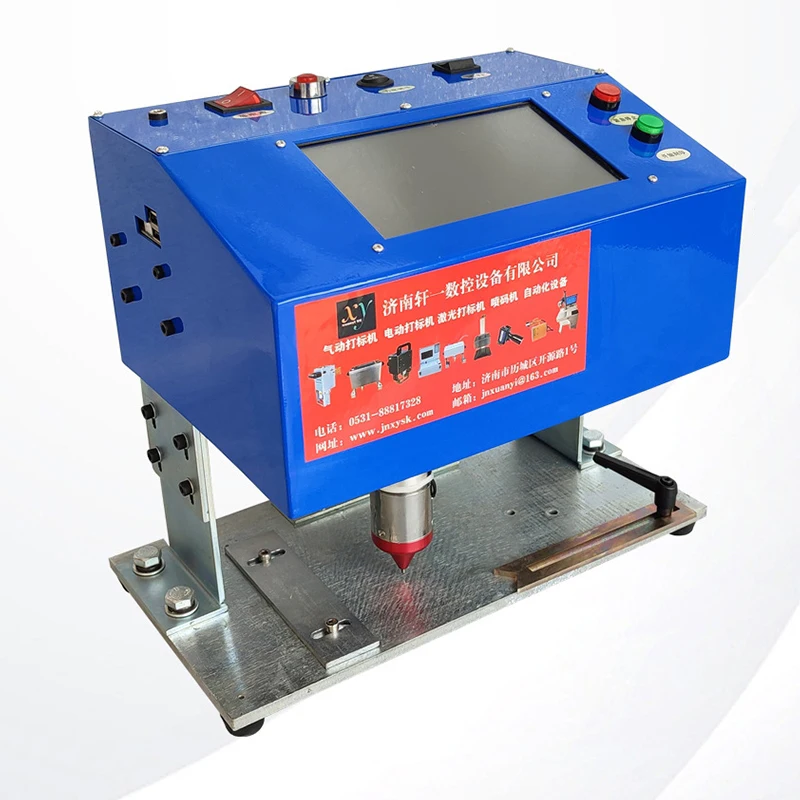
The photographs carry another maker's nameplate
The Hoting queue carries Product ID 1601266322802 as a TEBAK XY-24 dot peen marking machine for VIN plates, stainless signs, serial numbers and nameplates, and the listing publishes seven parameters. The eight gallery images publish a second and much larger set, and the first thing they show is not in the listing at all: the two machines photographed carry a red label naming Jinan Xuanyi CNC Equipment Co., Ltd., written in Chinese as 济南轩一数控设备有限公司, together with that company's telephone number, website and e-mail address, and a printed list of that company's own product range: pneumatic marking machines, electric marking machines, laser marking machines, inkjet coders, laser engravers and automation equipment.
None of that is improper, and a trading supplier selling another factory's machine under its own brand is one of the ordinary ways this market works. It does, however, change what a buyer has to establish, because the brand on the listing is not the brand on the machine. Four questions follow. Is the quoted machine that manufacturer's model supplied unbranded or re-badged? What is that manufacturer's model number for it, which is the number the spare parts list will be keyed to? Who supplies the pin, the belt or the drive, the controller and the firmware, and for how long? And who performs warranty work, given that the buyer's contract is with the seller in the listing rather than with the factory whose name is on the label?
Two smaller observations sit alongside that one and point the same way. The first is that the listing's model, XY-24, uses the same two-letter prefix as the manufacturer's name, Xuan Yi, and the same numeric style as three other marking machines recorded elsewhere in this same queue, which use XY-03, XY-16 and XY-22. That is consistent with a factory model series being sold under a house brand, and it is worth confirming rather than assuming. The second is that the two red labels on the two machines do not carry the same e-mail address: one shows an address at 126.com and the other the same mailbox name at 163.com, which is simply two label versions in circulation and a reminder to confirm the contact route in the contract rather than from artwork.
There is one more piece of context a buyer should weigh, and it is in the listing's own description field. The company profile text describes the business as a supplier of Product Machine, CNC Carbide inserts, turning tools and milling tools, and it never mentions marking machines, marking equipment or metrology. The profile is plain that the business is a trading house with a design and sales role, and the listing's own images show the machine's actual maker's range centred on marking and coding equipment. Neither statement is a problem on its own; together they say that the marking expertise sits with the factory and not with the seller, which is exactly why the technical questions in this guide should be put to the factory or answered in writing by the seller with the factory's confirmation.
The model in the title is missing from the record's own six-model table
The record devotes two gallery images to a table of six models, headed with the sentence that a variety of self-owned manufacturers are available and that personalised customisation is supported. The six models, with the figures the table gives for each, are these.
| Model | Print range | Engraving depth | Machine size | Customer must provide |
|---|---|---|---|---|
| XY/SD-1 | 90 by 30 mm | 0.1-1 mm | 160 by 170 by 280 mm | Computer |
| XY/M2-D | 200 by 120 mm | 0.1-1 mm | 300 by 215 by 325 mm | Computer |
| XY/M6-D | 200 by 120 mm | 0.1-1 mm | 300 by 215 by 325 mm | None |
| XY/BD-2 | 160 by 80 mm | 0.1-1 mm | 275 by 165 by 284 mm | None |
| XY/SD-2 | 90 by 30 mm | 0.1-1 mm | 167 by 115 by 274 mm | None |
| XY/TD-2 | 160 by 90 mm | 0.1-1 mm | 365 by 360 by 750 mm | None |
Two things about that table matter more than its contents. The first is that the listing's model does not appear in it. The six models are SD-1, M2-D, M6-D, BD-2, SD-2 and TD-2, and there is no XY-24 among them. Nor does any model number appear on the machines in the photographs, where the only legible plates are the manufacturer's company label and its product range list. So a buyer ordering an XY-24 has a model number that the record itself never uses, and the practical step is to ask for the factory's own model number for the machine being quoted and to put that number on the order, the invoice and the spare parts list.
The second is that none of the six table's print ranges equals any of the listing's five working sizes. The table gives 90 by 30, 200 by 120, 200 by 120, 160 by 80, 90 by 30 and 160 by 90 millimetres. The listing gives 80 by 30, 125 by 30, 140 by 40, 160 by 40 and 180 by 90 millimetres. The two sets have no member in common, and the near miss is instructive: the table has 160 by 90, while the listing has 180 by 90 and no 160 by 90 at all. A buyer who takes the title's designation 16090 as a working area will look for it in the parameter row and not find it.
A third difference is the depth. The table gives an engraving depth of 0.1 to 1 millimetre for all six of its models, while the listing's marking depth is 0.1 to 2 millimetres. The maximum depth in the two sets differs by a factor of two, and since depth is what decides whether a mark survives painting, blasting or service wear, the two figures cannot both describe one machine.
Finally, the table itself carries the marks of being assembled by hand or by machine translation rather than copied from a datasheet: two print ranges begin with stray leading characters, one depth label is preceded by a stray colon, one machine size uses a double asterisk, and Chinese text for application scope is printed overlapping the English text on two rows. Those are cosmetic, but they are the same signature as the listing's own parameter block, discussed below, and they mean the tables have to be read as artwork rather than as data.
Which window can hold a seventeen-character VIN
This is the check that decides whether the machine named in the title can do the job named in the title, and it needs nothing more than the character count and the window's long side. A vehicle identification number is seventeen characters long. The length a marking needs is the character width plus the spacing, multiplied by seventeen, and the window's long side has to be at least that, with clearance for the clamps.
| Character width and spacing | Needed for seventeen characters | Fits a window of |
|---|---|---|
| 3 mm plus 0.5 mm | About 60 mm | All five listed windows |
| 4 mm plus 1 mm | About 85 mm | 125, 140, 160 and 180 mm; not the 80 mm window |
| 5 mm plus 1 mm | About 102 mm | 125, 140, 160 and 180 mm; not the 80 mm window |
| 6 mm plus 1 mm | About 119 mm | 125, 140, 160 and 180 mm, the 125 mm window with only about 6 mm to spare |
The listed working sizes are 80 by 30, 125 by 30, 140 by 40, 160 by 40 and 180 by 90 millimetres. The short side is never the problem: a character 5 to 8 millimetres tall sits comfortably inside a window 30 millimetres tall. The long side is the problem, and the smallest window in the list, 80 by 30 millimetres, is too short for a seventeen character string in one line at any character width of 4 millimetres or more. It would hold a shorter serial number, an engine number, or a two line layout, and a VIN split across two lines is generally not acceptable on a vehicle identification plate, so the 80 millimetre window is a serial number window rather than a VIN window.
Two further consequences follow. The first is that the usable width is less than the nominal width once clamping is allowed for, and the machines in the photographs show two clamp bars lying across the platform, so the effective long side is shorter than the figure in the parameter row. The second is that if a longer plate has to be marked beyond one window, the work must be repositioned and the software must support marking at more than one origin, which is a function the record does not describe. A buyer whose plate is longer than 125 millimetres should ask directly how a second position is indexed and whether the software stores a multi-position template.
The same arithmetic gives the marking time for one VIN. A distance of about 85 millimetres at the stated speed of 30 to 40 millimetres per second takes about 2.1 to 2.8 seconds of head travel, which is the author's arithmetic from the given speed and not a cycle time, because the record states none and because loading, clamping and any second pass add to it.
Two machines in the photographs, and no word on how the data gets in
The photographs show two different machines built on the same platform. The first has no screen: its top face carries a rocker switch, a red stop button and two further controls, and the work is marked by a single head descending onto a flat platform. The second carries a colour touch screen set into the same blue housing, with the same head beneath it. The listing's parameter block mentions neither, and its seven parameters describe no controller, no software, no data input and no memory at all.
The record's own six-model table points at the same gap from a different direction, because one of its columns says what the customer must provide, and the answers differ by model: a computer for XY/SD-1 and XY/M2-D, and nothing for the other four. So the family is sold both as a machine that needs a computer and as a machine that stands alone, and the listing does not say which form is being quoted. That column is the most useful single column in the whole record, because it is the difference between buying a machine and buying a machine plus a computer plus software plus a licence.
For VIN work specifically, the data path is not a convenience, it is the control that prevents the wrong number being stamped into a vehicle or a plate. The questions to put in writing are these. Can the seventeen characters be keyed on the machine's own screen, uploaded from a file, or read from a barcode or a two dimensional code scanner? Does the software validate the string's length and format before marking, and can it be set to refuse a string that is not seventeen characters? Does it show a preview that the operator must confirm? Can it refuse a number that has already been marked, so that a duplicate cannot be produced in one shift? Is there a log recording what was marked and when, which is what an audit or a customer complaint will ask for? And can the operator be locked out of the font, size, depth and pattern settings, so that a line cannot quietly drift away from the approved mark?
Two practical details belong with those questions. If a computer is required, the buyer needs to know who supplies it, what operating system the software runs on, whether it runs on a modern version of that system, what file format it imports, and what happens on a machine that is not connected to a network. If the machine stands alone, the buyer needs to know how templates are stored and backed up, and what happens when the controller fails, since a controller that cannot be replaced with the same software turns a working machine into a spare platform.
A hardness limit of 60 with no scale
The parameter reads that materials hardness is less than or equal to 60. No scale is named, and without one the figure cannot be used, because 60 is a different material on every scale in common use. The typical values quoted below are standard published figures for ordinary materials rather than anything from this record, and they are here only to show how far apart the readings are.
| Scale | What a reading of 60 means there | Ordinary reference points |
|---|---|---|
| Rockwell C, for hard metals | Hardened material, close to tool steel | Quenched and tempered tool steel is commonly in the region of 58 to 65 on this scale |
| Brinell, for soft and medium metals | Very soft | Annealed mild steel is commonly around 120 on this scale, so 60 is half of that; pure aluminium is commonly around 20 to 25 |
| Vickers, used across the range | Softer still | The scale runs numerically close to Brinell at the soft end |
| Rockwell A, used for cemented carbides | A low reading on a scale whose normal working range sits far higher | Not a reading applied to structural steel |
Read as an upper limit, the two most likely readings point in opposite directions. Interpreted as 60 on the Rockwell C scale, the machine would be claimed to mark hardened tool steel, hardened shafts and hardened dies, which is a strong claim that a pneumatic dot peen head can only support at high striking force. Interpreted as 60 on the Brinell scale, the machine would be claimed to mark nothing harder than a soft aluminium alloy, would not mark ordinary structural steel, and could not mark the stainless plates that the listing's own title names. The same numeral, printed without a scale, can therefore be read as a promise or as a disqualification.
The remedy is to require the scale and the standard behind it: Rockwell to the ISO 6508 series, Brinell to the ISO 6506 series, Vickers to the ISO 6507 series. A buyer should also ask whether the limit refers to the bulk hardness of the material or to its surface, because a decarburised skin, a plated layer, a painted coat or a work-hardened surface behaves differently from the material underneath, and because the marking depth of up to the stated 2 millimetres is deeper than most plated or painted layers. For the stainless nameplate work the title names, the hardness question is rarely the obstacle, because annealed austenitic stainless sheet is far softer than any hardened tool steel and is routine work for a dot peen machine; the figure matters most on hardened components such as shafts, gears and dies, which is exactly where a misread unit would hurt.
Marking speed is a travel speed, not a throughput
The listing gives a marking speed of 30 to 40 millimetres per second. That is the speed at which the head travels along the line it is marking. It is not a measure of how fast the machine produces readable characters, and it is not comparable with a printer's characters per second.
The figure that decides how a mark looks is the distance between successive dots, and that comes from the strike frequency, which the record never gives. The relation is simple: the strike frequency in dots per second divided by the travel speed in millimetres per second gives the spacing in millimetres. The table below is the author's arithmetic across a range of frequencies the record does not state, included so that a buyer can see how much the missing figure matters.
| Strike frequency, if the machine did | Dot spacing at 30 mm/s | Dot spacing at 40 mm/s |
|---|---|---|
| 100 dots per second | 0.30 mm | 0.40 mm |
| 200 dots per second | 0.15 mm | 0.20 mm |
| 300 dots per second | 0.10 mm | 0.13 mm |
| 400 dots per second | 0.075 mm | 0.10 mm |
The consequence is that the same machine at the same stated speed produces a sparse, dotty character or a dense, near solid one depending on a frequency the buyer has not been told. At the finer spacings a character reads as a continuous stroke; at the coarser ones it reads as a row of separate marks, which is legible but noisier on a screen or a photograph and is what a buyer's customers will see on a finished plate. Two questions resolve it: what is the strike frequency range, and what dot spacing does the factory recommend for the material and for the depth being marked?
Depth belongs with the same question. The stated depth range of 0.1 to 2 millimetres is wide, and reaching the deeper end is a matter of the number of passes, the striking force and the spacing, which the software or the operator controls. So the third question is how the depth is set and controlled, whether it is a numeric setting in the software or a combination of air pressure and number of passes, and whether the factory will state the settings it used for its own sample marks, which appear in one of the gallery images on steel, on an aluminium rim, on a valve plate, on a motor label and on what appears to be a gas cylinder.
The working sizes, and where the title's two designations come from
The working size parameter holds five figures in a single value: 80 by 30, 125 by 30, 140 by 40, 160 by 40 and 180 by 90 millimetres. They are not separated by any convention that says whether they are options, a range, or one machine with several interchangeable fixtures, and the parameter does not say which one is supplied at the quoted price. Four of the five windows are 30 or 40 millimetres tall, and the fifth is 90 millimetres tall, more than twice the height of the others; a jump of that size usually means a different machine class rather than another fixture for the same platform, and the record's own six-model table supports that reading, because its 160 by 90 millimetre print range belongs to XY/TD-2, a machine 365 by 360 by 750 millimetres with a handwheel column, which is a different build from the bench top machines in the photographs. So the 180 by 90 millimetre window in the parameter row may not describe the machine in the pictures at all.
The title's two designations, 16040 and 16090, can also be read as working areas, and doing so exposes a mismatch. Read as 160 by 40, the first matches the parameter row's 160 by 40 window. Read as 160 by 90, the second matches nothing in the parameter row, which has 180 by 90 and no 160 by 90; 160 by 90 appears instead in the six-model table, as the print range of XY/TD-2. So the title appears to combine a size from the listing's own list with a size from the record's other table, and a buyer who orders against the title's designation may receive a different working area from the one they assumed.
Three questions close this section. Which of the five windows is supplied with the quoted machine, and what does each of the others add to the price? Is the working area the design limit of the mechanism or the area that can actually be marked once clamps are fitted, since the clamp bars in the photographs sit inside the platform? And can the machine mark more than one position on a longer plate, which is the function needed when a plate is longer than the window.
How a cylinder is marked on a flat platform
The gallery's sample marks include curved work: what appears to be a gas cylinder body, a wheel rim and round valve plates, alongside flat nameplates and steel blocks. The record's own six-model table supports the same claim, listing oxygen cylinders among the application scopes of two of its models and large workpieces for another. But the machines in the photographs stand on a flat platform with two straight clamp bars, and no rotary axis, no vee block, no chuck and no roller support appears in any image, and no rotary option is described anywhere in the listing or in the tables.
The gap matters because a dot peen head works on a line of a known height above a flat surface. A round part presents a surface whose height changes as it curves away, and it also rotates under the striking force unless it is held. Marking a cylinder therefore needs either a vee block or a pair of rollers to support it, a way to index the rotation, and either software that drives a fourth axis or a decision to mark only along the axis of the cylinder where the surface height is constant. The photographs suggest the last of those, since the mark on the cylinder body appears to run along its length, which is the case where a flat platform machine can work without a rotary axis.
The questions are consequently specific. How is a round part supported and prevented from turning during marking? What range of diameters can be held? Is a rotary fixture available, and does the software drive it? For a curved part marked along its axis, how is the top of the part set to the correct height, and is there a height gauge or a probe? And for a plate, is the clamp pattern in the photographs sufficient to stop a thin 1 millimetre plate from bowing or shifting when the head strikes it, since a thin plate on a flat table can flex under repeated impact and give an uneven mark. A buyer with cylindrical or thin work should treat the fixture as part of the machine's price, and should ask for it by name before the order rather than after.
The parameter block has been pasted in as a table
Several small defects in the parameter block point to the same origin, and together they tell the buyer that this block is artwork rather than a specification. The first parameter's label is Item and its value is Parameter: that is the header row of a table, stored as though it were a parameter, so anyone reading the list receives a junk line and anyone copying the list into an order form copies it too. Two labels are misspelled, reading marking deepth and pressure requirment. The hardness value is stored as the HTML entity for the less than or equal sign rather than as the character, so wherever the text is shown as plain text it reads ampersand-le-sixty, as it does in the listing's own description field.
The description field repeats the whole parameter block with double line breaks between every line, which is what a copy from a web table produces, and then appends a company profile that is cut off mid word, ending with the two letters T and E. The same profile also spells the abbreviation for original equipment manufacturer as OED rather than OEM. None of this affects the machine, and all of it means a buyer should rebuild the specification rather than paste it, and should treat the machine's own nameplate, not the listing, as the authority for the model, the voltage and the pressure range.
What the record does not state at all
- Which of the five working sizes is supplied, and the price of each of the others.
- The machine's own dimensions in the listing, although the six-model table gives them for six other models and none of those is the listed one.
- Machine weight, carton dimensions and packed weight.
- Whether a computer is required, which the record's own table answers for other models and not for this one.
- Any controller, software, font, symbol set or file format information, and any statement of how a seventeen character string is entered and validated.
- Whether the software can reject a duplicate number or keep an audit log, which is the control that prevents a wrong or repeated VIN.
- The strike frequency and the recommended dot spacing, which together decide how the mark looks.
- How depth is set and controlled, and what settings produced the sample marks in the gallery.
- Air consumption at the stated pressure, which is the figure needed to size a compressor; and the pressure figure itself is written with the unit as Mpa rather than MPa.
- The pin or stylus specification, its life, its price and whether it can be replaced by the user.
- Any fixture for round or thin work, and any statement of the diameter range supported.
- Noise level, and whether the machine needs to be bolted down, which a striking head on a light bench usually does.
- Warranty, certification, packing list, and a manual or parts diagram with part numbers.
- Which legal entity sells the machine, given that the maker named on its label is a different company from the one in the listing's profile.
One further omission is worth separating from the list. The listing's title names VIN plates and stainless steel, and the parameters name a working area no smaller than 80 by 30 millimetres; and the parameters also give a marking depth of up to 2 millimetres, which on a 1 millimetre stainless plate would be deeper than the plate itself. Nothing in the record reconciles a 2 millimetre depth with marking sheet metal, so the buyer should establish whether the deep end of the range applies only to solid blocks and whether the machine has a depth setting suitable for thin plate, where a mark can distort the surface around it.
Incoming inspection when the machine arrives
- Photograph the machine's own nameplate before unpacking and record the model, the voltage, the pressure range and any serial number, then compare the model with the one on the order, since the listing's model appears neither in the record's own six-model table nor on any label visible in the photographs.
- Measure the actual marking window with a steel rule or calipers by moving the head to each limit of its travel, and compare it with the window that was ordered; do not accept the parameter value as the measured area.
- Mark a seventeen character test string at the character size intended for production, on the same material as production, and measure the string's total length against the window's long side, leaving the clamps in place.
- Weigh the machine and the packed carton separately, and measure the carton, since the record gives neither weight nor carton.
- Confirm whether a computer is needed for the machine as delivered, and if it is, record the operating system and software version and take a backup copy of the templates and settings on the first day.
- Enter a seventeen character string by every route the machine offers, keyed, uploaded and scanned, and record which routes validate the length and which accept anything.
- Try to enter an incorrect string deliberately, and record whether the machine refuses it, warns, or marks it without objection; this is the only test of the error-proofing that matters.
- Mark the same number twice and see whether the second attempt is refused or allowed, and whether anything is logged.
- Check whether the operator can change the font height, the depth setting and the pattern without a password, and record the answer, because an unlocked setting is a route to unapproved marks.
- Measure the dot spacing on the test mark with a magnifier or a profile projector, and compare it with the spacing the factory recommended.
- Increase the depth setting step by step on solid test blocks until the deepest usable setting is found, and record the number of passes and the pressure at each step.
- Mark the thinnest plate the machine will be used on and check for bowing, for a raised rim around the mark, and for any distortion visible on the reverse face.
- Mount a round part the way it will be held in production and mark it, and record how it was supported, whether it rotated, and whether the depth varied across the curve.
- Set the air supply to each end of the stated range, mark a test piece at each, and compare the depth and the edge quality.
- Check the air line for leaks at the couplings, confirm what the tool requires regarding oil and filtration, and record the setting of any filter, regulator or lubricator fitted.
- Run the machine for the length of a production block and record the cycle time for one complete part including loading and clamping, which is the figure the record does not provide.
- Measure the noise level at one metre while marking, and check whether the machine moves or walks on the bench, since a striking head on a light frame will otherwise need bolting down.
- Fill in the warranty terms in writing, name the party responsible for spares, and record the price of a spare pin or stylus at the same time as the machine is ordered.
The specification to send before ordering
| Item | Answer required as |
|---|---|
| Model | The factory's own model number for the quoted machine, plus the seller's model number, both printed on the order |
| Working window | Which of the five sizes is supplied, its measured usable area with clamps fitted, and the price of each larger window |
| Character capability | The smallest and largest character height and width, the character set and symbols the software supports, and whether the buyer's own fonts or logos can be added |
| String length | The longest string the window can hold in one line at the character size the buyer intends to use |
| Depth | How depth is set, the achievable range in the buyer's material, and the setting used for plates of 1 mm and thinner |
| Strike frequency | The frequency range in dots per second, and the recommended dot spacing for the buyer's material and depth |
| Speed | Travel speed range, and the measured cycle time for the buyer's own part including loading and clamping |
| Hardness limit | The hardness scale and its standard, whether the limit applies to bulk or surface, and the maximum reading the machine will mark |
| Data path | Whether the machine is standalone or needs a computer, the software and its version, the file formats accepted, and whether a barcode or two dimensional code reader can be connected |
| Error-proofing | Whether the software validates string length and format, previews before marking, refuses duplicates, keeps an audit log, and can lock settings against operator changes |
| Fixtures | Whether a rotary axis, vee block, roller support or indexing fixture is available, the diameter range, and the price of each |
| Clamping | The clamp arrangement supplied, and whether it suits thin plates without bowing them |
| Air supply | Consumption in litres per minute at the stated pressure, the pressure range written correctly in megapascals, and the filtration and lubrication required |
| Electrical | Whether the delivered unit accepts both 110 and 220 volts in one build or comes in two variants, the plug and cable fitted, and the earthing arrangement |
| Dimensions and weight | Machine dimensions, machine weight, carton dimensions and packed weight as four separate figures |
| Spares | Part numbers and prices for the pin or stylus, the drive components and the controller, and the recommended spares holding |
| Safety and environment | Noise level at one metre, whether the machine must be bolted down, and the duty cycle for continuous production |
| Legal entity | Which entity quotes, invoices, receives payment and signs the origin certificate, and which party provides warranty service |
| Commercial terms | Price, minimum order quantity, trade term, the payment instrument actually accepted, sample lead time and cost, production lead time including any fixture, and the warranty period |
| Documentation | A manual, a parts diagram with part numbers, and the software's licence terms, in English |
The commercial terms in the gallery, and two payment panels that disagree
The listing's parameter rows carry no price, no minimum order quantity, no lead time and no trade term. Those appear in a panel among the images, which answers six questions as follows: quotations are usually issued within twenty-four hours of an enquiry; samples can be offered for reference; design work is available; payment is thirty per cent deposit with seventy per cent balance before shipping, by telegraphic transfer, PayPal or Western Union; the mass production lead time is about fifteen working days depending on quantity; and the delivery terms accepted are EXW, FOB and CIF.
A second panel in the same gallery lists the payment methods differently, showing telegraphic transfer, HSBC, Western Union, PayPal, MasterCard, VISA and MoneyGram, together with a courier list, and the same gallery panel appears in other records from this supplier in more than one version, which carries trade assurance, PayPal, Western Union, escrow, letter of credit and telegraphic transfer alongside a different set of couriers. So the gallery holds at least two payment panels, they do not list the same instruments, and neither of them lists only the three that the answers panel names. Card brands and money transfer services are also unusual instruments for a machine tool order of this size, which suggests the panels are template artwork rather than a statement of the seller's accounts.
Three points follow. First, the instrument matters more than the price on a first order, because seventy per cent before shipping places the whole of the buyer's money with the seller before the goods leave the country, so the buyer should ask for the transaction to run through a trade assurance or escrow route, or through a letter of credit, and should get the accepted instrument named in the quotation rather than inferred from a badge. Second, samples are offered for reference but no sample lead time, sample cost or sample carriage is stated; for a marking machine the sample that matters is not the machine but the mark, on the buyer's own material, at the buyer's own character size and depth, and that is a different request which should be made explicitly. Third, the fifteen working day figure is a mass production lead time and does not cover a non standard working window, a custom fixture or a computer supplied with the machine, each of which should be quoted with its own date.
Answers to the questions this record raises most often
Who makes the machine?
The machines in the photographs carry a red label naming Jinan Xuanyi CNC Equipment Co., Ltd., with that company's telephone, website and e-mail and a list of its own product range, which includes pneumatic and electric marking machines. The listing sells the machine under a different brand, and the listing's own company profile describes its business as cutting tools and carbide inserts without mentioning marking machines. The practical step is to establish which factory makes the quoted machine, what its model number is, and which party supplies spares and performs warranty work.
Is the model XY-24 in the record's own model table?
No. The record's six-model table lists XY/SD-1, XY/M2-D, XY/M6-D, XY/BD-2, XY/SD-2 and XY/TD-2. Neither XY-24 nor any other XY number appears among them, and none of those models' print ranges equals any of the listing's five working sizes.
Can it mark a vehicle identification number?
That depends on which working window is supplied and how large the characters are. A seventeen character string needs about 60 millimetres at a 3 millimetre character width, about 85 millimetres at 4 millimetres, and about 119 millimetres at 6 millimetres. The smallest listed window, 80 by 30 millimetres, is therefore too short for a seventeen character string in one line at any character width of 4 millimetres or more, while the 125, 140, 160 and 180 millimetre windows can hold it. The window has to be settled before the order.
Does the machine need a computer?
The listing does not say, and the record's own table shows that the answer differs between models: a computer is listed as customer provided for two of the six models and as unnecessary for the other four. The two machines photographed differ visibly in whether a screen is fitted, which is the same distinction from the other direction. Ask which form is quoted, and if a computer is required, who supplies it, what the software runs on and what the licence terms are.
How does the number get into the machine?
Unstated. For VIN work this is the control that prevents a wrong mark, so require an answer on whether strings are keyed on the machine, uploaded from a file or read by a scanner, and on whether the software checks the length and format, previews before marking, refuses duplicates, keeps an audit log and allows the settings to be locked.
What does a hardness limit of 60 mean?
Nothing, until the scale is named. On the Rockwell C scale, 60 is hardened tool steel. On the Brinell scale, 60 is softer than annealed mild steel, which is commonly around 120. Read one way the figure promises that the machine marks hardened steel; read the other it says the machine cannot mark the stainless plate named in the listing's own title. Require the scale and its standard, and whether the limit refers to bulk or surface hardness.
Is 30 to 40 millimetres per second fast?
It is a travel speed, not a throughput. The appearance of the mark depends on the dot spacing, which is the strike frequency divided by the speed, and the frequency is not stated. At the stated speeds, a frequency of 100 dots per second would space dots 0.30 to 0.40 millimetres apart, while 400 dots per second would space them 0.075 to 0.10 millimetres apart, which is the difference between a dotted and a nearly solid character. Ask for the frequency range and the recommended spacing.
Why is the pressure written as Mpa?
The correct form is MPa, for megapascal. The listing writes the unit as Mpa in both the parameter's label and its value, and the description field carries the same spelling. The numbers are ordinary workshop pressure, 0.3 to 0.5 megapascals being about 3 to 5 bar, or roughly 44 to 73 pounds per square inch, so the figure itself is plausible; the missing air consumption in litres per minute is the figure that cannot be inferred.
What about the first parameter, Item equals Parameter?
That is the table's own header row stored as a parameter, along with two misspelled labels and a hardness value stored as an HTML entity that prints as ampersand-le-sixty in plain text. The block reads as artwork rather than as data, so it should be rebuilt rather than pasted into an order.
Will it mark round parts?
The samples include curved work and the record's own tables list cylinders among the applications, but the machines photographed sit on a flat platform with straight clamp bars and no rotary axis, vee block or roller support appears anywhere, and no round workpiece can be seen being held. Ask how a cylinder is supported and indexed, what diameter range is possible, and whether a rotary fixture exists, and price it as part of the machine.
What does the record leave out completely?
The machine's dimensions and weight, the carton, which window is supplied, whether a computer is needed, any software or file format detail, the strike frequency, how depth is set, air consumption, the pin specification and spare price, any fixture for round or thin work, noise, duty cycle, warranty, certification, the packing list and a manual. Each becomes a line in the buyer's own specification rather than a figure read from the listing.
Source, scope and what this guide does not claim
This guide is based on the Hoting queue record for Product ID 1601266322802, titled as a TEBAK XY-24 dot peen marking machine for VIN number plates, stainless signs, serial numbers and VIN numbers, and on the eight detail images that accompany it. All eight images were examined.
The seven listing parameters are quoted as they appear: a first row whose label is Item and whose value is Parameter; working size given as 80 by 30, 125 by 30, 140 by 40, 160 by 40 and 180 by 90 millimetres in one value; marking depth written as 0.1 to 2 millimetres according to materials; marking speed 30 to 40 millimetres per second; pressure requirement written as 0.3 to 0.5 with the unit as Mpa; materials hardness written as an entity that prints as less than or equal to 60; and voltage as 110 and 220 volts, 50 and 60 hertz, single phase. The description field reproduces that block as text and appends a company profile that names Hengshui Mengshang Trading Co., Ltd., describes the business as a supplier of Product Machine, CNC Carbide inserts, turning tools and milling tools, spells the abbreviation for original equipment manufacturer as OED, and is cut off mid word.
The gallery supplies the rest. Two of its images carry the six-model table quoted in full above, headed by the sentence about a variety of self-owned manufacturers and about personalised customisation. Two of them show the same bench top machine from different angles, one without a screen and one with a colour touch screen, both carrying a red label naming Jinan Xuanyi CNC Equipment Co., Ltd. in Chinese as 济南轩一数控设备有限公司 together with that company's telephone number, website, e-mail address and product range, and the two labels carry different mailbox domains for otherwise similar addresses. One image shows sample markings under the heading Display of printing effect, and the marks visible there are on steel blocks, a plate carrying a star symbol followed by a long alphanumeric string, a further nameplate, what appears to be a motor label with a VIN field, a tyre rim marked as tubeless, a valve plate bearing an LP gas mark, what appears to be a gas cylinder body, and a lifting plate carrying a mark in a triangle. One image is a shipping and payment panel showing telegraphic transfer, HSBC, Western Union, PayPal, MasterCard, VISA and MoneyGram, with a courier list; one is a photograph of a factory gate whose stone sign reads 衡水梦尚贸易有限公司; and one is a six question answers panel. The answers panel and the factory gate photograph are the same images that appear in the preceding record in this same queue, and the preceding record's payment panel is a different panel from this one, listing trade assurance, PayPal, Western Union, escrow, letter of credit and telegraphic transfer; that comparison is a direct reading of the two records' own image addresses and of the panels themselves.
Several figures in this guide are the author's arithmetic rather than published data, and are identified so that they are not mistaken for a specification. The string lengths of about 60, 85, 102 and 119 millimetres for seventeen characters are calculated from the stated character widths and spacings and are not published figures. The marking time of about 2.1 to 2.8 seconds for an 85 millimetre string is derived from the listing's own speed range and excludes loading, clamping and any second pass. The dot spacing table is calculated as strike frequency divided by travel speed, using frequencies the record does not state, and is included to show the size of the missing figure. The conversion of 0.3 to 0.5 megapascals into about 3 to 5 bar and roughly 44 to 73 pounds per square inch uses one megapascal as ten bar and one bar as about 14.5 pounds per square inch. The hardness reference points are ordinary published values for well known materials, quoted only to show how far apart the readings on different scales are: quenched and tempered tool steel in the region of 58 to 65 on the Rockwell C scale, annealed mild steel commonly around 120 on the Brinell scale, and pure aluminium commonly around 20 to 25. The references to the ISO 6508, ISO 6506 and ISO 6507 series name the frameworks for Rockwell, Brinell and Vickers testing, and no particular grade or limit is asserted because the record names none. Nothing in this guide states what any named company did or did not do; the company names and the label details are reported because they appear in the record and its images, and the points drawn from them are procedural questions for a buyer to ask.
A buyer can close this specification with seven answers and five measurements. The answers are which factory makes the machine and its own model number; which of the five working windows is supplied and its usable area with clamps fitted; whether a computer is required and what software and file formats apply; how a string is entered and what validation, duplicate checking and logging the software performs; the strike frequency range and the recommended dot spacing; the hardness scale and standard behind the hardness limit, and how depth is set; and the air consumption with the electrical configuration. The measurements are the measured window, the seventeen character test string in the buyer's own material at production size, the dot spacing and depth on that test, the cycle time for one complete part, and the noise level at one metre. Everything else in this guide follows from those twelve answers, and none of them is in the record as it stands.
Key specifications
- Item (a header row that has been pasted in as a parameter)
- Parameter
- Working size
- 80*30mm 125*30mm 140*40mm 160*40mm 180*90mm
- Marking deepth (as spelled)
- 0.1-2mm (according to materials)
- Marking speed
- 30-40mm/s
- Pressure requirment (as spelled)
- 0.3-0.5Mpa
- Materials hardness (no scale named)
- ≤60, with the HTML entity printed as text
- Voltage
- 110V/220V 50/60Hz single phase
- Models listed in the record's own six-model table
- XY/SD-1, XY/M2-D, XY/M6-D, XY/BD-2, XY/SD-2, XY/TD-2; the listing's XY-24 is not among them
- Print ranges in that table
- 90*30, 200*120, 200*120, 160*80, 90*30, 160*90 mm; none equals any of the listing's five working sizes
- Engraving depth in that table
- 0.1-1mm for all six models, against the listing's 0.1-2mm
- Machine sizes in that table
- 160*170*280, 300*215*325, 300*215*325, 275*165*284, 167*115*274, 365*360*750 mm; the listing gives no machine size
- Computer requirement in that table
- Customer-provided Computer for XY/SD-1 and XY/M2-D; None for the other four; the listing says nothing
- Manufacturer named on the machines' own labels
- Jinan Xuanyi CNC Equipment Co., Ltd. (济南轩一数控设备有限公司), with its telephone, website and e-mail
- Product range printed on those labels
- pneumatic marking machines, electric marking machines, laser marking machines, inkjet coders, laser engravers, automation equipment
- Business described in the listing's own company profile
- Product Machine, CNC Carbide inserts, turning tools and milling tools; marking machines are not named
- Character set or software functions
- not stated; the sample marks include a star symbol, so symbols are producible but the set is undocumented
- Air consumption
- not stated
- Machine weight and carton
- not stated
- Rotary fixture for cylindrical work
- not stated, although cylinders appear among the sample marks and the application scopes
- Stylus or pin specification, spares and prices
- not stated
- Warranty, certification and packing list
- not stated