
Two specification sets in one record, and seven points where they disagree
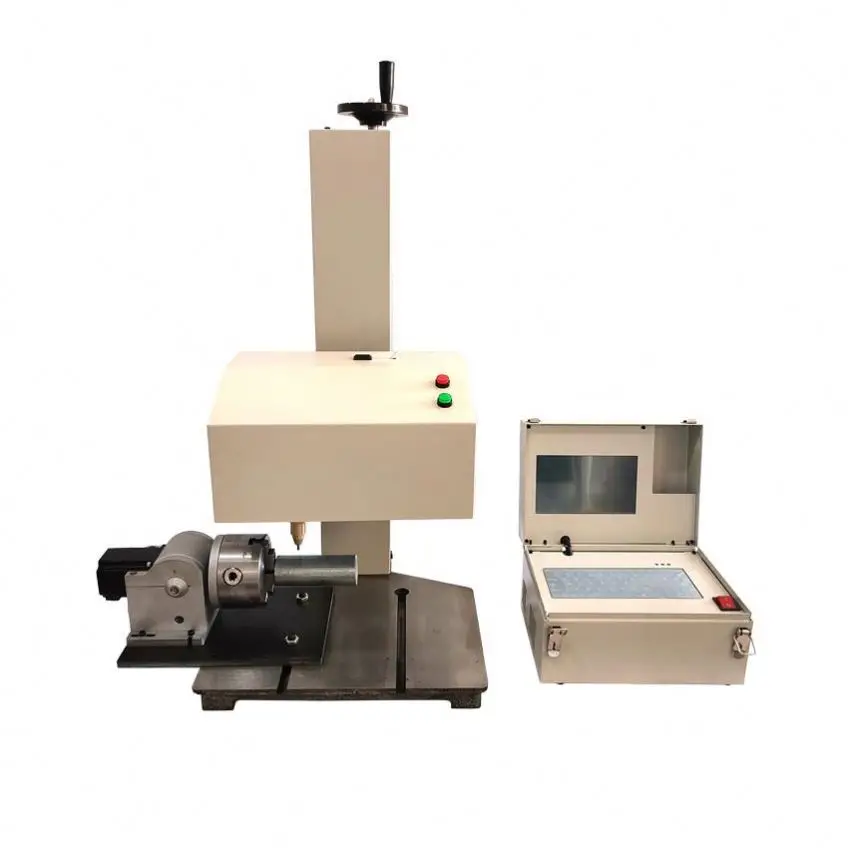
Product ID 1601247392471 is a rotary dot peen marking machine with a pneumatic head, offered under the description three axis rotary coding machine. The record contains two separate specification sets, and both look authoritative. The first is the parameter block, fourteen rows of labelled figures in the listing's own fields. The second is an English panel headed Product Parameters in the fourth of the eight gallery images, which carries four dimensioned drawings of the machine and a full technical table underneath them. A buyer who reads only the fields and a buyer who reads only the panel will come away with different machines.
Setting the two side by side, they disagree on seven items, and the disagreements are not rounding differences:
| Item | Parameter block | Gallery panel, image 4 | Difference |
|---|---|---|---|
| Marking depth | 0.01 to 2 mm | 0.01 to 0.5 mm, stated for 235 steel plate | Upper limit is four times higher in the block |
| Speed | At most 50 mm/s, given as 3 to 4 numbers per second with 3 mm character height | 1 to 100 characters per minute | The ranges do not overlap at all |
| Air pressure | 0.2 to 0.6 MPa, printed twice | 0.1 to 0.7 MPa | The panel asks for less minimum and more maximum |
| Accuracy | Marking accuracy 0.01 mm | Repeat precision better than 0.1 mm | A factor of ten |
| Power | Machine power at most 400 W | Power supply 220 V, at most 300 W | One third again more in the block |
| Working temperature | Minus 5 to 40 degrees Celsius | Minus 10 to 45 degrees Celsius | Different on both ends |
| Model designation | M1, M3, L4 | XY/M1, XY/M3, XY/L4 | The panel carries a family prefix the block omits |
The obvious question is which set governs, and the record does not say. What it does offer is a way to judge the two against each other, because one set is internally consistent and the other is not. The panel's figures agree with each other. It states a speed ceiling of 100 characters per minute and, separately, a beat of one minute per piece, which is what 100 characters per minute means if a typical piece carries up to about a hundred characters. It states a depth upper limit of 0.5 mm for 235 steel plate, and the material and the depth belong together as a pair. It states an accuracy of better than 0.1 mm, which is the kind of figure a stepper-driven carriage on a column can hold.
The parameter block does not hold together the same way, and its speed row is the clearest case. Three to four numbers per second is 180 to 240 characters per minute. The panel's ceiling of 100 per minute does not sit below that by a little; it sits below the block's own floor by nearly half. The two are disjoint, so at most one of them describes the machine. Working the block's other speed term, the 50 mm per second traverse, against its own rate of three to four characters a second gives 12.5 to 16.7 mm of travel per character, which is several times the width of a three millimetre character, so the 50 mm per second figure is the speed of movement between marks rather than the rate at which marks are made. That reading is coherent, but it also means the block's two speed terms describe different things without saying so.
None of this settles which set is correct, and it is not meant to. It sets the question: ask the supplier which specification the machine is built and tested to, and if the answer is the panel, ask for the parameter block to be corrected, because the block is what appears in the fields a buyer reads first and what gets copied into a purchase order.
A parameter block that repeats one of its own rows
The fourteen rows of the parameter block include the same label twice. Air Pressure appears at position five with the value 0.2-0.6Mpa and again at position ten with the value 0.2-0.6 Mpa, identical except for a space before the unit. Nothing distinguishes the two rows, no second port or second circuit is named, and the record offers no reason for the repetition. It is a duplicated row.
The same fourteen rows are also printed a second time, in full, inside the description field, where they appear as a two-column text block ahead of a Packing and Shipping heading that has nothing under it. So this record states its specification twice, in two places, structured and unstructured, and the structured copy already carries a duplicate. That matters for a small reason and a large one. The small reason is that a buyer comparing listings by field will see fifteen values where there are fourteen, and any automated extraction will treat the two air-pressure rows as two separate requirements. The larger reason is what the duplication says about the record: it is a copy of a template, not a description of a tested machine, and the same expectation should be applied to the rest of its figures.
Two further details of the block belong here because they affect what a buyer sees. The values are stored with HTML entity codes still in them, so the field reads at most fifty millimetres per second as an entity string rather than as the symbol, and the power supply reads 220V plus-or-minus 10 percent in the same encoded form; a person reading the listing sees the symbols and a parser sees the codes, which is one reason figures copied out of listings introduce errors. And the product's own web address is eighty characters long and stops mid-word at the letters vin-numb, cut from VIN Number, so the permanent identifier of the product is a fragment of its title.
The models: three codes, one set of values, and one code used twice
The model field reads M1, M3 and L4. Three codes are offered, and the record gives them one shared column of figures, so nothing in the block distinguishes one from another. The gallery panel corrects the naming and adds a prefix: its four cards are labelled XY/M1, XY/M3, XY/L4 and, on the fourth card, XY/M3 again. That prefix matters beyond tidiness, and it is returned to below.
Four cards for three codes means one code is shown twice, and the two cards that carry the code XY/M3 show different machines. The second card shows the marking head on a base with a stand-mounted computer at the side, and its dimension lines describe the head unit and the control box. The fourth card also reads XY/M3, and it shows the same head mounted with a rotary chuck for cylindrical work and a separate cabinet holding a screen and keyboard. Same code, two configurations, one of them with a rotary axis and one without.
That is the practical problem with the model field, and it goes further once the gallery is read as a whole. The panel's four cards give dimensions, but the record's own photographs show the head on at least four different mountings: on a bench base, on a floor cabinet, on a wheeled cart with a long arm for horizontal cylinders, and in one photograph on a production floor alongside other machines. None of those mountings appears in the model field, and the model field does not say whether the mounting is part of the model or an accessory. So the questions are the ones the record cannot answer: what distinguishes M1 from M3 from L4, which code covers the rotary version, whether the mounting is included or quoted separately, and which of the two XY/M3 configurations a quotation for XY/M3 will deliver.
Multi-model fields are rare in this queue, which is worth knowing because it sets how much can be read into one. Fourteen of the five hundred and twelve records put a dividing slash in a model-like field, which is 2.7 per cent, and this is one of them. Seven of those fourteen carry the same pair of codes under a common prefix with the two codes run together and no separator between them at all, which means that even where the field looks as if it is separating models it is not reliably doing so. The rest name a spindle taper series, a pair of synonymous words, and a set of sizes, so a slash in that field usually indicates a range rather than a family of distinct machines. Here it indicates three codes that the record does not separate.
The title promises three axes, and the parameters specify one
The listing's title calls this a three axis rotary machine. The parameter block contains exactly one axis figure: Z axis lifting range, given as 0 to 300 mm or customized. There is no X travel, no Y travel, and no rotary-axis figure whatever, in a machine whose title says rotary. So the buyer knows the vertical travel of the column and nothing about how far the head moves across the work, how far it moves towards it, or what the rotary axis can hold or rotate.
The rotary axis is the larger omission, because it is the feature the title leads with and it is the axis that decides whether the machine can do the job. A rotary marking axis is specified by what it holds and how it holds it: chuck diameter and type, clamping range, maximum workpiece diameter, maximum workpiece length or unsupported span, whether one end is supported by a tailstock, the rotary resolution or the smallest angular increment, and the rotation speed. The record states none of these. The photographs show a three-jaw chuck mounted on the base with a tube clamped in it and, in the dimensioned drawings, a rotary configuration with the workpiece held horizontally, so the machine demonstrably has such an axis. What it can carry is unknown from the record.
The axis count itself is worth a question rather than an assumption. If the three axes are the two in the plane of the work plus the vertical column, then the rotary axis is a fourth and the title is using three axis loosely. If the three axes include the rotary axis, then the column is an extra and the block's Z row describes something outside the count. Either reading is possible and the record does not choose. A buyer should ask the supplier to name the three axes explicitly and to state the travel of each, since a machine quoted as three axis with only one travel figure supplied is a machine whose envelope cannot be checked against a drawing.
The column in the photographs disagrees with the column in the parameters
The parameter block gives a Z axis lifting range of 0 to 300 mm, with the words or customized attached. One of the gallery images is a close-up of the marking head's main column, and that column carries a printed scale. The numerals on it run up to 500, in divisions of ten millimetres, and the visible sequence runs down through 490, 480, 470 and onwards. The panel's dimensioned drawings put the machine's overall height at 710 mm.
So the record offers three different vertical figures that a buyer might mistake for the same thing: a stated lifting range of 300 mm, a scale on the column marked to 500, and an overall machine height of 710 mm. Each can be true at once, because a column longer than its powered stroke is normal and the machine height is not the travel. But the record never says which is which, and the difference between a 300 mm stroke and a column marked to 500 is the difference between marking a long shaft and not.
The scale image also carries the caption that explains the column's purpose, saying that marking direction and positioning tools can be customized according to the products so as to meet the marking requirements of workpieces of different shapes. That is a statement about a configurable fixture, which is consistent with the machine being built to order, and it goes with the or customized wording in the parameter block. It also means the marked scale may not describe the delivered machine's stroke, because on a customized column the scale and the usable stroke need not match. The questions follow: what is the usable powered stroke, what is the total column length, is the stroke limited mechanically or in the controller, and does a customized build change any figure in the block.
A print range of 160 by 90 millimetres that lives only in an image
The parameter block never states the marking window, which is the figure a buyer needs first: how large an area the machine can mark without repositioning the work. The gallery panel gives it, and gives it identically on all four of its model cards, as 160 by 90 mm. It also gives a head weight of 30 kg per card, against the block's whole machine weight of 60 kg.
That the print range exists only in an image is the practical problem. It is the specification a buyer compares against a drawing, and in this record it cannot be compared field to field, only by reading a picture. The same is true of the depth qualifier on the panel, which states its 0.01 to 0.5 mm figure for 235 steel plate specifically, naming the material and thereby making the depth meaningful, while the block's 0.01 to 2 mm stands with no material attached.
For a buyer marking identification plates, the window decides whether a plate is marked in one pass or in several, and a multi-pass job on a rotary axis introduces a registration question that a single-pass job does not have. So the questions are concrete: is the 160 by 90 mm window a rectangle in the plane of the work, and does it apply to the rotary configuration as well, where the equivalent figure is a length along the circumference and a width across it. On a rotary axis the useful figure is not a rectangle but a cylinder, and the record gives none of its dimensions.
A pin at HRC 92, in eight records of the same queue
The parameter block states pin hardness as HRC 92. That figure cannot be correct as written, because the Rockwell C scale is not defined that high. Hardened steel runs out in the high sixties on that scale, and harder materials are measured on other scales, which is why carbides are usually quoted as HRA, as HV, or as a maker's grade rather than in HRC. A dot peen pin is normally a tungsten carbide stylus, so if the intended value is a genuine hardness figure it belongs on one of the other scales.
What makes this more than a typographical question is a second figure elsewhere in the same record. The gallery panel states workpiece hardness as HRC 50 or less, which is a properly written Rockwell C limit for a workpiece, with the scale named and the direction of the limit given. The same panel therefore demonstrates that the author of this specification knows how to write an HRC figure correctly, while the pin's hardness is printed as an impossible one. And the figure is not unique to this listing. Searching every parameter of every record in the queue for a Rockwell C value returns nine records, eight of which state exactly HRC 92 for pin hardness, and one of which states a range, HRC 57 to 62, for a different machine. Eight records sharing one impossible figure means the value was copied across listings rather than measured per machine.
For a buyer the consequence is about consumables, not about prestige. The pin is the part that wears, its hardness governs how long it lasts, and the record states its life in one place only: the gallery panel gives 500,000 characters per pin or more on 235 steel plate. At seventeen characters for a vehicle identification number, that is about twenty-nine thousand plates per pin, which is a usable planning figure. What the record does not give is the pin's material grade, the number of pins supplied with the machine, the pin's diameter and tip geometry, or the price of a replacement. Ask for the grade on a scale that can be verified, for a test certificate if one exists, and for the spare pin price, because the pin's cost per thousand plates is the real consumable cost of owning this machine.
Air at four different pressures and no consumption figure at all
The machine is pneumatic, which the record says twice and which the photographs confirm: a blue hose runs into the marking head in the close-up of the head assembly, and the marking force comes from air. To specify a pneumatic machine a buyer needs two numbers, the pressure and the consumption, and this record supplies only the first. Worse, it supplies three different versions of the first. The parameter block states 0.2 to 0.6 MPa in two separate rows, and the gallery panel states 0.1 to 0.7 MPa.
No air consumption figure appears anywhere in the record. Without one, the compressor cannot be sized, and the omission matters more than it looks for a machine of this type. Dot peen marking is intermittent, so the consumption that governs is not the continuous draw but the draw during the striking phase, and the compressor has to cover the peak rather than the average. A buyer who takes the pressure range as sufficient and connects the machine to an existing workshop line may find that the marking force drops when the line is busy, which shows up as inconsistent depth rather than as a machine fault. The questions to put are the consumption in litres per minute at each of the two pressures, whether that figure is free air delivery or measured at the inlet, what the striking phase draws, and the minimum supply pipe size.
There is also a quality-of-air question that the record leaves open and that is a common cause of early failure in pneumatic marking heads. Air fed to a cylinder and a striking mechanism normally has to be either lubricated or specifically dry, depending on how the head is built, and it must be free of water and particulate. The record does not say which the head requires, and the photographs show no filter, regulator or lubricator on the machine itself, so the buyer may be expected to supply one. Ask what the head requires, whether a filter-regulator-lubricator is included or quoted separately, and what the air quality standard is. This gap is not unique to this listing: twenty-one of the five hundred and twelve records in this queue mention an air pressure figure and state no consumption at all, so it is worth checking on any pneumatic machine on this catalogue.
0.21 cubic metres, and the only volume-instead-of-dimensions figure in the queue
The last row of the parameter block reads Measurement, and its value is 0.21CBM. That is a volume in cubic metres, given where every other listing in the queue gives dimensions. Searching all five hundred and twelve records for a cubic-metre figure returns exactly one, this one, so the practice is unique here rather than typical.
A volume is not useless. It supports a freight calculation, and for this machine the calculation is worth doing because it inverts the expectation set by the previous article in this series. Two hundred and ten litres of packing at a divisor of 6000 gives a volumetric weight of 35 kg, and at 5000 gives 42 kg. The machine's own stated weight is 60 kg. So here the actual weight exceeds the volumetric weight on either divisor and air freight bills on the actual weight plus packaging, which is the opposite of the case for a bulky light product. The 0.21 cubic metres is also consistent with a single tall carton of roughly 450 by 450 by 1000 mm, which is about the size a 710 mm machine on a 370 mm base would need.
What the volume cannot do is the rest of what dimensions are for. It cannot be checked against a pallet footprint, it cannot be used to compute a girth or length-plus-girth limit that some carriers apply to individual pieces, it does not say how many cartons there are, and it cannot be verified on arrival by measuring. And there is a reason to think there may be more than one carton. The dimensioned drawings on the gallery panel show the marking head with a separate control unit, dimensioned on the first card at about 260 mm across and on the second at about 270 mm, and two further cards show a separate cabinet holding a screen and keyboard. The photographs of the installed machine show a cabinet-mounted configuration with a monitor. If the control unit or the cabinet ships as its own package, then 0.21 cubic metres covers the main unit only and the shipment's real volume is larger.
So the ask is a packing list: number of cartons, dimensions and weight of each, total volume, and whether the machine ships assembled on its base or partly dismantled. Add the question of whether the base, the column, the chuck and the control unit are individually packed or banded to a pallet, because on a machine of 60 kg with a 710 mm column those choices decide whether the shipment arrives needing a realignment.
What the gallery shows that the parameters do not
Six of the eight images are the machine's own, and between them they establish several things the parameter block omits, along with some questions of their own. One image is a sales panel: the drawing shows a column with a handwheel, a marking head, a rotary chuck with a tube clamped in it, a slotted base table, and a separate cabinet with a screen, and the panel states a seven inch touch screen and the phrase clear lettering and durable over it. Under the machine runs a six-icon feature strip with short captions covering automatic printing, bilingual operation, hardness, service life, mark quality and ease of operation.
Another image is a close-up of the head's main column with the handwheel and the printed scale described earlier. A third is a product detail panel built around two pictures: one of linear rolling guide rails with blocks on a rail, captioned as giving long usage time with the explanation that the machine adopts a linear rolling guide rail structure and runs smoothly, and one of the marking head with its pneumatic hose over a workpiece plate, with a caption stating that positioning tooling and clamping fixtures are designed and manufactured according to the size of the workpiece, so that the workpiece is located accurately and the engraving is clear and the position accurate. The rails and blocks in that picture carry inscriptions consistent with a maker's name and part numbers, though at the resolution supplied the letters are only partly legible. That is worth a question rather than a judgement, because guides and blocks are wear parts: ask which maker's guides and blocks are used, what the part numbers are, whether they are available as catalogued spares, and whether the rail is protected from swarf. The heading on that same panel is printed twice over itself, with one caption reading clear engraving and another that appears to read metal analysis laid on top, so the line is partly illegible. That is a design artefact in the supplier's own graphics and is recorded here only because it indicates the panel was assembled from more than one source.
A fourth image is a collage of marking samples on other people's parts: a dark plate with a repeated alphanumeric string, a stainless plate with a column of vehicle-style numbers, a nameplate from a Chinese electric tricycle maker, a wheel rim marked tubeless, saw blades, a curved stainless plate carrying a coffee company's name and founding year, a plate marked with the words trusted by bone and joint surgeons, and a sequence of capital letters running down a metal block. A fifth image is a product photograph panel with four application shots, captioned for steel tube arc marking, marking of an electric vehicle frame, horizontal cylinder marking and desktop rotation marking. In the second of those, the machine stands on a production floor beside rows of similar machines with a laptop controlling it, and in the fourth the marking software on the screen displays a name. That screen name reads XIANYI MARK.
Two things follow, and both are questions rather than conclusions. The first concerns who makes the machine. This record's model codes carry the prefix XY in the gallery panel, its control software identifies itself as XIANYI MARK, and elsewhere in this same queue seven records list a model number built from the same XY prefix with two codes run together. A record published earlier in this series, for product ID 1601266322802, recorded that the machines in its own photographs carry a red label naming Jinan Xuanyi CNC Equipment Company Limited, a romanisation that corresponds to the software mark on the screen of this machine. The description field of this record, meanwhile, names a trading company and a brand of its own. None of that is improper, since machines are commonly made by one firm, supplied by another and marketed under a third name, but it means the buyer should ask who manufactures the machine, whether it is a rebadged model, who holds the drawings and the spare parts, and who provides technical support and training. It is also the reason to ask whether the software is the maker's own and whether it is licensed per machine.
The second concerns configuration. The gallery's four model cards give one set of dimensions, but the application photographs show the head on four different mountings: on a bench base, on a floor cabinet, on a wheeled cart with a long arm arranged for horizontal cylinders, and on a production floor integrated into a line. None of those mountings appears in the parameter block, and the model field does not distinguish them. A buyer who needs the cart-mounted version for large cylinders, or the cabinet version for a workshop, is looking at configurations the record shows but does not sell by name. Ask which configuration each model code covers and whether the mounting is included in the price.
The shared panels, and a description field cut off mid-sentence
Two of the eight images are not this machine's own. One is a panel headed shipping service with payment methods and courier logos, and one is a gate photograph. Comparing this record's image addresses against every image address in the queue gives the same counts that the two preceding articles in this series reported, because the files are the same files: the payment and courier panel is shared by one hundred and nineteen of the five hundred and twelve records, and the gate photograph by seventy-seven. Both were confirmed the same file by download rather than by appearance, at 192,646 bytes and 148,637 bytes respectively, byte-identical to the copies used by the record published immediately before this one in the same series. So the two panels are not merely similar across listings, they are the same two files travelling together through the catalogue.
The gate photograph shows a Chinese sign whose characters and romanised English line both name a trading company, the same trading company named in this record's description field, so here the image and the profile agree. The description field itself, setting the title aside, contains the fourteen parameter rows printed out as a text block, a Packing and Shipping heading with nothing beneath it, and the opening of a company profile. That profile is the same boilerplate that appears in other records of this queue, and here it stops after one hundred and sixteen characters, ending in the middle of a product list at the words turning. Two records earlier in this same series carried the same opening and ran to six hundred and sixty-one characters before being cut in the middle of a different word. The same text, truncated at two different points, in two records of one catalogue, is the clearest single indication that description fields here are pastes of a template rather than descriptions of machines.
One consequence is worth stating plainly, since it applies to every figure in this article. Because the description field is boilerplate and the parameter block repeats a row and disagrees with the gallery panel on six further figures, no single field in this record is authoritative on its own. The gallery panel is the more internally consistent of the two specification sets, and where the two disagree the panel's figures are the better starting point. Neither is a substitute for a quotation and a data sheet, and both should be reconciled with the supplier in writing before an order.
What the record does not state at all
- Which of the two specification sets governs, where the two disagree on depth, speed, pressure, accuracy, power and working temperature.
- The travel of the X and Y axes, and therefore the machine's working envelope.
- Any figure for the rotary axis: chuck diameter and type, clamping range, maximum workpiece diameter and length, rotary resolution and rotation speed.
- Whether the three axes named in the title include the rotary axis, and which three axes are meant.
- The usable powered stroke of the column, as distinct from the column's printed scale to 500 and the overall machine height of 710 mm.
- Air consumption in litres per minute at either stated pressure, and the consumption during the striking phase.
- Whether the head requires lubricated or dry air, and what filtration and air quality are required.
- Whether a filter, regulator or lubricator is included, or supplied by the buyer.
- The pin's material grade on a verifiable scale, the number of pins supplied, the pin diameter and tip geometry, and the replacement pin price.
- How many cartons the shipment contains, the dimensions and weight of each, and the total volume, given that the only packing figure is a volume of 0.21 cubic metres.
- Which maker's linear guides and blocks are fitted, their part numbers, and whether they are catalogued spares.
- The marking software's name, its licence terms, whether a licence is per machine, and whether it runs on the supplied control unit or on a buyer's computer.
- Whether the control unit, cabinet, mountings, chuck and fixtures are included in the price or quoted separately.
- File formats accepted for marking data, connection type, and memory or program storage.
- The character set and font limits beyond the panel's mention of adjustable exchange.
- Whether the machine carries any safety certification or marking for the destination market, and what electrical standard the 220 V supply complies with.
- Warranty period, its scope, and who performs service and training.
- Delivery term, port pair, production lead time and transit time.
- The brand under which the machine is made, and the relationship between the maker and the supplier, given the marks visible in the record.
Incoming inspection when the machine arrives
- Before accepting delivery, count the cartons and weigh and measure each one, then compare the total against the supplier's packing list rather than against the 0.21 cubic metre figure in the listing, which may cover the main unit only.
- Photograph each carton on arrival and note any crush damage on the packing list before signing, since a 710 mm column and a 60 kg machine are easily knocked out of alignment in transit.
- Check the machine against the model code on the order, and confirm which of the two XY/M3 configurations the gallery shows is the one delivered.
- Measure the actual X and Y travel by jogging the axes to their limits and recording the distances, then measure the column's powered stroke, and compare all three against the quotation.
- Mount a known-diameter and known-length workpiece in the chuck, and record the largest and smallest diameters the chuck will grip and the longest span it will hold without a tailstock.
- Mark a test plate at both ends of the working envelope and measure the distance between the marked positions against what the program commanded, which is the practical check on the stated accuracy.
- Mark at the stated maximum depth in 235 steel plate and drive the pin to the depth limit, then check whether it reaches the panel's 0.5 mm or the block's 2 mm.
- Time a marking program at the stated fastest rate and count characters actually marked per minute, then compare with both stated speed figures, which differ by a factor of more than two.
- Connect the machine to the workshop air line and measure the pressure at the machine's inlet while marking, then measure consumption over a timed run and record the peak draw during the striking phase.
- Check the air supply for water and particulate, and confirm whether the head is supplied with lubricated or dry air as the maker requires.
- Inspect the linear guides and blocks and record the maker and part numbers actually fitted, then confirm they can be reordered.
- Run the machine on the material and at the character size you intend to use, and photograph the marks at both ends of the envelope, because mark quality varies with the surface and the depth rather than with the machine alone.
- Check the marking software's version, its licence status, and whether the licence is bound to the supplied control unit.
- Verify the electrical supply against the machine's nameplate, including the supply voltage tolerance, and check that the earth is continuous.
- Record the pin, its tip geometry and its condition, then log the marks made, so that the pin life figure can be verified against your own production rather than taken from the panel.
- File the supplier's answers to the specification questions below alongside the delivery documentation, so that a later delivery can be compared with this one.
The specification to send before ordering
| Item | What to require in writing |
|---|---|
| Model and configuration | The exact model code with its XY prefix, what distinguishes M1 from M3 from L4, which code covers the rotary version, and whether the mounting is included or quoted separately. |
| Axes | The three axes named explicitly, with the travel of each, plus the rotary axis's clamping range, maximum workpiece diameter and length, rotary resolution and rotation speed. |
| Marking window | The marking area confirmed in writing, including whether the 160 by 90 mm figure applies to the rotary configuration and what the corresponding cylinder dimensions are. |
| Column stroke | The usable powered stroke, the total column length, whether the scale matches the stroke, and whether a customized column changes any stated figure. |
| Depth and speed | Which figure governs, 0.5 mm or 2 mm of depth and 100 characters per minute or 3 to 4 per second, with the material and character height the figures were established on. |
| Accuracy | Whether the figure is 0.01 mm or better than 0.1 mm, what it refers to, and over what travel it is held. |
| Pin | Material grade on a verifiable scale, a test certificate if one exists, tip geometry and diameter, number supplied, expected life with the material and character size it was measured on, and the replacement price. |
| Air | The required pressure range as one figure rather than three, the consumption in litres per minute at both ends of that range and during striking, the air quality required, and whether filter, regulator and lubricator are included. |
| Power | Supply voltage and tolerance, whether the machine is 300 W or 400 W, whether other voltages are available, and the electrical standard it complies with. |
| Weight and packing | Net and gross weight stated separately, the number of cartons with the dimensions and weight of each, the total volume, and whether the machine ships assembled. |
| Guides and spares | Maker and part numbers of the linear guides and blocks, and confirmation that they and the chuck jaws and the pin are available as catalogued spares. |
| Software and support | The software's name and version, its licence terms, the accepted data formats, whether training and a manual are included, and in what language. |
| Commercial | Unit price for the specified configuration, what is excluded, delivery term and port pair, production lead time, transit time, warranty period and scope, and who performs service. |
Frequently asked questions
Is the machine three axis or four?
The title says three axis rotary, and the parameter block gives one axis figure, the Z lifting range of 0 to 300 mm. No X travel, no Y travel and no rotary-axis figure appears anywhere. If the three axes are two in the plane of the work plus the column, the rotary axis is a fourth; if the rotary axis is one of the three, the column sits outside the count. Ask the supplier to name the three axes and give the travel of each, because a three-axis machine with one travel figure supplied cannot be checked against a drawing.
Which specification is right, the fields or the panel in the image?
The record does not say, and they disagree on depth, speed, air pressure, accuracy, power, working temperature and the form of the model code. The panel is the more internally consistent of the two, since its speed ceiling, its one-minute beat and its depth figure stated for a named material fit together, while the block's speed terms describe different things without saying so. Use the panel as the better starting point and ask the supplier to correct the block, because the block is what appears in the fields and what gets copied into a purchase order.
Why does the same air pressure row appear twice?
Because the block contains a duplicated row: air pressure appears at position five and again at position ten, with the same value written two ways. Nothing distinguishes them and no second circuit is named. The record also prints its fourteen rows a second time inside the description field, so the specification is stated twice and the structured copy already repeats itself. Treat the block as a pasted template rather than as per-machine data.
The pin is rated HRC 92. Is that possible?
No. The Rockwell C scale is not defined that high; hardened steel tops out in the high sixties, and harder materials such as carbides are quoted on HRA, HV or by maker's grade instead. Eight of the five hundred and twelve records in this queue state exactly HRC 92 for pin hardness, and the one record that states a range gives HRC 57 to 62, so the figure has been copied rather than measured. Note that the same record states workpiece hardness correctly, as HRC 50 or less, which shows the scale is being used properly elsewhere. Ask for the pin's grade on a scale that can be verified, and for the replacement price.
What does the 0.01 mm accuracy figure mean?
The block states a marking accuracy of 0.01 mm while the gallery panel states repeat precision better than 0.1 mm, a factor of ten apart. On a machine of this type, 0.01 mm is credible as a controller increment or as repeatability under ideal conditions, and is not credible as absolute positioning accuracy across a marking envelope and a column of this size. Seven of the five hundred and twelve records in this queue state a 0.01 mm accuracy figure in a parameter. Ask what the figure refers to, and over what travel it is held.
Can I size a compressor from this record?
No. The record gives pressure and no consumption, and it gives three versions of the pressure: 0.2 to 0.6 MPa twice in the block and 0.1 to 0.7 MPa in the panel. Consumption in litres per minute is what sizes a compressor, and because dot peen marking draws its air in bursts, the peak draw rather than the average governs. Ask for consumption at both ends of the pressure range and during striking, and for the air quality required, since a pneumatic head normally needs either lubricated or specifically dry air. Twenty-one of the five hundred and twelve records in this queue state a pressure with no consumption figure, so the gap is common here.
How large an area can the machine mark?
The gallery panel states a print range of 160 by 90 mm on all four of its model cards; the parameter block states no print range at all. That figure is the one to compare against a drawing, and it exists only in an image, so confirm it in writing. On the rotary configuration the equivalent figure is not a rectangle but a length along the circumference and a width across it, and the record gives neither.
How much air freight will the machine cost?
The only packing figure is a volume, 0.21 cubic metres, which is the sole volume-instead-of-dimensions figure in the whole five hundred and twelve record queue. Two hundred and ten litres gives a volumetric weight of 35 kg at a divisor of 6000 and 42 kg at 5000, against a stated machine weight of 60 kg, so for this machine the actual weight governs and air freight bills on weight rather than volume. But the panel's drawings show a separate control unit and two cards show a separate cabinet, so the shipment may contain more than one carton while the record gives one volume. Ask for the packing list.
Who makes the machine?
The record does not say, and three different marks appear. The gallery panel's model codes carry an XY prefix, the control software on the screen identifies itself as XIANYI MARK, and the description field names a trading company with a brand of its own. Elsewhere in this queue, seven records list model numbers built from the same XY prefix, and an article published earlier in this series, for product ID 1601266322802, recorded a red label on the machines naming Jinan Xuanyi CNC Equipment Company Limited. Machines are commonly made by one firm, supplied by another and sold under a third name, so the questions are who manufactures it, whether it is a rebadged model, who holds the drawings and spares, and who provides support.
Source, scope and what this guide does not claim
Everything here comes from the record for Product ID 1601247392471 as it stands: fourteen parameter rows with one duplicated label, a description field containing those same rows as a text block plus an empty Packing and Shipping heading and a truncated company profile, and eight gallery images, six of the machine and two shared panels. The figures attributed to the parameter block are the block's own values, including the encoded symbols it stores. The figures attributed to the gallery panel are transcribed from the English specification panel in the fourth image and from the application photographs in the fifth, and the model codes XY/M1, XY/M3 and XY/L4 are the panel's own labels, as are the print range of 160 by 90 mm, the head weight of 30 kg, the depth of 0.01 to 0.5 mm for 235 steel plate, the speed of 1 to 100 characters per minute, the repeat precision better than 0.1 mm, the air pressure of 0.1 to 0.7 MPa, the power of at most 300 W, the workpiece hardness limit of HRC 50 or less, the working temperature of minus 10 to 45 degrees Celsius, the humidity range, the noise limit, the impact frequency, the beat of one minute per piece, the duration of more than 48 hours and the pin life of 500,000 characters.
Several figures are this guide's own and are marked as such where they appear. The counts of how many records share the description boilerplate, the image addresses, the model-slash convention, the HRC 92 figure, the 0.01 mm accuracy figure, the air-pressure-without-consumption pattern and the cubic-metre measurement come from scanning every parameter and every image address of all five hundred and twelve records in the queue, so they count identical text and identical addresses and are lower bounds. The volumetric weights, the plates-per-pin figure and the travel-per-character arithmetic are calculations from the record's and the panel's own numbers, with their assumptions stated where they are made, and they are not the supplier's figures. The byte counts that identify the shared panels as the same files come from downloading them and comparing their digests. No image was altered, no machine was tested, no pin was inspected, no air consumption was measured and no hardness was verified.
Nothing here asserts that the supplier has misrepresented the machine. Two specification sets that disagree on seven figures, a repeated row, a hardness value outside its scale and a packing figure given as a volume are the ordinary defects of a listing assembled from a template, and the same pattern of template reuse is visible across the catalogue in the counts above. The sample collage showing other companies' parts, marks and logos is normal in this trade and no inference is drawn from it beyond the practical point that another firm's part is not evidence about your own. The observations about the XY prefix, the software mark and the earlier nameplate are recorded so that a buyer can ask who manufactures the machine, which is a question about support and spares rather than about anyone's conduct. Nothing in this guide is legal, electrical or safety advice, and the certification required for any particular market must be established for that market and that installation.
Key specifications
- Product Name
- Dot Peen Rotary Marking Machine
- Model
- M1/M3/L4 (three codes in one field; the gallery panel gives the same three as XY/M1, XY/M3, XY/L4)
- Marking Depth
- 0.01~2mm (the gallery panel says 0.01-0.5mm for 235 steel plate)
- Marking Speed
- ≤50mm/s (for characters height of 3mm / 3-4 numbers /second) (the gallery panel says 1-100 characters/minute)
- Air Pressure
- 0.2-0.6Mpa (a second row repeats the same label: 0.2-0.6 Mpa; the gallery panel says 0.1-0.7MPa)
- Z Axis Lifting Range
- 0-300 mm or customized (the column in the photographs carries a printed scale to 500)
- Marking Accuracy
- 0.01mm (the gallery panel says repeat precision <0.1mm)
- Pin Hardness
- HRC 92 (not attainable on the HRC scale; the same panel states workpiece hardness correctly as HRC≤50)
- Power Supply
- 220V±10%, 50HZ
- Machine Power
- ≤400 W (the gallery panel says ≤300W)
- Working Environment
- -5~40 °C (the gallery panel says -10~45C)
- Whole Machine Weight
- 60KG (the gallery panel gives head weight 30KG)
- Measurement
- 0.21CBM (a volume, with no dimensions; the only such figure in the queue)
- Print Range
- not stated in the parameter block; the gallery panel gives 160*90mm for every model card
- Axes specified
- one: the Z lifting range. No X travel, no Y travel, and no rotary-axis figure at all.
- Air consumption
- not stated, so the compressor cannot be sized
- Packing list, carton dimensions
- not stated. The drawings show a separate control cabinet and, on two cards, a separate computer.
- Consumable life
- not stated in the parameter block; the gallery panel gives 500,000 characters per pin on 235 steel plate
- Working humidity, noise, impact frequency
- not stated in the parameter block; the gallery panel gives 0-90% non-condensing, <80dBA and ≥300Hz
- Product slug
- 80 characters, truncated mid-word: it ends in the letters vin-numb, cut from VIN Number.