
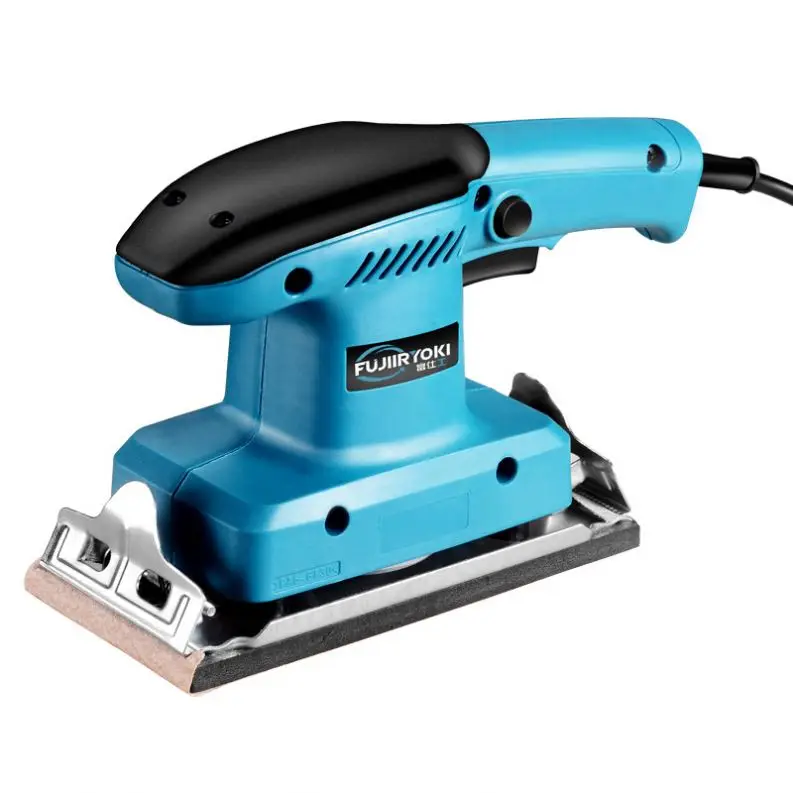
Source-controlled product identity
The Hoting queue identifies Product ID 1601391332856 as a portable electric orbital sander for woodworking, listed under the title "TK Factory Direct Sale 220V Portable Surface Finishing Electric Orbital Sander Woodworking Constant Speed 400W Sanding Machine". The description repeats the title and then gives a parameter block with seven rows.
This is one of the more useful records in the queue, because all seven rows carry values rather than headings. It is also a record in which three of the seven cannot be used as they stand. The speed is stated on a unit that does not describe what a finishing sander does, and the figure matches the speed of a motor rather than the rate of the sanding action. One certification in the list belongs to a market whose mains voltage the machine cannot be sold into at the stated rating. And the accessories row names a category instead of listing anything.
This guide reads the seven rows one at a time, shows the arithmetic that makes the speed entry worth questioning, and sets out what a buyer must obtain before this sander can be quoted, stocked or resold.
The seven recorded parameters, verbatim
| Parameter | Recorded value |
|---|---|
| Rated input power | 400W |
| Rated voltage | 220 v-240 v |
| Rated frequency | 50 Hz 60 Hz |
| Sanding pad size | 93x185mm |
| No load speed | 1000 rpm |
| Accessory including | Standard accessories |
| Certifications | GS CE EMC ROHS UL |
Below the table the record has a heading reading "List of functions" with nothing under it, and a company introduction that ends mid-word.
The three electrical rows, and what they fix
Rated input power is 400 W, rated voltage 220 to 240 V and rated frequency 50 to 60 Hz. Taken together these three rows define the machine as a mains-powered tool for the markets that use 220 to 240 V, and they fix the current it will draw. Dividing power by voltage gives about 1.8 A at 220 V and about 1.7 A at 240 V. That is a light load on a domestic circuit, so a buyer does not need to plan a dedicated supply for one machine, but a workshop running several units on one circuit should still add the figures up.
The 50 to 60 Hz rating is more interesting than it looks, and it is the row that makes the speed entry questionable. A universal or induction motor does not run at the same speed on both frequencies. For an induction motor the synchronous speed is set by the supply frequency and the number of poles, as 120 times the frequency divided by the number of poles. At 50 Hz that gives 3,000 rpm for a two-pole motor, 1,500 rpm for four poles and 1,000 rpm for six poles. At 60 Hz the same motors run at 3,600, 1,800 and 1,200 rpm respectively.
A recorded 1,000 rpm is exactly the synchronous speed of a six-pole motor on a 50 Hz supply. That is a strong indication that the figure describes the motor rather than the sanding action, and it raises a consequence the buyer should plan for: run the same machine on a 60 Hz supply and the motor speed rises to about 1,200 rpm, a fifth higher. Whatever the sanding action does, it does about twenty per cent faster on 60 Hz than on 50 Hz, unless the tool has electronic speed control that is calibrated to hold a constant output on both. The title claims constant speed, so the buyer should ask how that claim is implemented and whether the calibration covers both frequencies. These figures are arithmetic on the stated frequency and a standard motor relationship, not a measurement of this machine.
Row four: the sanding pad and what it implies about the paper
The pad is 93 by 185 mm. That is a familiar size in woodworking and identifies the machine as a third-sheet sander rather than a quarter-sheet or a half-sheet one, and the implication for the buyer is the sandpaper format the machine will eat. A third-sheet sander takes paper supplied in the matching sheet size, which the operator cuts or tears, and holds it either by clamping at both ends or by hook and loop.
The record does not say which. This matters more than it appears. A clamp-type pad holds paper anywhere on the sheet and costs less to run, but changing paper takes longer and the paper must be cut to size. A hook-and-loop pad changes paper in seconds but requires the paper to be supplied with the matching loop backing, which is a consumable the buyer must be able to source locally. Ask which system the machine uses, and if it is hook and loop, ask for the pad's hook side life, since a worn hook face stops holding paper and is not repairable.
Ask also for the paper size the pad is designed for and for the recommended grit sequence, because a buyer stocking the tool for resale will be asked for consumables and should be able to name them. Ask whether the pad takes a punch plate or a hole pattern for dust extraction, and how many holes.
Row five: the speed entry, and why an orbital sander is not described in rpm
The record states a no-load speed of 1,000 rpm, and this is the entry that a buyer should not accept without a question, because a finishing sander is not specified by the rotation speed of anything.
A random orbit or orbital sander does not spin a disc. The pad moves in a small circle, and what describes the machine is how fast that circle is traversed, quoted as orbits per minute, and how large the circle is, quoted as the orbit diameter or stroke in millimetres. Those two figures together, with the input power, decide what the tool removes and what finish it leaves. A tool with a large orbit and a high orbit rate removes material quickly and leaves a coarser scratch pattern; a small orbit at a lower rate leaves a finer finish and removes material slowly. Two machines with the same wattage and the same pad can behave completely differently on those two figures, and neither figure appears in this record.
There is a second question hidden in the same row, and it decides the character of the machine. An orbital sander can be built as a simple orbital, in which the pad traces a fixed circle and the abrasive moves always in the same direction, or as a random orbit machine, in which the pad is mounted on a free-floating bearing so that the orbit axis itself rotates, changing the direction of the scratch continuously. The random orbit machine is the one that resists leaving swirl marks, and it is the reason the phrase random orbit appears on most finishing sanders sold today. The title of this record says orbital and not random orbit, which may be a translation choice or may describe the actual mechanism, and the buyer cannot tell from the record.
So three questions belong on the list before anything else: whether 1,000 rpm is the motor speed or the sanding action; the orbit rate in orbits per minute at the stated power; and the orbit diameter in millimetres, together with a clear statement of whether the machine is a simple orbital or a random orbit tool. If the supplier can supply a photograph of the pad mounting with the bearing visible, that answers the mechanism question faster than any specification line.
The constant speed claim, and what would have to be true for it
The title claims constant speed, which in a power tool normally means electronic speed regulation: the control measures the motor's speed and adds power to hold it as the load rises, so that the tool keeps cutting when the operator leans on it rather than bogging down. It is a real and useful feature on a sander, but it is a behaviour, and a behaviour has to be demonstrated rather than asserted.
Three questions make the claim testable. First, what is the speed under load rather than at no load, since the recorded figure is explicitly a no-load figure and the entire point of speed regulation is the loaded condition. Second, is the speed adjustable, and if it is, what is the range. Third, is the regulation electronic, and is it calibrated for both 50 and 60 Hz supplies given the dual frequency rating discussed above. A buyer who intends to sell the tool on the strength of the constant speed feature should ask for a demonstration or a test figure, because the record currently contains no evidence of it beyond three words in a listing title.
Row six: "Standard accessories" is not a list
The accessories row reads "Standard accessories", which is a category rather than a specification, and the practical consequence is that the buyer does not know what is in the box. For a sander the contents decide whether the tool can be used on delivery and whether the buyer has to source anything separately.
Ask for an itemised list and a photograph of the box contents. The items that matter in practice are the dust bag or dust canister and its capacity, the extraction port and its diameter together with the adaptor if one is included, the punch plate if the paper has to be pierced, whether any abrasive paper is supplied and in which grits, whether a carrying case is included, and whether spare carbon brushes are supplied. Carbon brushes are worth asking about specifically on a tool with a universal motor, since they are the consumable that limits the tool's life and a buyer who cannot source them locally has a tool with a service life of one brush set.
Row seven: the certification list, read carefully
The certifications row lists five items: GS, CE, EMC, ROHS and UL. These are not the same kind of thing, and reading them as a uniform block of certificates is the most common mistake a buyer can make with a row like this.
CE is not a certificate issued to a manufacturer by a body. It is a marking applied by the manufacturer or importer as a declaration that the product meets the applicable European requirements, backed by a technical file. What a buyer should ask for is the declaration of conformity and the underlying test reports, which for a mains-powered tool would cover electrical safety and electromagnetic compatibility. EMC and RoHS are separate European requirements, one about electromagnetic behaviour and the other about restricted substances, and both are demonstrated through testing and documentation rather than through a mark that stands on its own.
GS is different in kind. It is a voluntary mark issued by a third-party testing organisation after its own assessment of the product, and a genuine GS mark therefore implies an identifiable certificate and a certificate holder. If the supplier claims GS, ask which organisation issued it, for the certificate number, for the certificate holder's name and for the validity date, and note that GS is normally tied to a specific production facility, which is worth knowing if the buyer assumes a particular factory will make the goods.
UL is the entry that should prompt the sharpest question, and the reason is voltage. UL is a North American safety mark, and the market it serves is the one that supplies portable power tools at 120 V from domestic outlets. This machine is rated 220 to 240 V. Those two facts do not fit together for a single tool sold into that market, because a 220 to 240 V handheld sander is not a product for a North American domestic outlet. There are two ways the listing can be true, and the buyer needs to know which. Either the UL file belongs to a different voltage variant of the tool which is not the one described in these seven rows, or the mark has been carried over from a sibling listing and does not apply to this version. Ask for the UL file number, ask which model and voltage variant it covers, and ask for the file holder's name. A file number is a checkable fact, and a claim without one should not be relied on.
There is a broader point about the whole row. A list of marks is a claim about documentation, not documentation itself. Whatever the destination market is, the buyer should request the actual test reports relevant to that market, confirm which legal entity holds each certificate, and confirm that the certificate's scope matches the product and voltage variant being ordered. For a product that will be sold to end users with mains voltage in its hand, that documentation is not a formality.
What the record leaves out entirely
Several things a buyer needs are absent from the record altogether. The machine's weight and dimensions are not stated, and on a handheld tool that is used for long periods the weight decides how long an operator can work with it. The noise level is not stated, and a sander running for hours is one of the louder tools in a small workshop. The vibration value is not stated, which matters for exposure over a working week. The orbit diameter and orbit rate discussed above are missing, and so is the dust extraction port size. The power cord length, the insulation class and the ingress protection are not given, nor is the warranty period or the minimum order quantity. There is no price in the record and no lead time, and the packing section is absent.
None of this is unusual for a listing of this kind, and none of it is a defect in the product. It is simply the difference between a listing and a specification, and the buyer's job is to close that difference before committing.
What a buyer should request before ordering
- Confirmation of whether the stated 1,000 rpm is the motor speed or the sanding action, and the orbit rate in orbits per minute if it is the motor speed.
- The orbit diameter (stroke) in millimetres, and a clear statement of whether the machine is a simple orbital or a random orbit type, with a photograph of the pad mounting.
- The speed under load as well as at no load, whether the speed is adjustable and over what range, and whether the speed regulation is electronic and calibrated for 50 and 60 Hz supplies.
- Whether the pad holds paper by clamping or by hook and loop, the paper size the pad is designed for, the punch plate and hole pattern, and the hook face life if applicable.
- An itemised accessory list with a photograph of the box contents: dust bag or canister and its capacity, extraction port diameter and any adaptor, punch plate, supplied abrasive and grits, carrying case and spare carbon brushes.
- The test reports and declarations behind each of the five listed marks, the certificate numbers, the organisations that issued them, the certificate holders and the validity dates.
- For the UL entry specifically, the UL file number, the model and voltage variant it covers, and the file holder, together with confirmation of which voltage variants exist for this tool.
- Which voltage and plug variants are available, and which markets each is intended for, given the 220 to 240 V rating.
- Machine weight, overall dimensions, power cord length and insulation class.
- Measured sound pressure level and hand-arm vibration value, with the measurement conditions.
- Dust extraction port diameter and whether it suits common workshop hoses.
- Motor type, whether it uses carbon brushes, the expected brush life and the price of a replacement set.
- Bearing and switch quality, and whether any of the wear parts are standard sizes available locally.
- Warranty period and what it covers, the terms for a cross-border claim and who pays the return freight.
- Carton dimensions, quantity per carton, gross weight and packing method.
- Price at the buyer's quantity, minimum order quantity, trade term, payment terms and lead time.
Acceptance and incoming inspection
Because the specification leaves the mechanism unclear, the buyer's own measurements become the reference and should be taken on the first delivery and kept for comparing later shipments.
Establish what the pad actually does. Mark a reference point on the pad and observe its motion while the tool runs, which distinguishes a fixed orbit from a random orbit action within a few seconds, and photograph the pad mounting to record the mechanism. Measure the orbit diameter if it can be done safely with a mark on the abrasive and a slow test run on scrap, since a stated orbit figure is worth confirming against the delivered machine.
Measure the speed rather than trusting the label, using a tachometer or a strobe if one is available, and take it at no load and then under load on a scrap panel, because the difference between the two is the whole substance of the constant speed claim. If the tool is to be sold into a 60 Hz market and it was developed on a 50 Hz supply, run it on the supply it will actually be used on before repeating the measurement, since the motor speed changes with frequency.
Check the electrical documentation against the machine. Read the rating plate and confirm it matches the order, note the model and voltage variant, and compare it with the certificates supplied. Confirm the plug and the cord are appropriate for the destination market. Inspect the dust path, fit the extraction port to a workshop hose, and run the tool with a dust bag to confirm the dust actually goes where it should rather than out of the vents.
Run the tool for a sustained period at working load and watch for the things that show up only after a few minutes: heat at the housing, a smell of hot insulation, a switch that becomes unreliable, and a pad that begins to wander or vibrate. Then check the box contents against the itemised accessory list and confirm that the consumables the buyer intends to stock, paper and carbon brushes, are actually obtainable.
Buyer decision framework
The source for this guide is a record with seven stated parameters, a "List of functions" heading with nothing under it, and a company introduction that ends mid-word.
Two of the seven rows can be used as they stand. The electrical rows fix the machine as a 220 to 240 V tool drawing under two amps, which together with the 50 and 60 Hz rating tells the buyer which markets it suits and that its motor speed will differ between them.
Three rows need qualification before they mean anything. The speed figure is on a unit that does not describe an orbital sander and matches a motor rather than a sanding action, and an orbital sander is chosen on its orbit rate and orbit diameter, which are missing. The accessories row names a category instead of listing contents, which decides whether the tool is usable on arrival and what the buyer must stock. The certification row mixes a self-declaration, two European requirements, a third-party mark and a North American mark whose voltage does not match this machine, and every entry in it needs its document rather than its name.
The purchase becomes a decision once four things are known: what the sanding action actually is, meaning the orbit rate, the orbit diameter and whether the mechanism is random orbit; what the constant speed claim amounts to under load on the supply the tool will be used on; which certificates and test reports exist for the voltage variant being bought, and for which market; and what the consumables cost, since paper, a hook-and-loop pad face and carbon brushes decide the cost of owning the tool rather than buying it. Until those are answered, this record describes a plausible 400 W third-sheet sander with a credible electrical rating and an unverified mechanical and compliance story.
Frequently asked questions
What does the 1,000 rpm figure mean?
The record does not say. An orbital sander is normally specified by orbits per minute and orbit diameter, not by rpm, and 1,000 rpm is exactly the synchronous speed of a six-pole motor on a 50 Hz supply, which suggests the figure may describe the motor. Ask whether it is motor speed or sanding action, and for the orbit rate and orbit diameter either way.
Is this a random orbit sander or a simple orbital sander?
The title says orbital, which may be a translation or may describe the mechanism, and the record does not distinguish them. The difference decides whether the tool leaves swirl marks, because a random orbit machine changes the direction of the scratch continuously. Ask for a photograph of the pad mounting so the bearing can be seen.
Will the speed differ between a 50 Hz and a 60 Hz supply?
Yes, for a motor whose speed is set by the supply. A six-pole motor runs at 1,000 rpm on 50 Hz and about 1,200 rpm on 60 Hz, a fifth faster. If the machine claims constant speed through electronic regulation, ask how that is calibrated for both frequencies. The figures given here are arithmetic on the standard motor relationship and not a measurement of this machine.
What sandpaper does it take?
Not stated. The 93 by 185 mm pad identifies it as a third-sheet sander. Ask for the paper format, whether the pad holds paper by clamping or by hook and loop, and whether a punch plate and a hole pattern are used for dust extraction.
What is included in the box?
The record says only "Standard accessories". Ask for an itemised list and a photograph: dust bag or canister and its capacity, extraction port diameter and adaptor, punch plate, any supplied abrasive and grits, carrying case and spare carbon brushes.
Are the certifications genuine?
They are listed as GS, CE, EMC, ROHS and UL, which are not the same kind of thing. CE is a manufacturer's declaration rather than a certificate, EMC and RoHS are European requirements demonstrated by testing, GS is a voluntary third-party mark with a certificate and a holder, and UL is a North American mark. Ask for the underlying reports, the certificate numbers and the holders.
Why is UL a problem on a 220 to 240 V machine?
UL serves the North American market, which supplies portable tools at 120 V, while this machine is rated 220 to 240 V. Either the UL file covers a different voltage variant than the one described, or the mark has been carried over from another listing. Ask for the UL file number and the model and voltage variant it covers.
How much current does it draw?
400 W at 220 V is about 1.8 A and at 240 V about 1.7 A. That is a light load for a domestic circuit, but several units on one circuit should be added together.
What will need replacing first?
On a tool with a universal motor the carbon brushes are the consumable that limits life, and on a hook-and-loop pad the hook face is the part that wears and cannot be repaired. Ask for brush life, brush prices and the pad's replacement cost, and confirm that both can be sourced.
What is not in the record at all?
Orbit rate and orbit diameter, weight, dimensions, noise and vibration figures, cord length, insulation class, extraction port size, warranty, minimum order quantity, price, lead time and packing. None of these is a defect; all of them are gaps the buyer must close before ordering.
Source and contact
This guide is based on the Hoting queue record for Product ID 1601391332856. All seven recorded parameters are reproduced above verbatim: the rated input power of 400W, the rated voltage of 220 v-240 v, the rated frequency of 50 Hz 60 Hz, the sanding pad size of 93x185mm, the no load speed of 1000 rpm, the accessory row reading "Standard accessories" and the certification row reading "GS CE EMC ROHS UL". The title describing the product as a TK factory direct sale 220V portable surface finishing electric orbital sander with constant speed is reproduced from the record, as is the "List of functions" heading that has no content beneath it and the company introduction naming Hengshui Mengshang Trading Co., Ltd. and the TEBAK brand, which ends mid-word. No orbit rate, orbit diameter, weight, dimension, noise or vibration figure, cord length, insulation class, extraction port size, warranty, price, minimum order quantity or lead time appears in this article because the record contains none. The current figures derived from power and voltage, the relationship between supply frequency, pole count and motor speed, the description of CE as a manufacturer's declaration rather than a certificate, the character of the GS and UL marks and the observation that a 220 to 240 V handheld tool does not match the North American domestic supply are reasoning and general engineering and conformity knowledge rather than claims about this product, and every point about the mechanism, the consumables, the documentation and the accessories is a question for the supplier rather than a statement of what the machine has.
Request confirmation of whether the recorded 1,000 rpm is motor speed or sanding action, the orbit rate in orbits per minute and the orbit diameter in millimetres, and whether the machine is a simple orbital or a random orbit type with a photograph of the pad mounting; the speed under load, whether it is adjustable and whether the regulation is electronic and calibrated for both frequencies; the paper format and whether the pad clamps or uses hook and loop, with the punch pattern; an itemised accessory list with a photograph of the box contents including the dust bag capacity, the extraction port diameter, the punch plate, supplied grits, carrying case and spare brushes; the test reports, certificate numbers, issuing organisations, holders and validity dates behind each of the five listed marks, and for the UL entry the file number, the model and voltage variant it covers and the file holder; which voltage and plug variants exist and for which markets; machine weight, dimensions, cord length and insulation class; sound pressure level and hand-arm vibration value with their measurement conditions; brush life and the price of a replacement set; the pad's replacement cost; the warranty terms for a cross-border claim; carton dimensions, quantity per carton and gross weight; and the price, minimum order quantity, trade term, payment terms and lead time, quoted through the TEBAK sales inquiry channel before ordering.
Key specifications
- Rated input power
- 400W
- Rated voltage
- 220 v-240 v
- Rated frequency
- 50 Hz 60 Hz
- Sanding pad size
- 93x185mm
- No load speed
- 1000 rpm
- Accessory including
- Standard accessories
- Certifications
- GS CE EMC ROHS UL