
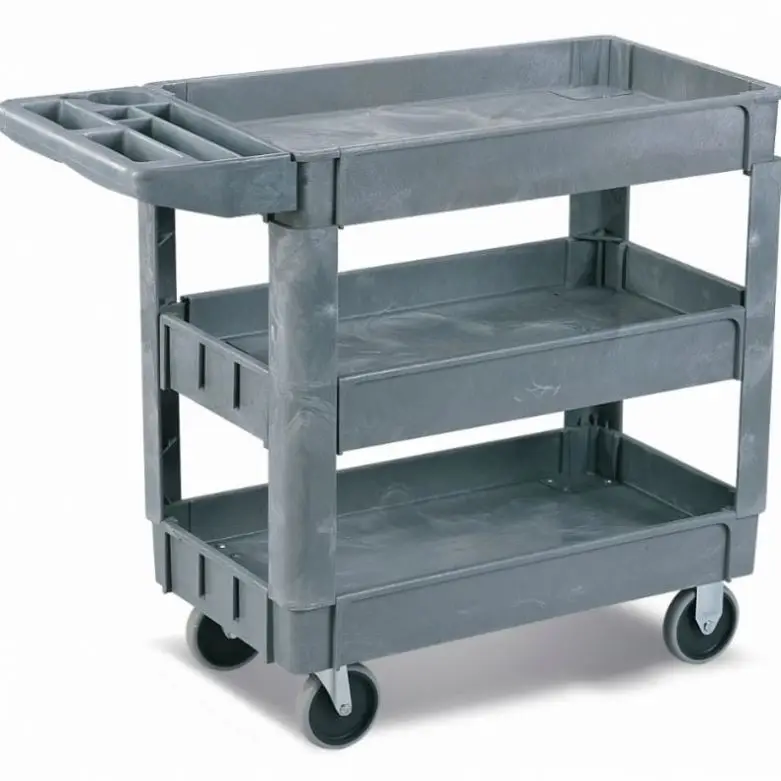
An empty parameter block, and a company profile about cutting tools
Product ID 1601247308626 sells a two-tier plastic service trolley. On a platform where every listing carries a specification block, this one carries none: the parameter count is zero. There is no origin, no material, no model number, no size, no weight and no load figure in machine-readable form. The description field, which is where a listing usually puts what the parameters cannot hold, contains three things and nothing else. It repeats the title. It prints a Packaging & Shipping heading with nothing underneath it. And it carries a company profile.
The profile is the interesting part, because it describes a different business. Its own terms are Product Machine, CNC Carbide inserts, Turning tools and Milling tools. It states that the brand is TEBAK, that the company has many years of experience in what it renders as this filed, that it leads what it renders as OED&ODM manufacture, that it has various kinds of productc, that they are 70% for expert, that customers come from North America, Europe, South America, the Middle East, East Asia and Africa, and that quality control standards are based on what it renders as ISO9001 certifications. The sentence about the machining center is cut off mid-word, ending in the letters comp.
So a buyer reading the description of a catering trolley is told about a cutting-tool supplier: turning tools, milling tools, carbide inserts. Nothing in that profile describes a moulded plastic cart, and the text does not mention moulding, plastics, catering, food service or the trolley at all.
This is boilerplate, and its spread can be measured. Comparing the record's description text against every other record in the same five-hundred-and-twelve-item queue:
- 151 of 512 records (29.5%) have no parameters at all. An empty parameter block is not an exception on this queue; it is close to a third of it.
- The same 661-character company profile block appears in 36 of 512 records (7.0%), this record among them. That count is of the identical text block, so records carrying a near-identical profile with a word changed are not included and the true spread is higher.
- The string OED&ODM appears in 329 of 512 records (64.3%). Almost two thirds of the queue carries that same typo, which is the profile text pasted at scale rather than written for a product.
Two consequences follow for anyone sourcing from this listing. First, the description field is not evidence about this product and should not be read as one. Second, and more practically, the profile describes a cutting-tool trading business, so the question of who actually moulds and assembles the cart is open, and it is worth asking directly. The name on the gate photograph, discussed further below, is a trading company rather than a moulding works, which is consistent with a range of goods bought in and resold.
One more artefact belongs here. The product's own web address is eighty characters long and stops mid-word: it ends in the letters ley-fo, cut from the phrase for Restaurant. The address is generated from the title and truncated at a fixed limit, which means the product's permanent identifier is a fragment. Copy it exactly when quoting it.
The specification exists, and it is inside a photograph
The record's only specification is a Chinese table embedded in the fifth of its eight images. It is worth setting out in full, because everything else in this guide depends on it, and because a buyer who reads only the English fields will not find it at all.
The table's own heading reads UD252/UB252 for the two-tier pair and UD253/UB253 for the three-tier pair, and its first column is the label, with one column per model.
| Item | UD252 | UB252 | UD253 | UB253 |
|---|---|---|---|---|
| Tiers | 2 | 2 | 3 | 3 |
| Load capacity (kg) | 250 | 250 | 250 | 250 |
| Top board size, L x W x depth (mm) | 790 x 435 x 110 | 950 x 650 x 110 | 790 x 435 x 110 | 950 x 650 x 110 |
| Top board height (mm) | 850 | 850 | 850 | 850 |
| Shelf spacing (mm) | 500 | 500 | 190 | 190 |
| Bottom board height (mm) | 150 | 150 | 150 | 150 |
| Casters (mm) | 125 x 26 | 125 x 26 | 125 x 26 | 125 x 26 |
| Net weight (kg) | 18 | 22 | 23 | 30 |
| Gross weight (kg) | 16 | 20 | 20 | 27.5 |
| Carton, one per cart (mm) | 830 x 490 x 240 | 980 x 710 x 240 | 804 x 458 x 343 | 960 x 678 x 331 |
Under the table the image prints a packing section headed Packing Details, with a photograph of a carton containing a disassembled cart and two loose trays, and the four carton sizes repeated as text.
Three features of this table determine how the rest of this guide reads. It names four models while the record's parameter block names none, so the model codes exist only as pixels. It covers two tier counts while the title commits to one. And its weight rows are ordered in a way that cannot be true. Those are taken in turn below.
Net weight above gross weight, in all four columns
Read the two weight rows as printed. UD252 is 18 kg net and 16 kg gross. UB252 is 22 net and 20 gross. UD253 is 23 net and 20 gross. UB253 is 30 net and 27.5 gross.
Net weight is the product; gross weight is the product plus its packaging. Gross cannot be smaller than net, and in all four columns of this table it is. The gap is consistent: 2 kg, 2 kg, 3 kg and 2.5 kg. A consistent gap is the signature of a labelling error rather than of four separate mistakes, and the most likely error is that the two rows have been exchanged, since swapping them gives gross weights of 18, 22, 23 and 30 kg against net weights of 16, 20, 20 and 27.5 kg, which is arithmetically ordinary and leaves packaging weights of 2 to 3 kg for a carton containing a moulded cart, which is also plausible.
But plausible is not the same as established, and the difference is worth money in both directions. Gross weight is what the freight forwarder charges against, and it is the figure that appears on the packing list and the bill of lading. Net weight is what was ordered. A buyer who reads the rows as printed will quote freight against a figure 2 to 3 kg light per cart, which for a full container of the heavier model is a real difference. A buyer who assumes the rows are swapped and is wrong has the same problem in the other direction. The rows must be confirmed in writing, with the packing weight stated separately.
The same impossibility appears elsewhere in this series, and the way it appears is instructive. Across the full five-hundred-and-twelve-record queue, exactly one record states a gross weight below its net weight in a parameter: product ID 1601276018834, whose single parameter reads Gross/Net weight equals 5/5.7kg. This record is the second instance, and its version lives inside a table image rather than in a parameter. A check that reads parameters only would find the first and miss this one, which is the argument for reading the images on every listing rather than trusting the field that is easiest to parse.
One further point about the weights. Nowhere in the table or the record is it stated whether the net weight is the cart alone or the cart plus the loose trays shown in the packing photograph, or whether the casters are counted. For a disassembled cart shipped in a carton, those distinctions are the difference between a shipping weight and a catalogue weight, and they should be named.
The title says two tiers, the table covers three, and the gallery shows both
The title reads two tier. The record's own table lists four models, of which two are two-tier, UD252 and UB252, and two are three-tier, UD253 and UB253. So the words in the title describe half of what the record offers, and the four model codes that would disambiguate an order exist only inside an image.
The gallery does the same thing. One image shows a cart with a top tray and a single lower shelf, which is a two-tier cart. Two further images show carts with an intermediate shelf between the top tray and the base, which are three-tier carts. A fourth image is a group photograph of three carts together, and the carts in it differ in height and in what is fitted to the top tray. Six images of product and no caption anywhere states which model is shown.
Two of the images of the three-tier cart look very similar. They are separate files and are not the same file: measured by download, one is 310,972 bytes and the other is 139,977 bytes, so they are two distinct files. At the resolution supplied it is not possible to establish whether they are the same photograph re-encoded at a different quality or two separate exposures of the same cart, and this guide does not assert either. What can be said is that the gallery presents three-tier carts twice while the title names only two tiers, which reinforces the point rather than resolving it.
The practical risk is straightforward. A buyer who orders from the title, which is the only machine-readable description the listing offers, may receive a three-tier cart when a two-tier one was wanted or the reverse, and the four model codes that would have prevented it are not in the parameters. If the order matters, write the model code into it: UD for the narrower pair at 790 x 435 mm, UB for the wider pair at 950 x 650 mm, and the final digit for the tier count. That reading fits the table as printed, with 2 for two tiers and 3 for three, and it should be confirmed with the supplier rather than assumed, because the record never states it.
The shelf-spacing figure does not close
The table gives a top board height of 850 mm and a bottom board height of 150 mm for every model. The distance between them is therefore 700 mm. It then gives a shelf spacing of 500 mm for the two-tier models and 190 mm for the three-tier models, and neither fits that 700 mm under either reading a buyer might reasonably try.
Take spacing as pitch, meaning the centre-to-centre distance from one board to the next. A two-tier cart has one gap to span, so an even arrangement would need 700 mm, not the printed 500 mm. A three-tier cart has two gaps, so an even arrangement would need 350 mm each, not the printed 190 mm.
Now take spacing as clear opening, which is the figure a buyer actually cares about because it is the height available for whatever is being carried. Subtracting the tray depth of 110 mm, which the table itself supplies in the top board size, from those pitches gives 590 mm for the two-tier models and 240 mm for the three-tier models. Those are not the printed 500 mm and 190 mm either.
Neither reading reproduces the number, and the record never says which quantity the row measures. That matters more than it sounds, because shelf clearance is the specification that decides whether a tray, a box or a stack of plates will fit under the upper board, and the three candidate answers for a three-tier cart differ by a factor of nearly two: 190, 240 or 350 mm. So the questions to put to the supplier are specific. Which quantity does the spacing row measure, from which surface to which surface. What is the clear opening under the top board and under the intermediate board separately. And is the top board height of 850 mm measured to the rim of the tray or to its floor, because the tray is 110 mm deep and the difference is the depth of the tray.
Two hundred and fifty kilograms, on what basis
Every model in the table carries the same load figure: 250 kg. The same figure covers a 790 mm cart and a 950 mm cart, and a two-tier cart and a three-tier cart. Uniformity across four different structures is possible, and it is also what a table looks like when one figure has been copied down a column, so the basis needs stating. The record states none of it:
- Whether 250 kg is the rating for each shelf, for the cart, or for a uniformly distributed load. Three shelves rated at 250 kg each is 750 kg on one cart, which is not the same claim as 250 kg in total.
- Whether the figure applies to the plastic trays, to the frame, or to the casters, since the weakest of the three governs.
- Whether it is a static or a dynamic rating, and what safety factor sits behind it. A cart at rest and a cart being pushed over a threshold are different load cases.
- Whether it was tested, to what standard, and whether the result is available as a report, or whether it is a design intention.
- How it was tested: a point load in the centre, a distributed load, a repeated load over time.
The casters are the place to start, because they are the smallest parts carrying the load and the table gives them one line. The table prints 125 by 26 mm, which is a wheel diameter of 125 mm and a tread width of 26 mm, and 125 mm is a common industrial caster size. Divided four ways, 250 kg is 62.5 kg per caster, which is a plausible working load for a caster of that diameter and is not a reason to doubt the figure. What the table does not give is the caster's own rated capacity, how many are fitted, whether they swivel or are fixed, whether any carries a brake, what the wheel is made of, or what bearing it runs on. For a trolley pushed around a restaurant, the answers change how it behaves: a 125 mm wheel has a low obstacle height, and a brake on at least two casters is what stops the cart rolling on a floor that is not perfectly level.
Two further questions belong with the load figure and are absent. What happens at the joints: the photographs show the trays and the legs brought together with fasteners rather than moulded as one piece, and the table says nothing about the fasteners, their material, their number or whether they are replaceable. And what the cart does when it is overloaded: for plastic, the failure mode at the joint matters, because a moulded socket that cracks rather than deforming takes the whole cart out of service.
Food trolley, restaurant, and nothing about food contact
The title calls this a food trolley for restaurant, and the rest of the keyword string calls it a utility plastic service cart. The photographs show a cart of a type used in janitorial and workshop service: it has a moulded top tray with a raised rim, one or two lower shelves, and, on at least one of the carts, a top-tray organizer with rectangular compartments and circular openings of the kind used to carry tools, bottles and cloths.
Nothing in the record addresses food contact, and for a trolley that carries open food, trays or utensils, that is the specification a professional kitchen will be asked about. The record does not state the polymer, so it does not state whether the material is a polypropylene, a polyethylene, a blend or something else. It does not state the grade, the UV stabilisation, whether recycled material is used, or how much. It does not state the temperature range the trays tolerate, so it does not state whether they can be washed at the temperature a commercial dish room uses. It does not state which cleaning chemicals the trays resist, so it does not state whether the sanitisers used in a kitchen will craze the surface over time. And it does not say whether the tray is one-piece moulded or assembled, which decides whether liquid and debris can collect in the joints.
Where a market regulates materials intended to come into contact with food, a buyer needs a declaration from the maker covering the food-contact surfaces, and where it does not, the buyer still needs to know the polymer in order to decide. Neither can be obtained from this record, and both should be requested before an order rather than after. This guide does not give legal advice on which framework applies; that is a question for the buyer's own compliance adviser, in the destination market and for the intended use.
One smaller point runs the same way. If the intended use is serving food rather than carrying tools, ask whether a version without the top-tray organizer is available, because the organizer occupies part of the top tray and its dimensions are not stated, so the flat usable area of the top surface cannot be worked out from the record. The tray itself is 790 by 435 mm on the UD models and 950 by 650 mm on the UB models, and that is the area before anything is taken out of it.
Freight will be billed on volume, not on the weights in the table
The table gives one carton size per model, which is enough to work out what a shipment weighs by volume, and the answer is that the declared weights are not a usable basis for a freight estimate. Volumetric weight is the carton's length times width times height divided by a divisor set by the carrier, commonly 6000 for air freight in centimetres and kilograms, and 5000 on some lanes and services. Computing it from the table's own carton sizes:
| Model | Carton (mm) | Volume (litres) | Volumetric weight at 6000 | Volumetric weight at 5000 | Gross weight as printed |
|---|---|---|---|---|---|
| UD252 | 830 x 490 x 240 | 97.6 | 16.27 kg | 19.52 kg | 16 kg |
| UB252 | 980 x 710 x 240 | 167.0 | 27.83 kg | 33.40 kg | 20 kg |
| UD253 | 804 x 458 x 343 | 126.3 | 21.05 kg | 25.26 kg | 20 kg |
| UB253 | 960 x 678 x 331 | 215.4 | 35.91 kg | 43.09 kg | 27.5 kg |
At the 6000 divisor, volumetric weight exceeds the printed gross weight for three of the four models, by 7.83 kg for UB252, by 1.05 kg for UD253 and by 8.41 kg for UB253, and it is within 0.27 kg of it for UD252. At the 5000 divisor all four exceed it, by 3.52, 13.40, 5.26 and 15.59 kg respectively. In other words, on the carton sizes the record itself supplies, a cart shipped by air will be charged on its volume for every model in the list, and the gross weight printed in the table will not be the figure the forwarder uses. Buying on the printed weight is a way to under-budget freight by a margin of the same order as the cart's own weight.
The carton sizes support a second calculation, for sea freight. Taking a nominal twenty-foot container with internal dimensions of about 5,898 by 2,352 by 2,393 mm, or roughly 33.2 cubic metres, and loading cartons with no pallets and no stacking loss, the floor plan limits the load before the volume does in all four cases:
| Model | Carts per layer | Layers | Carts per 20 ft by floor plan | Carts per 20 ft by volume |
|---|---|---|---|---|
| UD252 | 28 | 9 | 252 | 340 |
| UB252 | 18 | 9 | 162 | 198 |
| UD253 | 35 | 6 | 210 | 262 |
| UB253 | 18 | 7 | 126 | 154 |
These are calculations from the record's own carton dimensions and not figures from the supplier, and they assume perfect packing, no pallets, no dunnage and no allowance for loading. Real loads are lower, and a container quoted by the supplier should be compared against these numbers rather than accepted as they stand. The point of showing them is that the difference between the UD and UB models is not proportional to the tray area: the UB carton is about 1.7 times the volume of the corresponding UD carton, so the wider model carries a freight penalty beyond its larger size, and that belongs in a landed-cost comparison between the two.
One check of the carton sizes against the product does pass, and it is worth stating because a carton cannot be smaller than the thing inside it. Each carton is larger than its tray footprint in both directions, by 40 and 55 mm on UD252, by 30 and 60 mm on UB252, by 14 and 23 mm on UD253, and by 10 and 28 mm on UB253. The margins are tight on the three-tier models, which is consistent with a carton sized around a disassembled cart rather than a pre-assembled one, and it is one reason to ask whether the cart ships flat and is assembled on arrival, since that determines whether the buyer needs assembly instructions, a tool kit and a fastening schedule.
The panels in the gallery are shared across the queue, and this can be counted
Three of the eight images are not photographs of the product. One is a panel of payment and courier logos headed Shipping Service, one is a gate photograph, and one is a panel of six frequently asked questions. Comparing each of this record's image addresses against every image address in the five-hundred-and-twelve-record queue gives a count of how many records share each one:
| Image | Records sharing the same image address | Share of the queue |
|---|---|---|
| Payment and courier logo panel | 119 | 23.2% |
| Gate photograph used here | 77 | 15.0% |
| Six-question FAQ panel used here | 58 | 11.3% |
| The five product photographs and the specification table | 1 each, only this record | 0.2% each |
The method is a comparison of image addresses, so these are counts of identical addresses and are lower bounds: the same panel re-exported to a new address, as a file with identical content but different bytes, is counted once per address under this method. That case occurs in this very series. The six-question panel used by this record is 375,883 bytes; the panel used by the previous record in this series carries the same six questions in the same wording and layout and is 405,186 bytes, and the two files have different content digests. So the same template travels under at least two addresses, and the true reach of the template is larger than any single count in the table above.
The panel's content is worth reading as terms rather than as an advertisement, since the terms are the only commercial information the record contains. It promises a quotation within twenty-four hours and says that urgency should be flagged so the enquiry is treated as a priority. It says samples are available for reference. It offers drawing and manufacturing support. On payment it states thirty per cent deposit with the seventy per cent balance before shipment, by telegraphic transfer, PayPal or Western Union. On lead time it states about fifteen working days and adds that this depends on the order quantity. On delivery it states EXW, FOB, CIF and others at the buyer's choice.
Three consequences follow for a trolley order. A seventy per cent balance before shipment on a container of carts means the buyer carries the whole cost before the goods are on the water, with nothing retained against a delivery that does not match the samples. A lead time that depends on quantity and delivery terms the buyer selects means neither the date nor the place is fixed by the record. And PayPal and Western Union appear as payment routes alongside telegraphic transfer, which matters for whoever carries the buyer's compliance and remittance requirements. The same panel appears in one hundred and nineteen records of this queue under one address, so none of it describes this product; it describes the supplier's template, and the terms that will actually apply are the ones on the quotation.
What the product photographs show, and what they leave unreadable
Five of the eight images are of the product, and between them they show the four-model range rather than one cart. The narrow two-tier cart appears in the specification image and in its own photograph, with a top tray carrying a moulded organizer, a single lower shelf and four casters. The wider three-tier cart appears twice, with an intermediate shelf between the top tray and the base. A group photograph shows three carts together, and the carts in it differ in height and in what is fitted to the top tray. One image is the specification and packing table itself. No image carries a caption identifying which model is which.
Three details are visible and are worth naming because they carry information the parameters do not. First, the top-tray organizer on the carts that have one is a moulded insert with rectangular compartments and circular openings; its dimensions are not stated, so the flat area of the top tray it leaves cannot be worked out. Second, the trays and the legs meet at joints that appear to be fastened rather than moulded as a single piece, which is what allows the cart to ship flat and is also where water and debris will collect unless the joint is closed. Third, at least one cart carries a yellow triangular warning label with a pictogram and text on the front face of the top tray. The label's wording is not legible at the resolution supplied and this guide does not guess at it. A warning label of that kind is normal on equipment photographs, and its presence here is recorded as an observation rather than as anything else.
The colours in the photographs add a question that the parameters do not answer. The carts are shown in a mid grey with visible light streaks and mottling, and in a darker grey, and the group photograph shows carts that differ from each other in shade. That may be lighting, it may be two colour options, or it may be different mouldings. Nothing in the record lists available colours, so a buyer who needs a specific colour for a dining room should ask whether colour is selectable, what the minimum quantity is per colour, and whether the colour range is stable between orders. A darker grey and a mid grey are not the same specification in a room where the cart will be seen by guests.
One thing the product photographs do confirm is that the cart is offered as a plastic cart throughout: the trays, the legs and the shelf structure appear to be moulded polymer with metal casters. The record does not state the polymer, and it does not state whether any part of the structure is metal, so the material should be named in the order rather than inferred from the photographs.
The gate photograph, and the company on it
The gate photograph in this record shows a sign reading, in Chinese, Hengshui Mengshang Trading Company Limited, with the same name romanised beneath it in capitals. That name is the company named in this record's own description field, so here the factory image and the profile agree with each other, which is not always the case in this series: the immediately preceding record in this series carried a gate photograph naming a different company from the one in its profile text. Recording the difference is not a criticism of either listing; it is the reason a buyer should check the two against each other rather than assuming they match.
Two properties of the image itself are worth noting. It carries faint diagonal watermark lettering across the building and the sky, and its surface is uniformly clean, with no people, vehicles, signage or activity. Images of that kind are commonly retouched or licensed rather than shot on a working day. Whether this one is, this guide does not assert. What follows is only that a gate photograph is not a statement about who moulds the cart, and that on a trade profile whose own text describes turning tools and milling tools, the question of who actually produces the plastic parts is open.
The company name is a trading company by its own wording, and trading companies buy in and resell, which is entirely normal and is also the reason the technical answers have to come from somewhere specific. So the questions are direct. Who moulds the trays. At which plant are the carts assembled and packed. Can the moulding works be named. If the same cart is available under a maker's own model code, what is that code, since a maker's code is what appears in any technical data sheet. And if the supplier holds an ISO 9001 certificate, as the profile claims, what is the certificate's scope, does it cover plastic moulding or trading, and can the certificate be supplied with its number and validity dates. None of that is answered in the record, and all of it is cheap to settle before an order.
What the record does not state at all
- Any parameter at all: the parameter block is empty, so there is no model number, no size, no weight and no material in machine-readable form.
- The polymer: not the resin, not the grade, not the UV stabilisation, not whether recycled material is used or how much.
- Whether any food-contact declaration exists, and for which surfaces, although the product is titled a food trolley for restaurant.
- The temperature range the trays tolerate, including the temperature of a commercial wash.
- Which cleaning chemicals and sanitisers the trays resist.
- Whether the tray is one-piece moulded or assembled, and whether the joints are sealed.
- Available colours, colour stability, and minimum quantity per colour.
- The load basis for the 250 kg figure: per shelf, per cart, uniformly distributed, static or dynamic, tested or intended.
- The caster's own rated capacity, the number fitted, whether they swivel or are fixed, whether brakes are fitted, the wheel material and the bearing type.
- The caster mounting: how it is fixed into the moulding, and whether it is replaceable.
- Fastener material, count and replaceability at the tray-to-leg joints.
- Which quantity the shelf spacing row measures, and the clear opening under each shelf.
- Whether the top board height is measured to the tray rim or the tray floor.
- Whether the cart ships assembled or flat, and if flat, whether instructions, a tool kit and a fastening schedule are included.
- Whether the net weight covers the cart alone or the cart with its loose trays and casters.
- Which weight row is which, given that gross is printed below net in all four columns.
- Carton grade, number of cartons per cart, palletisation, and whether a pallet or a slip sheet is used.
- Loading quantity per twenty-foot and forty-foot container, as a supplier's figure rather than a calculation.
- Warranty, spare parts, and the availability of replacement casters and trays as separate items.
- Delivery term, port pair, production lead time applicable to a specified quantity, and transit time.
Incoming inspection when the first cartons arrive
- Confirm which model arrived by its tier count before opening anything: top tray plus one shelf means the two-tier model, top tray plus an intermediate shelf and a base means the three-tier one.
- Measure the top tray at its outside dimensions in both directions, then measure the tray's internal depth, and compare all three against the table's 790 x 435 x 110 or 950 x 650 x 110 mm.
- Measure the top board height and the bottom board height from the floor, and derive the clear opening under each shelf from the measurements rather than from the spacing row, since that row does not reconcile with the heights.
- Weigh one cart as delivered, without its packaging, and weigh one complete carton, then compare both against the table's two weight rows and record which row the measurements support. This is the check that settles the net and gross question with a number.
- Measure the carton's outside dimensions and compare them with the table's figures, then calculate the volumetric weight at both the 6000 and 5000 divisors for the record.
- Load one cart to a quarter of its stated figure, then half, then the full 250 kg if the equipment and the floor allow, and record where the deflection appears first: the tray, the joint or the caster.
- Count the casters, confirm whether each swivels, confirm which, if any, carry brakes, measure the wheel diameter and tread width, and record the wheel material and whether the mounting is a socket, a plate or a stem.
- Inspect the tray-to-leg joints for gaps and for whether liquid can enter, then pour a small measured quantity of water into the joint and record whether it drains or is retained.
- Test the trays with the cleaning chemicals and the temperature the intended kitchen actually uses, on one tray, and record any crazing, colour change, deformation or odour.
- Ask for, and file, whatever food-contact declaration the destination market requires, and refuse to place the carts in food service until it is on file.
- Photograph the top tray with the organizer in place and measure the remaining flat area, since the organizer's dimensions are not stated.
- Confirm the colour against the order under the lighting of the room where the carts will be used, not under warehouse lighting.
- Retain one complete carton unopened as a reference, marked with its date and model code, so that a later delivery can be compared against it physically.
- Record the packing method actually used, including whether the cart arrived assembled or flat, and whether a pallet, a slip sheet or loose cartons were used, then reconcile it against the invoice.
- Reconcile the delivered cart against the model code written on the order, since the record's own gallery shows carts of two different tier counts and the title names only one.
The specification to send before ordering
| Item | What to require in writing |
|---|---|
| Model | The model code from the table: UD252, UB252, UD253 or UB253, or the supplier's confirmed equivalent, written into the order so the tier count cannot be left to the title. |
| Material | The polymer of the trays, legs and shelf, its grade, its UV stabilisation, whether recycled material is used and at what proportion, and whether any part of the structure is metal. |
| Food contact | A declaration covering the food-contact surfaces, against the framework the destination market requires, plus the document number and its validity. |
| Dimensions | Top tray outside length, width and internal depth; clear opening under the top board and under the intermediate board, with the measurement datum named; overall height; and which surfaces the heights are measured to. |
| Load | The 250 kg figure restated with its basis: per shelf or per cart, uniformly distributed or point, static or dynamic, the safety factor, and the standard or test report behind it. |
| Casters | Diameter, tread width, number fitted, swivel or fixed, brake on which casters, wheel material, bearing type, and the caster's own rated capacity with its catalogue reference. |
| Colour | Available colours, the colour reference for the order, colour stability between orders, and minimum quantity per colour. |
| Top tray | Whether the organizer insert is fitted, its dimensions, whether a version without it is available, and the flat tray area remaining when it is fitted. |
| Weights and cartons | Net weight and gross weight stated separately and unambiguously, including whether the net weight covers the cart alone or the cart with trays and casters; carton dimensions, carton grade, and number of cartons per cart. |
| Packing and assembly | Whether the cart ships assembled or flat, and if flat, the assembly instructions, the tool kit and the fastening schedule. |
| Loading and freight | The supplier's own loading quantity per twenty-foot and forty-foot container, the carton's volumetric weight at the carrier's divisor, and the packing used for sea freight. |
| Commercial | Unit price per model, minimum order, delivery term and port pair, production lead time for the specified quantity, transit time, and the warranty on trays, joints and casters with the price of replacement casters and trays as spare parts. |
Frequently asked questions
Is a two-tier or a three-tier cart being sold?
Both. The title says two tier, but the record's own specification table covers four models, of which UD252 and UB252 are two-tier and UD253 and UB253 are three-tier, and the gallery photographs show two-tier carts and three-tier carts. The four model codes exist only inside an image and are absent from the parameters, so the tier count should be written into the order as a model code rather than left to the title.
Why does the table show a net weight above the gross weight?
Because the two rows appear to have been exchanged, or because they are mislabelled. Gross weight is the product plus packaging and cannot be smaller than net weight, and in this table it is smaller in all four columns by a consistent 2 to 3 kg. Swapping the rows produces ordinary numbers with a plausible packing weight, which is a reason to read it as a labelling error and not a reason to assume which row is which. Confirm both weights in writing, and ask for the carton weight separately.
The description talks about turning tools and milling tools. Is this the wrong product page?
The listing is for a plastic service trolley; the description field carries a company profile that describes a cutting-tool business. The profile is boilerplate: the same 661-character profile block appears in 36 of 512 records in this queue, and the same typo appears in 329 of them, so it was pasted rather than written for this product. Read it as information about the supplier's range and not as information about the cart, and ask who moulds the plastic parts.
Can the shelf spacing be relied on to work out clearance?
No, and the three possible answers differ by nearly a factor of two. The stated top board height of 850 mm and bottom board height of 150 mm give a span of 700 mm; a pitch interpretation would need 700 mm for two tiers and 350 mm for three, and a clear-opening interpretation after subtracting the 110 mm tray depth would give 590 mm and 240 mm. The table prints 500 mm and 190 mm, neither of which matches. Ask which quantity the row measures and what the clear opening is under each shelf.
Is the 250 kg figure usable in a specification?
Not as printed. It is the same figure for all four models across two widths and two tier counts, and the record does not say whether it is per shelf or per cart, uniformly distributed or point, static or dynamic, or whether it is a tested value or a design intention. Ask for the basis and for the report, and check the caster's own rating, since the smallest part governs. Divided four ways, 250 kg is 62.5 kg per caster, which is plausible for a 125 mm caster and is not a substitute for the caster's stated capacity.
What will freight cost be based on?
On volume, for every model in this list, if the carts travel by air. Working from the record's own carton sizes, volumetric weight at a 6000 divisor exceeds the printed gross weight for three of the four models and at a 5000 divisor for all four. Use the volumetric figure when requesting air quotes, and use the supplier's own loading quantity per container rather than a calculation when requesting sea freight.
Can the cart be used for food?
The title says food trolley for restaurant, but the record states no polymer, no food-contact declaration, no wash temperature and no chemical resistance, so nothing in it supports a food-contact decision. The photographs also show a janitorial-style cart with a tool organizer on the top tray. Ask for the polymer and for the declaration the destination market requires, and take your own compliance advice on which framework applies before the carts go into service.
How many carts fit in a container?
Ask the supplier for its own figure. The calculation in this guide, from the record's carton dimensions, gives 252, 162, 210 and 126 carts per twenty-foot container for UD252, UB252, UD253 and UB253 respectively by floor plan, with the floor plan binding rather than the volume in all four cases, and it assumes perfect packing with no pallets. A supplier's loading figure is normally lower and is the one that should appear on the quotation.
Source, scope and what this guide does not claim
Everything here comes from the record for Product ID 1601247308626 as it stands: an empty parameter block, a description field consisting of the title, an empty Packing & Shipping heading and a truncated company profile, and eight gallery images, of which one is the specification and packing table, five show the product, one is a payment and courier logo panel and one is a six-question panel. The table's figures, including the four model codes, the dimensions, the weights and the carton sizes, are transcribed from that image and are the record's own numbers, not measurements.
Several figures in this guide are the guide's own and are marked as such wherever they appear. The counts of how many records share this record's description block, its typos and its image addresses come from comparing this record against every record in the same five-hundred-and-twelve-item queue, so they count identical text and identical addresses and are lower bounds. The count of records whose parameters state a gross weight below the net weight comes from parsing every parameter of every record in the queue, and the one record it found is named with its ID. The volumetric weights, the cartons-per-container figures and the shelf-spacing arithmetic are calculations from the record's own numbers, with their assumptions stated where they are made; they are not the supplier's figures and should be replaced by the supplier's on any order. The byte counts that distinguish two similar product images and two versions of the same question panel come from downloading both files and comparing their digests. No image was altered. No cart has been tested by this guide, no polymer has been identified, and no food-contact assessment has been performed.
Nothing here asserts that the supplier has misrepresented the product. A table whose weight rows have been exchanged is a clerical error, not a fraud, and the same figure copied across four models is as likely to be a conservative rating as a copied one. The shared panels, the retouched-looking gate photograph and the company profile about a different product range are normal features of listings assembled from a supplier's standard assets, and they are recorded here as things a buyer should ask about rather than as findings against anyone. The product photographs are of the cart and show what a cart of this type looks like; whether the delivered cart matches them is exactly what the inspection list above is for. Nothing in this guide is legal or compliance advice, and the food-contact framework to apply depends on the destination market and the intended use.
Key specifications
- Parameters
- NONE. The record's parameter block is empty: zero rows.
- What the description field contains
- The title repeated, a Packaging & Shipping heading with nothing under it, and a company profile.
- What the profile describes
- Product Machine, CNC Carbide inserts, Turning tools and Milling tools, a cutting-tool business.
- Where the specification actually is
- A Chinese table inside description image 5 of 8. It is not in the parameter block and it is not in the description text.
- Models named in that table
- UD252, UB252, UD253, UB253
- Tiers
- UD252 and UB252: 2 tiers. UD253 and UB253: 3 tiers. The title says 2 Tier.
- Load capacity, all four models
- 250 kg, printed as kg. No basis, no safety factor, no standard, no static or dynamic distinction.
- Top board size (L x W x depth)
- 790 x 435 x 110 mm for UD252 and UD253; 950 x 650 x 110 mm for UB252 and UB253
- Top board height
- 850 mm, all four models
- Shelf spacing
- 500 mm for the two-tier models; 190 mm for the three-tier models. The record does not define what this measures.
- Bottom board height
- 150 mm, all four models
- Casters
- 125 x 26 mm, all four models, printed under a row labelled simply wheels
- Net weight, as printed
- 18 kg / 22 kg / 23 kg / 30 kg
- Gross weight, as printed
- 16 kg / 20 kg / 20 kg / 27.5 kg. Lower than net in every column.
- Carton size, one carton per cart
- UD252 830 x 490 x 240 mm; UB252 980 x 710 x 240 mm; UD253 804 x 458 x 343 mm; UB253 960 x 678 x 331 mm
- Polymer
- not stated. Not the resin, not the grade, not the UV stabilisation, not the recyclate content.
- Food contact
- not addressed anywhere, although the title and the keyword set say food trolley for restaurant.
- Working temperature and cleaning
- not stated, so wash-down temperature and cleaning chemicals are unknown.
- Caster detail
- not stated: number fitted, swivel or fixed, brake or no brake, wheel material, bearing type, load rating.
- Load basis
- not stated: whether 250 kg is per cart, per shelf or uniformly distributed, or whether it applies to the casters or the frame.
- Model number field
- absent from the record, so none of the four model codes in the table appears in the parameters.
- Product slug
- 80 characters, truncated mid-word: it ends in the letters ley-fo, cut from for Restaurant.