
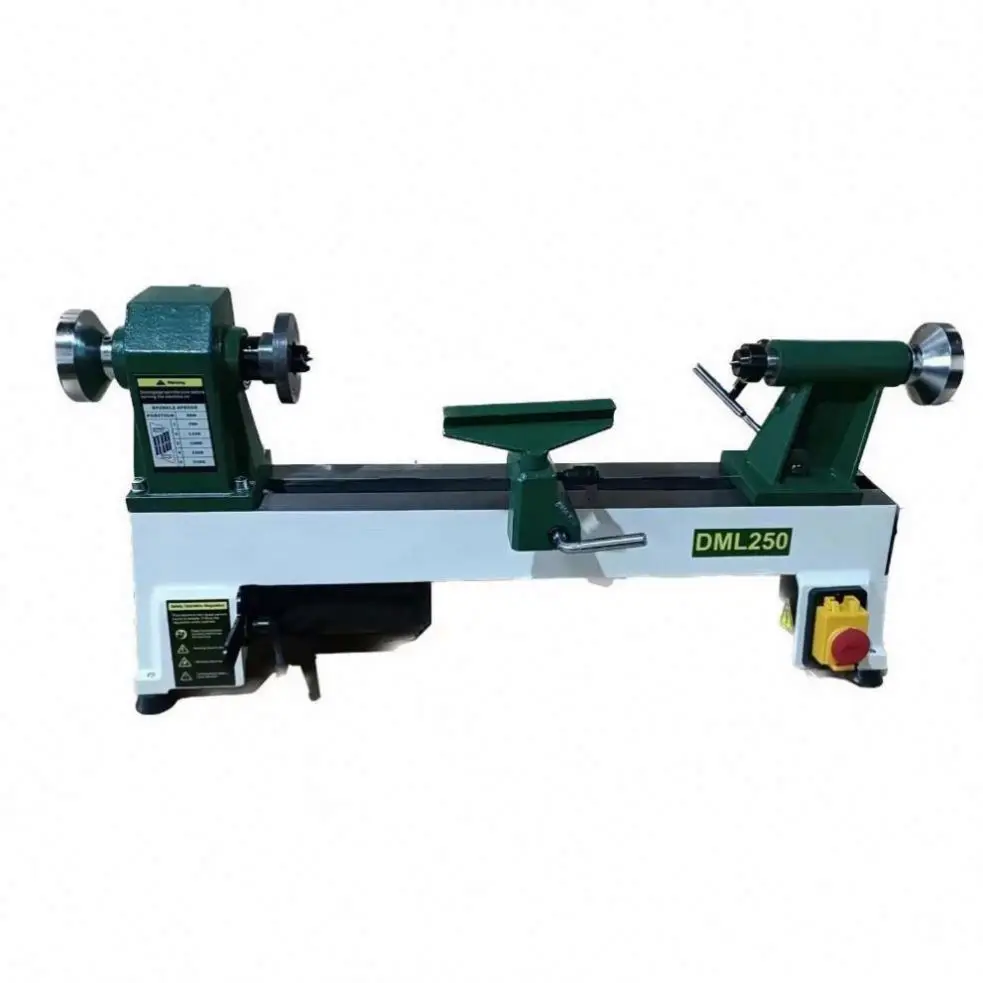
Nine of the ten parameter rows describe a different machine
The parameter block on this page has ten rows. One of them — power, 1.5 kW at 220 V — could belong to a lathe. The other nine cannot:
| Row as published | Value | Belongs on a wood lathe? |
|---|---|---|
| Power | 1.5kw/220v | plausible in form, wrong in value (see below) |
| Stroke | 500cm | 500 cm is five metres of travel |
| pump | Customised high quality oil pump | no |
| Valve | Precision high quality multi-way valve | no |
| Tyre | 2.6/4 | no |
| Knife | 150*90*45cm | 1.5 m by 0.9 m by 0.45 m is not a lathe tool |
| Cylinders | 63/500 | no |
| Use of hydraulic oil | 46#/68#l wear-resistant hydraulic oil | no |
| Net/Gross Weight | 35kg/37kg | roughly right, but see the table |
| Packing size | 1000*285*460mm | plausible, but see the table |
An oil pump, a multi-way valve, hydraulic cylinders 63/500, 46# or 68# hydraulic oil and a tyre size are the specification of a hydraulic press, with a tyre carried over from something else again. This block has been pasted onto at least three listings in this catalogue: this one, a second copy of the same MC1218VD, and an unrelated eight-inch pen lathe. All three carry the same ten rows, the same 500 cm stroke and the same tyre.
So the page as a search result is close to useless. What follows is what the photographs actually show, because the seller photographed a real specification table and put it in the gallery.
The real specification is in image two
One of the eight images is a clean table headed Product Model 12128VD. Transcribed exactly:
| Field | Value |
|---|---|
| Product model | 12128VD |
| Voltage | 220 V / 50 Hz |
| Rated power | 900 W |
| Speed control | two gears, 350–1450 rpm and 750–3800 rpm |
| Swing diameter | 300 mm |
| Centre distance | 475 mm |
| Faceplate diameter | 75 mm |
| Tool rest length | 150 mm |
| Weight | 38 kg net / 40 kg gross |
| Packaging | 880 × 460 × 330 mm |
| Overall, from the drawing | 750 mm long, 440 mm high |
That is a complete, internally consistent specification for a small bench lathe. Every figure in it cross-checks against the dimensioned drawing in the same image: 475 mm between centres plus a headstock and a tailstock gives the 750 mm overall length, and a 750 mm machine fits an 880 mm crate.
The other images confirm two of the numbers from the machine's own data plate: DIA. 12" and CAPACITY 18", and MOTOR: 900W. Twelve inches is 304.8 mm, which the table rounds to 300 mm; eighteen inches is 457.2 mm against the table's 475 mm. Both are close enough to say the plate and the table describe the same machine.
Power: the page says 1.5 kW, the plate and the table both say 900 W
This is not a rounding difference. 1,500 W is 66.7 percent higher than 900 W, and the two numbers sit in the two places a buyer checks first.
| Source | Power | Current at 220 V, pf 0.80, eff 0.85 |
|---|---|---|
| Parameter block | 1.5 kW | 10.0 A |
| Specification table | 900 W | 6.0 A |
| Data plate on the headstock | 900 W | 6.0 A |
Two sources against one, and the two are the ones physically attached to the machine. Treat 900 W as the working figure. It also changes the electrical requirement: 6 A runs comfortably on an ordinary 10 A lighting circuit, while 10 A does not, so a buyer who plans around the parameter block will over-specify the supply and a buyer who plans around 900 W will be right.
The practical consequence is in the cut, not the label. At 900 W the lathe is a small-bench machine for blanks up to about 300 mm across, and it will slow down under a heavy roughing cut on green timber. That is what 900 W buys. The 1.5 kW figure would suggest a different class of machine.
Centre distance: one published figure, four competing claims
| Where it appears | Figure | Against the 475 mm table |
|---|---|---|
| Specification table | 475 mm | the reference |
| Data plate "CAPACITY 18\"" | 18 in = 457.2 mm | 18 mm shorter, i.e. the same machine |
| Two images labelled "Extended Package" | 1000 mm | 2.11 times longer |
| Parameter block "Stroke" | 500cm = 5,000 mm | 10.5 times longer |
The 500 cm row is a unit error and can be set aside; read as 500 mm it is still 25 mm off the table. The 1,000 mm is a different problem, because it is drawn on a photograph with an arrow between centres and labelled clearly. A lathe with 1,000 mm between centres has a bed far longer than the 750 mm overall length the specification table gives, and cannot be packed in an 880 mm crate.
So either the extended packages are a separate, longer machine that the table does not describe, or the 1,000 mm annotation is wrong. Both possibilities mean the same thing for a buyer: you do not know how long the bed is, and bed length is the number that decides whether you can turn a 900 mm table leg or only a 400 mm one.
Five accessory packages, and no statement of which one you are buying
The gallery does not show one product. It shows the same orange lathe with five different accessory sets, each with its own header:
| Package as labelled | Contents shown | Centres |
|---|---|---|
| (base, no header) | flower disc, front and rear ejector pins, knife rack, wrench, hexagon socket, pusher | not shown |
| Chuck Set 1 | 4-inch linked chuck, drilling chuck, eight-piece turning tool set | not shown |
| Chuck Set 2 | 6-inch linked chuck, drilling chuck, 6-inch alloy tool holder, eight-piece turning tool set | not shown |
| Chuck Set 3 | 5-piece combination chuck, drilling chuck, 9-inch long tool holder, 6-piece combination tool set | not shown |
| Extended Package 1 | 6-inch linked chuck, centre frame, drilling chuck, 9-inch tool holder, 8-piece tool set | 1000 mm |
| Extended Package 2 | 5-piece combination chuck, 6-piece tool set, drilling chuck, centre frame, 12-inch tool holder | 1000 mm |
The differences are not cosmetic. A 4-inch chuck and a 6-inch chuck are different workholding capacity; a centre frame, present in the two extended packages and absent from the others, is what lets you turn a long thin spindle without it whipping. A buyer who assumes the base package and receives a bare machine, or who needs a centre frame and orders a package without one, gets a machine that cannot do the job.
Ask which package the price refers to, and get the accessory list in writing. On a lathe of this class the accessories are a large fraction of the value.
Two different drives at the same 900 W
The image headers do not all say the same thing. Three say Stepless Speed Regulation Model. One says Brushless Variable Speed Model.
| Drive | What it means | Consequence over years |
|---|---|---|
| Stepless speed regulation | a speed controller on a conventional motor, continuously adjustable | brushes wear if it is a brushed motor; cheaper to replace |
| Brushless variable speed | a brushless motor and its driver | no brushes to wear, better torque at low speed, a driver board that is the failure point |
Both are 900 W and both are variable speed, so the headline figure is identical while the hardware is not. Brushless is the better drive in a workshop that runs the lathe for hours; a brushed motor with a controller is cheaper to repair. The listing does not say which one ships, and the parameter block does not mention a motor type at all.
On the evidence of the photographs the listing covers both, which is another reason to fix the configuration in writing before paying.
Speed, torque and rim speed
The two gears are published as 350–1450 rpm and 750–3800 rpm. They overlap from 750 to 1450 rpm, which is 64 percent of the low gear's range — normal for a two-step pulley with electronic control behind it, and useful, because it means you can choose a gear for torque rather than for speed in that band.
From 900 W, the torque available at each published speed is:
| Speed | Angular velocity | Torque at 900 W | Use |
|---|---|---|---|
| 350 rpm | 36.7 rad/s | 24.6 N·m | roughing a large green blank |
| 750 rpm | 78.5 rad/s | 11.5 N·m | general turning |
| 1450 rpm | 151.8 rad/s | 5.9 N·m | finishing |
| 3800 rpm | 397.9 rad/s | 2.3 N·m | small diameter only, low material removal |
The top speed is where the arithmetic becomes a safety question rather than a performance one. Surface speed at the rim:
| Workpiece diameter | 350 rpm | 750 rpm | 1450 rpm | 3800 rpm |
|---|---|---|---|---|
| 50 mm | 0.9 m/s | 2.0 | 3.8 | 9.9 |
| 100 mm | 1.8 | 3.9 | 7.6 | 19.9 |
| 150 mm | 2.7 | 5.9 | 11.4 | 29.8 |
| 200 mm | 3.7 | 7.9 | 15.2 | 39.8 |
| 300 mm | 5.5 | 11.8 | 22.8 | 59.7 |
A 300 mm blank turning at 3,800 rpm is moving at 59.7 m/s at the rim, which is 215 km/h. Nothing about the machine prevents that combination, so the operator has to. The low gear exists for exactly this reason: a 300 mm blank belongs at 350–750 rpm, where the rim speed is 5.5 to 11.8 m/s, and the top gear belongs to work under about 100 mm.
The machine publishes no spindle bore, no spindle taper and no tailstock taper. Those three numbers decide which chucks, faceplates and drill chucks fit, and the accessories in the photographs are shown without their mounting specification.
300 mm is a diameter, not a radius
Swing diameter 300 mm means a workpiece up to 300 mm across clears the bed. It does not mean you can turn a 300 mm cylinder held at one end: that requires a faceplate and a low speed, and the faceplate supplied is 75 mm diameter, which is small for a 300 mm blank.
| Workpiece | Practical comment on this machine |
|---|---|
| Pen blanks, 20–25 mm | comfortable, and the pen-lathe listing in this catalogue is the tool for it |
| Tool handles, 30–50 mm | comfortable in either gear |
| Table legs, 60–80 mm | fine on diameter, but 475 mm of centres limits length to roughly 450 mm of turning |
| Bowls, 150–250 mm | possible on the faceplate at low speed; the 75 mm faceplate is small for the job |
| Anything 300 mm across | the swing allows it, the 75 mm faceplate and 2.3 N·m at top speed do not |
The 475 mm centre distance is the real constraint for spindle work, and it is the number most often ignored when a buyer compares this class of lathe on swing alone. A 475 mm bed turns a 450 mm spindle, not a 900 mm one.
Weight and packing, for the freight quote
The table gives 38 kg net and 40 kg gross in a carton of 880 × 460 × 330 mm. The parameter block gives 35 kg and 37 kg in 1000 × 285 × 460 mm.
| Item | Specification table | Parameter block | Difference |
|---|---|---|---|
| Net weight | 38 kg | 35 kg | 3 kg, 7.9 percent |
| Gross weight | 40 kg | 37 kg | 3 kg |
| Carton volume | 0.1336 m³ | 0.1311 m³ | 1.9 percent, despite different figures in all three dimensions |
The two cartons have almost the same volume while sharing no dimension, which is coincidence rather than agreement. For freight, the volume decides: this is 0.13 m³ of cargo at 40 kg, so volumetric weight at the 1:6000 air factor is 22.3 kg against 40 kg actual, and the actual weight governs. By sea it is a fraction of a cubic metre and will be charged at the minimum.
A 40 kg machine on a bench needs two people or a lift, and 300 mm of swing on a bench lathe means the bench has to be rigid. None of that is a problem, but the parameter block's 35 kg understates it.
“Milling machine” and “home use” in one title
The title carries four claims: woodworking, infinitely variable speed turning, lathe milling machine, and home use. Three are fair. One is not.
A wood lathe turns work against a tool rest. It has no X and Y table, no milling spindle, no quill feed and no way to move work under a cutter in a controlled plane. A drilling chuck in the tailstock lets you bore along the axis of rotation, which is a useful lathe operation and not milling. Calling it a milling machine will bring it into search results for people who want to cut slots and faces, and those people will be disappointed.
The other three claims hold. 900 W, 300 mm of swing and 38 kg is a genuine home or small-shop machine, and the stepless or brushless drive is what makes it pleasant to use rather than a three-pulley changewheel affair.
One caveat on “home use”: nothing in the listing mentions a guard, a low-voltage release, or a brake. At 3,800 rpm a 300 mm blank is a serious object, and the machine ships with an emergency stop on the headstock — visible in every photograph — but you should ask what else is fitted before letting an inexperienced operator use it.
Another lathe in this catalogue shows what a proper parameter block looks like
The seller is capable of publishing real lathe specifications. A profiling lathe elsewhere in the same catalogue carries seven rows that answer every question this page leaves open:
| That listing publishes | This listing publishes |
|---|---|
| turning diameter 260 mm | nothing (300 mm is only inside an image) |
| turning length 1450 mm | “500cm” |
| spindle speed 750 / 1200 / 2860 rpm | nothing |
| installed power 2.2 kW | 1.5 kW, contradicted by two sources |
| weight 350 kg | 35 kg, contradicted by the table |
| appearance size 2700 × 750 × 1400 mm | nothing |
So this is not a seller who cannot describe a lathe. It is a listing where the parameter block was filled from the wrong product. The corollary matters for a buyer: the same seller's other listings may be equally unreliable, and each one has to be checked rather than trusted.
What to put in the request for quotation
| # | Question | Why |
|---|---|---|
| 1 | Is the rated power 900 W or 1.5 kW | Two sources say 900 W; the parameter block says 1.5 kW |
| 2 | Centre distance in mm, and overall bed length | 475 mm in the table, 1,000 mm in two images, 500 cm in the block |
| 3 | Which of the five packages is the quoted price for | Accessories differ by chuck size, tool holder length and centre frame |
| 4 | Stepless or brushless drive | Both appear at 900 W; different hardware and different wear |
| 5 | Spindle bore, spindle taper and tailstock taper | Decides which chucks and drills fit |
| 6 | Faceplate diameter supplied | The table says 75 mm, which is small for a 300 mm blank |
| 7 | Minimum and maximum speed, confirmed as 350 and 3800 rpm | The two-gear ranges overlap and could be misread |
| 8 | Is the motor brushed or brushless, and is a spare controller available | Controller failure is the common failure on these drives |
| 9 | Net and gross weight, and carton dimensions | 38/40 kg in 880 × 460 × 330 mm against 35/37 kg in 1000 × 285 × 460 mm |
| 10 | Guard, low-voltage release and brake, if fitted | Not mentioned anywhere; 3,800 rpm is fast |
| 11 | Spare belts, and the belt size | A belt-drive lathe consumes belts |
| 12 | CE documentation, and which directive it is declared under | A CE mark is visible on the data plate; ask for the declaration |
Questions 1 to 3 decide what arrives. The rest decide whether the machine can do the work after it arrives, and questions 5 and 6 are the ones buyers forget.
What this lathe is good for
On the evidence of the specification table rather than the parameter block, this is a 900 W bench lathe with 300 mm of swing, 475 mm between centres and two speed ranges. That is a sensible machine for its class and a poor one for two common jobs.
| Good fit | Poor fit |
|---|---|
| Tool handles, knobs, pens, small spindles | Table legs longer than about 450 mm |
| Bowls up to about 200 mm on a faceplate, at low speed | Large platters near the 300 mm swing |
| A first lathe for a home workshop with a solid bench | Production turning, where 900 W and 2.3 N·m at speed will not keep up |
| Shops that will check the configuration in writing | Buyers who order from the parameter block |
The honest summary: the machine described in the photograph is fine and the page describing it is not. Three of the first four numbers a buyer reads — power, stroke and weight — are wrong, and the correct ones are only available by reading a table that has been rendered into a JPEG.
Key specifications
- Power
- 1.5kw/220v
- Stroke
- 500cm
- pump
- Customised high quality oil pump
- Valve
- Precision high quality multi-way valve
- Tyre
- 2.6/4
- Knife
- 150*90*45cm
- Cylinders
- 63/500
- Use of hydraulic oil
- 46#/68#l wear-resistant hydraulic oil
- Net/Gross Weight
- 35kg/37kg
- Packing size
- 1000*285*460mm
Frequently asked questions
- What is the actual power of this wood lathe?
- 900 W. The specification table in the gallery says rated power 900 W and the data plate on the headstock reads MOTOR 900W. The parameter block says 1.5kw/220v, which is 66.7 percent higher. At 220 V that is the difference between 6.0 A and 10.0 A, so plan the electrical supply around 900 W.
- Why does the parameter block mention an oil pump, a multi-way valve and hydraulic oil?
- Because it was copied from a hydraulic press. Nine of the ten rows describe a press: oil pump, multi-way valve, cylinders 63/500, 46# or 68# hydraulic oil, and a tyre size. The same ten rows appear on at least two other listings in this catalogue, including an unrelated eight-inch pen lathe. Ignore the block and read the specification table in the images.
- What is the distance between centres, 475 mm or 1000 mm?
- The specification table says 475 mm and the data plate says CAPACITY 18 inch, which is 457 mm, so 475 mm is the real figure for the machine in the table. Two images labelled Extended Package show 1000 mm between centres, which is a different and longer machine that cannot fit in the published 880 mm carton. The parameter block says 500cm, which is five metres and is a unit error. Ask which bed you are buying.
- Which accessories are included?
- The gallery shows five packages: a base set, Chuck Set 1, Chuck Set 2, Chuck Set 3, and Extended Package 1 and 2. They differ in chuck size from 4 to 6 inch, tool holder length from 6 to 12 inch, and whether a centre frame is supplied. The listing never states which package the price covers, so get the accessory list in writing.
- Is it stepless or brushless?
- Both appear. Three image headers say Stepless Speed Regulation Model and one says Brushless Variable Speed Model, all at 900 W. The headline power is identical while the motor and drive are not. Brushless has no brushes to wear and better low-speed torque; a brushed motor with a controller is cheaper to repair. Confirm which one ships.
- Can it turn a 900 mm table leg?
- No. With 475 mm between centres the usable spindle length is roughly 450 mm. The extended packages are shown at 1000 mm but that contradicts the specification table and the 880 mm carton, so it has to be confirmed before ordering. Swing of 300 mm is the diameter that clears the bed, which is a separate limit.
- Is it a milling machine as the title says?
- No. It is a wood lathe with a tool rest. It has no X and Y table and no milling spindle, so it cannot cut slots or faces. A drilling chuck in the tailstock allows boring along the axis of rotation, which is a normal lathe operation and not milling. The other three claims in the title, woodworking, variable speed and home use, are fair.