
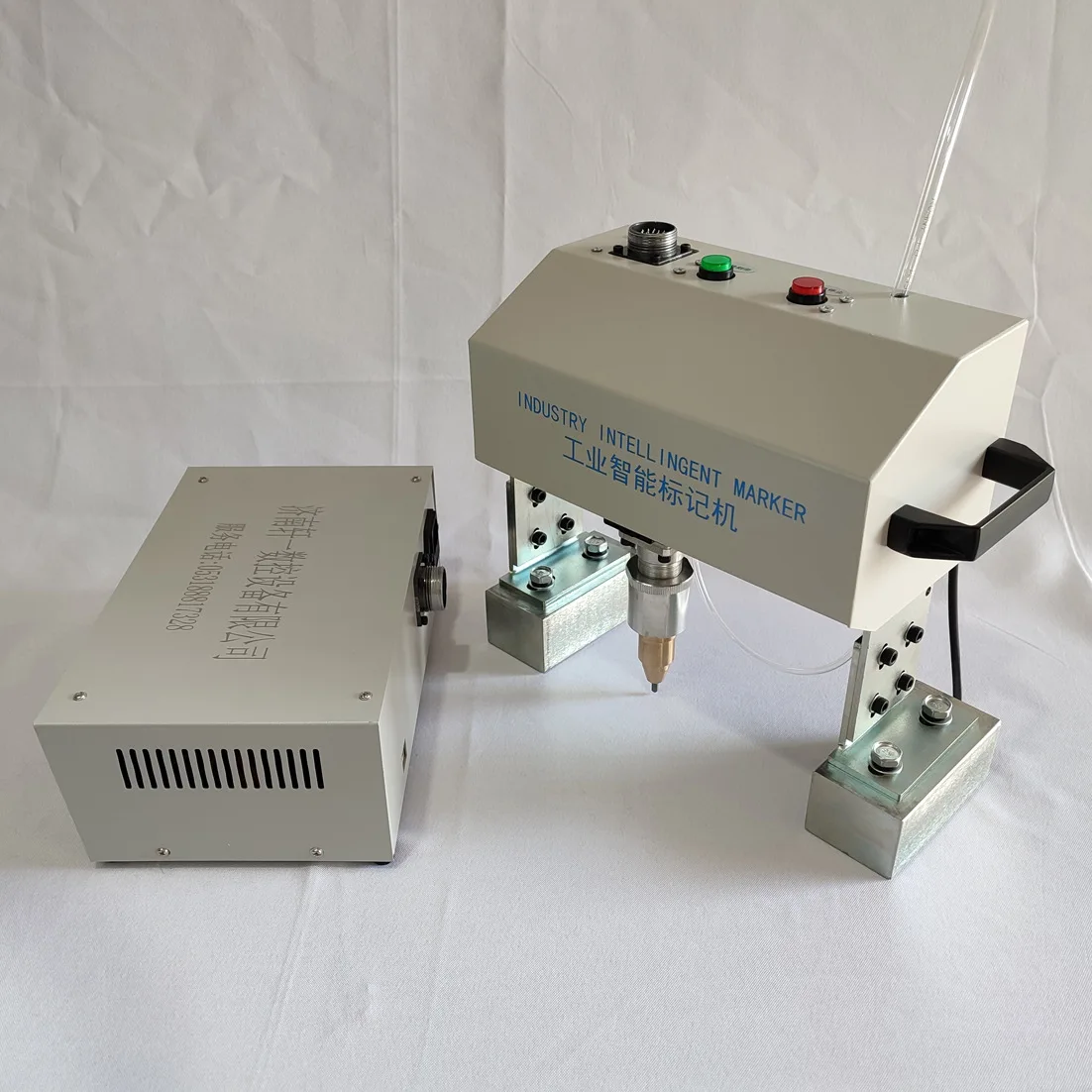
One listing, four machines, and a power source that changes three times
The title calls this an XY-02 pneumatic metal marking machine. The parameter block calls it a labeling machine. The first gallery frame is a TEBAK-branded panel headed Portable electric marking machine, seven-inch touch screen. The parameter table further down that gallery specifies a battery of 18–24 V and a power draw under 120 W. And the packing frame at the end of the sequence carries a carton label reading XY/M6-D.
Four of those statements cannot all be true of one object. Pneumatic and electric are not two ways of describing the same tool: one runs from a compressor and the other from a battery or a mains supply, and the difference decides what you have to install before the machine earns anything.
This page sorts the evidence. It separates what is printed, what is photographed, and what is arithmetic, and it ends with the questions that have to be answered in writing before a purchase order makes sense.
Pneumatic is an infrastructure commitment, not a feature
A pneumatic marker has no motor in the marking axis. A cylinder drives the pin, and the cylinder is fed by compressed air. That single sentence has three consequences a buyer should price before looking at the machine cost.
- You need a compressor, and it has to be sized. Not "a compressor in the corner" — a supply that holds working pressure while the marker fires repeatedly. Undersized supply shows up as shallow, uneven marks late in a long run, which reads as a machine fault and is not one.
- You need dry air. Moisture in the line reaches the cylinder and the guideways. On a marking head that reciprocates thousands of times a shift, water is the difference between a guide that lasts years and one that develops play.
- The marking force is set by pressure, not by a menu. Depth becomes a function of the regulator setting, the material, and the bore of the cylinder. That is workable, but it means the useful specification is the cylinder bore and the recommended pressure band — neither of which appears anywhere in this listing.
If your workshop has no compressed air, this machine is the wrong purchase regardless of price. If it does, the compressor question still has to be answered: the listing publishes no air consumption figure, and without litres per minute at working pressure you cannot tell whether your existing supply is adequate.
What the specification table actually describes
The one real parameter table in the gallery is unambiguous, and it is not describing a pneumatic machine. It states: marking range 90×30 mm or 120×30 mm; marking depth 0.1–1.0 mm depending on material; marking speed 1–3 characters per second; power under 120 W; vibration frequency up to 200 Hz; battery voltage 18–24 V wide voltage; touch-screen input; barcode optional; CAD import; automatic serial increment; automatic counting of printed content.
An 18–24 V battery and a 120 W power ceiling describe a self-contained electric unit. A pneumatic marker has no battery, and its energy comes from the air line, so "power under 120 W" would refer only to the controller. The table is therefore evidence for the electric product — most likely the handheld model published separately in this catalogue — and it has been carried across into a listing that claims to be something else.
The practical rule: do not use that table to specify an XY-02. If the machine you receive is genuinely pneumatic, three of its rows (battery, power, frequency) do not apply, and the two rows that do apply (marking range, depth) still need to be confirmed against the actual unit, because they were written for a different head.
Can it engrave a full metal card? The arithmetic says no, in one pass
The title advertises CS and SS metal name cards and ID cards. That is a checkable claim, because cards have a standard size and the listing publishes its marking ranges.
An ID-1 card under ISO/IEC 7810 measures 85.60 × 53.98 mm. A metal business card is normally cut to the same footprint, because it has to sit in the same wallet slot. Compare that with the two marking ranges in the table:
| Marking range | Area | Share of card face | Card long side (85.60 mm) fits? | Card short side (53.98 mm) |
|---|---|---|---|---|
| 90 × 30 mm | 2700 mm² | 58.4% | yes (85.60 ≤ 90) | 23.98 mm short |
| 120 × 30 mm | 3600 mm² | 77.9% | yes (85.60 ≤ 120) | 23.98 mm short |
Read the last two columns together, because they point in opposite directions. The long side of the card clears both ranges with room to spare. The short side does not: at 30 mm of travel against a 53.98 mm card, the marking head covers 56 percent of the card's height, leaving 23.98 mm untouched.
So a full-face card engraving cannot be done in a single pass on either published range. It requires two passes with a 30 mm step and roughly 6 mm of overlap (30 + 30 = 60 mm of travel to cover 53.98 mm). That is a normal technique on a dot peen machine, but it moves the risk somewhere else: registration between passes.
Two-pass marking puts the risk in the seam
When a job is split into two marking passes, the second pass must land within a fraction of a millimetre of where the first one stopped, or the artwork shows a visible band where the two halves meet. On a card with a border, a logo or a line of text crossing the join, that band is the first thing a customer notices.
Three things decide how clean the join is, and only one of them is on the specification sheet.
- Workholding with an index stop. A hard stop the card registers against, that does not move between passes. A fixture held by hand will not repeat.
- Repeatable origin. The controller has to return to a known zero, not to wherever the head happens to be.
- A test piece before the batch. Mark the joint on scrap of the same material and the same thickness, then measure the offset. On stainless, the depth of the first pass also affects how the second pass reads under light, so the join can appear even when the geometry is right.
If your product is a card with a continuous border, buy a machine whose marking range covers the card in one pass (something on the order of 120×80 mm or better) rather than planning a two-pass workflow around a 30 mm axis. The saving on the machine is small next to the scrap rate on finished metal cards.
"Labeling machine" is the wrong product category, and it is not cosmetic
The parameter block gives the product name as Labeling machine. A labeling machine applies labels. A dot peen marker deforms the surface of a part with a hard pin. They are different categories of equipment, with different buyers, different search terms and different declared descriptions on shipping documents.
For a buyer the consequence is immediate: the page will not be found by anyone searching for a marking machine, and the declared product name on the commercial invoice will not match what arrives in the carton. That mismatch is the kind of detail a customs broker queries, and the kind of detail that makes a warranty claim awkward when the supplier's own paperwork calls the item something else.
Ask for the product name to be corrected on the invoice and packing list to match the machine actually shipped, and keep that corrected document with the order. It costs nothing to request and it removes an argument later.
The manufacturer's name and service number are printed on the machine
Look closely at the controller in the main image. Its lid carries the company name and service telephone of a machine builder in Jinan, printed as part of the case artwork — not a sticker that peels off, but the finish of the enclosure itself.
This is normal in OEM supply and it is worth understanding before you resell. An end user with a fault will read the number on the box and call the original builder directly, which means you lose the service relationship, the spare-parts margin and the visibility of what failed. If the machine is to be sold under your own brand, the enclosure artwork has to be changed at the factory, and that is a tooling conversation with a lead time — not something you fix with a label after arrival.
If you are buying for your own shop, the printed number is harmless and even useful. If you are buying to resell, it is a branding decision that must be made before the order, because the alternative is grinding a manufacturer's name off every unit you ship.
The carton label names a different model
The packing sequence ends with a carton labelled FRAGILE and a printed shipping label whose model field reads XY/M6-D. The listing is XY-02. Either the packing photographs were taken from a different order, or the model designation is not stable between the factory's paperwork and the marketplace listing.
Neither explanation is comforting, and both are easy to test: ask the supplier to send a photograph of the label on the carton they will actually ship, with your order number, before it leaves. A supplier who cannot produce that photo is a supplier whose model numbers are decorative.
What is missing for the pneumatic version specifically
Strip away the electric specification carried over from the other product and almost nothing remains. For a pneumatic marking head the purchasing decision rests on five numbers, and the listing publishes none of them.
- Working pressure band (MPa or bar). Without it you cannot set the regulator, and you cannot tell whether your compressor's output is in range.
- Air consumption (litres per minute at working pressure). This is what sizes the compressor and the receiver.
- Cylinder bore and stroke. Bore sets the force at a given pressure; stroke sets the usable depth adjustment.
- Marking force or impact energy. The number that decides whether the pin will mark stainless rather than polish it.
- Guideway and pin life. The consumable on a dot peen machine is the pin, and the wear part is the linear guide. Neither life figure is given.
For context on why bore matters, the force from a cylinder is pressure times piston area. At an assumed 0.5 MPa on an assumed 40 mm bore, the thrust is about 628 N. Halve the bore and the force falls to roughly a quarter, because area scales with the square of diameter. That sensitivity is why "pneumatic" without a bore figure is not a specification at all — it is a category.
The gallery shows four different machines, so identify yours by photograph
One panel is headed PRODUCT SHOWS and contains four distinct builds: a blue benchtop unit on a baseplate with a red manufacturer label, a grey enclosure, a column machine with a handwheel on top, and a handheld unit with a battery handle. They have different marking envelopes, different workholding and different mounting.
Before ordering, ask for a photograph of the exact configuration you are buying, with a ruler or a card in frame for scale, and compare it to the frame you based your decision on. On a listing where the title, the specification table and the packing label each name a different product, the photograph is the only artefact that cannot be mistyped.
One more observation about this gallery: three of its eight frames, including the parameter table and the VIN/engine application photographs, are byte-identical files used in the catalogue's separate listing for a battery-powered handheld marker. Reused artwork is how the electric specification ended up under a pneumatic title.
Incoming inspection for a marking machine
- Confirm the power source on arrival before anything else. If the carton contains a battery and a charger, you have received the electric model, whatever the invoice says.
- Match the model plate and the carton label against the order. Photograph both.
- Measure the marking envelope yourself with a steel rule on a test plate, in both axes. Do not trust the table.
- Mark a depth ladder on scrap of your production material at several settings and measure the depth with a micrometer. Pick the setting that gives a legible mark without cracking thin sheet.
- Run a two-pass card test if cards are your product, and measure the seam offset. Reject the workflow if the join is visible at arm's length.
- Cycle for ten minutes continuously and check the guideway for heat and the pin for wear burrs.
- For a pneumatic unit, log the pressure at which the mark quality holds through a full shift, not just at start-up.
RFQ checklist
| Question | Why it decides the order |
|---|---|
| Is the unit pneumatic, electric, or battery? | The three need different infrastructure; the listing claims all three |
| Exact model and a photograph of the shipping label | The packing photo in this listing reads XY/M6-D |
| Working pressure band (MPa) | Sets the regulator and rules your compressor in or out |
| Air consumption (L/min at working pressure) | The only figure that sizes a compressor and receiver |
| Cylinder bore and stroke | Force at pressure, and usable depth adjustment |
| Marking force or impact energy | Decides whether it marks stainless or polishes it |
| Marking range, measured, in both axes | Determines whether a full card fits in one pass |
| Repeatability and origin return | Makes or breaks a two-pass workflow |
| Pin and guideway life, and spare pin price | The recurring cost of ownership |
| Whether the enclosure carries another company's name | A branding and service decision, not a cosmetic one |
| Corrected product name for the invoice | The block currently says "Labeling machine" |
| Net weight, carton size, and whether a compressor is included | Freight and installation planning |
What we will and will not quote from this page
The card dimensions come from ISO/IEC 7810 ID-1 and are cited; the coverage percentages and the 23.98 mm shortfall are arithmetic on those dimensions against the marking ranges printed in the listing's own table. The cylinder force figure is arithmetic on an explicitly assumed bore and pressure, stated as an illustration of sensitivity, not as a specification of this machine.
What this page will not do is supply an air pressure band, an air consumption figure, a marking force, a weight or a price for the XY-02. None of them appears in the listing, and every one of them is a number you will need before the machine can be installed rather than merely delivered.
Send the checklist with your material, thickness and card size, and the reply can be a configuration rather than a photograph.
Key specifications
- Product Name
- Labeling machine
- place of origin
- China
- Model number
- XY-02
Frequently asked questions
- Is the XY-02 pneumatic or electric?
- The listing says all three things. The title says pneumatic, the TEBAK panel says portable electric with a seven-inch touch screen, and the parameter table specifies an 18–24 V battery and under 120 W. Those cannot describe one machine. Ask for the power source in writing and a photograph of the unit you will receive.
- Can it engrave a full ID card or metal business card in one pass?
- No, on either published marking range. An ISO/IEC 7810 ID-1 card is 85.60 × 53.98 mm. A 90×30 mm range covers 58.4 percent of the card face and a 120×30 mm range covers 77.9 percent; both leave 23.98 mm of the card's height unmarked, because only 30 mm of travel is available against a 53.98 mm side. Full-face work needs two passes with about 6 mm of overlap, or a machine with a larger envelope.
- What infrastructure does a pneumatic marker need?
- A compressor that holds working pressure during repeated firing, dry air to protect the cylinder and guideways, and a regulator to set marking depth. The listing publishes no air pressure band and no air consumption figure, so neither the compressor nor the receiver can be sized from the page.
- Why does the parameter block say 'Labeling machine'?
- Because it is the wrong category. A labeling machine applies labels; this machine deforms the surface with a hard pin. The mis-declaration affects how the product is found, and it will not match the machine on the commercial invoice — ask for the name to be corrected on the shipping documents.
- Whose name is printed on the controller?
- A machine builder in Jinan, with a service telephone, printed as part of the enclosure artwork. That is normal OEM supply. If you intend to resell under your own brand, the artwork has to be changed at the factory before the order, because it cannot be removed cleanly afterwards.
- The packing photo shows a different model. Why?
- The carton label in the packing sequence reads XY/M6-D while the listing is XY-02. Either the photographs came from a different order or the factory's model designation does not match the marketplace listing. Ask for a photograph of the label on your own carton before it ships.
- What is the most important number to obtain first?
- The power source, followed immediately by the marking envelope measured in both axes. Every other decision — compressor, fixture, two-pass workflow, card size — depends on those two answers, and the listing gives neither reliably.