
What this record contains, and where its specification actually lives
The Hoting queue identifies Product ID 1601251114190 as a TEBAK XY-03 marking machine listed under a title that names a VIN number handheld dot pin engraving machine, a metal laser desktop marking machine and a name card and ID card machine in the same sentence. The record belongs to the Hoting category and carries eight detail images alongside a main image.
The first fact a buyer has to work with is that the record's structured parameter block is empty. Unlike the PEQD series record in the same queue, which publishes sixteen parameter rows, this record publishes none. The specification exists only inside the detail images: one of them carries two printed PARAMETER panels and a dimensioned drawing of each variant. Everything below is transcribed from those images, and the practical consequence is that a buyer who orders from the record alone has no specification on the purchase order at all.
The second fact is that the description text is not a specification either. It carries a heading, a contents list (product introduction, packing and shipping, company introduction) and a company paragraph that stops mid-sentence at the words TEBAK relies on advance. The paragraph also contains a phrase reading they are 70% for expert, which reads as a typographical slip for export rather than a figure to rely on.
So this guide does three things. It reproduces the parameter table exactly as the record's images print it, for both variants. It works through what each line decides in use. And it sets out the questions the record leaves open, ranked by how much money each one can move.
The parameter table as printed in the record's own images
Two panels appear, one above the other, with a dimensioned drawing beside each. The text below reproduces both panels line for line, including the punctuation the record uses.
| Line as printed | XY/F1-9030 | XY/F3-9030 |
|---|---|---|
| Equipment name | handheld pneumatic marking machine | handheld pneumatic marking machine |
| Product Model | XY/F1-9030 | XY/F3-9030 |
| Print Range | 90*30mm | 90*30mm |
| Cutting depth | 0.1~1mm (depending on the material) | 0.1~1mm (depending on the material) |
| Equipment Power | <300W? | <300W? |
| Equipment Weight | nose <3.2KG | nose <3.2KG |
| Customer-provided | computer, air pump | air pump |
| Application Scope | mold, workpiece, cylinder block, etc. | mold, workpiece, cylinder block, etc. |
Two details in that table deserve attention before anything else. The equipment name says pneumatic, which settles a question the title leaves open. And the power line prints a question mark after the figure: the record itself is not asserting the number, it is offering it tentatively. A figure the supplier will not state flatly is not a figure a buyer should design a power supply around.
The dimensioned drawings add the physical envelope, which the parameter block does not carry at all:
| Item | XY/F1-9030 | XY/F3-9030 |
|---|---|---|
| Control unit, length × width × height | 260 × 160 × 105mm | 270 × 180 × 135mm |
| Marking head, 160 × 170 × 210mm | shared | shared |
| Head across the base | 90mm | 90mm |
Two model codes, and a third one in the title
The title and the description heading both call the machine XY-03. The parameter panels call it XY/F1-9030 and XY/F3-9030. Those are not the same string, and the differences matter for ordering.
Spare needles, needle holders, control boards, keyboard membranes and service documentation are all ordered against a model code. A machine whose nameplate reads XY/F3-9030 while the purchase order reads XY-03 leaves the buyer with no clean route to a spare part a year later, and no way to prove to a supplier which machine was bought. The fix is procedural and costs nothing: ask for a photograph of the nameplate on the machine that will actually be shipped, and write the code from that photograph onto the purchase order. If the supplier quotes XY-03 as a family name, ask for the family's orderable codes in writing.
What actually separates XY/F1-9030 from XY/F3-9030
Read the two panels side by side and only two lines differ: the model code, and the customer-provided line. Print range, depth, power, weight and application scope are identical. So the difference between the two variants is a control arrangement, not a marking capability.
The customer-provided line states the difference in the supplier's own words. Variant F1 requires the customer to provide a computer and an air pump. Variant F3 requires only an air pump. The plain reading is that F1 has no on-board programming interface, so marking files have to be prepared and sent from a computer, while F3 carries its own screen and keyboard in the case and can hold or edit a job at the machine.
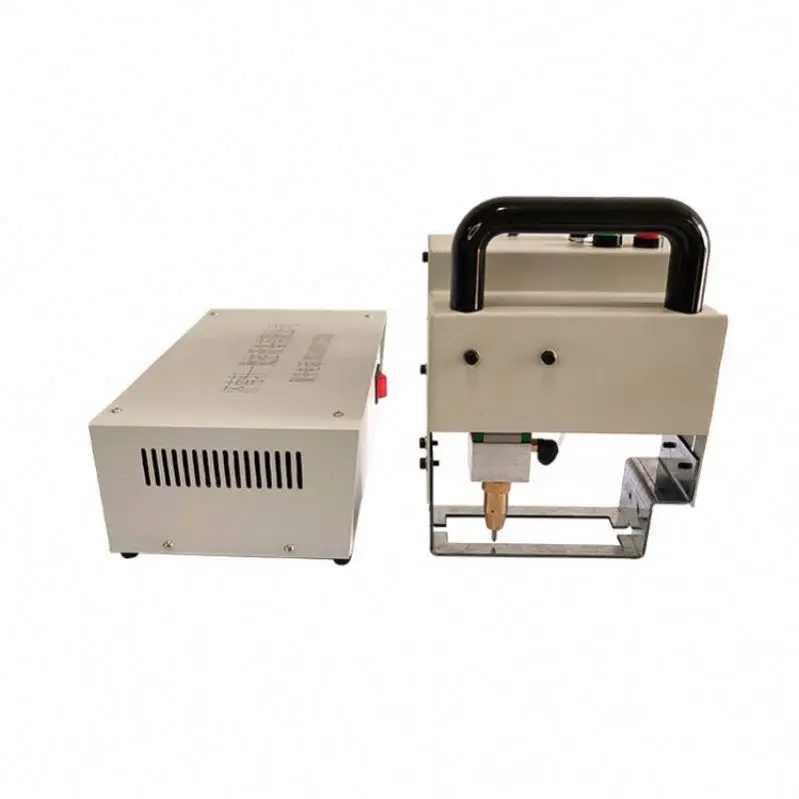
The images support that reading. The main image shows two separate objects: a rectangular control box with louvre vents, a red rocker switch and rubber feet, and beside it a marking head with a black carrying handle, two black adjustment knobs, a brass-coloured stylus pointing down, and a U-shaped metal bracket beneath it. One of the detail images shows the F3 control unit as an aluminium case with the lid open, a screen in the lid and a membrane keyboard in the base, with the marking head standing beside it.
The two control units are close in size but not identical, and the arithmetic is worth doing before deciding where the machine will live:
- F1 control box: 260 × 160 × 105mm = 4,368,000 cubic millimetres, about 4.4 litres.
- F3 control case: 270 × 180 × 135mm = 6,561,000 cubic millimetres, about 6.6 litres.
- The F3 case is therefore roughly half again the volume of the F1 box and 30mm taller, which is the price of the lid, screen and keyboard.
- The marking head is common to both at 160 × 170 × 210mm with a 90mm base and a nose weight under 3.2 kilograms, so the thing the operator lifts is the same in either purchase.
That leads to the question the record does not answer, and it is the one that decides the variant: where will marking jobs be created? If jobs are written at a desk and sent to the machine, F1 plus an existing laptop is the cheaper configuration and there is one fewer screen to keep alive in a workshop. If the operator must change a job, a serial number or a date at the point of marking, F3 removes a walk back to a computer and removes the need for a second device entirely. Neither answer is universal, and the price difference is not stated, so ask for both variants quoted as separate line items.
Three further questions sit inside the F3 choice, and none is answered by the record. How is a job file loaded into the case: a memory card, a USB port, a network connection or a serial cable? How many files does it hold, and can it run an automatic counter or a date code without being rewritten? And what protection does the membrane keyboard carry, because a keyboard in an open lid beside a machine that uses an air line is exposed to dust and to oil mist, and the keyboard is the part most likely to fail first.
The marking window is 90 by 30 millimetres, and the head base is 90 millimetres
Both variants state a print range of 90 × 30 millimetres, and both drawings give 90mm across the base of the marking head. The two numbers being equal is not a coincidence worth ignoring: it suggests the 90mm figure is the mechanical limit of travel in the long axis of the head, with the workpiece or the head indexed by hand for anything longer, and the 30mm axis is the short stroke. Ask the supplier to confirm that reading, because if the 90mm window is a hard limit, then a mark longer than 90mm is a two-position job and the operator's positioning accuracy, not the machine's, sets the result.
In practice, a 90 × 30 millimetre window suits a data plate, a nameplate, a mold insert face or the flat boss on an engine block. It is a single-line or two-line window. At a 3 millimetre character height with a typical line pitch of about 6 millimetres, 30 millimetres of window height holds roughly five lines; that is arithmetic on the window, not a figure the supplier publishes, and it should be confirmed against the character set and line pitch the supplier actually uses. What the window does not do is mark a full 300 millimetre chassis rail or a long VIN plate in one pass. If that is the job, the head has to be moved and re-datumed between passes, which is exactly why the head is built with a handle and weighs under 3.2 kilograms.
Where the PEQD series record in the same queue offers five optional windows up to 200 × 100 millimetres, this record offers one. A buyer whose job needs a wider window should ask whether the XY series has other window sizes, or should compare against the PEQD-030 dot peen machine note before committing to the 90 × 30 millimetre head.
The head is pneumatic: what the air line adds to the project
The parameter panel names the equipment a handheld pneumatic marking machine, and both variants list an air pump as customer-provided. That single word settles the machine's physical class: this is a pneumatically driven dot peen marker, not a laser.
It is worth stating plainly because the listing title says otherwise. The title and the description heading both call it a metal laser marking machine. The components shown in the record's own component image are a tungsten steel alloy needle, an industrial copper-core stepper motor and a miniature profile linear rail with an MGN9B-class designation on the block. A needle driven along a rail is a mechanical marking head. There is no laser source, no lens, no focal distance and no laser class in the record. That is good news for the buyer on one axis and bad on another: there is no laser safety regime to set up, but there is a compressed-air supply to install, a consumable stylus to keep in stock, and a depth that depends on air pressure and on how many strokes the head makes per millimetre.
The record does not state air consumption. Without it a compressor cannot be chosen, so the buyer has to close that gap explicitly. The method is to ask for consumption in litres per minute at the rated pressure, then size the compressor so the machine's steady demand sits within about 70 per cent of the compressor's free air delivery, leaving headroom for the receiver to recover between jobs. In formula terms, the demand is the number of marking cycles per second multiplied by the air drawn per cycle multiplied by sixty, converted to the unit the compressor is rated in. Two further air questions belong in the same enquiry: whether the machine needs dried and filtered air and to what grade, because water and oil in a pneumatic marking head show up as inconsistent depth and as a sticky stylus, and how long the air hose and the control cable are, because that length sets how far the head can reach from the control unit and therefore whether a chassis rail under a vehicle is reachable at all.
The power line reads under 300 watts, with a question mark in the source
The equipment power line in both panels reads <300W?. The question mark is in the record, not in this transcription. For a pneumatic machine the wattage covers the control electronics and the stepper, so a figure under 300 watts is plausible, but a buyer should not size a generator, a transformer or a workshop circuit against a number the supplier writes with a question mark.
Ask for the definitive power figure, the voltage and frequency the machine is built for, whether the control unit and the head draw from one supply or two, and what happens to the marking if the air pressure drops mid-job. That last question is not academic: on a pneumatic marker, low air pressure shows up as shallow or partly missing characters rather than as an error message, and a plate that leaves the station with a half-formed number is worse than one that was never marked.
Components named in the record's own component image
One detail image is headed four reasons for choosing us and shows four components with a caption for each. The captions are the supplier's own claims, reproduced here so the buyer can see which claims touch a purchase decision.
| Component shown | Claim as printed | What it decides for the buyer |
|---|---|---|
| Tungsten steel alloy needle | High hardness, long service life, super wear-resistant, stable marking | It is the consumable. Ask for needle diameter, measured life, the price of a needle and a collet, and the lead time on both. |
| Industrial copper core motor | Copper core industrial grade stepper motor, high precision, no loss, high temperature resistance, fast heat dissipation | Sets marking force and repeatability, and how the machine behaves in a continuous shift rather than a demonstration. |
| Industrial control panel | Self-developed digital chip, faster transmission, stable quality | Sets job handling, file capacity and interface, which is where the F1 and F3 variants diverge. |
| High-precision imported linear guide rail | Strong wear resistance, high precision, stable operation, clear marking | The rail and its block set depth consistency. A miniature profile rail is a precision item with a preload class and a service life; ask which, and ask for the price of a replacement block. |
Two of those four rows carry a hidden running cost and one carries a hidden failure mode. The needle is a consumable and belongs in the quotation with a price. The rail block is a wear item in a handheld head that gets pressed against steel all day. The control panel is the only item on the list that is described as self-developed, which is also the item most likely to be unavailable from any second source. Ask what the supplier's commitment is on control board availability and software support for the machine's working life.
The samples the record shows, and what they do and do not prove
One detail image is headed marking effect display and on-site case presentation. Six sample panels and four site photographs appear. Reading them as evidence rather than as decoration changes what the record can be said to support.
| Panel | What the image shows | What it supports |
|---|---|---|
| Sign marking | A tricycle data plate carrying a manufacturer name, an approval number, a VIN field, an engine model, a displacement of 1400ml, a 3000kg figure labelled quality, a 2000kg figure labelled loading, five persons and a 2021 date, plus a CCC mark | That the head can mark a flat production data plate inside the stated window. It does not prove the plate was marked by this model. |
| Marking of parts | A hand holding a machined steel part marked with a short alphanumeric string | Short-string part marking on a machined surface. |
| Car logo | A mould or plate bearing an engraved vehicle marque | Fine line work on a mould or plate. It also raises a compliance question, see below. |
| LOG marking | A cylindrical drum face carrying a character and a circular emblem beside a short code | Marking on a curved surface, which the parameter panel's application scope does not mention. |
| Sign printing | An operator marking a plate at a bench with the control box beside him | Bench use with the control unit and head separated by a cable, in daylight, in a production room. |
| Frame marking | An operator holding the head against a truck frame out of doors | The application the title's VIN wording points at: re-marking a vehicle frame in situ. |
| Cylinder marking | Gas cylinders with regulators and gauges | Marking on a cylinder body. Cylinders are a pressure item with their own marking rules in most markets. |
| Steel structure site | An operator marking a structural steel section on site | Field use, which is where a handheld head and a separate control box earn their keep. |
Two conclusions follow. The first is that the samples are a maintenance and re-marking pattern: plates, frames, cylinders and structural steel, mostly at the point where the item already is. Nothing in the samples shows the machine marking a mould cavity or an engine block, which is what the parameter panel's application scope actually names. A buyer whose job is production marking of small parts inside a machine shop has no sample to look at, and should ask for one on their own workpiece.
The second is a definition question the buyer should settle before ordering. Marking a vehicle marque onto a plate or a mould is not the same act as marking a serial number, and in many markets the reproduction of a manufacturer's identification mark on a vehicle part is regulated, as is the marking of a pressure cylinder. The record shows both as capabilities and neither as a disclaimer. Agree in writing what may be marked, on what items, and who carries the responsibility for the plate complying with the rule that applies where the vehicle or the cylinder is registered or used.
Four identity signals inside a single record
A buyer checking who they are dealing with has four separate pieces of evidence in this record, and they do not point at the same name.
| Where it appears | What it says |
|---|---|
| The company introduction in the description text | Hengshui Mengshang Trading Co., Ltd., described as a supplier of product machinery, CNC carbide inserts, turning tools and milling tools, trading as TEBAK, with quality control standards based on ISO9001 certification. |
| The factory photograph in the detail images | A building entrance with a large stone sign carrying the same name in Chinese characters, 街水梦尚贸易有限公司, which is the form of a trading company rather than a manufacturing company. |
| The contact card in the detail images | The TEBAK mark with the tagline PTFE and technopolymers manufacturing, a sales manager name, the website www.cntebak.com, an address in Hengshui City, Hebei Province, a mobile number, and an email address on the hssanrenxing.cn domain. |
| The parameter images | The line focus on the production of identification industry for 15 years. |
Three things follow from reading the four together, and each is a question rather than an accusation.
The entity and the claim do not match. The description text says the company is a leading OEM and ODM manufacturer with many years of experience. The name on the factory sign is a trading company. Both can be true at once, because trading companies sell the output of factories they do not own, but the buyer should know which one is contracting: ask for the full registered name of the entity that will appear on the quotation, the contract and the invoice, and ask which factory the machine is built in.
The brand's stated specialism is a different industry. The contact card's tagline places the TEBAK mark in PTFE and technopolymer manufacturing, while this record is a pneumatic marking machine and the same brand text appears on a queue of industrial tooling and machinery listings. A brand mark with one tagline across several product families is common, and it is not a defect, but it does mean the tagline carries no information about the marking head. The evidence that matters here is the parameter panel and the marked samples, not the logo.
The contact details have to be reconciled. The card gives a website, an email domain and a mobile number; the description text gives a different company name. Before money moves, confirm that the bank account name matches the contracting entity exactly, because a deposit sent to an account in one name against a contract in another is the single hardest payment dispute to unpick. Ask for the beneficiary name in writing and compare it character by character with the contract.
Four of the eight detail images are shared with a sibling listing
The record carries eight detail images. Four of those image files are byte-identical to image files used on another marking machine listing in this same queue, the PEQD series record. The shared files are the component image headed four reasons for choosing us, the marking effect and on-site case image, the shipping service image and the FAQ image.
Image reuse across listings from one supplier is normal and does not by itself mean anything is wrong. What it does mean is that these four images are company collateral, not product evidence. The component image describes parts the supplier uses across the range. The FAQ image carries commercial terms that are not tied to this model. The shipping image is a general service page. Only the two parameter panels, the two dimensioned drawings and the two product photographs are specific to this machine.
The practical instruction is short: when ordering, ask for photographs of the specific machine to be shipped, with the nameplate legible and beside a rule or a tape, plus a photograph of the control unit that will be delivered. Do not accept the parameter panel image as proof of the delivered configuration, because the same panel appears under more than one listing and the supplier's own table prints a question mark against the power figure.
The commercial terms the record does state
One detail image is a six-question FAQ, and it is the only part of the record that states commercial terms. It is reproduced here because these lines are as relevant to the decision as the print range is, and because they are the same lines the supplier will hold the buyer to.
| Question as printed | Answer as printed |
|---|---|
| How fast can I get the quotation? | Usually within 24 hours after the inquiry is received, with a request to telephone or to say so by email if the price is urgent, so the inquiry is given priority. |
| How can I get a sample to check your quality? | Samples can be offered for reference. |
| Can you do the design for us? | Yes, with a professional team experienced in drawing design and manufacturing, working from the buyer's idea. |
| What are your payment terms? | 30 per cent deposit, 70 per cent balance before shipping, payable by T/T, PayPal or Western Union. |
| What is the lead time for mass production? | Usually about 15 working days, depending on the order quantity. |
| What are your terms of delivery? | EXW, FOB and CIF are accepted, with the choice left to the buyer on grounds of convenience or cost. |
Three of those answers change how the purchase is structured, and none of them is a reason to walk away.
Seventy per cent before shipping means the whole sum is paid before the goods move. There is no balance against a copy bill of lading, so the buyer carries the full payment across the production period and the transit period at once. Two consequences follow. The buyer should insist that the pre-shipment inspection happens before the 70 per cent is released, not after, and that the inspection covers the points in the checklist below. And the buyer should know what recourse exists if the machine arrives not matching the record, because with payment complete the only lever left is the supplier's willingness, or a claim in the supplier's own jurisdiction.
Fifteen working days is about three calendar weeks of production before the freight clock starts, and the answer says it depends on quantity, so it is a floor rather than a promise. A buyer planning a shutdown or a contract deadline should ask for the lead time to be stated as a number of working days from receipt of deposit, in writing, with the air supply and the computer named as buyer-side items so they cannot be blamed for a delay.
The trade term decides who owns the risk in transit, and the record leaves the choice to the buyer. EXW puts the whole movement on the buyer from the factory gate, FOB from the port of loading, and CIF carries the freight and insurance to the destination port but still leaves the buyer to clear and to forward inland. For a machine in two cases weighing under 3.2 kilograms for the head, air freight becomes realistic, and the shipping image in the record does show express and postal couriers alongside sea and road freight. Ask for a door-to-door quotation under two trade terms and compare the landed total rather than the headline price.
On payment channels, the shipping page shows the marks the supplier accepts, including T/T, Western Union, PayPal and major card networks. For an industrial machine, agree in writing which channel is used, who pays the transaction fee, and whether the beneficiary account name matches the contracting entity, as set out above.
Total cost of ownership: the lines the record does not price
The record states one price for the machine and states it nowhere in the text. Everything a pneumatic marking machine needs to run is either named as customer-provided or absent from the record. The list below is the buyer's own total-cost frame, and the second column says where each line comes from.
| Cost line | Where it comes from |
|---|---|
| Base machine, F1 or F3 | Not stated in the record. Ask for both variants as separate line items, since the price difference is the whole basis of the choice. |
| Air supply: compressor, receiver, dryer and filter, hose, fittings, regulator | The record names an air pump as customer-provided for both variants and states no consumption figure, so this line cannot be sized from the record. |
| Computer and marking software, for F1 | The record names a computer as customer-provided for F1 and does not say what software, driver or file format is required. |
| Fixture or jig for the workpiece | Absent from the record. The head has a U-shaped bracket in the main image, but no fixture for a curved surface or for repeat positioning is described. |
| Consumables: needles, collets | Absent from the record. The needle is named as tungsten steel alloy and described as long life, with no life figure and no price. |
| Spares: rail block, keyboard membrane, control board | Absent from the record. All three are wear or failure items on this design. |
| Freight, insurance, duty and inland movement | The trade term is left to the buyer, so the landed cost has to be built by the buyer. |
| Installation, training and the first calibration against the buyer's own samples | Absent from the record. |
| Warranty and the service route outside China | Absent from the record. For a machine whose control board is described as self-developed, the spares route matters more than the warranty term. |
Reading the second column top to bottom is the fastest way to see the shape of this purchase: the record is a capability statement, not a specification, and it pushes the air supply, the computer and the tooling onto the buyer. A buyer who prices only the machine will find the project costs more than the quotation, and a buyer who prices the whole list before ordering will negotiate the machine line with better information.
Questions to put to the supplier before ordering
- Which orderable model code is being quoted, XY/F1-9030 or XY/F3-9030, and how does it relate to the XY-03 name in the title? Please state the code that will appear on the nameplate.
- Is the machine the record describes a pneumatic dot peen marker or a laser marker? The title says laser and the parameter panel says handheld pneumatic marking machine. Which is correct for the item quoted?
- What is the definitive equipment power figure? The record prints under 300 watts followed by a question mark.
- What air consumption does the head require, in litres per minute at the rated pressure, and what receiver size and air quality grade do you recommend?
- How long are the air hose and the control cable between the head and the control unit?
- What is the marking window, confirmed in writing, and is the 90 millimetre figure the mechanical travel limit of the head?
- What is the smallest character height, the largest character height, the number of lines and the characters per line the control supports?
- Can the machine run an automatic sequential counter and a date code without rewriting the job, and how is a job file loaded?
- How many job files does the control hold, and what is the file format?
- What is the needle diameter, the measured life and the replacement price, and what does a collet cost?
- What is the maximum achievable depth on mild steel, stainless steel, aluminium and a hardened component, and will you supply a sample marked at our required depth on our own material?
- What depth consistency should be expected across the window, and is the head floating or fixed?
- What fixture do you recommend for a curved surface, given the cylinder and drum samples in the record?
- Which rail and preload class is fitted, and what does a replacement rail block cost?
- For the F3 variant, what protection does the keyboard and screen carry, and what does a replacement membrane cost?
- For the F1 variant, what computer specification, operating system and software are required, and is the software supplied or licensed?
- What is the warranty term, what does it cover, and how is a warranty claim handled from our country?
- What electrical documentation and marks does the machine carry, and can you supply a declaration of conformity or test reports for our destination market?
- Please quote the base machine, the alternative control variant, any optional marking window, a spare needle and collet set, and a rail block, each as a separate line with its own lead time.
- Please confirm the full registered name of the contracting entity and the bank account beneficiary name, and confirm that the two match.
Two of those twenty questions are worth more than the other eighteen. Question eleven, a sample marked on the buyer's own material at the required depth, is the only way to convert an image-only specification into evidence, because depth depends on material and on air pressure and neither is stated as a number. Question twenty, the beneficiary name, is the only one that protects the money if something goes wrong later.
Incoming inspection when the machine arrives
Because the record's parameter block is empty and its power figure carries a question mark, the inspection on arrival has to do more work than usual. The following checks are ordered so that the cheapest ones come first and a failure at any step stops the next one.
- Photograph the nameplate and the packing list before opening anything, and compare the model code and serial number with the purchase order.
- Confirm every item on the purchase order is present: both units, the head, the bracket, the air hose, the control cable, the tool kit, the needle or needles, the collets, the manual and any software media.
- Measure the control unit and the head against 260 × 160 × 105 millimetres or 270 × 180 × 135 millimetres as applicable, and 160 × 170 × 210 millimetres for the head, with a 90 millimetre base. A dimension that is out by more than a few millimetres is a different product.
- Inspect the head for transport damage: the handle, the two adjustment knobs, the stylus, the U-shaped bracket and the rail. Move the rail through its travel by hand and feel for a gritty or loose spot.
- Confirm the needle is straight, that a spare is present, and that the collet grips without scoring the shank.
- Power the control unit on and confirm the voltage and frequency it is marked for match the site supply. Check the screen, the keyboard and every key on the membrane.
- Connect the air supply and set the pressure to the figure the supplier confirms. Listen for leaks at the head, the hose ends and the regulator, and check that the pressure holds with the machine idle.
- Mark a test coupon of the buyer's own material at three character heights and at the two ends of the 90 × 30 millimetre window, and measure the depth. This is the test the specification cannot do for the buyer.
- Mark the same string twice on one plate and confirm the two marks are indistinguishable, which is the practical test of repeatability.
- Run the machine for the length of a normal shift, or for at least thirty continuous minutes, and check the head's temperature and the depth on the last plate against the first. A pneumatic head that drifts as it warms will drift on the production line.
- Deliberately reduce the air pressure mid-job and confirm the machine either stops or alarms, rather than producing a shallow number that passes a visual check.
- File the marked coupons with the inspection report, with the date, the pressure, the character height and the depth recorded beside each one. When a spare needle arrives six months later, that record is what tells the buyer whether the machine or the operator changed.
Answers to the questions this record raises most often
Should I buy the F1 or the F3 variant?
The two variants mark identically; only the control arrangement differs, and the customer-provided line states it in the record's own words, with F1 needing a computer and an air pump and F3 needing only an air pump. Choose F1 if jobs are written at a desk and sent to the machine and a computer already exists at the station. Choose F3 if a job, a serial number or a date has to be changed at the point of marking. Ask for both quoted, because the record gives no price and the difference is the entire decision.
Does this machine need a compressor?
Yes. The parameter panel names it a handheld pneumatic marking machine and both variants list an air pump as customer-provided. The record does not state air consumption, so the compressor cannot be sized from the listing; ask for consumption in litres per minute at the rated pressure and for the recommended receiver size and air quality grade.
Is it a laser machine?
No, on the evidence in the record. The title and description heading say metal laser marking machine, but the parameter panels say handheld pneumatic marking machine and the component image shows a tungsten steel alloy needle on a miniature profile linear rail driven by a stepper motor. That is a mechanical dot peen head. Confirm it in writing before ordering, because the two technologies carry different safety requirements, different consumables and different surface results.
Will it mark a seventeen character vehicle identification number?
The record states a print range of 90 by 30 millimetres and nothing about character height, line pitch or characters per line, so the arithmetic cannot be finished from the listing. A seventeen character string at a 3 millimetre character height is a single-line layout question, and it either fits inside 90 millimetres or it does not depending on the pitch the supplier uses. Ask for a marked sample of the buyer's own number at the buyer's own character height, and ask how many passes it needs.
Can it mark name cards and ID cards, as the title says?
The record gives no support for that. The title names a name card and ID card machine, while the parameter panels give an application scope of mould, workpiece and cylinder block and the samples show a vehicle data plate, a machined part, a drum face, a truck frame, gas cylinders and a structural steel section. A machine that marks a steel data plate to a controlled depth and a machine that engraves a plastic card are different products. If card engraving is the requirement, treat the title as inapplicable and ask the supplier directly.
What depth will it reach on my material?
The stated range is 0.1 to 1 millimetre, with the record adding depending on the material. That qualifier is the honest part of the line: the figure that matters is the depth on the buyer's own workpiece, at the pressure the buyer will actually run, and it is obtained by a sample, not from a table.
Who manufactures the machine?
The record does not settle it. The description text describes a leading OEM and ODM manufacturer, the factory photograph shows a sign for a trading company, and the contact card carries a brand tagline about PTFE and technopolymer manufacturing. Ask for the full registered name of the contracting entity, the identical beneficiary name on the bank account, and the factory the machine is built in.
Source, scope and what this guide does not claim
This guide is based on the Hoting queue record for Product ID 1601251114190, whose title names a TEBAK XY-03 VIN number handheld dot pin engraving machine, metal laser desktop marking machine and name card and ID card machine, and whose description heading names a TEBAK XY-03 metal laser desktop mini portable marking machine.
The record's structured parameter block contains no rows at all, so no parameter is quoted from it. Every figure in this guide is transcribed from the record's own detail images. The two PARAMETER panels supply the equipment name reading handheld pneumatic marking machine, the model codes XY/F1-9030 and XY/F3-9030, the print range of 90 by 30 millimetres, the cutting depth of 0.1 to 1 millimetre depending on the material, the equipment power of under 300 watts with a question mark, the equipment weight of a nose under 3.2 kilograms, the customer-provided lines reading computer and air pump for F1 and air pump for F3, and the application scope reading mould, workpiece, cylinder block and so on. The same image supplies the dimensions of 260 by 160 by 105 millimetres for the F1 control box, 270 by 180 by 135 millimetres for the F3 control case, and 160 by 170 by 210 millimetres for the marking head with a 90 millimetre base. The component image supplies the tungsten steel alloy needle, the copper core stepper motor, the industrial control panel and the imported linear guide rail, and the rail block in that image carries an MGN9B designation. The FAQ image supplies the twenty-four hour quotation answer, the samples answer, the design answer, the 30 per cent deposit and 70 per cent balance before shipping with T/T, PayPal and Western Union, the fifteen working day lead time and the EXW, FOB and CIF terms. The shipping image supplies the courier, freight and payment marks described above. The sample image supplies the panels headed sign marking, marking of parts, car logo, LOG marking, sign printing, frame marking, cylinder marking and steel structure site, together with the data plate fields described in the text. The company and contact facts are read from the description text and from the factory and contact card images.
Three passages are the author's arithmetic or reasoning applied to those figures and are identified here so they are not mistaken for supplier data. The volume comparison between the F1 control box and the F3 control case, at about 4.4 litres against about 6.6 litres or roughly half again the volume, is calculated from the printed dimensions. The estimate that a 30 millimetre window height holds about five lines at a 3 millimetre character height with a typical 6 millimetre line pitch is an approximation for the process and not a figure the supplier publishes. The air sizing method, which asks for consumption in litres per minute and sizes the compressor so the machine's steady demand sits within about 70 per cent of free air delivery, is a general engineering approach and not a supplier recommendation. The observation that four of the eight detail image files are byte-identical to files used on another marking machine listing in the same queue is a comparison of the record's own image URLs.
Unless a figure appears in the list above, it is not in this article because it is not in the record. The record states no price, no whole-machine weight, no air consumption, no hose or cable length, no character height range, no characters per line, no line count, no font list, no sequential or date marking capability, no job file capacity, no interface detail, no marking time for a real job, no material-specific depth, no depth consistency figure, no dot pitch, no needle diameter or life, no rail class, no fixture description, no keyboard or screen protection rating, no software details, no warranty term, no spare part price, no packing detail, no certificate list and no lead time for a spare. Each of those is a gap the buyer closes by asking, and the twenty questions above are arranged to close them in order of how much money each one moves.
A pneumatic marking machine in this class is bought once and used for years, and the two facts that decide whether it earns its place are the depth it achieves on the buyer's own material and the availability of a needle, a collet, a rail block and a control board when they wear out. Neither is in the record. Arrange the sample and the quotation, get the model code and the beneficiary name in writing, and price the air supply and the tooling before comparing the machine price, through the TEBAK sales inquiry channel.
Key specifications
- Equipment Name
- Handheld Pneumatic Marking Machine
- Product Model
- XY/F1-9030 (control box) | XY/F3-9030 (control case with screen and keyboard)
- Print Range
- 90×30mm
- Cutting Depth
- 0.1~1mm (depending on the material)
- Equipment Power
- <300W (printed with a question mark in the record's own table)
- Equipment Weight
- Nose <3.2KG
- Customer-provided (F1)
- Computer and air pump
- Customer-provided (F3)
- Air pump
- Application Scope
- Mold, workpiece, cylinder block, etc.
- Control Box, F1
- 260 × 160 × 105mm
- Control Case, F3
- 270 × 180 × 135mm
- Marking Head
- 160 × 170 × 210mm, 90mm across the base
- Needle
- Tungsten steel alloy
- Drive
- Industrial copper-core stepper motor on a miniature profile linear rail