
What this record contains, and the one image that carries its data
The Hoting queue identifies Product ID 1601250991751 as a TEBAK XY-22 smart intelligent hand-held steel printing machine, a pneumatic marking machine, in a title that also names printing on metal and hard plastic frames. The record sits in the Hoting category and carries eight detail images plus a main image.
As with the sibling XY record in this queue, the structured parameter block is empty. There are no parameter rows at all, so nothing in this guide is quoted from a parameter block. The specification lives in the images instead, and in this record it lives in exactly one of them: the last detail image is a five-row model selection table headed own factory, several models to choose from, with a dimensioned drawing beside each row. That image is the data source for everything below.
Two facts about the record shape how it should be read. The first is that the description text is the same generic company paragraph used on the sibling XY record, pointing to product machine, CNC carbide inserts, turning tools and milling tools under the TEBAK brand, and it is cut off mid-sentence at the words TEBAK relies on advance. It contains no product specification whatsoever. The second is that this listing's eight detail images are unique to it, with no image file shared with the sibling XY record, even though the hardware pictured looks like the same two-unit design.
A buyer therefore has a model selection table with five rows, a title naming a model that appears in none of them, and no parameter block. This guide decodes the model codes, maps the two window sizes onto the engine classes the table itself names, and sets out what has to be asked before an order.
The five-row model table, as printed in the record's own image
The table is headed own factory, several models to choose from, and closes with the line there is always one to suit you. Five rows follow, each with a heading naming the machine type, then six specification lines. The table below reproduces all five rows.
| Row | Machine type heading | Model | Print range | Depth | Weight | Application range | Customer provides |
|---|---|---|---|---|---|---|---|
| 1 | small pneumatic marking machine | XY/F17020 | 70×20mm | 0.1–1mm | 5.3KG | small and micro vehicle engines and workpieces | computer, air pump |
| 2 | small touch screen marking machine | XY/F37020 | 70×20mm | 0.1–1mm | 7.5KG | small and micro vehicle engines and workpieces | air supply |
| 3 | small pneumatic marking machine | XY/F19025-D | 90×25mm | 0.1–1mm | 5.3KG | large vehicle engines, metal parts | computer, air supply |
| 4 | touch screen pneumatic marking machine | XY/F39025-D | 90×25mm | 0.1–1mm | 7.5KG | large vehicle engines, metal parts | air supply |
| 5 | small pneumatic marking machine | XY/F19025-B | 90×25mm | 0.1–1mm | 5.5KG | large and small vehicle engines, parts | computer, air supply |
Four things in that table are worth naming before analysing it. The depth is the same on all five rows at 0.1 to 1 millimetre. The weight is not the same, and it splits into three values only: 5.3, 5.5 and 7.5 kilograms. The customer-provided column is not the same either, and it is the column that decides what else the buyer has to buy. And the application range splits cleanly in two, with the 70 by 20 millimetre rows assigned to small and micro vehicle engines and the 90 by 25 millimetre rows to large vehicle engines and metal parts.
Decoding the model code: the numbers are not arbitrary
Read the five codes in order and a pattern appears that is consistent across every row, which is useful because it lets a buyer check a quotation against the table without trusting the sales copy.
- The first digit after the F separates the control arrangement. Rows 1, 3 and 5 carry codes beginning F1, and every one of them lists a computer in the customer-provided column. Rows 2 and 4 carry codes beginning F3 and the heading of both rows names a touch screen, and neither lists a computer. So F1 is the version programmed from an external computer and F3 is the version with its own touch screen.
- The last four digits are the marking window in millimetres. F17020 and F37020 are both rated 70×20mm; F19025-D, F39025-D and F19025-B are all rated 90×25mm. The code carries the window directly, with the first two digits the length and the last two the height.
- The weight gap between an F1 and an F3 row is 2.2 kilograms. Row 1 at 5.3 kilograms against row 2 at 7.5 kilograms is the same 70×20 millimetre machine with a touch screen case added; row 3 at 5.3 kilograms against row 4 at 7.5 kilograms repeats the comparison on the 90×25 sheet. So the touch screen case costs about 2.2 kilograms, and it is the only physical difference the table records.
- The letter suffix is not defined anywhere in the table. Rows 3 and 4 carry the suffix D and row 5 carries B, and the only differences the table shows between row 3 and row 5 are a weight of 5.3 against 5.5 kilograms and an application range reading large vehicle engines and metal parts against large and small vehicle engines and parts. A 0.2 kilogram difference between two codes on the same window suggests a menu or feature difference rather than a size difference, and the table never says what the letters mean.
That decoding is offered as reasoning applied to the table, not as a legend the supplier publishes. It should be confirmed in writing, because the difference between an F1 and an F3 purchase is not a marking difference at all, it is whether a computer has to sit next to the machine and whether a job can be edited at the vehicle. Ask the supplier to state the rule for the code, and ask what B and D denote. A buyer who understands the code can tell from the quotation alone whether the machine being offered is the one the table describes.
The model in the title is not in the table
The title calls the machine XY-22. The five-row table contains no XY-22. It contains XY/F17020, XY/F37020, XY/F19025-D, XY/F39025-D and XY/F19025-B, and it heads itself as a selection of models rather than a single machine.
This is the third record in this queue where the title's model designation and the specification image disagree, after the PEQD record's XY-08 against PEQD-030 and the sibling XY record's XY-03 against XY/F1-9030 and XY/F3-9030. The pattern is consistent enough to plan for it. A buyer should treat the letters in a listing title as a family label and the codes in the specification image as the orderable items, and should require the code on the quotation to match the code on the machine's nameplate before paying a deposit.
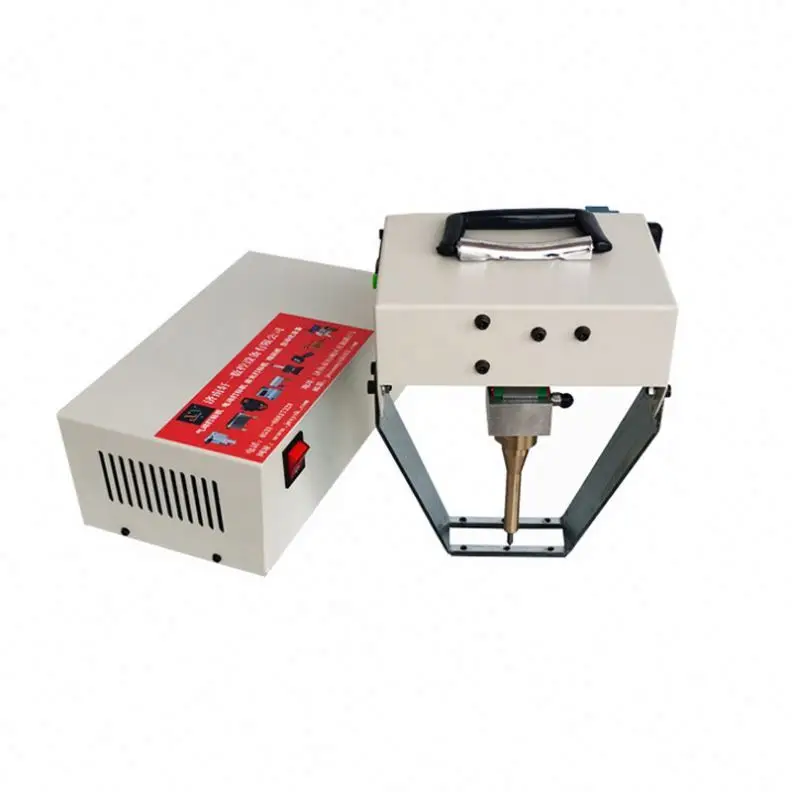
There is a second reading worth testing directly with the supplier, and the images support it. Every product photograph in this record shows the same two-unit hardware as the sibling XY listing: a control box with louvre vents and a red switch, and a separate marking head with a carrying handle, adjustment knobs, a brass coloured stylus and a U-shaped bracket beneath it, plus a case version with a screen in the lid and a membrane keyboard in the base. If XY-22 is simply the family name the supplier uses when the models are sold under one listing, the five codes are the orderable variants and the buyer should ask which one the price refers to. If XY-22 is a distinct machine, its parameter row is missing from the table and has to be requested. Either way the question is the same: which code, at which price, with which window.
Choosing between a 70 by 20 and a 90 by 25 millimetre window
The table offers exactly two window sizes, and it does something unusually helpful by naming the application for each. The 70 by 20 millimetre rows are assigned to small and micro vehicle engines and workpieces. The 90 by 25 millimetre rows are assigned to large vehicle engines and metal parts, with row 5 widening it to large and small vehicle engines and parts.
The two sizes are closer than they look in linear terms and further apart in area:
- 70 × 20 millimetres is 1,400 square millimetres of marking field.
- 90 × 25 millimetres is 2,250 square millimetres.
- The larger window is therefore about 61 per cent more area, from a length increase of about 29 per cent and a height increase of 25 per cent.
What that buys is not a longer character string in the first instance, it is the number of lines and the range of plate layouts the machine can cover in one pass. A 20 millimetre height holds fewer lines than a 25 millimetre height at the same character height, and a workshop that marks an engine plate with a serial, a model code and a date in stacked lines needs the height more than it needs the length. The honest way to finish the comparison is to send the supplier the actual plate layout, its line count and its character height, and ask which of the two windows covers it in one pass, because the table gives window dimensions and nothing about character height, line pitch, characters per line or number of lines.
A buyer whose engine class changes during the year should also ask whether one head can be supplied with both windows, or whether the two sizes are separate heads. The table presents them as separate models, which suggests separate heads, and that turns the window decision into a permanent purchase decision rather than a setting.
What the weight column actually weighs, and why it matters more than it looks
The weight column carries three values, 5.3, 5.5 and 7.5 kilograms, and it is the only physical measurement in the entire table. The image does not say whether each figure is the marking head alone, the control unit alone, or the two together, and that ambiguity matters more here than on a bench machine, because the head is designed to be held in the hand.
The arithmetic points one way. If the F1 rows at 5.3 kilograms were the head alone, a handheld dot peen head would weigh more than most hand-held power tools and would be difficult to hold against a vehicle frame for a working shift. If the figure is the whole shipment, then the head is a fraction of it, and the number the buyer needs is the head weight, which the table never states. The sibling XY record in this queue does state a head weight, under 3.2 kilograms, and that figure is a more useful starting point for judging handheld use than a whole-machine weight.
The 2.2 kilogram gap between an F1 row and its F3 equivalent is the one weight difference the table explains, because the touch screen case is visible in the photographs: a case with a lid, a screen, a membrane keyboard and latches. Two and a bit kilograms is what the offline programming option weighs, and a buyer who intends to carry the whole system to a site, rather than move the head between jobs at a bench, should decide whether that weight is acceptable before choosing the touch screen for convenience and then discovering the case has to be carried as well.
The hardware the photographs show, and what they do not show
Seven of the eight detail images are photographs of the product. They show three configurations of the same design.
- A control box in a light enclosure with louvre vents on the side, a red rocker switch, rubber feet, and a red printed label on the top face carrying Chinese text and small product pictures. A marking head stands beside it with a black carrying handle, two adjustment knobs on the front face, a brass coloured stylus pointing down through a machined block, and a U-shaped metal bracket beneath.
- The same control box and head from a second angle, with Chinese text printed on the top face instead of the red label.
- A case version: an aluminium case with the lid open, a screen mounted in the lid, a membrane keyboard in the base, latch catches on the front, and the same marking head standing beside it.
Two observations follow from comparing the photographs with the table. First, the control box in the photographs carries a red label and a flat lid, and it is not shown with a screen, so the photographs illustrate the F1 style configuration and the case version illustrates the F3 style; the photographs do not prove which of the five codes was being photographed. Second, the machine type heading in the table distinguishes a small pneumatic marking machine from a small touch screen marking machine, and the photographs support that distinction as the only visible difference between rows.
The main image also shows what appears to be a Chinese nameplate on the control box top face. It is small in the frame and not legible at publication size, and this guide makes no claim about what it says. A buyer should ask for a close photograph of it, because on this family the nameplate is where the orderable model code appears, and the record demonstrates that the title and the specification image do not agree on that code.
The component claims, including one that does not hold as printed
One detail image is headed with the line manufacturer direct sales, quality assurance, and then genuine materials, precision manufacturing, and sets out four numbered claims with photographs. They are reproduced here with what each means for a buyer.
| Claim as printed | Supporting text | What it means for the buyer |
|---|---|---|
| 1. Pure copper motor | High strength, high temperature resistance, fast heat dissipation | It sets the marking force and how the head behaves over a shift. The frame the motor sits in is not stated, and the term pure copper describes the winding rather than the motor's duty rating. |
| 2. Taiwan linear guide rail | Smooth, no jamming | It is a sourcing claim, and a sourcing claim is not a specification. The rail class, preload and block model are not given. Ask for the rail designation and the price of a replacement block, because this is a wear part on a hand-held head. |
| 3. Carbide alloy steel needle | Needle hardness up to 92HRC, able to mark various materials below 65HRC hardness; high hardness, long life, wear resistance | See the note below. The needle is the consumable and no diameter, life figure or price is given. |
| 4. Source factory | Quality control, direct after-sales, use with more confidence | The photograph shows a rack holding a large number of marking machines, which supports that the supplier handles this product class. The machines on the rack are in blue and teal enclosures while every product photograph in this record shows a cream enclosure, so the rack shows the supplier's range rather than the quoted unit. |
The needle claim needs a note because the number as printed cannot be read literally. 92HRC is not a valid Rockwell C reading. The C scale is defined for hard materials and is customarily reported up to about 70 HRC, and values above that are not meaningful on that scale. A tungsten carbide tip is normally quoted on the Rockwell A scale, where values around 88 to 92 HRA are typical, and 92 as a number fits HRA rather than HRC. The likely situation is that the intended scale was A and the printed scale letter is wrong, which is the same printing issue seen on the PEQD record in this queue.
The more consequential half of the same line is the claim that the needle can mark materials below 65HRC. Marking a part at 65 HRC means indenting hardened steel, and the claim should be tested rather than assumed. Two things follow. The first is that depth on a hard material is not the same as depth on mild steel, and the table's 0.1 to 1 millimetre range carries no material qualifier at all in this record, unlike the sibling XY record which added the words depending on the material. The second is that a stylus marking hardened parts wears faster than one marking mild steel, so the needle life question becomes more important, not less, and no life figure is published. Ask for a marked sample on the buyer's own hardened material, with the depth measured, and ask what needle life to expect on that material.
What the customer-provided column costs
The customer-provided column is the most commercially useful line in the table, because it converts three of the five rows from a machine purchase into a machine plus equipment purchase. It reads computer and air pump on row 1, air supply on row 2, computer and air supply on rows 3 and 5, and air supply on row 4.
Two of the three terms in that column are worth pinning down in writing. An air pump and an air supply are not the same phrase and may not mean the same thing, so ask for the pressure and the flow the machine needs, the size of receiver recommended, and the air quality requirement, and then size the compressor against those figures. A computer is not specified at all, so ask which operating system, which interface, whether a driver or a licence is required and whether the marking software is supplied with the machine or bought separately, because on the F1 rows the software is as necessary as the air.
The consequence for budgeting is direct. A buyer comparing an F1 row at 5.3 kilograms against an F3 row at 7.5 kilograms is comparing a machine that needs a computer and a compressor against a machine that needs a compressor. If a suitable laptop already sits at the marking station, the F1 configuration is the lower cost route and the 2.2 kilogram weight saving is a bonus. If no computer belongs at the station, the F3 case removes that requirement and one more thing that can go wrong in a workshop, and the touch screen row is the one to price.
What this record does not state at all
The sibling XY record in this queue carried a six-question FAQ image stating quotation turnaround, sample availability, deposit and balance terms, lead time and delivery terms. This record carries no commercial terms image and no commercial terms text. There is no price, no deposit percentage, no lead time and no trade term anywhere in it. Everything in this section therefore has to be obtained rather than read.
The record also states no whole-machine or head weight breakdown, no character height range, no characters per line, no line count, no font list, no marking speed, no marking time for a real job, no air consumption, no hose or cable length, no voltage or frequency, no power figure, no depth consistency figure, no dot pitch, no needle diameter or life, no rail class, no fixture for a curved surface, no software detail, no warranty term, no spare part price, no packing detail, no certificate list and no service route outside China.
Against a sibling record that at least published a power figure with a question mark after it, this one publishes no power figure at all, which means the electrical side of the project cannot even be estimated from the listing.
Total cost of ownership for each of the five rows
Because the table splits the five rows by window and by control type rather than by price, the cheapest way to compare them is to build the total cost of each configuration and then ask for prices. The table below takes the five rows and lists what has to be added to each.
| Model | What the table gives | What has to be added to make it run |
|---|---|---|
| XY/F17020 | 70×20mm window, 5.3KG | Computer, marking software if not supplied, air pump or compressor with receiver and filtration, hose and fittings, fixture for the workpiece, needles and collets, freight under the chosen trade term |
| XY/F37020 | 70×20mm window, 7.5KG, touch screen | Air supply with receiver and filtration, hose and fittings, fixture, needles and collets, freight |
| XY/F19025-D | 90×25mm window, 5.3KG | Computer, software if not supplied, air supply, hose and fittings, fixture, needles and collets, freight |
| XY/F39025-D | 90×25mm window, 7.5KG, touch screen | Air supply, hose and fittings, fixture, needles and collets, freight |
| XY/F19025-B | 90×25mm window, 5.5KG | Computer, software if not supplied, air supply, hose and fittings, fixture, needles and collets, freight |
Three cost items are common to every row and belong in the comparison whichever model is chosen. The air supply is common to all five rows in one wording or another, so its cost is the same across the range and can be settled first. The needle and collet set is the running cost that will be paid repeatedly, and no price is published for it. The fixture is the item most often forgotten, because the table's application range names engines and workpieces but shows no fixture for either, while the photographs show only a U-shaped bracket under the head, which is part of the head assembly rather than a workpiece fixture.
The fourth common item is not a purchase at all. Because the machine marks engine plates and parts that may carry legally controlled identifications, the buyer should decide before ordering who verifies that each marked plate complies with the rule applying where the vehicle is registered or used. That decision costs nothing to make and can cost a great deal to make late.
Questions to put to the supplier before ordering
- Which of the five codes in your own model table is being quoted, and what is its price? The title of the listing names XY-22, which does not appear in the table.
- If XY-22 is a separate model, please send its parameter row in the same six-line format used in the table.
- What does the rule for the model code mean, and specifically what do the letter suffixes B and D denote? The table shows a 0.2 kilogram weight difference between XY/F19025-D and XY/F19025-B and no explanation.
- Is the weight figure for each row the marking head, the control unit, or both, and what is the weight of the head alone?
- What is the marking speed, and what is the measured time to mark a full engine plate with the buyer's own number of lines and characters?
- What character height range, characters per line and number of lines does each control support?
- What air pressure and air consumption does the head require, what receiver size do you recommend, and what air quality grade is needed?
- Does the phrase air pump in row 1 and air supply in row 2 mean the same equipment and the same specification?
- How long are the air hose and the control cable between the head and the control unit, and does the length differ between the box and case versions?
- What voltage and frequency is the machine built for, what is its power consumption, and is the marking affected if the air pressure drops mid-job?
- What is the maximum achievable depth on mild steel, on stainless steel, on aluminium and on a part at 65HRC, and will you supply a marked sample on our own material with the depth measured?
- What is the depth consistency across the window, and is the head floating or fixed?
- On the needle claim printed as 92HRC, which hardness scale is intended, and what is the correct figure on that scale?
- What needle diameters are available, what is the expected needle life on our material, and what does a needle and a collet cost?
- Which linear guide rail is fitted, in which class and preload, and what does a replacement rail block cost?
- Which plane and preload of fixture do you recommend for the workpiece we will mark, and what does it cost?
- For the F1 rows, what computer specification, operating system and interface are required, and is the marking software included, licensed or optional?
- For the F3 rows, how is a job file loaded into the case, how many files does it hold, can it run a sequential counter and a date code, and what protection do the screen and keyboard carry?
- What is the warranty term and what does it cover, what are the prices and lead times of a needle, a collet and a rail block, and how is a warranty claim handled from our country?
- What electrical documentation and marks does the machine carry, and can you supply a declaration of conformity or test reports for our destination market?
- What are the price, trade term, lead time, deposit and balance terms, and packing for the configuration quoted, and what does the total come to landed at our address?
- Please confirm the full registered name of the contracting entity and the bank account beneficiary name, and confirm that the two match.
Question one is the one that should be answered before any other, because until the code is fixed none of the rest can be priced. The listing title names a model the supplier's own table does not contain, so the first task is not to compare specifications, it is to establish what is actually for sale.
Incoming inspection when the machine arrives
The table gives five rows, a window, a depth, a weight and a control type. Those are the five things the inspection can check directly, and the order below puts the cheapest checks first.
- Photograph the nameplate on the control unit and on the head before unpacking further, and compare the model code with the code on the purchase order. This is the check the record itself shows is necessary.
- Confirm the window of the delivered head against the code: a code ending 020 should measure a 70 by 20 millimetre field and a code ending 025 a 90 by 25 millimetre field.
- Weigh the head and the control unit separately and record both figures, because the table's weight column does not say what it weighs and the delivery is the first chance to find out.
- Confirm that everything in the customer-provided column that you supplied is required and nothing more, and that any item you expected the supplier to include is present.
- Inspect the head for transport damage: the carrying handle, the adjustment knobs, the stylus and its block, the U-shaped bracket and the rail. Move the rail through its travel by hand and feel for a gritty or loose spot.
- Check the needle for straightness and that the collet grips without scoring the shank, and confirm a spare needle is present.
- Power the control unit on and confirm the voltage and frequency marked on it match the site supply. On the touch screen version, test every key on the membrane and check the screen for damage in transit.
- Connect the air supply at the pressure the supplier confirms, listen for leaks at the head, the hose ends and the regulator, and confirm the pressure holds with the machine idle.
- Reduce the air pressure deliberately during a mark and confirm the machine stops or alarms rather than producing a shallow character that passes a visual check.
- Mark test coupons of the buyer's own material at three character heights and at both ends of the window, measure the depth on each, and record the figures.
- Mark the same string twice on one plate and compare the two marks, which is the practical repeatability test.
- Run the machine for at least thirty minutes of continuous marking and compare the depth on the last plate with the first, to see whether the head drifts as it warms.
- File the marked coupons with the inspection record, with the date, the pressure, the character height and the depth beside each one, so that a future spare needle can be judged against evidence rather than memory.
Answers to the questions this record raises most often
Which of the five models should I buy?
The table answers by application and by window: the 70 by 20 millimetre rows are assigned to small and micro vehicle engines and workpieces, and the 90 by 25 millimetre rows to large vehicle engines and metal parts, with row 5 covering both engine classes. Within a window size the choice is between the computer version at 5.3 or 5.5 kilograms and the touch screen version at 7.5 kilograms. Buy the computer version if a laptop already belongs at the marking station and job files are prepared away from the machine; buy the touch screen version if a job, a serial or a date has to be changed at the point of marking.
Is XY-22 the model I am buying?
The record cannot confirm that. XY-22 appears in the listing title and in the description heading, and no row of the supplier's own five-model table carries that code. Ask the supplier to state which code in the table corresponds to the price on offer, and require that code on the quotation and on the nameplate.
Does this machine need a compressor and a computer?
A compressor or air supply is required on all five rows. A computer is required on the three rows whose codes begin F1 and whose customer-provided line reads computer and air pump or computer and air supply; the two touch screen rows list only the air supply. Neither the pressure, the flow nor the computer specification is given, so both have to be obtained from the supplier before the supporting equipment is bought.
Is the needle really 92 HRC?
Not as printed. The Rockwell C scale is customarily reported up to about 70 HRC and 92 is not a meaningful value on it, while a carbide tip is normally quoted on the Rockwell A scale where the high 80s and low 90s are typical. The number is probably correct on the wrong scale letter. The related claim that the needle can mark materials below 65 HRC is the one to test, because that is hardened steel and the achievable depth and the needle life on it are not stated.
Will it mark a full engine plate in one pass?
That depends on the layout, and the record does not give the figures needed to answer it. It states a window of 70 by 20 or 90 by 25 millimetres and nothing about character height, characters per line or line count. Send the supplier the plate layout with the line count and character height and ask which window covers it in one pass and how many passes the other window would need.
Why do the photographs look like another listing in this queue?
Because the two listings describe the same hardware family. This record's photographs show the same two-unit design as the sibling XY record, a control box with a separate marking head and a case version with a screen and keyboard. The difference in this record is that one image publishes a five-model table rather than two panels, and that no image file is shared between the two listings. The photographs therefore identify the family but not the code, which is one more reason to settle question one first.
Does this record state its commercial terms?
No. Unlike the sibling XY record, which carries a six-question FAQ image giving quotation turnaround, sample availability, payment terms, lead time and delivery terms, this record contains no commercial terms at all, and no price. Every commercial question has to be asked.
Source, scope and what this guide does not claim
This guide is based on the Hoting queue record for Product ID 1601250991751, whose title names a TEBAK XY-22 smart intelligent hand-held steel printing machine, a pneumatic marking machine, for printing metal and hard plastic frames, and whose description heading repeats the XY-22 name.
The record's structured parameter block contains no rows, so no parameter is quoted from it. Every figure in this guide is transcribed from the record's own images, and the specification source is one image in particular: the five-row model selection table, which supplies the model codes XY/F17020, XY/F37020, XY/F19025-D, XY/F39025-D and XY/F19025-B, the machine type headings small pneumatic marking machine and small touch screen marking machine and touch screen pneumatic marking machine, the print ranges of 70×20mm and 90×25mm, the print depth of 0.1 to 1 millimetre on all five rows, the weights of 5.3, 7.5, 5.3, 7.5 and 5.5 kilograms, the application ranges reading small and micro vehicle engines and workpieces, large vehicle engines and metal parts, and large and small vehicle engines and parts, and the customer-provided lines reading computer and air pump, air supply, computer and air supply, air supply, and computer and air supply. A second image supplies the component claims of pure copper motor, Taiwan linear guide rail, carbide alloy steel needle with the printed hardness claim of 92HRC and the printed ability to mark materials below 65HRC, and source factory, together with the line manufacturer direct sales, quality assurance. The remaining images supply the product photographs described in the text, including the control box with louvre vents, red switch and red printed label, the second control box view, and the case version with a screen in the lid and a membrane keyboard in the base.
Five passages are the author's arithmetic or reasoning applied to those figures and are identified here so they are not mistaken for supplier data. The decoding of the model code, in which the digit after the F separates the computer version from the touch screen version and the last four digits repeat the window dimensions, is a pattern observed across the five rows of the table and is not a legend the supplier publishes. The weight gap of 2.2 kilograms between a computer version and its touch screen equivalent is the difference between the printed weights on those rows. The window area comparison, at 1,400 square millimetres against 2,250 square millimetres or about 61 per cent more area, from a length increase of about 29 per cent and a height increase of 25 per cent, is calculated from the two printed window sizes. The observation that 92HRC is not a meaningful Rockwell C value and that the figure fits the Rockwell A scale is a statement about the scales and not about this needle. The observation that the source factory photograph shows machines in blue and teal enclosures while the product photographs in the same record show cream enclosures, and that no image file is shared between this record and the sibling XY record, are comparisons of the record's own images.
Unless a figure appears in the list above, it is not in this article because it is not in the record. This record states no price, no deposit or balance terms, no lead time, no trade term, no quotation turnaround, no warranty term, no power consumption, no voltage or frequency, no marking speed, no measured marking time, no character height range, no characters per line, no line count, no font list, no sequential or date marking capability, no job file capacity, no interface or software detail, no air pressure or air consumption, no hose or cable length, no head weight, no depth consistency, no dot pitch, no needle diameter or life, no rail class or block model, no fixture description, no screen or keyboard protection rating, no spare part price, no packing detail, no certificate list and no service route outside China. A buyer should treat the five-row table as the record's only specification and close every other item by asking.
For a machine that is carried to the workpiece and marks engine plates and parts, the two figures that decide whether it earns its place are the weight of the head in the hand and the depth it holds on the buyer's own material over a shift. This record publishes neither. Fix the model code first, then the window from the engine class the table itself names, then require a sample marked on your own material with the depth measured, and price the air supply, the computer and the tooling alongside the machine through the TEBAK sales inquiry channel.
Key specifications
- Model Row 1
- XY/F17020 — print range 70×20mm, depth 0.1–1mm, weight 5.3KG, small and micro vehicle engines and workpieces, customer provides computer and air pump
- Model Row 2
- XY/F37020 — print range 70×20mm, depth 0.1–1mm, weight 7.5KG, small and micro vehicle engines and workpieces, customer provides air supply
- Model Row 3
- XY/F19025-D — print range 90×25mm, depth 0.1–1mm, weight 5.3KG, large vehicle engines and metal parts, customer provides computer and air supply
- Model Row 4
- XY/F39025-D — print range 90×25mm, depth 0.1–1mm, weight 7.5KG, large vehicle engines and metal parts, customer provides air supply
- Model Row 5
- XY/F19025-B — print range 90×25mm, depth 0.1–1mm, weight 5.5KG, large and small vehicle engines and parts, customer provides computer and air supply
- Needle
- Carbide alloy steel needle, printed claim of needle hardness up to 92HRC and the ability to mark materials below 65HRC
- Guide Rail
- Taiwan linear guide rail (as printed on the component image)
- Motor
- Pure copper motor (as printed on the component image)