
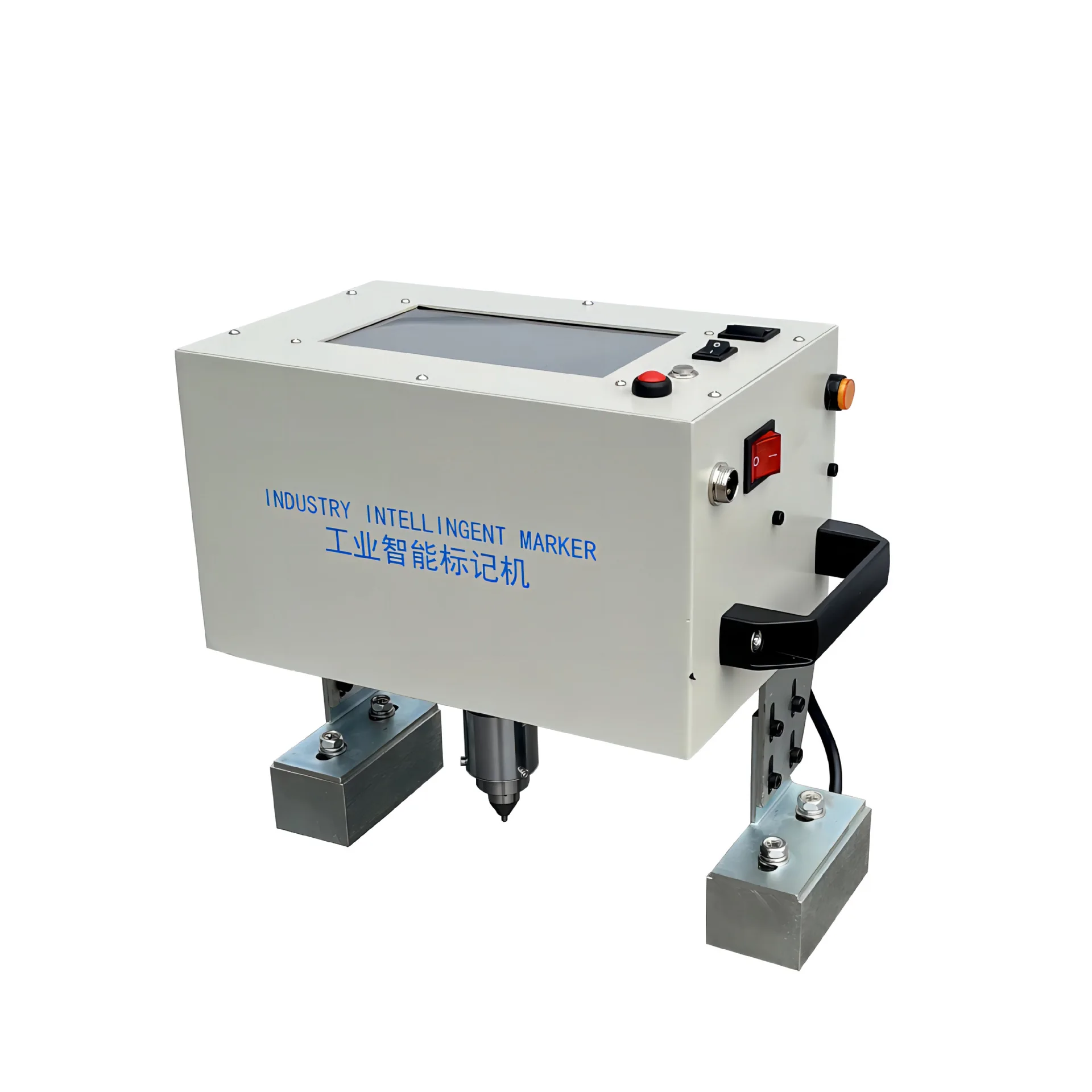
The product name field says “labeling machine”
The parameter block on this page has two rows. Both are transcribed here exactly:
| Label | Value |
|---|---|
| Product Name | Labeling machine |
| Model number | XY-06 |
That is the entire specification: two words in the wrong trade and a model number. A labeling machine applies adhesive labels to a surface. This is a marking machine, which indents metal with a stylus and applies no label. Filed as a labeling machine, the listing will not be found by buyers searching for marking equipment, and it will be shown to buyers who want a label applicator.
There is no marking range, no depth, no speed, no power, no weight and no dimensions anywhere on the page. Everything below therefore comes from two places: a specification panel inside the gallery, and the same machine family's panel on a different listing.
The gallery's only specification panel lists three models, and none of them is XY-06
One image is a panel headed Own manufacturers a variety of optional. It documents three machines:
| Model | Print range | Engraving depth | Machine size | Computer needed | Stated application |
|---|---|---|---|---|---|
| XY/SD-1 | 90 × 30 mm | 0.1–1 mm | 160 × 170 × 280 mm | yes | mould, workpiece, oxygen cylinder |
| XY/M2-D | 200 × 120 mm | 0.1–1 mm | 300 × 215 × 325 mm | yes | copper, iron, aluminium, stainless steel nameplate |
| XY/M6-D | 200 × 120 mm | 0.1–1 mm | 300 × 215 × 325 mm | no, standalone | brass, copper, iron, aluminium, stainless nameplates |
XY-06 is not on it. Two of the three need a computer tethered to the machine, and one does not, which is the difference between a bench with a laptop on it and a bench without.
This is the third time this model number has failed to appear in its own documentation. A separate listing for the same XY-06 code carries a six-model panel listing six other codes, which is documented in the earlier XY-06 sourcing note. A listing for XY-02 in the same catalogue carries all four machines and a parameter block that also reads “Labeling machine”, covered in the XY-02 comparison.
So the model number on this page does not identify a print range. For a card job the print range is the first decision, because it decides whether a card is one pass or two.
A card is 0.76 mm thick and 85.60 by 53.98 mm
An ID card is defined by ISO/IEC 7810 ID-1, also called CR-80: 85.60 × 53.98 mm, nominal thickness 0.76 mm, corner radius between 2.88 and 3.48 mm. A standard Chinese business card is 90 × 54 mm, which is almost exactly the same footprint — 4.4 mm longer, and 0.02 mm different in width.
| Object | Size | Area | Thickness |
|---|---|---|---|
| ID-1 / CR-80 card | 85.60 × 53.98 mm | 4,620.7 mm² | 0.76 mm |
| Business card | 90 × 54 mm | 4,860 mm² | typically 0.3–0.8 mm |
Two numbers matter and only two: the 54 mm short side, which is compared against the window's 30 mm, and the 0.76 mm thickness, which is compared against the depth range's upper bound. Everything else about card marking follows from those two comparisons.
The 90 × 30 mm window needs two passes for one card
| Window | Area | Coverage of an ID-1 card | Passes for one card |
|---|---|---|---|
| 90 × 30 mm (XY/SD-1) | 2,700 mm² | 58.4% | 1 × 2 = 2 |
| 200 × 120 mm (XY/M2-D, XY/M6-D) | 24,000 mm² | 519.4% | 1 |
With a 30 mm window against a 54 mm card, the card has to be marked in two passes and moved by 24 mm between them, which means a fixture with a repeatable stop. Two passes also means a visible seam if the depth or the dot pitch drifts between them.
The 90 mm window against a 90 mm business card is worse than it looks: it leaves zero margin. Nominal print range is not the same as usable travel, and a card placed at the extreme edge of the window will not be marked at the edge. Treat a 90 × 30 machine as a plate and tag machine, not a card machine.
If the job is cards, the range that fits in one pass is the 200 × 120 mm one, which is the M2-D or the M6-D — neither of which is the model named on this page.
Depth against thickness: where a mark becomes a hole
The panel publishes engraving depth as 0.1–1 mm. Against a 0.76 mm card:
| Depth | Share of a 0.76 mm card | Result on a card |
|---|---|---|
| 0.01 mm | 1.3% | surface mark only, visible but shallow |
| 0.05 mm | 6.6% | legible, no distortion |
| 0.10 mm | 13.2% | legible, the panel's floor |
| 0.15 mm | 19.7% | legible, the practical ceiling for a flat card |
| 0.20 mm | 26.3% | visible dishing on the reverse |
| 1.00 mm | 131.6% | through the card |
| 2.00 mm | 263.2% | through the card, twice over |
A dot peen machine does not have a depth setting in the sense a milling machine does. Depth is a product of stylus force, dot pitch and the number of passes, and the published range is the span the machine can reach, not a set of repeatable stops. That matters here because the usable band for a 0.76 mm card is roughly 0.05 to 0.15 mm, which is 6.6% to 19.7% of the thickness, and the machine's published ceiling is six to thirteen times that band.
On a chassis rail, 1 mm of depth is the point of the tool. On an ID card the same setting punches through and the card is scrap. Whoever runs the machine has to be able to hold the bottom of the range, and the listing gives no figure for the resolution of depth adjustment, no force specification and no dot pitch. Ask for all three.
Two depth ranges for the same family, a factor of ten apart at the floor
The panel in this gallery says 0.1–1 mm. A different listing for the same XY-06 code, in the same catalogue, publishes 0.01–2 mm.
| Source | Depth range | Lower bound | Upper bound |
|---|---|---|---|
| Panel in this gallery | 0.1–1 mm | 0.1 mm | 1 mm |
| Parameter block, other XY-06 listing | 0.01–2 mm | 0.01 mm | 2 mm |
| Difference | 10× | 2× |
The floor is the number that decides whether a card can be marked at all, and the two sources disagree by a factor of ten. If the true floor is 0.1 mm, that is 13.2% of a card and workable. If the floor is 0.01 mm, the machine is more controllable and better suited to thin stock. There is no way to tell from either page which is right.
Both upper bounds, however, exceed a card: 1 mm is 32% thicker than the card and 2 mm is 163% thicker. So on the upper bound the two sources agree about the thing that matters, which is that the top of the range is not for cards.
Stainless is not magnetic, so the magnetic feet cannot hold half of the claim
The title offers “CS SS” — carbon steel and stainless steel. The machine in the hero image is a handheld unit with two magnetic feet, and the same feet appear on the other XY-06 listing, where they are the only workholding shown.
| Material | Magnetic? | Do the magnetic feet hold it? |
|---|---|---|
| Carbon steel card or plate | yes | yes |
| Austenitic stainless such as 304 | essentially no | no |
| Ferritic or martensitic stainless | yes | yes, but confirm the grade |
| Aluminium or brass | no | no |
Austenitic stainless, which is what 304 and 316 are, is non-magnetic in the annealed condition. On a stainless card the magnetic feet hold nothing, so the operator holds the machine by hand against a 0.76 mm card while the stylus fires. That is not a repeatable process, and it is how a card walks out from under the stylus halfway through a logo.
The listing does not name a stainless grade, so it is also not possible to know whether the “SS” it advertises is a magnetic grade or not. Ask for the grade before assuming the feet work.
Handheld and table versions are different machines in these photographs
The gallery is a montage rather than a product set. One image headed PRODUCT SHOWS contains four visibly different machines: a blue body on a slotted base with an adjustable column, a white body with magnetic feet, a stainless body on a screw column over a slotted table, and a handheld unit with a screen.
Those are not four photographs of one product. They are a lineup, and at least one of them is a bench machine with a table and a height-adjustable head — which is the configuration a card job actually wants, because the card can be clamped flat and the head brought down to a stop.
| Configuration | What holds the work | Fits a card job? |
|---|---|---|
| Handheld with magnetic feet | magnets on ferrous work, otherwise the operator | no, unless the card is carbon steel and thick enough not to flex |
| Handheld with a frame or template | a bolted-on guide frame | partly, if a card-sized frame is supplied |
| Bench unit with column and table | a table with slots or clamps | yes, this is the right form factor |
The listing does not say which configuration ships. The hero image is the handheld one; the PRODUCT SHOWS montage includes a bench machine. That is the single biggest question on this page for a card application, and it is not answered anywhere.
What a card and a plate actually require
| Requirement | Why it matters on 0.76 mm stock | Published here? |
|---|---|---|
| A flat, clamped datum | a card that lifts or flexes changes the depth by more than the whole usable band | no |
| Depth repeatability, not depth range | the usable band is roughly 0.05–0.15 mm, so a 0.05 mm drift is a third of the band | no |
| Dot pitch and stylus geometry | decides legibility at 5 mm character height, which is normal for a card | no |
| Window of at least 90 × 54 mm | otherwise two passes and a visible seam | only inside an image, and only for the models not named |
| A support under the card | dot peen deforms the back face; a hard flat backing limits it | no |
| Throughput for the batch | three lines of text and a logo is a few hundred characters | no |
Five of the six are missing. That is not an argument against the machine; it is an argument that this page cannot be used to buy it for cards.
What the same family publishes elsewhere, for comparison
The XY-06 panel on the other listing gives a marking range of 90 × 30 mm for one model and does publish a character-rate figure, which this page does not. Between the three listings in this catalogue covering this family, the numbers that exist are:
| Figure | Where it appears | On this page |
|---|---|---|
| Print range 90 × 30 mm | XY/SD-1 panel | no |
| Print range 200 × 120 mm | XY/M2-D and XY/M6-D panel | no |
| Engraving depth 0.1–1 mm | panel in this gallery | no, only inside the image |
| Engraving depth 0.01–2 mm | other XY-06 listing | no |
| DC 24 V drive, 110–240 V input | other XY-06 listing | no |
| Machine size, per model | panel in this gallery | no |
| Weight | only in prose, elsewhere | no |
Nothing in this table is on the page a buyer reads. It is all in images or in other listings. A buyer who reads only the parameter block knows the words “labeling machine” and “XY-06”.
What to put in the request for quotation
| # | Question | Why it decides the purchase |
|---|---|---|
| 1 | Which model is actually shipped: XY-06, XY/SD-1, XY/M2-D or XY/M6-D | the print range is 90 × 30 or 200 × 120, which is the difference between two passes and one |
| 2 | Is it handheld with magnetic feet, or a bench unit with a column and table | a card has to be held flat; magnets do not hold stainless |
| 3 | The real depth floor, in millimetres, and how it is adjusted | the two sources give 0.1 and 0.01 mm, a factor of ten apart |
| 4 | Depth repeatability over 100 cards | the usable band is about 0.05–0.15 mm, so repeatability is the whole specification |
| 5 | Whether a computer is required, and which software | two of the three panel models need one tethered; one does not |
| 6 | The stainless grade the “SS” in the title refers to | decides whether the magnetic feet work on it |
| 7 | A card fixture, or dimensions to make one | none is shown, and 0.76 mm stock cannot be held by hand |
| 8 | Dot pitch, stylus tip radius and character height range | legibility at 5 mm character height is the normal card requirement |
| 9 | Characters per minute for a three-line card | no throughput figure appears on this page at all |
| 10 | Power supply, and whether DC 24 V from a 110–240 V adaptor | the other listing specifies this; this one does not |
| 11 | A marked sample on your own card stock, front and back | the back face is where dot peen shows, and no photograph shows it |
| 12 | Weight and carton size | neither appears on the page |
Questions 1, 2 and 3 are the ones that decide whether this machine can do cards at all. The rest are the difference between a machine that works and one that works reliably.
What this machine is good for, and what it is not
| Good fit | Poor fit |
|---|---|
| Serial numbers, asset tags and VIN plates on ferrous parts, held by the magnetic feet | ID cards and business cards, unless a bench configuration and a fixture are confirmed |
| Small steel and cast-iron nameplates up to 90 × 30 mm on the SD-1 window | Full-card artwork in one pass on the 90 × 30 window |
| Batch marking where deep, permanent indentation is the point | Thin stock where the mark must not perforate |
| Shops that will confirm the model and the depth floor in writing | Buyers who read the parameter block and expect a labeling machine |
The honest summary: this is a dot peen marker being sold for an application where the published depth range exceeds the workpiece thickness by 32%, where the plausible window needs two passes, and where the workholding does not hold the material the title advertises. It can do the job. Nothing on the page says how.
Key specifications
- Product Name
- Labeling machine
- Model number
- XY-06
Frequently asked questions
- Why does the product name say labeling machine?
- Because the field was filled from a template and never corrected. A labeling machine applies adhesive labels; this machine indents metal with a stylus. The parameter block on this page has only two rows, Product Name and Model number, and neither contains a specification. Filed this way the listing will not surface for marking searches and will attract buyers looking for label applicators.
- Can this machine mark an ID card or a business card?
- Only if the right model and a fixture are confirmed. A card is 0.76 mm thick and 85.60 by 53.98 mm for ID-1, or 90 by 54 mm for a business card. The published engraving depth reaches 1 mm, which is 132 percent of the card thickness, and the 90 by 30 mm window is 31 percent short on the card's 54 mm side, so a whole card needs two passes. Ask for the 200 by 120 mm models and a card fixture.
- Which model is actually being sold, XY-06 or something else?
- The page does not resolve this. The title and the parameter block say XY-06, but the only specification panel in the gallery lists XY/SD-1, XY/M2-D and XY/M6-D, and XY-06 is not among them. Two other listings in the same catalogue carry the same XY-06 code with different panels. Ask for the model plate photograph before ordering.
- Does the machine need a computer?
- It depends on the model. On the gallery panel, XY/SD-1 and XY/M2-D both say Customer-owned Computer, meaning a PC has to be tethered to the machine, while XY/M6-D says None, meaning it runs standalone from its own screen. The same distinction appeared in the XY-02 listing, where the model with a touchscreen needed no computer and the others did.
- Will the magnetic feet hold a stainless steel card?
- No, not if the stainless is austenitic, which 304 and 316 are. Austenitic stainless is essentially non-magnetic in the annealed condition, so the magnetic feet hold nothing and the operator has to hold the machine by hand. Ferritic and martensitic stainless is magnetic, but the listing does not name a grade, so this has to be asked. Carbon steel is magnetic and the feet work.
- What depth should be used on a card?
- Roughly 0.05 to 0.15 mm, which is 6.6 to 19.7 percent of a 0.76 mm card. That band is narrow, and dot peen depth is a product of stylus force, dot pitch and pass count rather than a dial setting, so the number that matters is repeatability rather than the published range. The two listings for this family publish floors of 0.1 mm and 0.01 mm, a factor of ten apart, so the floor has to be confirmed.
- Is there a version with a table instead of the handheld body?
- Probably, but the listing does not say which one ships. The hero image is a handheld unit with magnetic feet, while the PRODUCT SHOWS montage includes a bench machine with a slotted table and a height-adjustable head. For card work the bench version is the correct form factor because the card can be clamped flat and the head brought down to a stop.