
Almost every linear axis in a machine tool, a lab instrument or a packaging line ends up being driven by one of two screws, and the choice between them is usually made once, early, by whoever drew the layout. Get it wrong in one direction and the axis is slow, hot and expensive; get it wrong in the other and the axis drops when the power is cut, or loses a tenth of a millimetre every few months and nobody can find where it went.
This comparison is written from the point of view of someone specifying the screw rather than selling one: what a ball screw does better, what a lead screw does better, which catalogue values actually predict the difference, and the order of questions that settles the choice in about ten minutes. The numbers quoted for our own parts come from the product data, and the general figures are the usual engineering ranges rather than measured test results.
Core concept: one rolls, the other slides
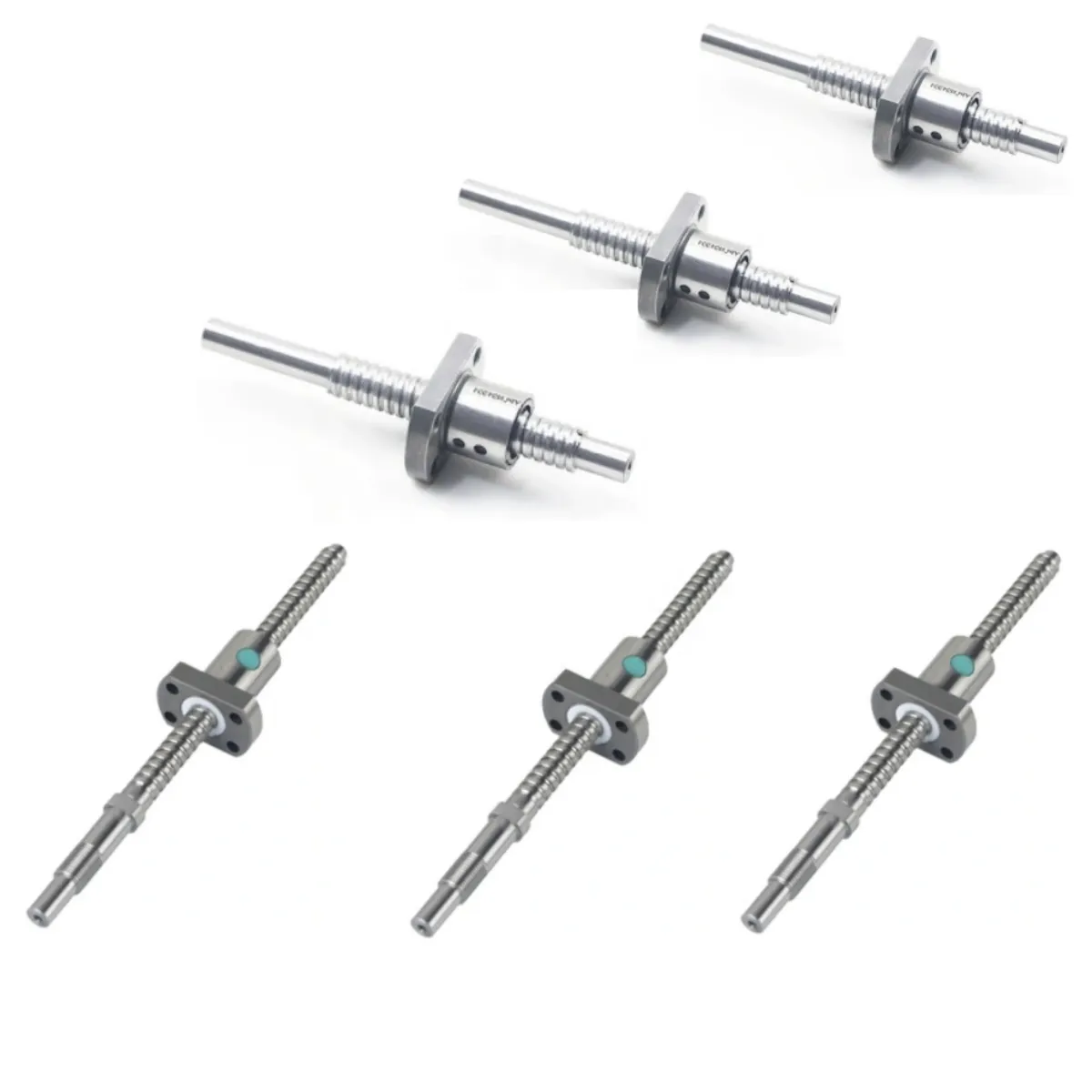
A ball screw puts hardened steel balls between the screw thread and the nut thread. The nut is a recirculating bearing: as the screw turns, the balls roll along the groove, enter a return channel at one end of the nut and come back at the other. A lead screw, also called a trapezoidal screw or a translation screw, has the nut sliding directly on the thread, usually with a plastic, bronze or cast iron nut running against a steel screw.
Why a ball screw returns most of the input to the load
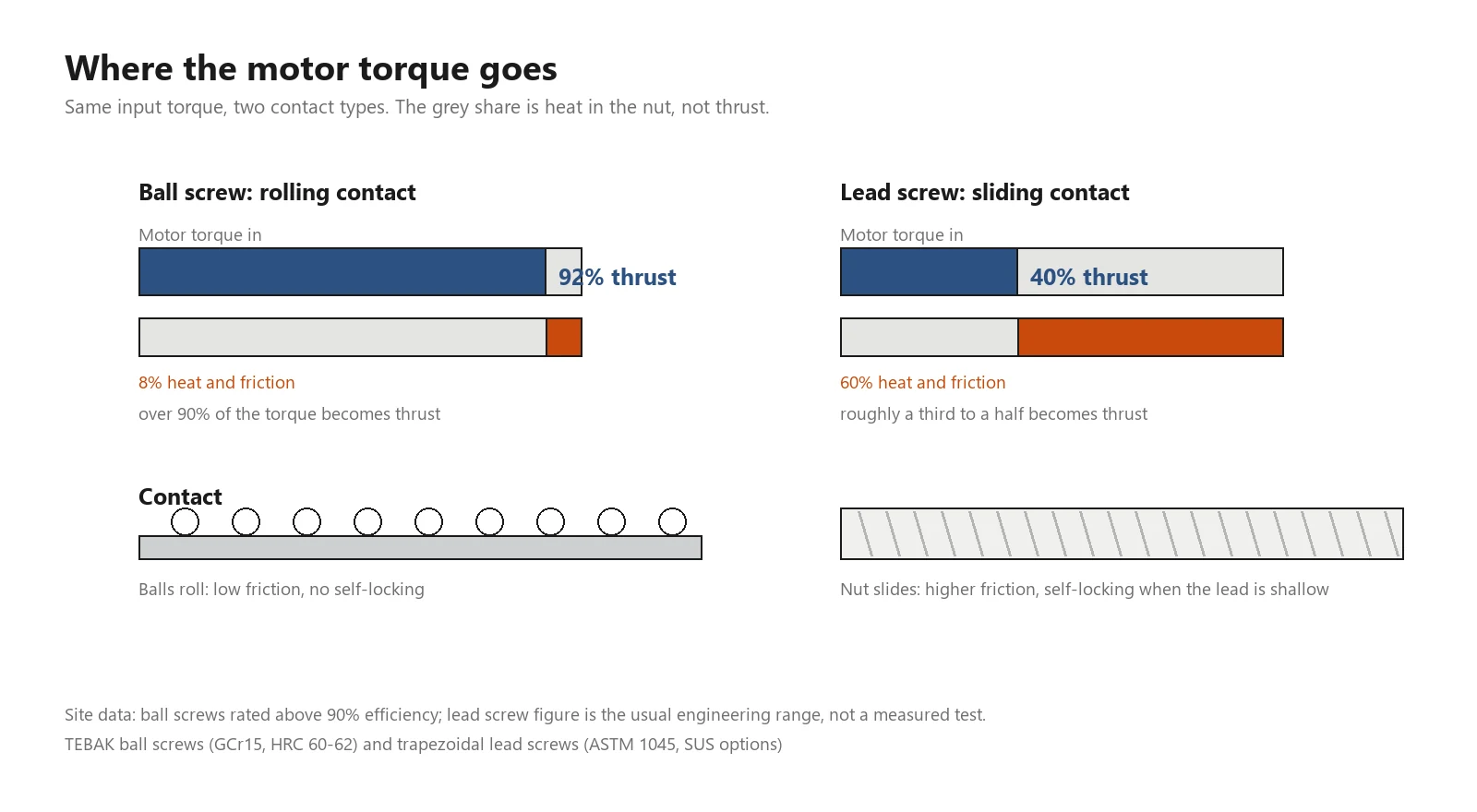
Rolling contact has a very low coefficient of friction, so almost all of the torque put into the screw comes out as linear force. Our ball screw data lists efficiency above 90 per cent. That figure is what makes a ball screw the default for high lead, high speed axes: the motor is not spending its current heating the nut.
Why a lead screw holds position when the power is off
A sliding nut on a thread with a shallow helix angle is self-locking: friction is high enough that a load pushing along the screw cannot make it rotate backwards. A ball screw with the same lead has no such property. That single difference decides the architecture of every vertical axis: a lead screw can hold a raised load with the motor de-energised, while a ball screw needs a brake on the motor or a counterbalance.
Where each one loses accuracy over time
A ball screw wears slowly and predictably because the contact is rolling, but it loses accuracy suddenly if contamination reaches the balls: grit is rolled into the raceway and the damage is permanent. A lead screw wears continuously and visibly: the nut material gives up a little at a time, backlash grows, and the operator compensates in the controller until the compensation becomes the problem. Neither behaviour is better; they fail in different ways, and the maintenance regime has to match the failure mode.
Types of screw you will actually be quoted
Both families split into variants that matter commercially far more than they matter technically. Knowing the variant tells you what the price difference is really buying.
Ball screw variants: ground, rolled, and how the balls return
Ground ball screws have the groove ground after heat treatment and reach the accuracy grades; rolled screws are formed and then hardened, cost less, and suit general automation where the grade is not critical. The nut is either an internal-return type, where balls come back through a channel inside the nut body, or an external-return type with a return tube on the outside. Internal return is compact and quieter; external return is easier to service and is common on larger diameters. Our range includes miniature SFK types from 8 mm and the SFU and DFU families in the common 1204, 1605 and 3205 combinations, in GCr15 at HRC 60 to 62 or 9Cr18 at HRC 55 to 58, with axial play from 0 to 0.005 mm and preload classes P0 to P4.
Lead screw variants: trapezoidal thread, and what the nut is made of
Most industrial lead screws use a trapezoidal thread profile, designated Tr, which is why you see sizes such as Tr8x8 or Tr10x2. The nut material decides the application: a POM or acetal nut runs dry and quietly and is the usual choice for light instruments and 3D printers; a bronze nut takes load and temperature but needs lubrication; a cast iron nut sits between the two. Our trapezoidal lead screws run from 10 mm to 25 mm diameter in the standard range, in ASTM 1045 carbon steel with stainless options in SUS303, SUS304, SUS316 and SUS316L, with zinc, nickel, hard chrome or fluorine coating, and thread clearance to class 7e with tighter classes available on request.
Anti-backlash nuts, and what they do not fix
An anti-backlash nut is two nut halves loaded against opposite flanks of the thread by a spring or a screw. It removes the play you can feel by hand, which is why it is popular. What it does not do is restore the thread profile: once the flanks are worn into a curve, the nut is being preloaded against a shape that no longer matches, friction rises, and the axis starts to stick-slip at low feed. Anti-backlash nuts extend the useful life of a lead screw; they do not convert it into a ball screw.
Ball screw vs lead screw: the trade in one table
The table below is the comparison that decides most projects. Read the third column as the consequence, because that is the part that shows up two years later.
| Property | Ball screw | Lead screw (Tr) |
|---|---|---|
| Contact | Rolling, recirculating balls | Sliding, nut on thread |
| Efficiency | Above 90% in our data | Roughly a third to a half |
| Self-locking | No; needs a brake on vertical axes | Yes, at shallow helix angles |
| Backlash | Near zero with preload, set at build | Grows with wear, compensated in control |
| Speed and lead | High lead and high speed, limited by critical speed | Limited by sliding wear and heat |
| Precision | Grades C3, C5, C7 on ground screws | Class 7e clearance, tighter on request |
| Contamination | Vulnerable; needs wipers and seals | Tolerant; grit is pushed aside |
| Noise | Low, ball passage frequency only | Low at slow speed, can creak dry |
| Cost | Higher, especially ground screws | Lower, and the nut is cheap to replace |
| Failure mode | Sudden, from contamination | Gradual, from nut wear |
Ball screw: what you gain
Efficiency, speed, stiffness and predictability. A preloaded ball screw has essentially no backlash when new, holds it far longer under load, and converts a small motor into a fast linear axis. For a machine that has to position quickly and repeatedly, nothing else in the price bracket competes.
Ball screw: what it costs you
Money, and attention to sealing. The same recirculation that makes it efficient makes it intolerant of swarf and grit, and it will not hold a vertical load by itself. A ball screw axis also needs a properly supported screw end: whip at speed destroys screws that were otherwise correctly sized.
Lead screw: what you gain
Self-locking, tolerance of dirt, and a very low entry price. The nut is a consumable that costs little and can be changed in minutes, and a lead screw axis does not need a brake or a counterweight to hold a raised load. For slow, occasional, or manually adjusted movement it is often the better engineering choice, not just the cheaper one.
Lead screw: what it costs you
Efficiency and speed. A sliding nut turns a large share of the motor torque into heat, so the same motor gives a fraction of the thrust, and running fast wears the nut quickly. Backlash is a maintenance item rather than a design constant, which means the controller has to be re-tuned over the life of the machine.
Parameter and technical standard: the values that actually decide it
Five catalogue values carry almost all of the difference. When you compare quotations, compare these, not the marketing lines.
Efficiency and the torque it implies
Efficiency sets the motor. A ball screw at above 90 per cent passes nearly all of the input through; a lead screw at a third to a half means roughly double the torque for the same thrust, and the difference shows up as motor size, drive current and heat in the nut. If the axis must move fast, this single number usually settles the choice before anything else is discussed.
Preload, axial play and backlash
Our ball screws are specified with axial play from 0 to 0.005 mm and preload classes P0 to P4; the class is chosen from the load case, not from a wish for stiffness. Lead screws are quoted by thread clearance — class 7e in our standard range — with tighter classes on request, and any remaining play is taken up by the nut design. The distinction matters: ball screw backlash is a build parameter, lead screw backlash is a wear parameter.
Accuracy grade C3, C5 and C7
Ground ball screws are graded by the permissible travel deviation over a defined length. C7 is the general-purpose grade, C5 is the normal machine-tool grade, and C3 is specified where the axis must hold a tight tolerance over its whole stroke. The grade is a property of the screw, not of the nut, and it cannot be improved by preload. A rolled screw sold as "precision" without a grade is being described by adjective, not by standard.
Critical speed and screw whip
Every screw has a rotational speed above which the shaft bows and vibrates — critical speed — and it falls as the unsupported length grows. This is the practical ceiling on ball screw axes with long strokes, and it is why long fast axes use a larger diameter, a pre-tensioned mounting, or a rotating nut instead of a rotating screw. A lead screw is rarely run fast enough for this to be the limiting factor, which is one reason it survives in long-travel slow applications.
Lead angle and self-locking
Self-locking depends on the helix angle, which is set by the lead divided by the diameter. A small lead on a large diameter gives a shallow angle and a self-locking screw; a large lead on a small diameter does not, whatever the nut material. If holding a load with the power off is a requirement, this calculation comes before the price comparison.
Application scenarios: where each one belongs
The same two products look very different once they are bolted into a machine. These are the applications where the choice is usually clear, and the ones where it is genuinely a trade.
CNC routers, machine tools and high-speed axes
Ball screw, without much debate. The axis needs speed, stiffness and repeatability, and the motor budget only works with a high-efficiency screw. The engineering effort then moves to the things that protect the investment: wipers, a bellows on a dusty machine, and a screw support sized for the stroke so the axis is not limited by whip. Where the axis is bought as a complete assembly rather than as parts, the same comparison has already been made inside the linear modules we supply, which use a ball screw, a profile rail and a machined body as one unit.
Vertical lifts, hospital equipment and adjustable furniture
Lead screw, for the self-locking. A raised load that stays raised when the power fails is a safety requirement, and a brake is a part that can fail. Trapezoidal screws with a shallow lead do the job with no control electronics involved, which also makes certification simpler.
Laboratory instruments, 3D printers and optical stages
Usually lead screw, sometimes a small ball screw. A POM nut on a Tr screw runs dry, quietly and without lubrication, at the slow speeds and light loads these machines use. Where the instrument has to hold a position for hours with the motor off, the self-locking property decides it. A ball screw only wins here when the stage must move fast or hold a tight tolerance under a varying load.
Packaging, labelling and pick-and-place
Ball screw, because cycle time is the product. Thousands of strokes a day at speed will wear a sliding nut out in months and waste motor torque on every cycle. The exception is the low-cost end of the market, where a lead screw axis at a few hundred cycles a day is cheaper to buy and cheap to keep.
Woodworking, foundry and other dirty environments
This is the case where the cheaper part is often the more reliable one. A lead screw pushes swarf aside; a ball screw rolls it into the raceway. If the machine cannot be protected, a lead screw with a bronze nut and a grease nipple will outlast a ball screw that ingests dust, at a fraction of the cost of ownership.
Common problems and solutions
Most of the failures we are asked about are not material failures. They are the screw being asked to do something its type cannot do.
Backlash that keeps coming back
Symptom: a lead screw axis that is adjusted, runs well for a month, then shows play again; the controller compensation creeps upward.
Cause: nut wear, or an anti-backlash nut preloaded against a worn thread.
Fix: replace the nut rather than re-shim it, check that the nut is not being run dry, and if the wear rate is unacceptable, the axis is being asked for more cycles than a sliding nut should carry — which is the point at which a ball screw becomes the cheaper answer over the machine's life.
Vibration and noise above a certain speed
Symptom: a ball screw axis that is smooth up to a feed rate and then starts to hum or vibrate, worse at mid-stroke.
Cause: critical speed, or a screw end that is not properly supported or pre-tensioned.
Fix: reduce the maximum speed, increase the screw diameter, change the bearing arrangement at the fixed end, or move to a rotating nut. Do not add preload to the nut in the hope that stiffness will cure a shaft resonance; it will not.
A vertical axis that drops when the drive is disabled
Symptom: the carriage falls a few millimetres when the servo is turned off.
Cause: a ball screw doing what a ball screw does.
Fix: a motor brake, a counterweight, or a change to a self-locking lead screw. This must be decided at design stage; retrofitting a brake to a machine that was drawn without one is expensive and often changes the motor frame.
Stick-slip at very low feed
Symptom: the axis moves in jumps at slow speeds, and the surface finish shows it.
Cause: static friction in a sliding nut exceeds the dynamic friction, so the axis releases in steps. Over-preloaded anti-backlash nuts and dry POM nuts are the usual culprits.
Fix: reduce the nut preload, change to a nut material matched to the load, or move to a ball screw where the rolling contact removes the effect. Note that a ball screw can also stick-slip if it is severely over-preloaded, but it is far less prone.
Grit inside a ball nut
Symptom: a rough feel through the screw, dark grease at the wiper, and a noise that appeared suddenly.
Cause: the wiper has failed or was never specified for the environment.
Fix: replace the wiper and seal set, flush and re-grease the nut, and correct the source — bellows, extraction or a move to a protected screw. Unlike nut wear on a lead screw, this damage does not reverse, so early detection is the whole game.
Selection and installation tips
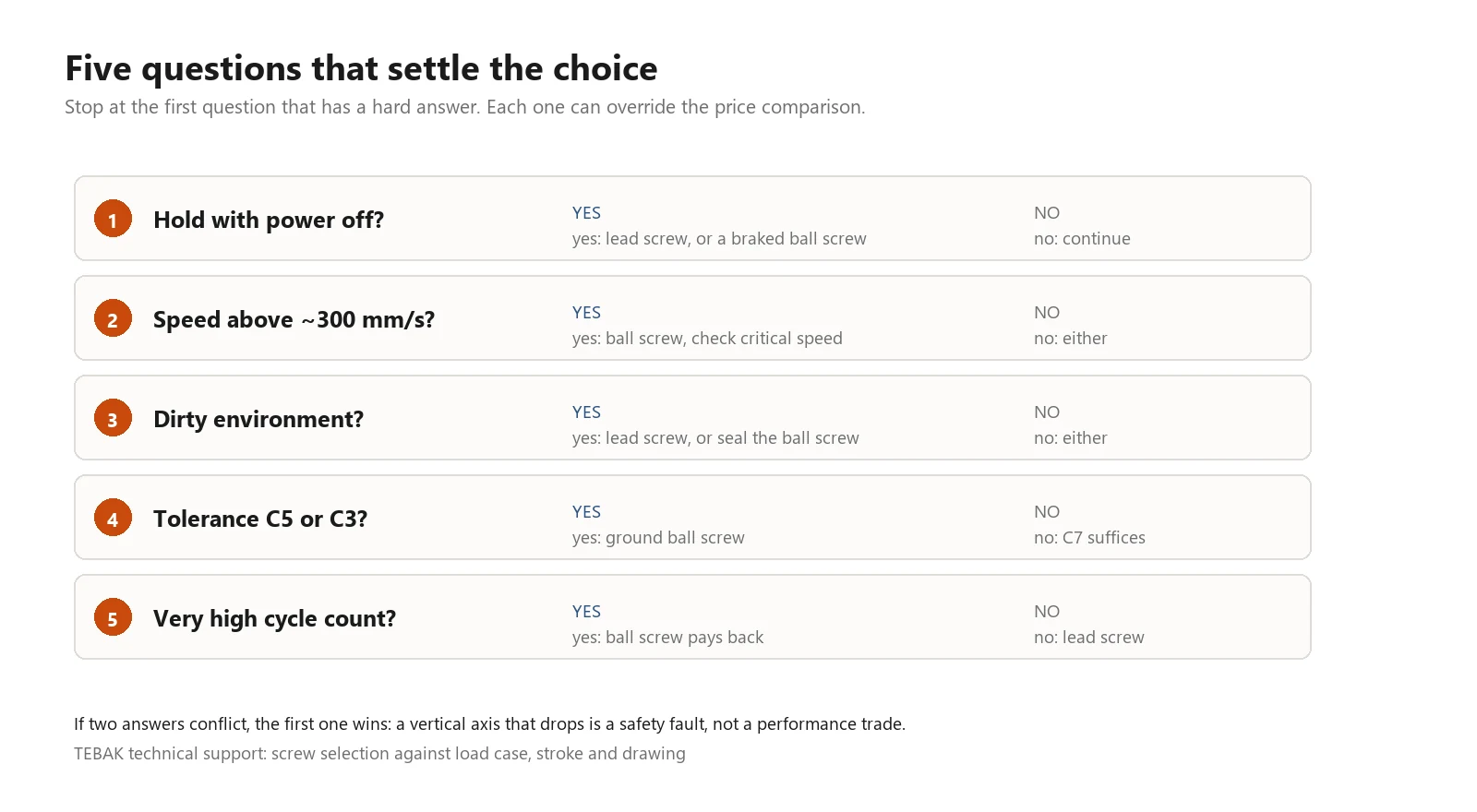
The choice between the two families is settled by five questions, and then the installation decides whether either one performs.
Ask the five questions in this order
One: must the axis hold its position with the power off? If yes, a lead screw or a braked ball screw, and if a brake is unacceptable, the choice is made. Two: what is the maximum speed and acceleration? Above a few hundred millimetres per second, the efficiency argument ends the discussion. Three: what tolerance must the axis hold, and over what stroke? Grade C7, C5 or C3 follows from that number. Four: what is in the air around the screw? Dust and coolant point one way, a clean room the other. Five: how many cycles over the machine's life? High cycle counts make the more expensive screw the cheaper one.
Size the screw end before the screw
The bearing arrangement at the fixed end decides how much of the screw's accuracy reaches the carriage. A single radial bearing allows the screw to float axially and gives away the preload in the nut; a proper angular contact pair with a lock nut holds it. Support units are usually sold as a matched pair with the screw, and they are not the place to save money.
Align the nut to the load, not the load to the nut
A ball nut is intolerant of misalignment between the screw axis and the carriage travel: the nut is forced sideways, the balls load unevenly and the screw develops a wear track within weeks. Align the screw to the guide rails, not the other way round, and check it at both ends of the stroke with the carriage bolted down.
Lubricate for the environment, then set the interval
Ball screws take grease or oil and need a film at all times; lead screws with POM nuts often run dry by design, and adding the wrong lubricant can swell the nut. Whichever family you use, the interval is a function of contamination, not of calendar time. Our ball screw assemblies are quoted with the preload class and axial play stated explicitly, so the lubrication and the load case can be matched to the catalogue rather than to habit.
FAQ: ball screw vs lead screw
Is a ball screw always more accurate than a lead screw?
No. A ground ball screw in grade C3 or C5 is more accurate than a standard trapezoidal screw, but a rolled ball screw without a stated grade can be no better than a good lead screw, and it costs more. Accuracy is a grade, not a family. Compare the grade on the drawing, not the product name.
When should I choose a lead screw instead of a ball screw?
Three situations: the axis must hold a load with the power off, the machine runs slowly and intermittently, or the environment is dirty enough that a ball nut would be destroyed. In each of those the lead screw is not a compromise, it is the correct engineering answer — and it is cheaper.
Can I replace a lead screw with a ball screw on an existing machine?
Mechanically yes, if the diameters and mounting match, but the axis will behave differently. You gain efficiency and speed and you lose self-locking, so a vertical axis needs a brake. You also need to check that the nut housing and the screw support can take the new nut, and that the controller's backlash compensation can be turned off without disturbing the tuning.
Do ball screws need a brake on a horizontal axis?
Not for holding position at rest — a horizontal ball screw will not back-drive under a static load in most designs — but the axis can drift during a power loss if there is any incline or external force. Wherever the axis could move dangerously, fit the brake regardless of orientation.
How long does each one last?
It depends on load, lubrication and contamination far more than on the family. A protected, correctly lubricated ball screw in a clean machine runs for years; the same screw in a woodworking shop with a failed wiper can be damaged in weeks. A lead screw nut is a consumable and is normally replaced several times over the life of the screw, which is cheap if access was designed in.
Is a trapezoidal screw the same as an ACME screw?
They solve the same problem with different thread standards. Tr is the metric trapezoidal profile used in Europe and Asia, ACME is the inch-based profile common in North America. They are not interchangeable, and a nut for one will not run correctly on the other even when the diameters look close.
Conclusion
The comparison is not really about which screw is better. It is about which property your axis cannot live without. If it is speed and efficiency, the ball screw wins and the rest is sealing and support. If it is holding a load with the power off, tolerance of dirt, or a low entry price on a slow axis, the lead screw wins and the rest is nut maintenance.
The expensive mistakes are always at the edges: a ball screw on a vertical axis with no brake, a lead screw on an axis that runs all day at speed, or either of them mounted with the screw out of line with the guides. Those three account for most of the failures we see, and none of them is a material problem.
Custom sizes, OEM and technical drawings
Both families are available to drawing: ball screws in GCr15 or 9Cr18 with preload P0 to P4 and axial play from 0 to 0.005 mm, in the SFU, DFU and miniature SFK combinations, with end machining and support units matched to the screw; trapezoidal lead screws from 10 mm to 25 mm diameter in ASTM 1045 or stainless, with the nut material chosen for the duty and thread clearance tighter than class 7e on request. Custom size available, OEM and ODM projects are quoted from the drawing, and bulk wholesale orders are priced with the grade, the nut material and the coating written into the same document so the technical and commercial sides agree. For brownfield replacements, send the screw length, the thread size and the end-machining sketch, and we will come back with a specification and a quotation for technical review.