
A linear guide that has run quietly for a year and then starts to squeal, knock or grind is not telling you that the rail is worn out. It is telling you which of four contact zones has changed. Most guides are replaced far too early because the sound was never traced to its source, and a fair share of new guides are fitted onto a machine that will make the same noise within a week because the cause sat in the mounting, not in the part.
This guide covers the linear guide noise causes that account for almost every complaint we see: a dry raceway, a pair of rails that are not parallel, a preload that is too heavy for the duty, a damaged wiper letting chips into the ball track, and a fixing that has come loose. Each one has a different sound, a different place to look, and a different fix, and the order in which you check them matters because two of them can only be confirmed after the others are ruled out.
Core concept: where a linear guide actually makes noise
A profile rail guide carries the load on balls that roll between the raceway of the rail and the raceway of the block. The balls enter the loaded zone, roll under load, leave it, and are returned to the start through a recirculation channel moulded into the end cap. Every one of those transitions is a place where energy is released as sound, and every one of them is sensitive to a different condition.
Raceway contact: the steady background noise
In the loaded zone the balls are in elastic contact with two hardened surfaces. Even in a healthy guide this contact produces a low, even hum that rises with speed. What changes is the character: a dry raceway turns the hum into a dry hiss or a squeal because the balls are no longer separated by an oil film, and a brinelled or corroded raceway adds a rhythmic click each time a ball crosses the damaged spot. The frequency of that click equals the ball passing frequency and rises in proportion to carriage speed, which is why a damaged raceway is often described as a noise that only appears above a certain feed rate.
Ball recirculation: the noise that follows the block
The return channel is the tightest curve the balls negotiate. A ball has to accelerate around the end cap and re-enter the load zone without skidding. If the guide is running dry, or if the end cap has picked up grit, the balls skid instead of rolling through the turn and the result is a rattle or a light knocking that repeats with the recirculation period rather than the ball passage period. The two are easy to separate: recirculation noise scales with carriage speed but not with load, while raceway noise scales with both.
Seals and wipers: the noise people mistake for a bad bearing
End seals and side wipers drag on the rail by design, and they are supposed to. A dry or hardened wiper lip produces a continuous squeak that sounds exactly like a failing ball track, and it is the single most common false diagnosis we are asked to quote against. The test is simple: wipe a thin film of the specified grease on a short section of rail and run the block over it slowly by hand. If the squeak disappears on that section and returns on the dry section, the noise is the wiper, not the balls.
Structure and mounting: the noise the guide is blamed for
Below roughly 200 Hz the sound stops coming from the bearing contacts and starts coming from the structure. A block bolted to a thin plate will amplify the ball passage frequency into a drum-like boom; a rail bed that is not flat will bend the rail into a wave that the block has to climb, producing a once-per-revolution knock as each block passes the fixing points. In these cases the guide is transmitting a problem that lives in the machine frame, and replacing it changes nothing.
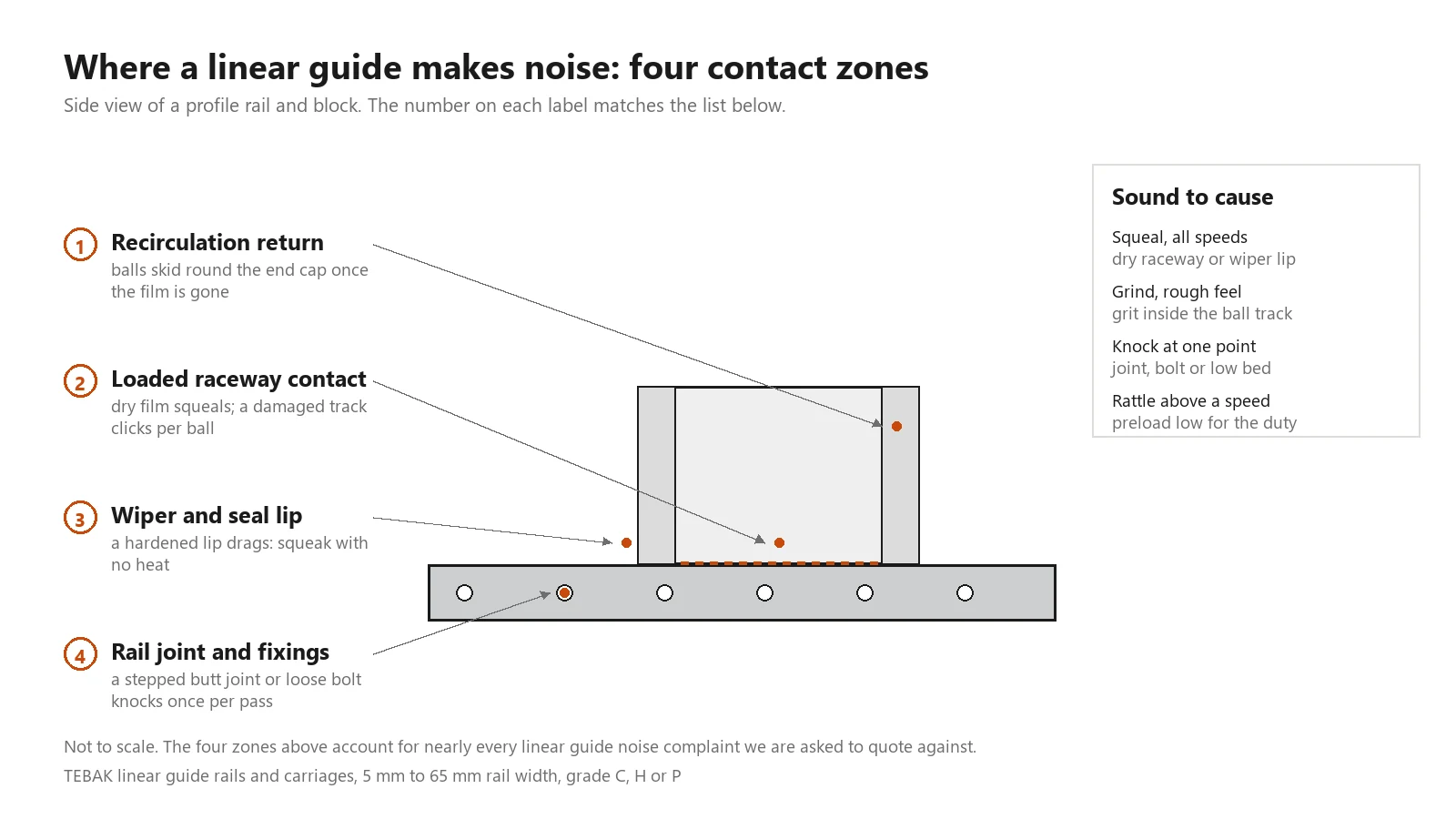
Types of linear guide noise and the condition behind each
Sound is a diagnostic channel. The table below maps the five patterns we are asked about most often to the condition that produces them. Treat it as a first filter, then confirm with the checks in the next section before ordering anything.
Continuous squeal or whistle
Present at all speeds, worse when cold, disappears briefly after greasing. Almost always a dry raceway or a dry wiper lip. Confirm by hand-feeding the block over a freshly greased patch of rail.
Grinding or a gritty rasp
Accompanied by a rough feel through the carriage and often by dark grease at the seal. Foreign matter — swarf, casting sand, blasting grit — has entered the ball track. This is the one pattern where continued running does permanent damage, because the particles are harder than the raceway and are being rolled into it.
Knocking or a rhythmic thump
Once per carriage pass over a particular point, or once per rail joint. Points to a rail butt joint that is not aligned, a low spot in the bed, a loose fixing at one hole, or a flat spotted ball from a previous overload. Knock that repeats with position rather than time is a rail or bed problem; knock that repeats with time at constant speed is a ball or end-cap problem.
Rattle at high speed only
Quiet at low feed, noisy above a threshold. Usually insufficient preload for the acceleration, or a recirculation channel that is dry. It can also be the block lifting and re-seating if the load reverses direction — common on vertical or cantilever axes where the block sees tension as well as compression.
Boom or drumming through the frame
Felt more than heard, low frequency, often worse on thin aluminium plate. The guide is fine; the structure is resonating at the ball passage frequency. Changing block preload shifts the frequency and can move the problem out of the machine's operating range, but stiffening the mounting is the real fix.
The four remedies and what each one costs you
Once the sound has been traced, the fix is usually one of four actions. They are listed here with their trade-offs, because in a repair shop the cheapest correct action is often not the one that feels most thorough.
Re-lubrication: cheapest, fastest, and often enough
Clearing the old grease, re-packing the block with the specified lubricant and running a short bedding-in stroke costs an hour and no parts. It removes squeal and light rattle caused by a dry film. The limitation is that it does nothing for contamination already inside the track, and on a guide that has run dry for months the raceway may already carry a wear mark that no amount of grease will smooth.
Re-alignment: the fix that removes position-dependent knock
Re-shimming the second rail to the first, re-checking the bed flatness and re-torquing the fixings in sequence addresses knock and thump that repeat with carriage position. It costs a day of machine downtime and a dial indicator, and it needs a datum. The benefit is that it also recovers the accuracy loss that usually accompanies the noise, which re-lubrication does not.
Preload or block change: correct when the duty has changed
If the axis now runs faster or with a reversing load that it was not specified for, the right answer is a block with a different preload class rather than a new rail. This is a parts cost with a short downtime, but it only works if the rail itself is still straight and undamaged; fitting a tighter block to a worn rail accelerates wear on both.
Replacement: correct when the raceway is damaged
A guide with a brinelled, corroded or grit-scored raceway cannot be restored by adjustment. Replacement is the honest answer, and the useful question then becomes whether to replace the block alone or the rail as well. If the damage is confined to the short section where the machine parks, the rail can be turned end for end when the hole pattern allows, which buys time without pretending the wear is gone.
Parameter and technical standard: which catalogue values control the noise
Noise is not a catalogue line item, but four catalogue values predict it better than any marketing claim. When you compare guides or write a specification, these are the fields that decide whether the axis will be quiet at production speed.
Grade: C, H and P
Our rails are offered in grade C, H and P. Grade C covers general transport and light automation where the axis does not have to hold a tolerance over long travel; grade H is the normal choice for machine tools; grade P is specified where the axis must hold a tight tolerance over its whole stroke. Grade matters to noise indirectly: a tighter grade means a straighter rail, and a straighter rail means the block is not being forced over a wave once per pass. If a machine knocks on a grade C rail after a rebuild, the first question is whether the rebuild needed a tighter grade rather than whether the block has failed.
Preload and clearance
Preload removes the internal clearance between balls and raceway and raises stiffness. It is the parameter most often pushed too far in the belief that stiffer must be quieter. An over-preloaded block runs hotter, the grease film thins, and the guide becomes noisy at exactly the speeds the designer cared about. Preload should follow the load case, not lead it: enough to keep every ball loaded under the reversing component of the duty, and no more.
Rail width and section
The miniature MGN and MGW families run from 5 mm to 15 mm rail width in bearing steel or SUS440C stainless; the profile HGR family starts at 15 mm and goes up to 65 mm in bearing steel. Section size sets both the ball size and the wall thickness of the block, and both affect how much of the ball passage frequency reaches the machine frame. A miniature guide on a thin plate is the classic boom generator; the same guide on a machined cast iron surface is quiet. The full range is listed with rail width and material on our linear guide rails and carriages page.
Speed, lubrication and sealing
Every series has a speed above which the recirculation channel cannot keep the balls under control with grease alone, and that limit falls as preload rises. Lubrication interval is a function of contamination and duty, not of calendar time: a guide in a woodworking shop needs attention far more often than the same guide in a clean measuring room, whatever the service sheet says. Seals are the first line of defence and the first thing to inspect when the grease turns dark.
Application scenarios: which noise complaint belongs to which machine
The same guide behaves differently depending on what it is bolted to, and the machine type narrows the suspects before you start measuring. These are the four situations we are asked about most often.
CNC routers and woodworking machines
The complaint is usually a rasp that appears after a few months of production and gets worse in humid weather. Dust has passed the wiper and mixed with grease to form an abrasive paste. The rail is often still straight; the blocks are not. In this application the fix is a wiper and seal kit plus a shorter lubrication interval, and the symptom returns within weeks if the dust extraction is not improved.
Laser and plasma cutting tables
Noise here arrives together with a positioning complaint, because the same grit that scores the raceway also changes the preload. A cutting table that starts to knock at one end of the stroke usually has a rail bed that has been distorted by thermal cycling rather than a worn block. If the machine is a fully assembled stage rather than a rail-and-block pair, the same checks apply to the linear modules we supply as complete units.
Pick and place, packaging and labelling lines
High cycle counts with light loads: the noise is a rattle at speed, not a grind. It is nearly always insufficient preload for the acceleration, sometimes combined with a recirculation channel that has been running on the last of its grease for too long. Cycle testing by hand at low speed will sound perfect, which is why this complaint is often dismissed until a ball is lost.
Measuring stages and inspection equipment
No noise is audible, but the operator hears it through the measurement. Any stick-slip or ball passage signature shows up as a periodic error in the trace. In this application the answer is a preloaded block on a grade P rail, with the rails aligned to each other rather than to the machine datums, because the pair — not the individual rail — sets the straightness of the axis.
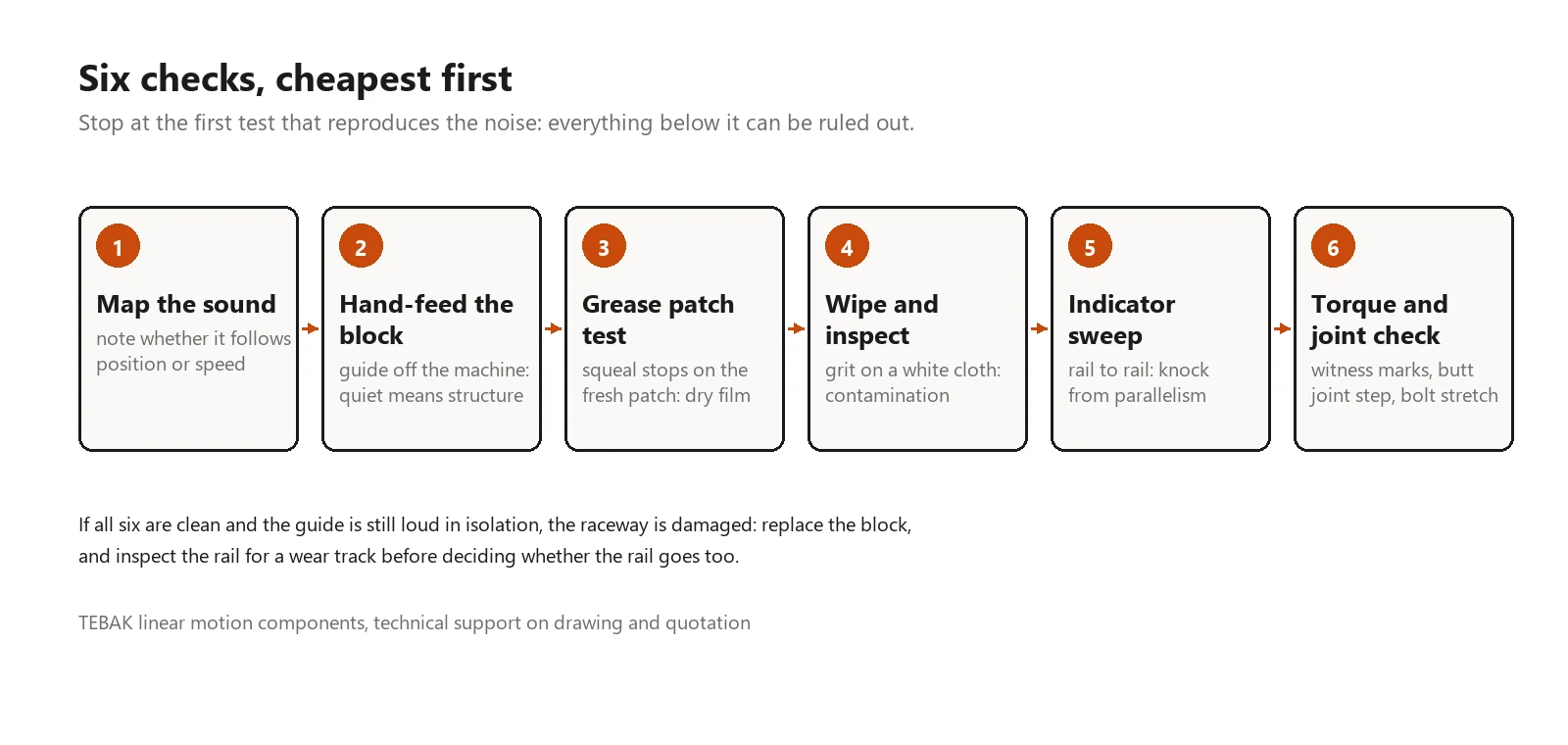
Common problems and solutions: the six causes behind almost every complaint
These are ordered by how often they turn out to be the answer, and by how cheap they are to rule out. Work down the list rather than jumping to the one that sounds most likely.
1. The raceway has run dry
Sound: continuous squeal, worse when cold, briefly quiet after greasing.
Check: run the block slowly by hand over a freshly greased 100 mm of rail. If the squeal stops on that patch, the film was gone.
Fix: remove the block, clear the old grease with a compatible solvent, re-pack to the specified fill, run a bedding-in stroke, then set a lubrication interval based on contamination rather than calendar time.
2. The two rails are not parallel
Sound: knock or thump once per carriage pass, worse at one end of the stroke, often with a measurable position error.
Check: mount a dial indicator on the first carriage and sweep the second rail; check the height and the lateral offset separately, because they produce different sounds.
Fix: loosen the second rail, bring it to the first with the carriage as the gauge, torque in sequence from the middle outward. Where the bed itself is out, shim the rail rather than forcing the block.
3. Preload is too heavy for the duty
Sound: a dry, tight hum that turns into squeal as the axis warms up; the block is noticeably warmer than its neighbour after an hour.
Check: compare block temperature after a production run; a block running more than a few degrees above ambient is being overworked.
Fix: step down one preload class, or reduce the preload by fitting a block specified for the actual load case. Do not compensate by greasing more often; that masks the heat rather than removing it.
4. Contamination has entered the ball track
Sound: grinding or gritty rasp, rough feel through the carriage, dark grease at the seals.
Check: wipe the rail ahead of the block with a clean white cloth; grit on the cloth confirms the path. Inspect the wiper lip for a nick or a hardened edge.
Fix: replace the seal and wiper set, flush and re-grease the block, and correct the source — extraction, bellows, or a move to a sealed block. Contamination is the only cause in this list that gets worse every hour it is left running.
5. A fixing has come loose
Sound: a single sharp knock at one point on the rail, sometimes with a visible witness mark around the bolt head.
Check: torque-check the rail bolts and the block-to-carriage bolts in the specified sequence. A stretched bolt will re-torque once and come loose again.
Fix: replace the affected bolts, clean the threads, re-torque to the rail manufacturer's figure and re-check after the first shift. On a machine that has been through a crash, check the carriage threads as well — a pulled thread in an aluminium carriage is common and mimics a loose guide.
6. The rail joint or the bed is not flat
Sound: a knock at the same position every pass, on a rail that was supplied in more than one length or on a bed that was machined in sections.
Check: a straight edge and feeler gauge across the joint, and a dial indicator on the rail top as the carriage crosses.
Fix: align the joint to the rail's own straightness rather than to the bed, and where the bed cannot be corrected, move the joint away from the working zone. Long travels assembled from several rails need the joints staggered from the parallel rail, never opposite each other.
Selection and installation tips that prevent the noise returning
Most of the work of a quiet axis is done before the first cut. These are the decisions that matter, in the order they are usually taken.
Build a tolerance budget before choosing a grade
Write down the position tolerance the machine must hold, subtract the contribution of the screw or belt, the bearing mounts and the structure, and what remains is the budget for the guide pair. A grade C rail asked to hold a budget it was never sized for will knock after every rebuild, and the parts will be blamed each time.
Specify preload from the load case, not from habit
Work out the reversing component of the load — the part that changes sign as the axis moves — and choose the preload that keeps every ball loaded under it. More preload than that buys nothing and costs heat, grease life and noise at speed.
Align the pair, not the individual rails
Both rails can be within their own tolerance and still be wrong as a pair. Parallelism between the two rails decides the finished accuracy of the axis more than the tolerance of either one, and it is also the first thing that produces position-dependent knock. Use the carriage as the gauge and bring the second rail to the first.
Match the sealing to the environment, then the lubrication to the sealing
A standard wiper is adequate in a clean room and hopeless in a woodworking shop. Specify the seal for the dirt, then set the grease interval for what gets past it. If the axis runs round shafts and bushings rather than profile rails, the same logic applies to the linear bushings and shaft supports on that axis, and the seating of the housing matters as much as the bushing itself.
Run in before judging the sound
A freshly greased guide is quieter than it will be after a week, and a freshly assembled axis is noisier for the first few strokes as the blocks settle. Judge noise after a bedding-in run at production speed with the machine at working temperature, not on the bench.
FAQ: linear guide noise causes
Why is my linear guide only noisy at high speed?
Because the two mechanisms that dominate at speed scale with it: recirculation through the end cap, and the ball passage frequency exciting the structure. A dry recirculation channel or a preload that is marginal for the acceleration will be silent at hand-feeding speed and loud at production feed. If the noise appears above a repeatable threshold, check grease condition in the end cap first, then whether the block is lifting under the reversing load.
Can I grease a linear guide without removing the block?
Yes, through the grease nipple where one is fitted, or by applying the specified grease to the rail and running the block over it several times. What you cannot do this way is remove contaminated grease, so if the symptom is a grind rather than a squeal, the block has to come off and be cleaned properly.
Does a noisy guide mean the block needs replacing?
Usually not. In our experience the majority of noise complaints are resolved by lubrication, alignment or a seal change, with the block itself untouched. Replacement is the right answer when the raceway is brinelled, corroded or scored — conditions you can feel as a rough spot when the block is run slowly by hand over a clean rail, not just hear.
What causes a knocking sound at one point on the rail?
Something at that position: a rail joint that is stepped, a fixing that has come loose, a low spot in the bed, or a flat spotted ball that only loads when the carriage is over that section. Knock that follows position is a rail or mounting problem; knock that follows time at constant speed is a ball or end-cap problem. The distinction is the fastest way to split the two families of cause.
How do I tell whether the noise is the guide or the machine frame?
Take the guide out of the structure. Run the block slowly along a straight section of rail by hand, off the machine if you can. If it is quiet in isolation but loud when bolted down, the frame is amplifying or distorting it, and no replacement part will fix that. If it is loud in isolation, the guide itself has the problem.
Is a thicker grease quieter than a thinner one?
A heavier grease damps noise at low speed and starves the recirculation channel at high speed, which is how a quiet axis becomes a loud one after a well-intentioned re-grease. Use the grade specified for the series and the speed, and change the interval rather than the grade when conditions get dirtier.
Conclusion
Linear guide noise is a symptom with a short list of causes, and the list is ordered by how cheap each one is to rule out. Dry raceway first, then rail parallelism, then preload against the duty, then contamination, then fixings, then the bed and the joints. Work that order and most noisy axes are quiet again in a day without a new part.
What does not work is treating the sound as a wear indicator and replacing the guide. A new block on a misaligned pair will make the same knock within a week, and the second failure is usually read as a quality problem rather than a mounting one. The guide is the most precisely made part on the axis; when it is noisy, the first assumption should be that something around it has moved.
Custom sizes, OEM and technical drawings
If the axis you are quieting needs a rail that is not in the standard range — a length cut to your stroke, a hole pattern that matches an existing bed, a carriages set with a specific preload class, or a pair aligned and supplied together — we quote against a drawing. Miniature MGN and MGW profiles from 5 mm to 15 mm and profile HGR rails from 15 mm to 65 mm are available in bearing steel or stainless, with matching blocks, end seals and wiper kits. OEM and ODM work runs on the same route, and bulk wholesale orders are quoted with the grade and the seal specification stated explicitly so the technical document and the commercial one agree.
Send the rail length, the hole pitch, the load case and the position tolerance you must hold, and we will come back with a specification and a quotation for technical review. If the noise is already there and you are not sure which of the six causes applies, send a short video of the axis running and the rail width — that is usually enough to narrow it to two.